DISTRICT COURT, BOULDER COUNTY STATE OF COLORADO 1777 6th Street Boulder, Colorado 80302 (303) 441-3750 | ▲ COURT USE ONLY ▲ |
Plaintiff: ANDREW MICHAEL BARON v. Defendants: ALDEN GLOBAL CAPITAL, RANDALL J. SMITH, HEATH FREEMAN | Case No.: 2025CV11 Division: 2 |
COMPLAINT | |

Plaintiff, Andrew Michael Baron, brings this action pursuant to the Colorado Consumer Protection Act, C.R.S §§ 6-1-101 et seq. (“CCPA”) and alleges as follows:
INTRODUCTION
1. Defendant Alden Global Capital, an investment manager hedge fund controlled by Defendants Randall Smith and Heath Freeman, has acquired numerous newspapers across the United States, becoming the second-largest owner of newspapers in the country.
2. One of Alden’s key subsidiaries is MediaNews Group which owns and controls The Denver Post and The Daily Camera.
3. Over the years, under the direction of Smith and Freeman, The Denver Post and The Daily Camera have faced severe cutbacks and layoffs leading to a major decline in journalistic quality. This has resulted in gross violations of their managerial duties, leading to controversial labor law practices, inaccuracies in reporting, documented harassment towards consumers, misuse of company resources, lack of employee oversight, product production failures, fraudulent omissions, fraudulent misrepresentations, and a general disregard for journalistic standards.
Misleading Statements to Attract and Retain Subscribers and Advertisers
4. Defendants prominently advertise a public procedures policy (“Policies and Procedures”, “The Policies and Procedures”), attached and incorporated herein as Exhibit A, which attracts subscribers and advertisers based on the premise that by following their special method of product production, the products which they sell —information reports—will be trustworthy.
5. The gap between Defendants’ public commitment to follow The Policies and Procedures and their actual practice demonstrates a consistent misrepresentation as they knowingly do not maintain the resources or standards they claim.
6. By promoting themselves as publishers of ethical journalism through their operational policies, while failing to meet such policy standards in practice, Defendants cause damage by misleading a broad demographic of consumers who pay for and rely on the publications’ information to live and prosper in Colorado and beyond.
7. Both The Daily Camera and The Denver Post are profitable, year-over-year, but Smith and Freeman extract those locally needed profits out of Colorado, up and through a series of subsidiaries directly to themselves in what has been well documented as an intentional harvesting operation, leaving the local news businesses unable to fill their requirements as companies.
8. No matter how hard the workers at the Defendants‘ newspapers may try, in actual practice, they are unable to uphold these promises due to the severe underfunding and profit demands caused by and for Defendants Randal Smith and Heath Freeman personally.
9. As the facts show, Defendants know they do not uphold their policies and promises but instead of updating their policies and promises to match their current practices, they choose to internationally try to hide their private admittances from public view.
10. The Defendants’ practices cause harm throughout the state of Colorado by misleading consumers into paying increased costs for a product that fails to meet the promised production standards while harming an even greater number of consumers by painting a misleading picture of the world people in Colorado rely upon to live democratically.
11. The depletion of essential resources has passed the breaking point, resulting in a breakdown of general operations, forcing the newspapers into practices that skirt the lines of legalities on a day-to-day basis.
12. For Plaintiff Andrew Baron, this misconduct was not merely theoretical but devastatingly personal. The Defendants’ calculated misrepresentations and product production breakdowns destroyed his business and inflicted irreparable harm to his life. Baron trusted the defendants, believing their promises of ethical journalistic integrity, only to be betrayed, again and again, by a production method that disregards consumers and then evades responsibility. This betrayal is not an accident but a predictable result of a deliberately broken process overseen by Randal Smith and Heath Freeman.
13. The Defendants’ actions have far-reaching implications beyond this case. They reflect a systemic failure in journalistic integrity that impacts the public’s ability to trust the information they rely on to make informed decisions. Holding the defendants accountable is not merely about addressing Baron’s harm—it is about safeguarding the public interest, protecting the production of ethical journalism, justifying the true need for good faith journalistic protections, and preventing similar harms to others.
14. Alden’s profit-driven model, which prioritizes profit extractions over operational viability, directly undermines the newspapers’ ability to perform their core duties, rendering Randal Smith and Heath Freeman’s business practices deceptive and unsustainable, rising to the level of consumer fraud under the Colorado Consumer Protection Act.
PARTIES
15. Plaintiff, Andrew Michael Baron (“Andrew Baron”, “Baron”), is a resident of Boulder, Colorado, who suffered catastrophic harms as a direct result of Defendants’ actions.
16. Defendant Alden Global Capital (“Alden”) is marketed as Alden Global Capital, LLC, a Limited Liability Company, with a principal office listed at 885 Third Avenue, 34th Floor, New York, NY 10022. Alden is believed to be operating as a division of Smith Management, LLC.1
17. Defendant Randall Duncan Smith (“Randall Smith”, “Smith”) is in control of Smith Management, LLC. Smith is the founder, shareholder, and Chief of Investments of Alden Global Capital. https://www.streetinsider.com/entities/Alden+Global+Capital
18. Defendant Heath Bradford Freeman (“Heath Freeman”, “Freeman”) is believed to have joined Smith Management, LLC in 2006. Freeman is a shareholder and President of Alden Global Capital. In addition to his operational responsibilities at Alden Global Capital, Heath Freeman serves as Vice Chairman of MediaNews Group (“MNG Enterprises, Inc.”, “MGM”, “MediaNews Group”).
JURISDICTION AND VENUE
19. This Court has jurisdiction because it has jurisdiction over Colorado Consumer Protection Act (“CCPA”) violation claims, C.R.S. § 6-1-101 et seq.
20. Venue is proper in Boulder County because the events giving rise to this Complaint occurred in Boulder County, Plaintiff lives and works in Boulder County, and the Defendants conduct business throughout this jurisdiction, including business activities that are material to this suit.
TRADE AND COMMERCE
21. The Defendants are engaged in trade and commerce as defined under the Colorado Consumer Protection Act, C.R.S. § 6-1-105(1), through the publication and sale of information reports, advertisements, printed newspapers, and digital subscriptions. Defendants sell these and other products and services to consumers throughout Colorado.
PRIMARY FACTS
Pre-Journey Preparation
22. To understand the nature of the defendants’ business operations and the basis for this complaint, the following facts provide essential preparation and context regarding the defendants’ trade practices, their public representations, and the activities that underpin their business model.
23. Plaintiff Andrew Baron, a Colorado resident and business owner, is the subject of an ongoing series of information reports on sale by both The Denver Post and The Daily Camera containing an incredible 120 inaccuracies across six stories so far.
1. Defamatory Allegations by Anna Segur
24. In 2017, an individual named Anna Segur who lives in Baron’s hometown spread false and defamatory allegations about Baron and his company’s finances. Segur accused Baron of theft and charity fraud, aggressively pushing her claims through social media platforms and direct communications with Baron’s customers.
25. Despite saturating Baron’s customer base with unrelenting allegations of wrongdoings by Baron, the allegations had no material impact on Baron or his business. The accusations were so far-fetched —and unsupported— that customers easily dismissed her and her claims of theft and charity fraud.
2. Publication by The Denver Post
26. The situation dramatically changed when The Denver Post published the same allegations.
27. Without conducting any meaningful research, fact-checking, or editing, The Denver Post reprinted Segur’s misrepresentations as a credible, investigative information report, specifically labeling it as a product of “Investigative Journalism,” with an author who had the title of “Investigative Journalist.”
28. Within days of the publication, the same misrepresentations by Segur that previously had no effect caused Baron’s entire customer base to collapse.
29. The difference between Segur’s baseless claims and the Denver Post’s publication lies in the promises made in The Denver Post’s Policies and Procedures.
30. Consumers trusted The Denver Post because of their commitment to their production method, based on the advertised standards, assuming that the allegations originally made by Segur against Baron had essentially been confirmed.
3. The Means of Production
A. Promises to the Consumer
31. The Denver Post Policies and Procedures begins with an ambitious aim regarding the type of business activity The Denver Post conducts:
The Denver Post is committed to the highest ethical standards. Fairness and accuracy are among our core values. But nothing stands above the need to maintain our integrity. The public’s trust — our most important asset — depends on it.
The Denver Post’s ethics policy covers fairness and accuracy in reporting; use of unidentified sources; quotations and attribution; bylines, datelines and credit lines; meals, tickets and travel; and gifts and sample products.
The ethics policy also addresses credibility and conflicts of interest. Staff members should avoid online and real-world activities that could conflict with their jobs. The policy covers financial holdings; freelancing; use of company property while freelancing; radio and television; honorariums; connections; and relationships.
32. Within The Policies and Procedures, The Denver Post prominently advertises its production method policies in a mix of aspirational terms, responsibilities, expectations, rules, representations, requirements, and more, and they are all legally actionable for reporters who break the policies, aspirational or not, as it states:
Employee discipline or discharge under the Code of Ethics shall be for just cause.
33. The Denver Post publicizes The Policies and Procedures for at least two important reasons: to explain to journalists what they must keep in mind and do, and to show consumers what they can expect from the information reports that they sell.
34. The important ethical principles The Denver Post uses in their product manufacturing process are required to assure a product that consumers can trust enough to live by.
B. The Trust Project
35. In one clause of The Denver Post’s Policies and Procedures, the business warrants that it meets the standards of The Trust Project2 to help consumers identify products of ethical journalism with high standards:
The Denver Post is a member of The Trust Project, an international coalition of reputable media organizations working together to promote truthful, verified news with fairness and accuracy. Through ongoing global collaboration with the public, news leaders, search and social platforms, the consortium is defining a standard for quality journalism that can be easily recognized anywhere.
36. The Policies and Procedures warrants:
The Denver Post is committed to using the standards and protocols of The Trust Project, such as transparent ownership and mission statements, ethics and reporting policies, clear labeling of story types and links to detailed author information on articles.
37. The complete set of media labeling designed for consumers that The Denver Post recognizes in The Policies and Procedures is listed as follows:
News: Based on facts, either observed and verified directly by the reporter, or reported and verified from knowledgeable sources.
Analysis: Based on factual reporting, although it incorporates the expertise of the author and may offer interpretations and conclusions.
Investigative: In-depth examination of a single subject requiring extensive research and resources.
Explainer: Provides context, definition and detail on a specific topic.
Obituary: Reports the death of an individual, providing an account of the person’s life including their achievements, any controversies in which they were involved, and reminiscences by people who knew them.
Opinion: Advocates for ideas and draws conclusions based on the author’s interpretation of facts and data.
Opinion Columnist: Represents the opinion of the author who is either a paid columnist or an unpaid guest columnist.
Editorial: Represents the opinion of The Denver Post editorial board which is separate from the newsroom.
Letters: Represent the opinion of the letter writers.
Review: An assessment or critique of a service, product, or creative endeavor such as art, literature or a performance.
Underwritten: Produced with financial support from an organization or individual, yet not approved by the underwriter before or after publication. Articles are held to strict journalistic standards, but are funded by entities interested in being associated with or expanding attention to a particular topic.
Machine Written: Produced with artificial intelligence using data provided by high school sports coaches and staff members.
Advertiser Content: Supplied by an organization or individual that has paid the news provider for its placement. As a result, while it may be written in the style of the publication, it is not impartial journalism. This is the same as the sponsored content and custom content.
Sponsored: Produced on behalf of an organization or individual that has paid the news provider for production and/or approved publication.
Affiliate Content: Produced to earn commission from products/services being mentioned and/or promoted. Amazon, Skim Links, etc.
Branded Content: Produced by the paper’s own advertising department to attract advertising. May or may not include product placement. As a result, while it may be written in the style of the publication, it is not impartial journalism.
38. In one example of improper use of the labeling system, when The Denver Post was first initiated into The Trust Project, they advertised with an information report “By The Denver Post” with their own departmental “Branded Content,” but they mischievously styled and labeled as “News”:
The Denver Post joins The Trust Project to curb the rising influence of misinformation
Amid public uncertainty, Trust Indicators highlight the rigorous standards behind honest journalism
Faux local news sites and frightening headlines about the coronavirus can leave readers and viewers struggling to tell which news is truthful and which is misleading, false and even dangerous. The Denver Post has long been committed to serving as a trusted source for reliable news about our community. But through our work with The Trust Project, it is now easier for readers to find our policies, learn about our reporters’ deep and varied experiences, and contact us when you see an error,” Denver Post Editor Lee Ann Colacioppo said.3
39. The information report went on to state:
The Trust Indicators are implemented by news sites that go through a rigorous approval and compliance process.
40. The Trust Project is a seal of approval that The Denver Post displays for the practice of high-end ethical journalistic standards.
C. Ownership and Editorial Control
41. The Defendants prominently assure consumers that editorial decisions at The Denver Post are independent, despite being owned and controlled by Smith and Freeman through Alden Global Capital. This assurance appears in The Denver Post’s Policies and Procedures and is highlighted on The Trust Project’s website, which states:
Ownership & Funding
The Denver Post is owned by the hedge fund, Alden Global Capital, which acquired the publication’s parent company, MediaNews Group, in 2010. As a private company, MediaNews Group makes business decisions that keep shareholders in mind, but editorial decisions are independent.
42. The Denver Post’s Policies and Procedures also includes this promise:
The Denver Post is committed to transparency in our ownership structure. We cite potential conflicts of interest on the same page as the relevant work. The Denver Post, which began publishing in 1892, is owned by Denver-based MediaNews Group. MediaNews Group is a privately owned company. The majority owner is Alden Global Capital, a privately held investment firm based in New York City. As a private company, MediaNews Group makes business decisions that keep shareholders in mind, but editorial decisions are independent.
43. The ownership structure is critical to consumers because it creates the expectation that the news they rely on is free from corporate influence. When ownership interferes with editorial decisions, it undermines public trust, skews the news narrative, and distorts the very information consumers depend on to make informed decisions about their lives and communities.
D. Corrections
44. The practice of selling information reports produced with ethical journalism has a catch-all in case of breakdowns in the product production process. The corrections process within The Denver Post’s Policies and Procedures states:
The Denver Post promptly corrects all significant errors that are brought to the attention of the editors.
45. The Denver Post establishes a level of care they put into their production process warranting attention to a minute factor of significance for the smallest type of inaccuracy:
Stories posted online will be fixed immediately after an error has been found. This includes fixes of minor errors such as misspellings.
46. Reporters are required to handle errors immediately.
When an error is discovered – whether it is detected by a member of the public or a staff member – it should be discussed immediately with your supervisor and corrected as soon as possible.
47. The Denver Post promises consumers that they keep track of every error, an important component of the special production process requirements:
Correction forms should be filled out and turned in to your supervisor.
48. The Policies and Procedures is ultimately a promise to act, most importantly, fairly. The concept of “fairness” is the first word that defines the aims of The Policies and Procedures, but following the specific rules of product production is required in reality to ensure the information products are up to standard and that they are of grade.
E. By Comparison: The National Enquirer
49. The National Enquirer also sells information reports in Colorado, including news reports, however, The National Enquirer does not have an ethics policy. When Baron was initially solicited by a reporter who had the title of “Investigative Journalist” had the reporter been with The National Enquirer, Baron would have ignored the solicitation due to this key distinction of production method.
50. Anyone in the world, without any qualification, can assume the title of “Investigative Journalist” but an “Investigative Journalist” title provided by The Denver Post is bound to an important set of legal requirements regarding their method of product production, as required by The Denver Post’s Policies and Procedures.
The Plaintiff’s Journey
51. In addition to the facts herein, additional facts including facts about Baron, his business, and how the six information reports came to be, are set forth in Exhibit B, which is attached hereto and incorporated herein by reference, and fully adopted as if stated in their entirety within this Complaint.
Information Report on Baron I
52. When The Denver Post first solicited Baron to create an information report about his business, the initial solicitation came to Baron through a ”cold-call” email pitch, and was addressed by a Denver Post reporter with the professional title of “Investigative Journalist.”
53. Baron saw it as an incoming opportunity to put Segur to rest, believing that an ethical investigative journalist would report on the facts of her activities, and that merely verifying and reporting the facts of her actions would be enough to stop her. Because Baron’s staff was aware of Segur’s outrageous conduct, Baron expressed his excitement that such a report would help to get them beyond her misrepresentations of theft and charity fraud, against not just Baron but others in Baron’s staff too.
54. Though the reporter represented himself as an “Investigative Journalist” from “The Denver Post,” the unusual writer, Christopher N. Osher, exhibited sustained fraudulent conduct.
55. Evidence shows Osher’s actions were not isolated lapses in judgment or an exercise on the boundaries of free speech but were part of a persistent pattern of deceit, fabrication, and willful distortion of the truth. It is reasonable to infer from the facts that Osher’s behavior is a rare and egregious societal example of extreme journalistic fraud, making it remarkable that such an individual could ascend within a respected journalistic institution without earlier detection.
56. For consumers like Baron, initially seeking corrections from The Denver Post seems easy. The Denver Post Policies and Procedures states:
To submit a correction to a story in print or online, contact the reporter, appropriate editor or let us know at dpo@denverpost.com or newsroom@denverpost.com.
57. After the first information report was released, though unable to explain how Osher could be so wrong, as described in detail in Exhibit B, Baron immediately contacted The Denver Post to show evidence of inaccuracies.
58. Denver Post’s Greg Griffin, the editor who was responsible for the product quality assurance of Osher’s information reports, wrote that The Denver Post refused to view Baron’s evidence of the inaccuracies, providing the rationale that Osher’s products were of a high enough production standard in the past that Griffin felt comfortable that this new report by Osher must be correct too:
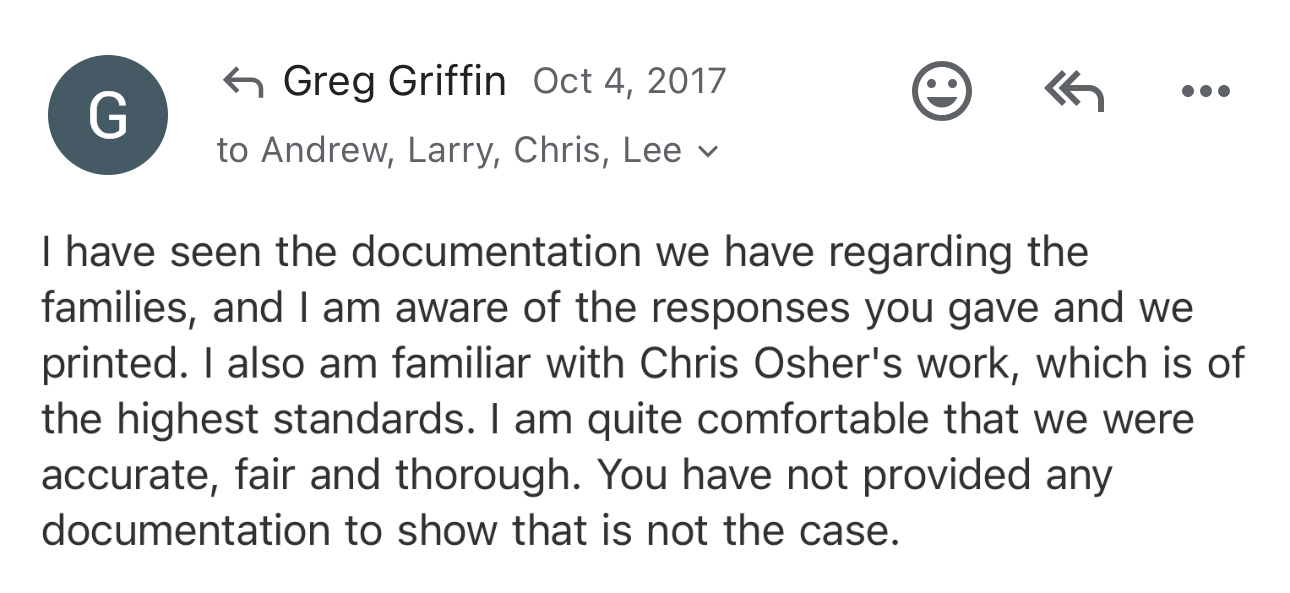
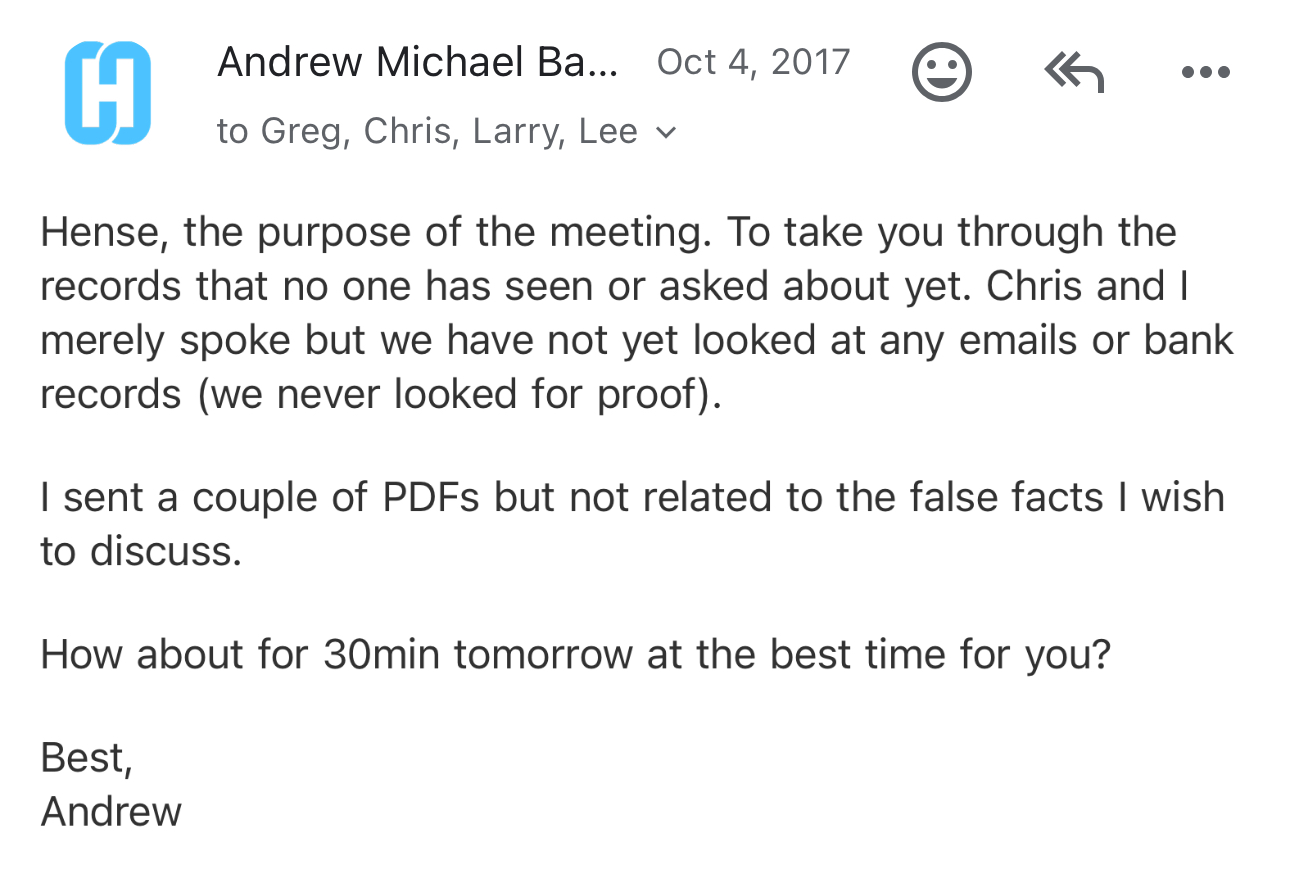
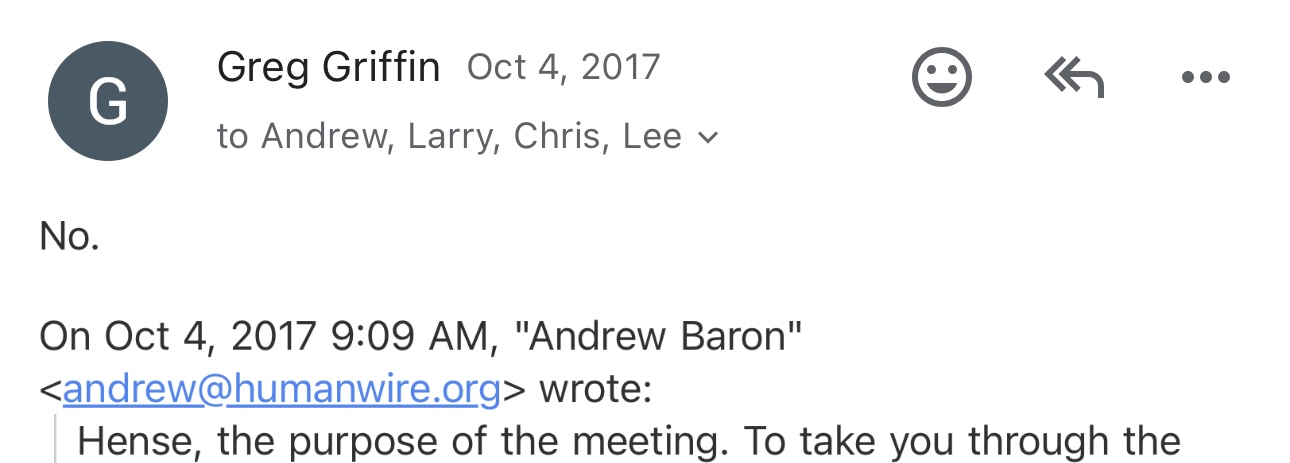
59. In addition to this gross disregard for the truth and Baron’s life, Griffin confirmed to Baron that the product production method and the resulting product quality were of the company’s “highest standards.”
60. The reporters’ misconduct, including refusing to view evidence that shows material problems with the product, led to profound, real-world consequences, causing police investigators to be misled, leading Baron to become falsely arrested.
61. Baron faced twelve years in jail for theft and charity fraud, for the same allegations that Segur passed on to The Denver Post.
62. The Denver Post’s negligence conferred upon Segur a false authority in a high form of societal truth — reputable investigative journalism —which she embraced and ran with, as described in detail in the facts of Exhibit B.
Information Reports on Baron II and III
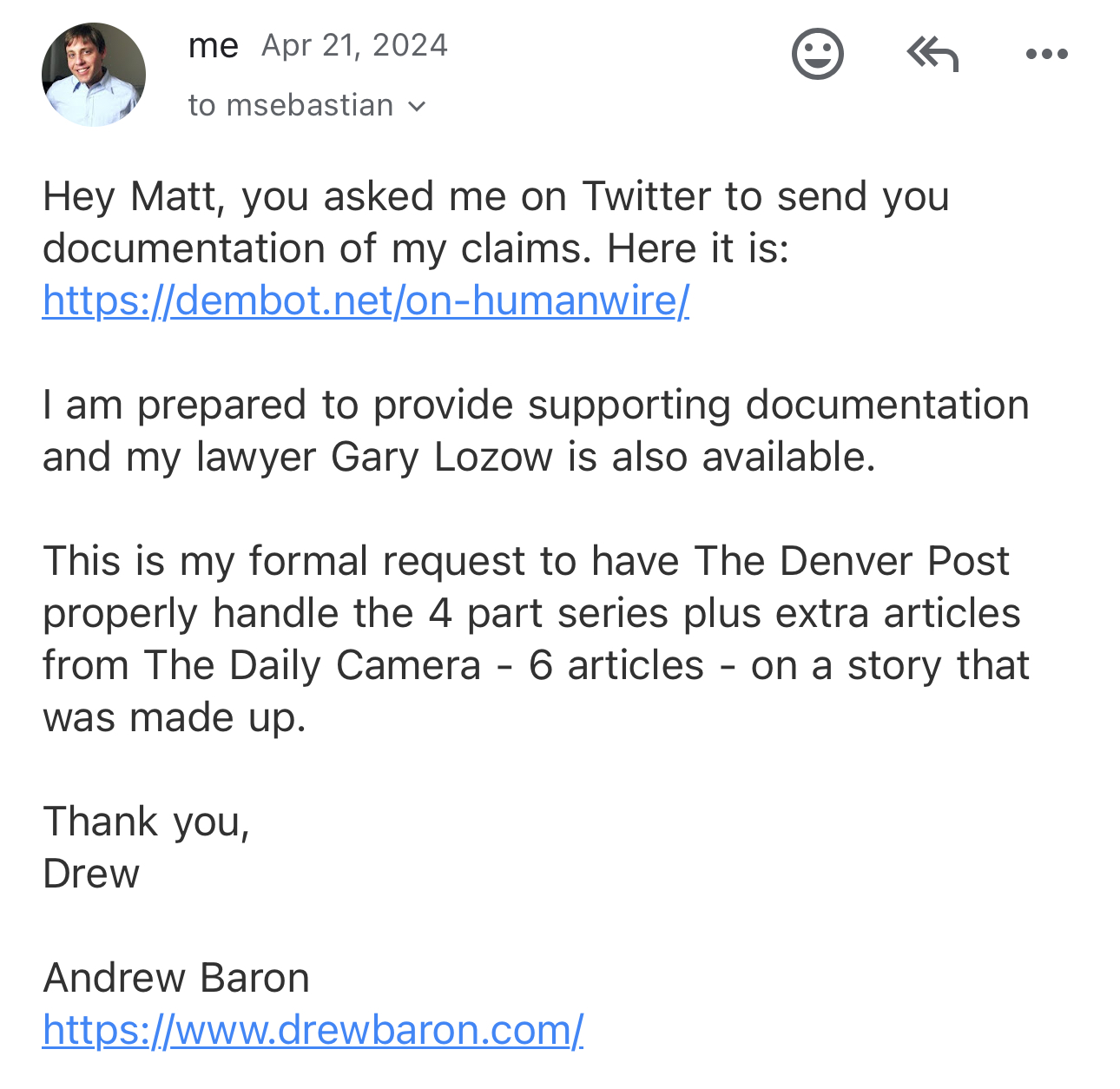
63. After Baron was arrested, The Denver Post ran a second information report and Osher took credit for the arrest, citing the counts of theft and charity fraud that were the result of the misinformation and bias of a story that Osher himself had manipulated.
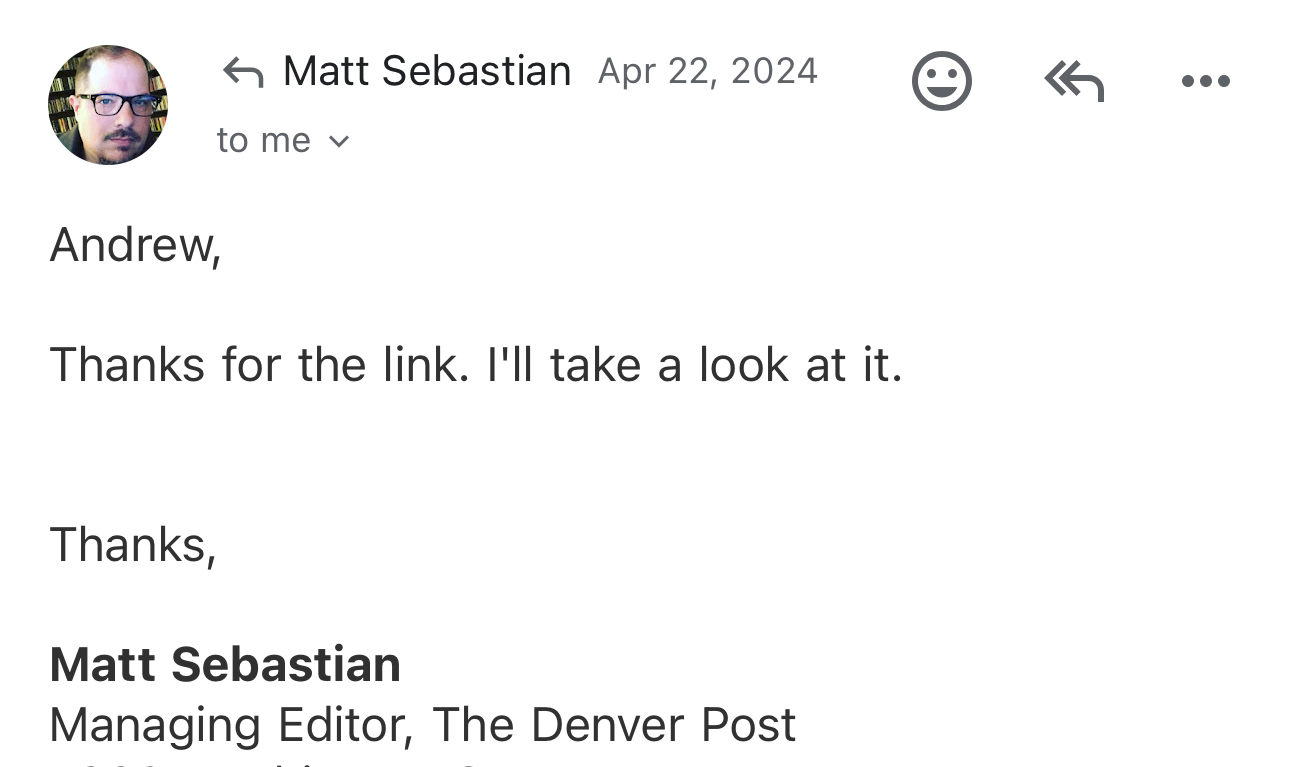
64. The Daily Camera syndicated the information report to Baron’s hometown in Boulder with information about the arrest on the front page, above the fold. The headline, printed in the largest font across the very top, was nearly impossible to miss, even for passersby on Pearl Street’s walking mall who read it through the plexiglass.
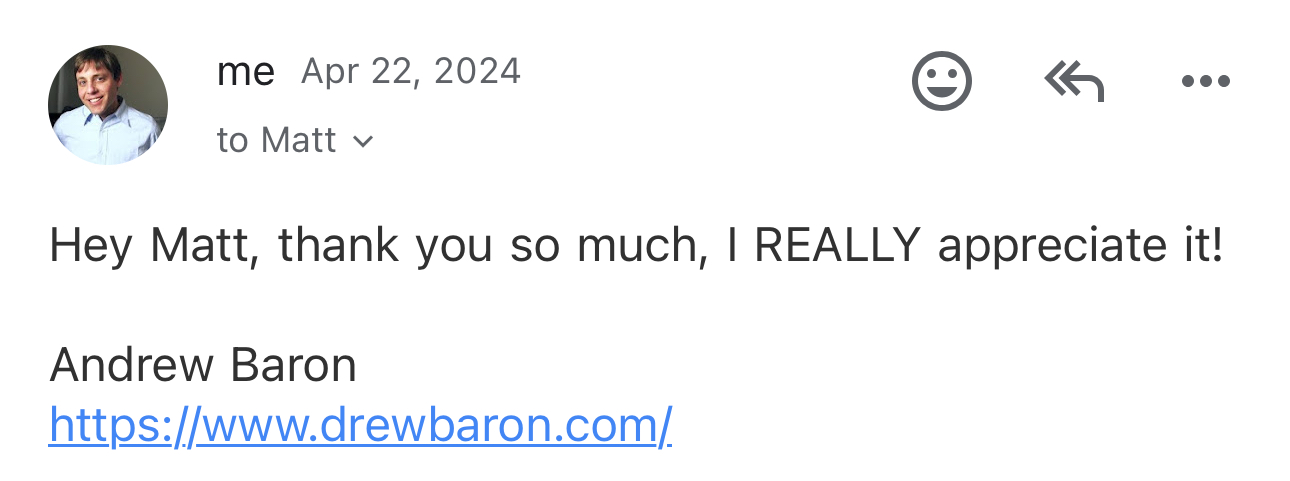
65. Baron denied the charges and began talks with the prosecutors.
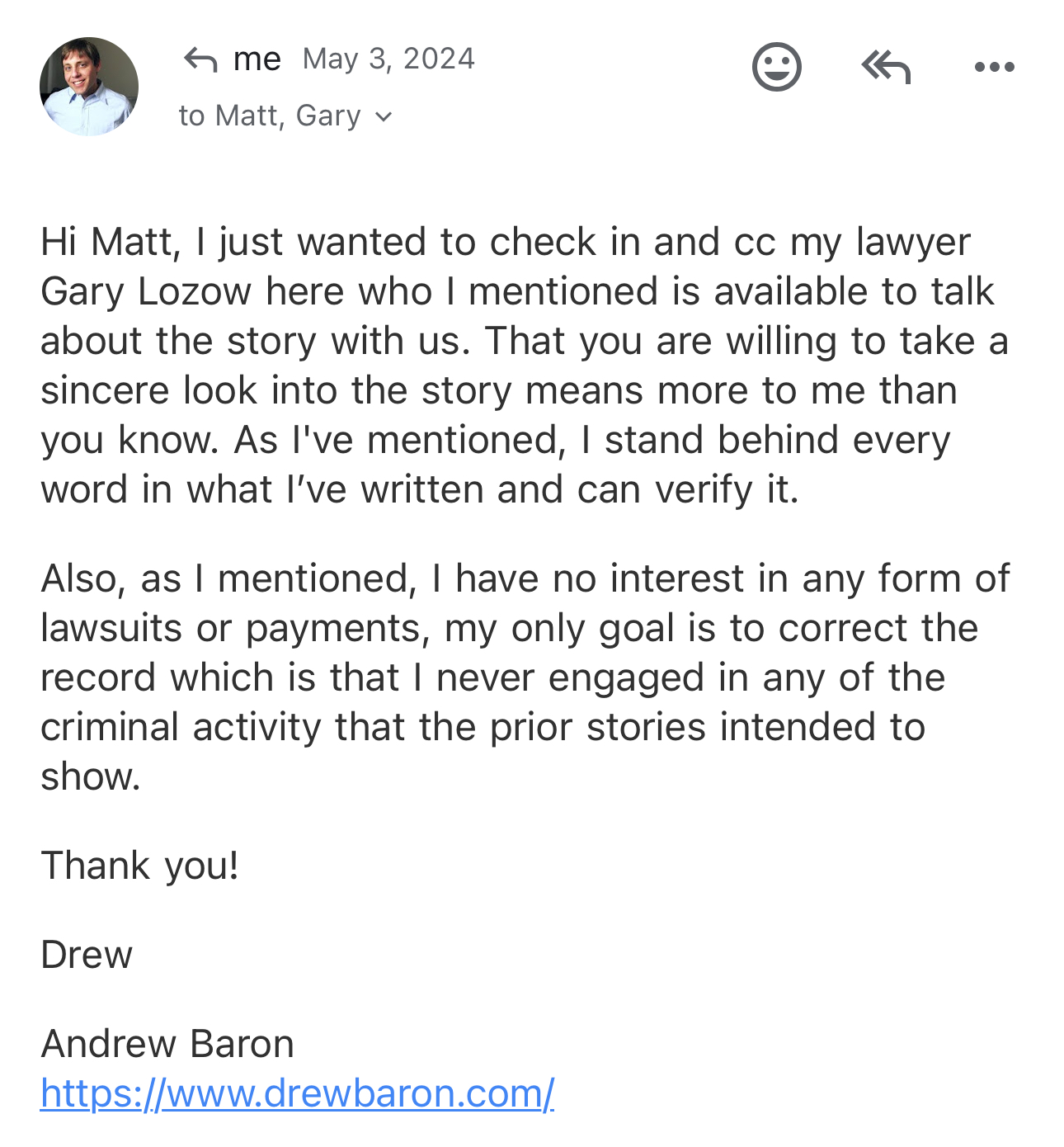
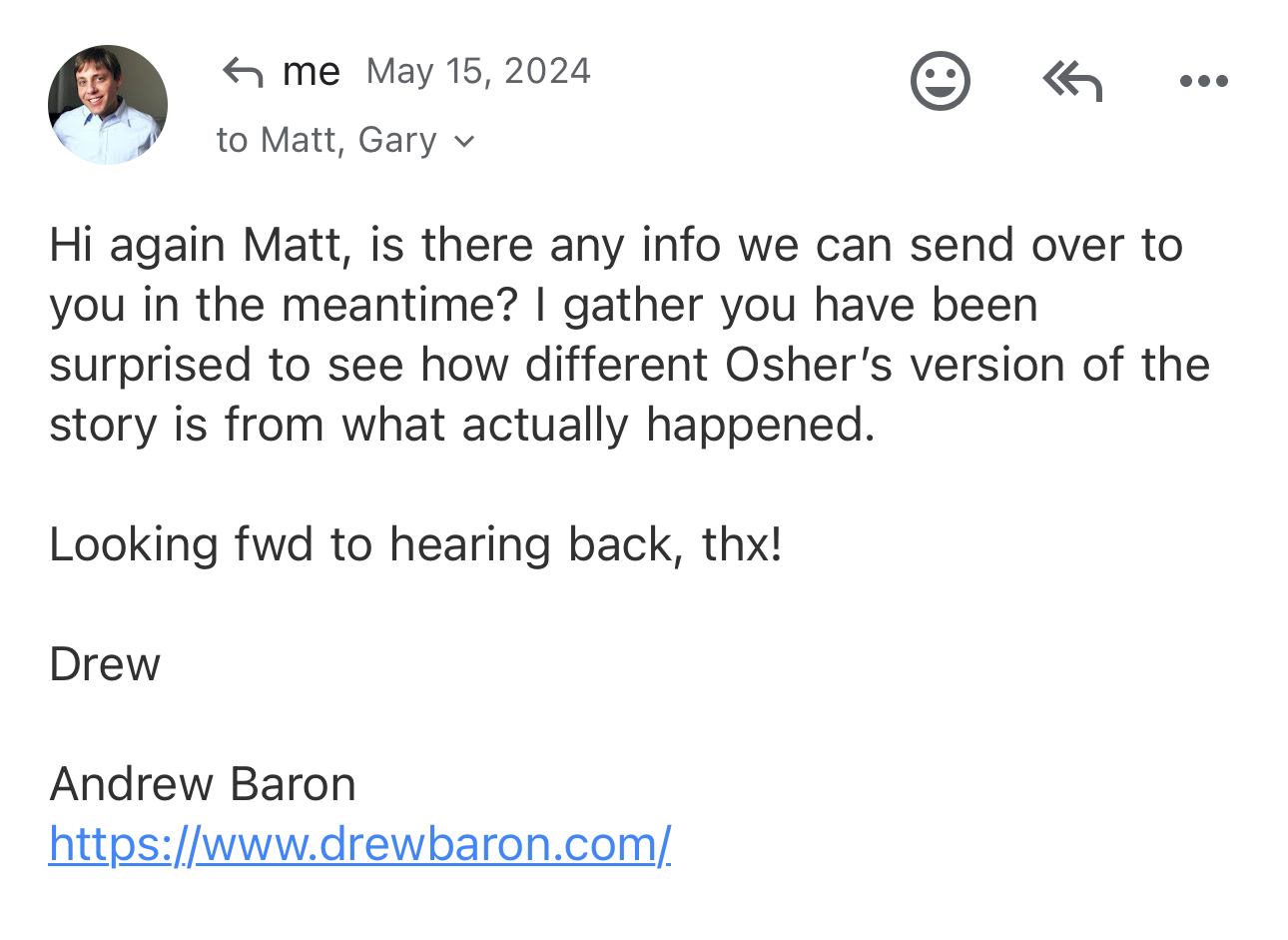
Information Report on Baron IV
66. Osher lined up a photo shoot for his third information report (what would become the fourth in the defendants’ cumulative assets base), which followed a formula Osher had used elsewhere after a successful media prosecution: The Victim Story.
67. The extra photos from the posed shoot went on sale online as Getty Images stock. The black and white versions bring out the lighting in a formulaic design to evoke sadness and betrayal.
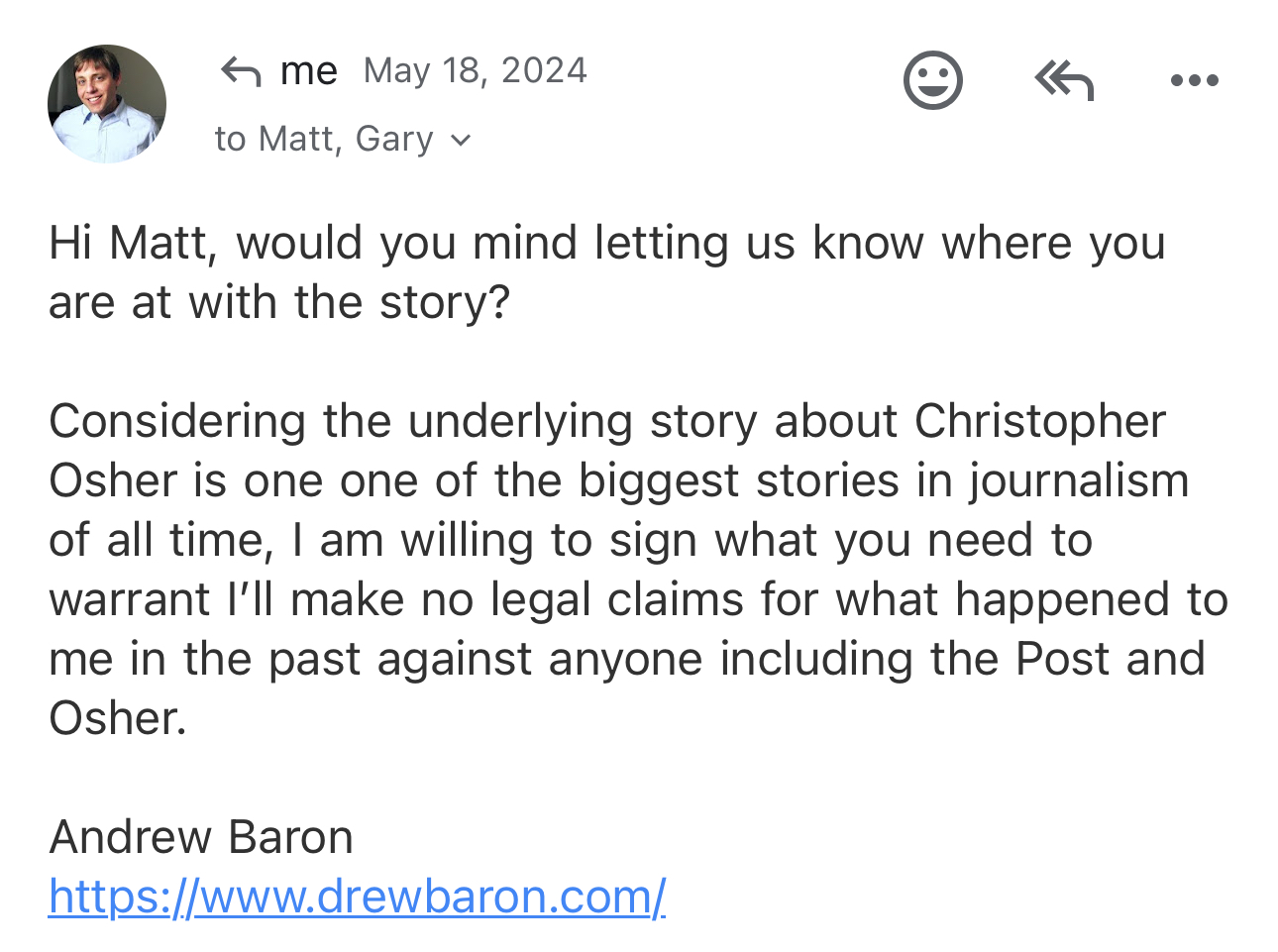
68. But The Policies and Procedures at The Denver Post promises consumers a completely different means of product production, providing a ”Visual Accuracy” clause:
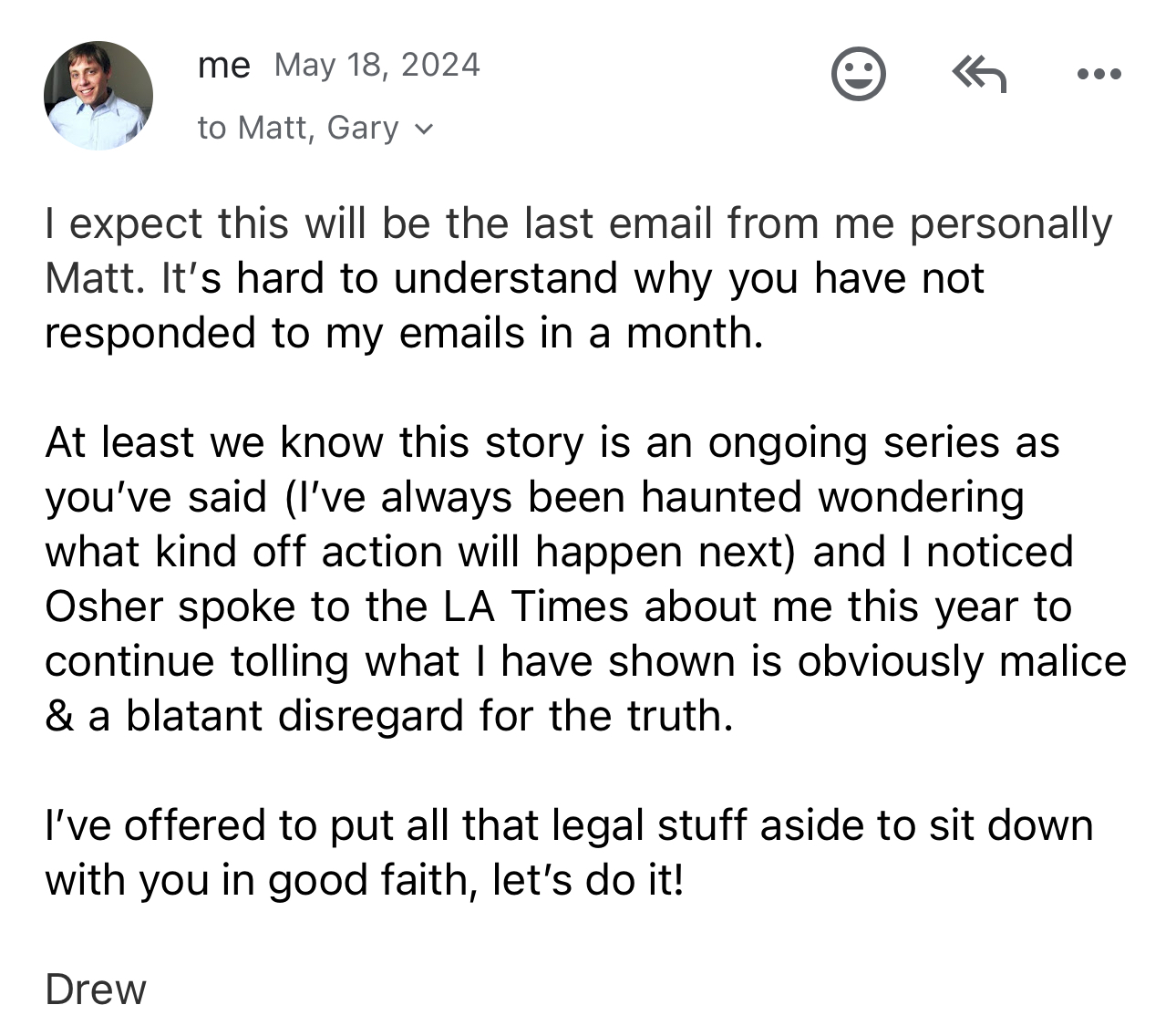
Our cameras should provide a lens to the truth.
Denver Post news photography must be genuine in every way. Photographs must not be staged or posed.
69. The ”Visual Accuracy” clause also states:
Nothing should be added to or omitted from scenes, and only traditional adjustments (such as cropping, dodging, burning, contrast and saturation) are acceptable.
70. Even with the finest details of his product production process, it’s clear that Osher’s activity was not born from a good faith intent to investigate Segur’s allegations, but from a disturbingly obsessive effort to activate consumers and law enforcement to prosecute the subjects of his information reports.
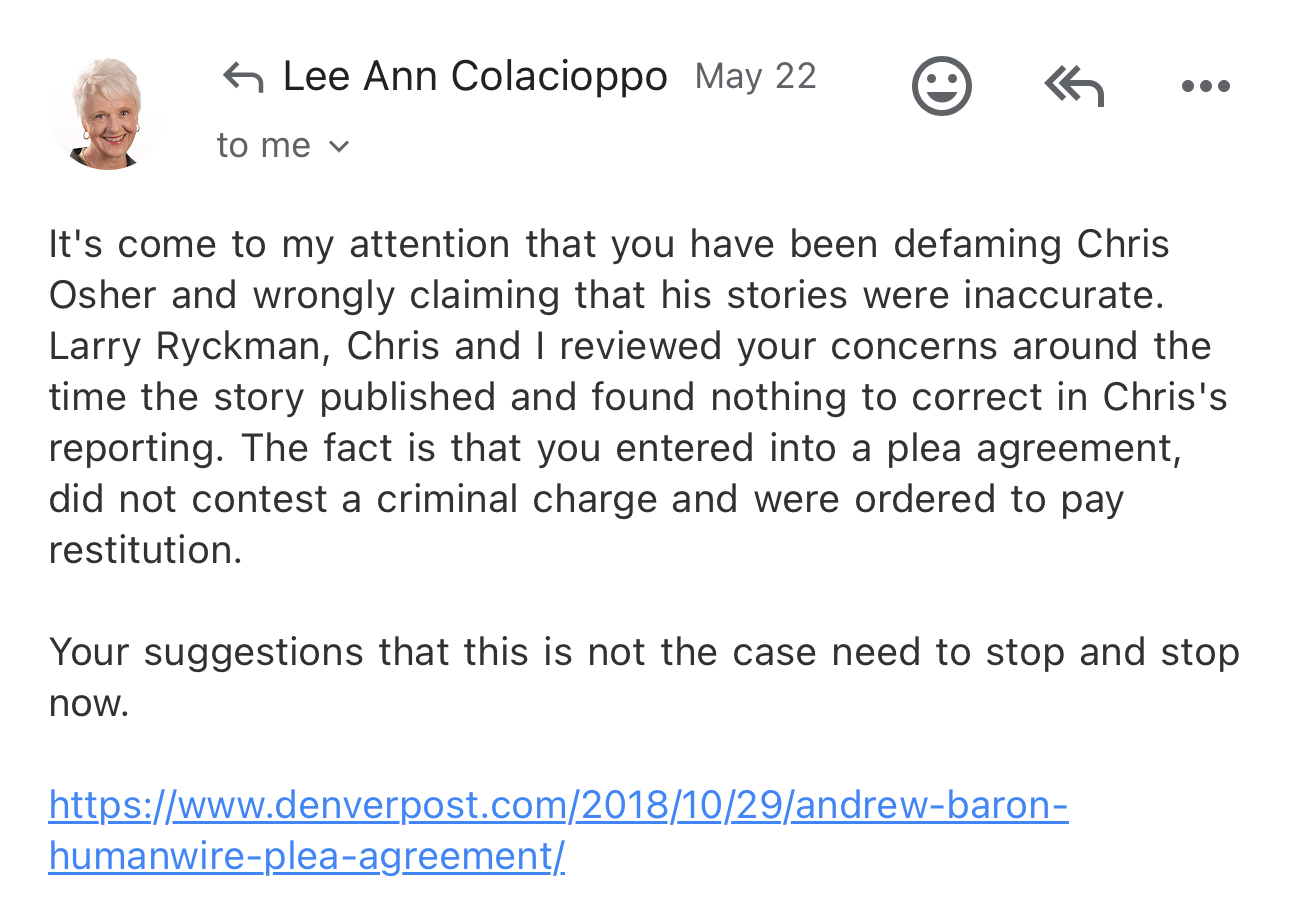
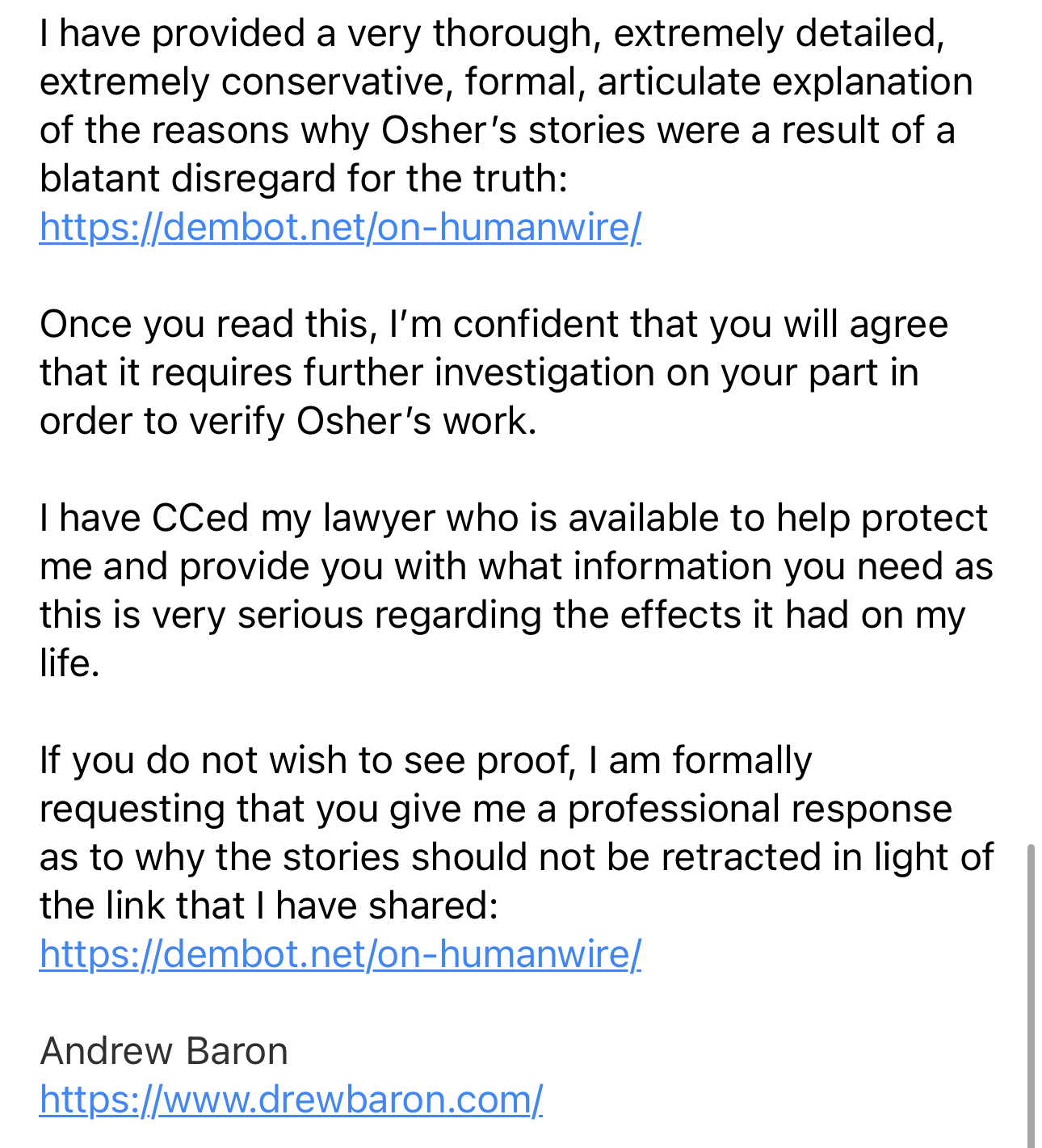
71. This being just one of the promised principles Osher disregarded in his prosecutorial activity against Baron’s life, it was the lack of oversight and care within the greater production process that reveals it was not an isolated incident.
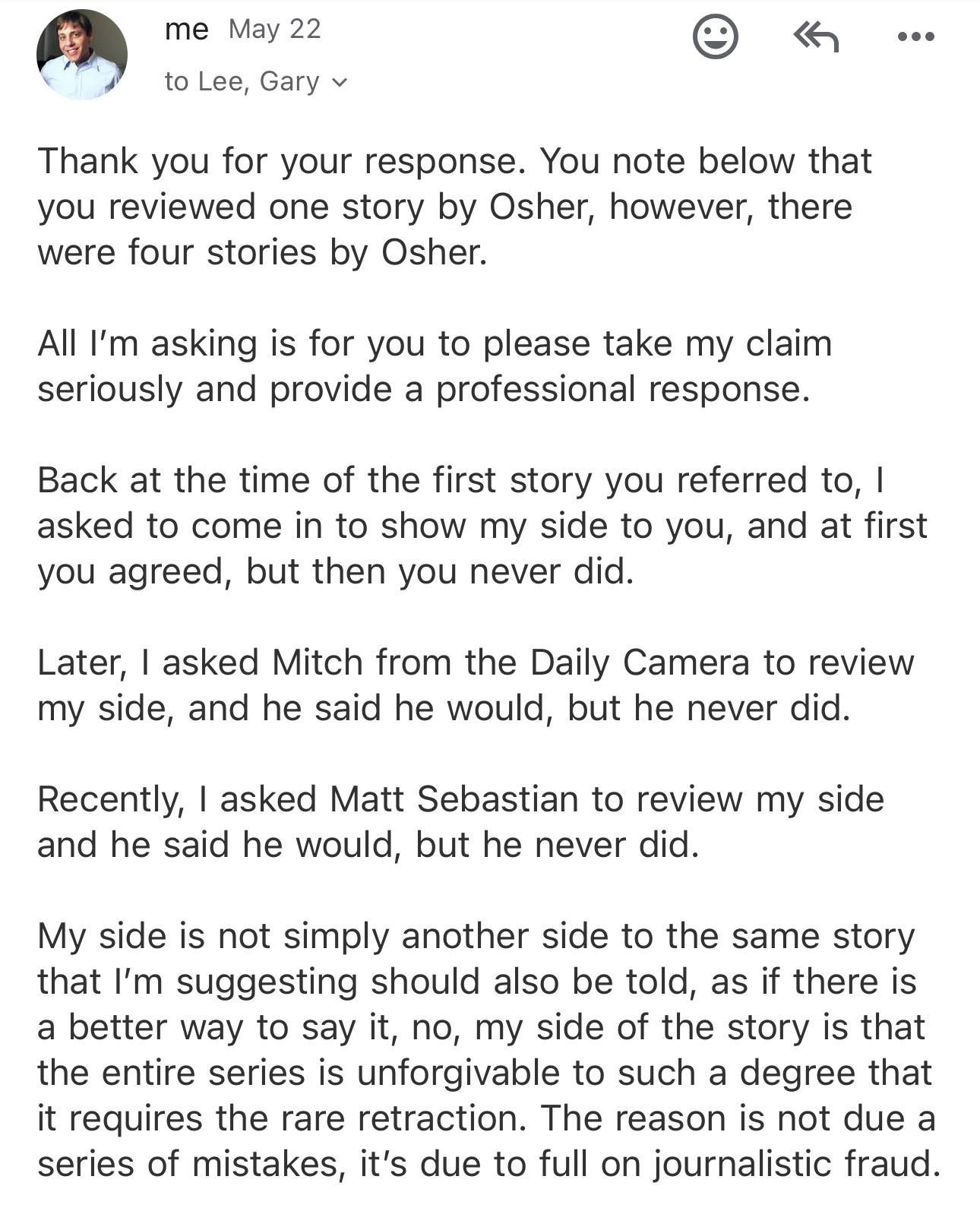
72. After forensic accountants found that all funds had been accounted for, and the prosecutors were unable to substantiate any of the allegations by Segur and Osher, through a no-guilt plea deal instigated and proposed by Baron himself, Baron’s case would become dismissed.
Information Reports on Baron V and VI
73. When The Denver Post was alerted that they missed that Baron‘s case had essentially been settled —they never attended any hearings —not knowing what happened, both The Daily Camera and The Denver Post, separately, rushed to publish new information reports anyway, under a breaking-news method of production, each with material inaccuracies and false light leading the average reader to conclude that Baron was guilty of theft and charity fraud.
74. The Daily Camera editor at the time, Matt Sebastian, wrote to Baron admitting to reworking The Daily Camera version of the story without a full understanding of the story as his excuse.
75. Sebastian also wrote to Baron, referring to Baron’s concerns about all six of the information reports between The Daily Camera and The Denver Post still on sale:
It is not uncommon for us, and other media organizations, to post initial versions of stories and then flesh them out with further reporting. Which is what Chris tried to do.
76. As an investigative series, the stories falsely portray Baron as a thief who disregarded people, left a wake of carelessness against others, refused to pay salaries, and concocted and deployed a criminal scheme. The series includes a false victim story about his partner who came from Lebanon as if he lured her to America to blame his alleged crimes on her.
77. Reasonable people of any age or background who read the stories today are left falsely believing Baron is a criminal who caused criminal harm, which is the primary intent of the series.
78. By industry comparison, the four-part series on Baron by Christopher Osher blatantly violates all four principles of the Society of Professional Journalists (“SPJ”) Code of Ethics, demonstrating a disregard for over thirty of the full set of thirty-five guidelines—a near-total breach of ethical standards. These violations are detailed in Exhibit C, which is incorporated into this complaint by reference to provide an analysis of the journalistic failings in Osher’s reporting.
79. Baron tried to explain to Sebastian that Osher had the investigative reports fundamentally wrong and that they had still not been ”fleshed out.”
80. Sebastian wrote that he would not take up the matter with Baron.
More Consumer Risks of Criminal Prosecutions and Interactions with Fraud Encountered by Baron
81. Unbeknownst to the newspapers at the time of their most recent rushed reports, reports V and VI, Baron’s case would become sealed a year later.
82. Baron remained in legal jeopardy for almost three years from the time of Osher’s first report on Baron for The Denver Post in mid-2017, through January 2020 when the Court dismissed the case and ordered the case sealed, up until March 2020, when Baron received a letter informing him that his arrest record was successfully cleared, the same month as the COVID-19 lockdown.
83. The statute of limitations on a Colorado defamation claim is generally one year, and by March 2020, after Baron’s case had been sealed, more than a year had passed since the most recent reports.
84. The passage of time does not absolve them of their promised duties to truth outlined in The Policies and Procedures. The Policies and Procedures do not provide conditions of time.
Baron’s Formal Request for an Update I
85. So in December 2020, Baron got the attention of The Daily Camera’s crime reporter, Mitchell Byars, who had produced two information reports on Baron, based on the four defective information reports from The Denver Post.
86. Reluctantly, Byars agreed to review Baron’s claims at the urging of other readers, including paying consumers in Boulder. Byars asked Baron on social media to email information to him, confirming that he would look into Baron’s claims.
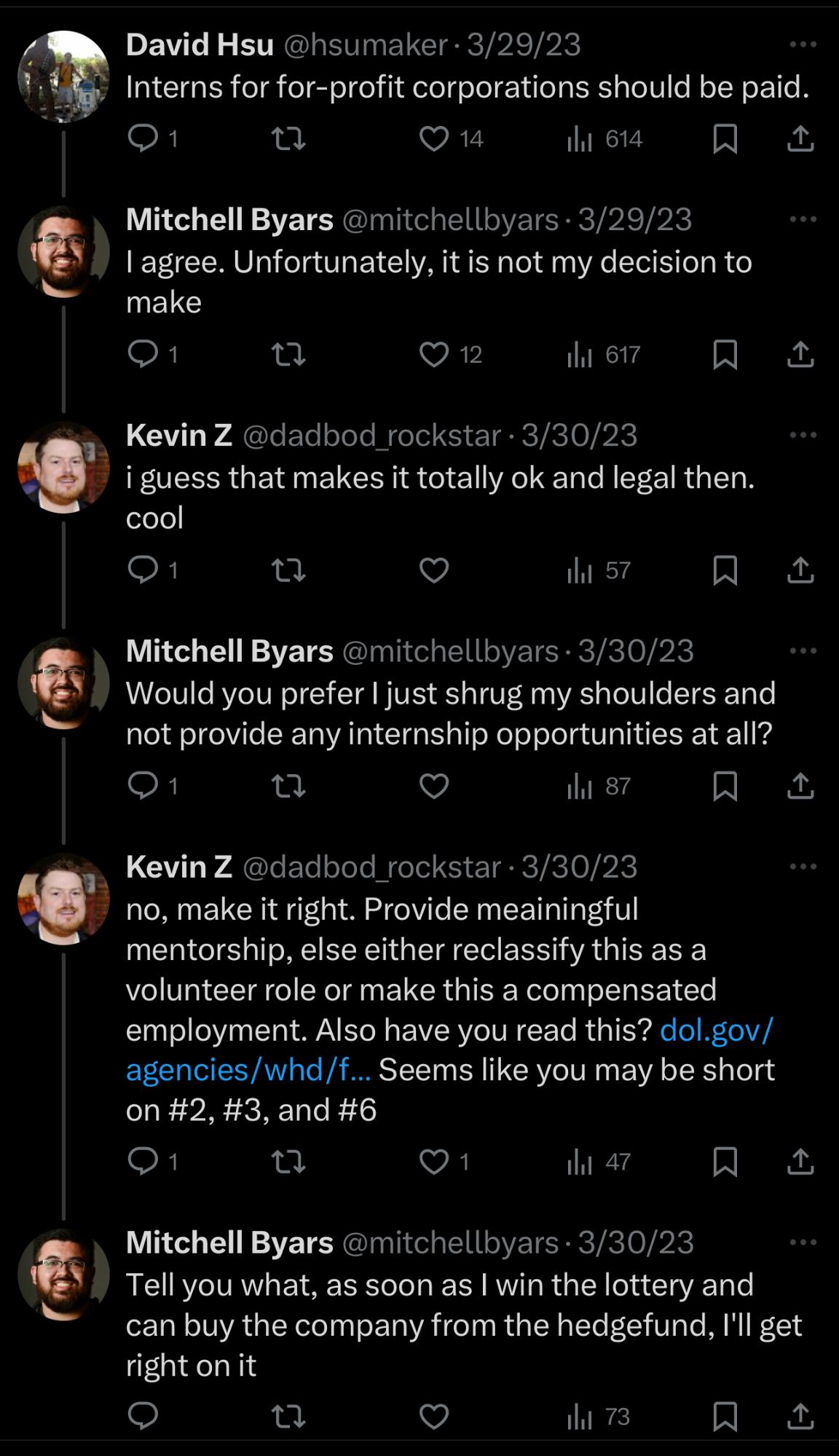
87. When Byars accepted Baron’s request to review Baron’s claims, this constituted a professional obligation on the part of The Daily Camera. By agreeing to revisit Baron’s claims, Byars acknowledged the importance of the matter and, in essence, started the formal process of reevaluating the original reporting about Baron for The Daily Camera.
88. Baron sent his claims to The Daily Camera. Baron offered to provide The Daily Camera with any evidence to back up his claims, including financial documents, without the need to rely on The Principal Post’s report. Baron followed up. But The Daily Camera ignored Baron’s emails and never replied to them again.
89. When Baron later publicly highlighted on twitter/X that The Daily Camera was unaccountable because they ignored Baron’s serious claims, even after agreeing to look, Byars replied publicly that he did not plan to respond to Baron because he did not take Baron seriously.
90. This caused a new public harm that significantly interfered with Baron’s ability to recuperate his life since it came from the town crime reporter who is expected to be among the most credible, thereby confirming the full extent of Osher’s still-unchecked gross disregard for the truth and product manipulation.
Unconscionable New Abuse to Baron by The Daily Camera
91. As Baron was endeavoring to rebuild his life, in March 2021, he came under yet another attack, a new, severe form of harassment from The Daily Camera when the crime reporter, Byars, contacted Baron, out of the blue, during the chaos of a mass shooting in Baron’s hometown, accusing Baron of a new crime.
92. Byars asked Baron over twitter/X Direct Message if he had doxed Byars, and asked Baron to take down the webpage as part of his accusation.
93. Baron categorically denies any involvement in, or knowledge of, any dox or webpage in question. At no time prior to being contacted by Mitchell Byars did Baron have any awareness of the alleged actions or materials. These allegations are wholly unfounded. In support of this denial, Baron submits Affidavit II, attached hereto and incorporated by reference, which provides an account of the events and confirms that he had no involvement or knowledge regarding the dox or webpage.
94. The crime reporter, with no evidence, indicated that he had just discovered it, and wrote that he contacted multiple people who he suspected might have done it.
95. Consumers of news from around the world were tuned in, and some expressed outrage and fear that a reporter would be doxed for merely reporting on a mass shooting.
96. But it wasn’t true.
97. Amazingly, as it was discovered via the Wayback Machine, the dox had been posted to the internet five years prior and showed an address that he no longer lived at, and was thus unrelated to the shooting.
98. That this false accusation occurred while the town was still reeling in chaos and confusion over a mass shooting takes The Daily Camera’s journalistically unethical behavior to the lowest of levels.
99. The Daily Camera’s crime department was acting not on journalistic inquiry but prejudiced suspicions which were used against Baron and others to trap their lives.
100. These acts also misled consumers and distracted the newsroom from covering the tragedy as Byars announced managers from The Daily Camera newsroom were scrambling around to try and get the page down right then to mitigate what they falsely perceived as an emergency threat.
101. Accusing someone of a crime—especially when that person has already been the subject of public controversy —requires thorough investigation. By failing to investigate before accusing Baron, and others, Osher, and then separately, Byars, acted with reckless indifference to the harm their actions would cause with an abuse of power and company resources.
102. The accusations by Byars were made in a highly charged atmosphere, exacerbating the harm caused to Baron, and bringing upon him a new criminal threat.
103. The slightest misstep by Baron in the confrontation brought on by Byars could have foreseeably led to a new arrest.
104. Out of fear of being accused, Baron felt he needed to defend himself and tweeted out that he was innocent. The Daily Camera put Baron in an impossible position, with no way to defend himself except to say he didn’t do it, where his word had already been disregarded.
105. This pattern of negligent and reckless behavior supports the legal standard of fraudulent malice and demonstrates a repeated failure to act responsibly by the actors involved in producing the products for the companies under false pretenses and without oversight.
106. Because there is no indication that the series was over, and because Baron was still being targeted, as the new attack from Byars confirmed, Baron has been living in complete and utter fear, while remaining limited by the improperly made information reports that would stand in anyone’s way like a brick wall.
Walking Into A Brick Wall
107. In November 2023, Baron’s attempts to rebuild his life were once again hindered when The Los Angeles Times, a non-Alden news business, initially wanted to cover his long-distance walk from Los Angeles to San Diego but later withdrew after learning about the defective reports by The Denver Post and reaching out to Christopher Osher.
108. The reporter for the Los Angeles Times, Deborah Vankin, at first agreed to write a story about the walk. Then Vankin’s editor agreed and confirmed the report for the upcoming Saturday edition. Vankin and Baron scheduled a time and location to meet based on where Baron would be the following day on his route, and Vankin would tag along for a while while she conducted the interview for The Los Angeles Times information report.
109. When Baron was speaking with Vankin over the phone, after she had looked at The Denver Post’s reports, Baron interpreted her understanding of the series as conveying that Baron had been convicted of a crime.
110. She indicated that The Los Angeles Times could not continue with their report out of an ethical responsibility to their readers to first investigate, since if what Baron alleged was true, she indicated, The Denver Post story would be both contradictory and left unfinished.
111. After a show of integrity by The Los Angeles Times reporter regarding her own business practices by comparison, where she too has a set of rigorous policies and procedures that also act as a public-facing good faith promise to consumers about her duties, Baron agreed with Vankin without pushback to cancel the story.
112. One does not simply say the four-part investigative series about them is just wrong and nobody listens.
No Accountability Validates Bad Practice
113. Another shock for Baron came when Osher and his colleague, both working for The Colorado Springs Gazette, a non-Alden company also in the business of selling information reports, received a George Polk award for investigative journalism in early 2024.
114. Baron took to social media to protest Osher’s award, pointing to the lack of ethics in Osher’s reporting and accusing him of journalistic fraud.
115. Baron confronted Osher before his peers, commenting on Osher’s lack of accountability for ignoring the serious allegations of fraud and bad-faith practices.
116. Baron’s protests were ignored and the newspapers continued to avoid addressing Baron‘s allegations, still never having challenged or denied a single fact alleged by Baron, but merely refusing to engage with any of his claims.
Baron’s Formal Request for an Update II
117. With persistence, in April 2024, Baron got the attention of Matt Sebastian, originally from The Daily Camera, but now managing editor of the Denver Post, #2 only to chief editor Lee Ann Colacioppo.
118. Baron emailed Sebastian with a link to his blog post (a near copy of the information report in Exhibit B), in the form of a formal request to revisit the information reports.
119. Sebastian responded in his email with gratitude that Baron contacted him, and Sebastian stated that he would look into it.
120. Encouraged by the response, Baron immediately followed up, expressing his gratitude.
121. After not hearing back, eleven days later Baron followed up again.
122. Baron emphasized his readiness to provide any evidence that might be required to back up his claims, but three weeks in, Sebastian still hadn’t responded.
123. Baron wondered if Sebastian might be worried about personal or legal liability as if admitting to mistakes would lead to embarrassment or expenses for remedies.
124. Baron offered Sebastian a waiver and was prepared to sign it even before Sebastian did his investigation and made his determination, for Baron only asked that Sebastian agree in good faith to sit down and review Baron’s claims, trusting that Sebastian was in good faith with his journalistic duties and promises for the information reports produced by The Denver Post.
125. When Sebastian as managing editor of The Denver Post formally accepted Baron’s formal request to review and committed in April 2024, this constituted the beginning of a new professional obligation on the part of The Denver Post born from and tied directly to the six defective information reports. Sebastian was in a high enough position to single-handedly decide what should be done, advocate internally for the right solution based on The Policies and Procedures, and handle it all the way through.
126. The Denver Post then disappeared and Sebastian never responded again.
127. This type of act by a managing editor, even when Baron replied with a ’cc that included Baron’s professional legal representation who could vouch for and communicate professionally on behalf of Baron in case Sebastian had a legitimate reason to ignore Baron, shows that consumers have insurmountable risks to mitigate in engaging with The Defendants' businesses, even for information reports that require extra care or when there are six. If a consumer is unable to obtain a response for a correction, the full set of instructions for the corrections process described in the clause, “Correction & clarifications” is as follows:
To submit a correction to a story in print or online, contact the reporter, appropriate editor or let us know at dpo@denverpost.com or newsroom@denverpost.com. Let us know what needs to be corrected, where the error was found (which page/section of the newspaper and/or the link to the story) and any other additional relevant information.
Legal demands for corrections must be in writing and sent to Editor Lee Ann Colacioppo at 5990 Washington Street, Denver, Colorado, 80216.
128. The corrections process which at first may look easy, could be described as a two-part process:
The Corrections Process Step 1
Email whatever to whoever.
The Corrections Process Step 2
If you don’t hear back, sue.
129. Without guidelines for consumers like Baron who entered into the process under the conditions of an emergency that was created to monopolize on him, and without sufficient resources, the reporters and chief editor can conveniently ignore anyone for any reason, forcing them to prepare a lawsuit that attempts to justify their claims no longer by the scope of The Policies and Procedures but by the actionable legal theories of torts, for example imposing time frames, boundaries and conditions, leading to major costs and time for consumers to prepare to seek a good faith update.
Baron’s Formal Request for an Update III
The Final Tipping Point
130. In May 2024, a turning point occurred when The Denver Post’s chief editor, Lee Ann Colacioppo, the highest known ranking editor of her subsidiary, emailed Baron, unsolicited, with a new, chilling threat on Baron’s freedom and free speech rights demanding that he stop asserting that the information reports from The Denver Post about him are inaccurate.
131. The email exchange from May 2024:

132. In that correspondence, Colacioppo stated the information reports were accurate, and then inadvertently revealed that she had never reviewed the full series and that she was unaware of the extent of the errors Baron had been highlighting.
133. Colacioppo attempted to settle Baron by stating that she had already conducted a review, referring to facts that encompassed the four stories from Osher, and noting that the review included editor Larry Ryckman.
134. According to The New York Times, Ryckman resigned from The Denver Post in May 2018, prior to future stories that would be published about Baron in The Denver Post and The Daily Camera. The New York Times wrote an information report devoted to Ryckman:
They left The Denver Post amid newsroom layoffs and interference in the editorial process by the newspaper’s hedge-fund owners.
135. Ryckman was quoted in the article as saying:
“None of us wanted to continue dismantling the Denver Post newsroom.”5
136. Additionally, Colacioppo inadvertently revealed she never read or engaged with Baron’s claims since she mistakenly claimed Baron’s motivation was to hide his arrest. Baron has been outspoken about his arrest and has detailed it on his blog and throughout social media.
137. Despite revealing that she had never been fully briefed on the case, Colacioppo pretended that she had, refused to investigate or consider any corrections or updates, showing a reckless disregard for the truth and a reckless indifference to the harm Baron is undergoing, on a level Baron could not have anticipated even after all that happened.
138. Colacioppo’s harassment and malice towards Baron in 2024 in threatening him to remain quiet, knowing she had never formally reviewed her stories about Baron against his claims, while refusing to look, while knowing that Baron’s claims were significant enough to contact him for the purpose of getting him to be quiet, is a nearly unheard of reckless disregard for the truth from a chief editor of such an organization, a gross abuse of The Denver Post’s published ethical standards, inadequate at providing oversight for any reporters who may abuse company policies and resources as Osher has done, abuse of power and authority over Baron’s business and life leading to Baron’s arrest, more malice for a new round of threats to Baron from the same position of power over him while refusing to review the material evidence that backs his claims, and legal fraud through her attempt at fraudulent concealment in asserting that she had adequately reviewed the series and Baron’s claims in her complete and utter disregard for the truth, revealing The Defendants’ methods for severely unlawful product production spans the gamut of a process Colacioppo once described as a fit for her to run due to her “love of chaos.”
139. By demanding that Baron stop asserting his version of the truth without ever reviewing the blog post or evidence he wanted to provide, Colacioppo showed willful ignorance of the facts and a reckless disregard for the truth. The chief editor’s failure to consider Baron’s evidence, despite being in the highest editorial leadership position, demonstrates a lack of professional diligence that can only be described as malicious and reckless. This reflects not just negligence but professional misconduct, as she is choosing to ignore credible allegations of journalistic fraud while actively upholding and participating in the fraud.
PARENT COMPANY NEGLECT
140. In August 2024, Baron escalated his concerns about the information reports that limit his life every day, sending his concerns focused on Osher’s journalistic malpractice to The Denver Post’s publisher and parent LLC subsidiary, The MediaNews Group, requesting an investigation and response.
141. The MediaNews Group never responded to Baron.
142. Baron’s outreach to The MediaNews Group, the publishing company of The Denver Post and The Daily Camera, adds another dimension to the case. By failing to investigate or respond to a claim for potential employee abuse or misconduct, the parent company is engaging in vicarious liability and negligent supervision, further implicating the corporate structure in the ongoing professional negligence and misconduct across all levels of Alden’s subsidiaries, where none in the hierarchy are capable, leading nowhere else but to the parent, where Randall Smith and Heath Freeman preside.
For The Journies of Others
143. In addition to the encounters of consumer fraud, harassment, abuse of power, and neglect introduced in Baron‘s journey, the underfunding and decay of The Daily Camera and The Denver Post operations have left a mogul field of other obstacles for consumers to deal with.
Misquoting and Inaccuracies in Other Reporting
144. In a 2021 information report6 commemorating the 20th anniversary of 9/11, The Daily Camera editor John Vahlenkamp published a single story with over 20 inaccuracies by his count, including fundamental errors such as:
- Labeling individuals as "survivors of 9/11" when none of them were involved in any attacks
- The location of the Pentagon.
- Misreporting the names and backgrounds of the featured individuals.
- A primary subject’s trip to New York, which was on a commercial flight and not on a special flight for the FBI.
145. In an information report about the incident by Colorado journalist, Cory Hutchins, Hutchins writes:
Newspaper retractions are rare and typically are embarrassing to news organizations when they have to make them. They can illustrate a breakdown in the journalistic process of a reporter and also a weakness in a paper’s editing regimen.
As the financial model for local newspapers has collapsed over the past decade or longer, many local newspapers have shed their copy editors. Many no longer employ fact-checkers — if they ever did. One of the elements of journalism that sets it apart from other forms of communication is its essence and discipline of verification.7
146. These types of errors are indicative of a severe failure to produce, due to the lack of necessary resources needed to create, fact-check, and review.
Using Affiliate Links for Personal Gain
147. Baron discovered that The Daily Camera columnist Dave Taylor was inserting affiliate marketing links and Google Ad trackers into his tech advice columns, which financially benefited Taylor personally. After Baron confirmed this benefit with the affiliate link providers, when he confronted Taylor about one of the links in his information report listed under “Business News,” Taylor admitted to it but attempted to brush it off as a mistake. In the report, titled “Dave Taylor: How to start your online business,” Taylor had included a link that appeared to be to "http://hostgator.com" but actually the hidden link was to
https://www.hostgator.com/managed-wordpress-hosting?clickid=3IfWr4Vw5xyKT7s0FoTXVTmBUks0JiztRVoJSQ0&irgwc=1&affpat=1&mpid=2232105&utm_source=IR&utm_medium=affiliate&utm_campaign=askdavetaylor&channelid=P61C46098237S645N0B2A20D0E0000V100&siteID=&irpid=2232105 The Daily Camera responded on twitter/X stating:
The Camera is not paid for affiliate links. The contributing columnist included the wrong link to the HostGator home page. We apologize for the error and the link has been updated.
148. After The Daily Camera removed the link, Taylor wrote to Baron: "I look forward to reading your small town newspaper that you write for and edit... I mean, you DO have expertise, right?". In response, Baron highlighted a second affiliate link in a separate article. Taylor then admitted to Baron to doing it intentionally, writing “You caught me” and also writing “I’m not a reporter and my column is an opinion column, not news reporting." The Daily Camera was alerted but appears to have made no meaningful change, and Taylor continues with his column under the categories of “News,” and ”Business News.”
Unqualified Sponsored Content Masquerading as Business News
149. Baron noticed that The Daily Camera presents articles by Bettina Swigger, the CEO of The Downtown Boulder Partnership, an active lobby group that serves the political interests of downtown businesses, as “Business News” without any disclosure of her organizational ties to the paper. Upon information and belief, the column of information reports8 is not “News” or “Business News” content but “Sponsorship” or a kind of undisclosed value exchange between The Daily Camera and The Downtown Boulder Partnership. The column recently took on “Downtown Boulder” as a taxonomic sub-category within the business news section, though the lobbyist, Swigger, is the only one writing information reports for the Downtown Boulder Business section.
Disregard for Federal Labor Laws
150. The Daily Camera reporter, Mitchell Byars, indicated on twitter/X that the company had just lost a photographer but instead of paying for a replacement, The Daily Camera was in search of someone to do it for free under the guise of an internship:
We are also looking at taking on one photo intern in an unpaid, part-time internship…Due to staffing, we're looking for a student with prior experience who is looking to really fill out their portfolio…For this particular internship, we just won't be able to offer the type of mentoring and supervision we can with the reporting interns. Plus, it's a lot harder to edit photos than stories. It's actually why we typically haven't done photo internships.
151. Consumers chimed in with concern about the offering because it violated the Federal Labor Law of Fair Labor Standards Act (FLSA):
152. Byars admitted he knew it was wrong but attempted to justify his actions as being above the law, expecting that consumers would rather he break the law than pay for information reports without photographs.
Exploitation of Unfair and Disrespectful Production Method
153. In a clause on “Fairness,” The Policies and Procedures states:
A strong sense of fair play must imbue our writing, accurately reflecting motives of sources. The tone and language of stories must be even-handed and avoid loaded phrasing.
154. Despite this, continuous, extreme breaches of this clause and other ethical principles outlined in The Policies and Procedures have resulted in loaded and disrespectful reporting targeting CU Boulder’s football coach, Deion Sanders. In response, the university recently banned The Denver Post writer from asking questions of anyone on their entire football team. This was not an issue of free speech, and CU has not made that claim or filed any related suit. Instead, the ban stemmed from the level of disrespect, harassment, and personal attacks, which directly contradict the promises outlined in The Policies and Procedures. Rather than addressing the ethical violations or amending The Policies and Procedures to account for the writer’s extremely disrespectful method, the writer escalated the use of language that further breaches the production method the company no longer follows, while The Denver Post’s digital sports team has actively supported the writer, capitalizing on the national attention to elevate his name and status and profit from the fame surrounding the controversy. According to a New York Times report about the ban, it was noted that The Denver Post no longer employs any full-time sports reporters.9
Breach of Freelancing Rules and Nondisclosure of Freelancers
155. Matt Sebastian shines for consumers when he can namedrop The Meat Puppets or give his opinion about Neil Young on his own personal news site, Slicing Up Eyeballs10, and he has opinions to share on his weekly multi-hour talk show, Dark Wave, where he works for Sirius XM Radio under Sirius XM Holdings Inc., but when he is not busy with all of his personal business publishing and the publishing of other media conglomerates, he is the managing editor of the Denver Post. As #2 in the newsroom to Colacioppo, Sebastian is believed to be working to help determine which stories to run, how to manage production budgets, issues with staff, various administrative tasks, interactions with the public, and to try and make sure each news article is complete and production-ready. On his public bio for Sirius XM Holdings, Sebastian describes himself not as a Denver Post editor but as follows:
Veteran journalist and former music critic Matt Sebastian launched SlicingUpEyeballs.com in 2009 to celebrate the legacy of ’80s college modern and indie rock—music that paved the way for the alt-rock revolution. Sebastian—who has a collection of thousands of records, CDs, and cassettes—publishes daily news items about new album releases, reissues, box sets, tours, reunions, and other ’80s college rock band-related activities.11
156. But The Denver Post’s Policies and Procedures states:
No freelance work may be done for media in direct competition with The Denver Post.
157. Sebastian is perfectly positioned to obtain any or all of the incoming news tips to The Denver Post — including all music-related news —and use that privileged, valuable knowledge for his own music site or his other employer. It would be understandable if he had to ignore Baron‘s request for an update because he was too busy with his personal work outside of The Denver Post, or if Alden isn’t willing to pay a worthwhile salary to stick around beyond the bell.
Interfering with The Denver Post Editor and Firing The Daily Camera Editor to Keep Alden’s Actions Veiled
158. Chuck Plunkett, editorial page editor of The Denver Post, resigned after Alden, through its subsidiary MediaNews Group, implemented a policy banning further reporting critical of Alden’s ownership. Plunkett had previously published editorials highlighting Alden’s practices, including its prioritization of profits over journalistic integrity, which inspired other editors to speak out.12 His resignation underscored Alden’s commitment to silencing dissent and protecting its image at the expense of editorial independence.13
159. This suppression extended to Dave Krieger, editorial page editor at The Daily Camera, who was fired after self-publishing an information report on his blog.14 The editorial, which criticized Alden’s profit-driven approach and its detrimental impact on local journalism, was refused publication by The Daily Camera. Krieger’s termination further illustrates Alden’s efforts to stifle transparency and suppress any critique of its ownership, leaving both Plunkett and Krieger unable to uphold ethical journalistic practices.
Deceptive Editorial to Influence Consumers with Opinions from Alden Executives Disguised as Those of Local Community Editors
160. In October 2023, The Denver Post introduced a new report titled “Editorial: Hamas attack should be recognized as an act of terrorism.”15 This report, produced outside The Denver Post company, was presented to Colorado consumers as an original piece created from within, by “The Denver Post Editorial Board” under the labels “Editorials” and “Opinion.” However, this report is deceptive because it was not created by The Denver Post Editorial Board. According to Axios, a non-Alden news organization that also trades in information reports,
…a situation occurred last October when dozens of Alden-owned newspapers ran an editorial urging the broader media industry to call Hamas a terrorist group. That decision was made by Alden’s MediaNews Group and Tribune Enterprises leadership, not the editorial boards of individual newspapers. A source confirmed to Axios that corporate ownership was involved in the decision. All Alden papers ran the editorial.16
161. Without proper disclosure, readers cannot discern whether viewpoints in the products represent their local editorial boards or Alden’s corporate executives. Lee Ann Colacioppo would be the person in charge at The Denver Post to put her foot down but she is complicit, for her duty to Alden’s embedded policies supersede her promises to Colorado consumers, knowing she is breaking The Policies and Procedures and willfully so.
Manipulative Editorial Control to Deceive Consumers with Editorial Persuasions, As A Column
162. At The Daily Camera, this deceptive editorial practice has become a near-daily routine. In a recent example, on December 29, 2024, The Daily Camera published an editorial titled “Editorial: Trump should reform financial watchdogs — here’s how”17, which was identical in title and content to a report published the same day by The Boston Herald. While The Boston Herald attributed the copypasta to its own editorial board, The Daily Camera listed it as being produced “By VIEWS FROM THE NATION’S PRESS.” This arbitrary practice underscores Alden’s strategy of disseminating identical editorials across its MediaNews Group and Tribune Publishing newspapers without clearly attributing them to its centralized ownership. Notably, The Daily Camera features an entire column18 devoted to these corporate editorials, yet they lack bylines, leaving it entirely unclear which individuals or groups are writing these columns of information reports referred to by the author “VIEWS FROM THE NATION’S PRESS,” deceptively presented and sold through the support of the editorial ideals and opinions of the local media reporters.
Evidence of Similar Consumer Abuses by Alden Across Industries Not Covered in The Denver Post or The Daily Camera
163. Alden uses similar harvesting tactics in other large-scale consumer interest markets which reporters and editors are forbidden from reporting on, including the transportation and real estate industries.
164. Alden, through a once secret affiliate, has acquired over 10,000 manufactured housing lots in 138 parks across 17 states, investing more than a quarter of a billion dollars in the last four years. While initial purchases were believed to have been made in cash, Alden subsequently encumbered these properties with mortgages leading to significant rent increases, reduced maintenance, and the elimination of previously free services for residents, predominantly affecting low-income Americans.19
165. Despite coverage of these issues in non-Alden information reports, The Denver Post and The Daily Camera have not reported on this housing controversy, leaving consumers in Boulder and Denver uninformed about these developments in the housing sector.
166. In the transportation sector, Alden purchased 33 Greyhound bus terminals for $140 million in 2022. Following these acquisitions, the terminals are being sold off for gains to Alden, forcing passengers to board buses at curbside locations without adequate facilities.20
167. These actions reflect a pattern of acquiring assets, leveraging them with significant debt, and reducing services, adversely impacting consumers who rely on affordable housing and transportation.
168. Notably, newspapers at Alden have not been allowed to write about this major American transportation story or refer to these activities, which not only adds to interference editorially throughout the information reports for media, housing, and transportation information sectors but helps to protect Alden’s secret dealings and remain out of the public eye.
169. In an article about the sale of the architecturally notable Greyhound station in Denver, The Denver Post made no mention of the fact that their owner, Alden, was the one selling it, in their information report titled Greyhound station hits the market in downtown Denver’s “new neighborhood.”21 In case the Denver Post newsroom didn’t know about it at the time, the most recent known article to date about Greyhound’s lack-of-a-station woes makes no mention in the September 2024 information report.22
False Advertising and Misrepresentation of Accountability and Community Impact
170. Alden Global Capital, MediaNews Group, and The Denver Post falsely advertise their digital subscriptions by creating a misleading perception that subscribers are directly supporting the production of ethical, impactful, and honest journalism. For example, The Denver Post prominently claims in their marking propaganda, Why Subscribe to The Denver Post, at the point of online sales:
Accountability for those at the top; the Denver Post is a watchdog that challenges authorities and gives voice to the voiceless.
171. This claim is contradicted by evidence that the newsroom operates under strict editorial oversight from Alden, which explicitly discourages investigative journalism that might conflict with the owners’ financial interests. Defendants’ actions, including suppressing editorials critical of their practices and firing editors who defied these orders, demonstrate a deliberate failure to uphold the “watchdog” role promised in their advertising. By suppressing critical voices and underfunding investigative journalism, Defendants misrepresent the core service consumers believe they are paying for.
172. What more, far from holding those in power accountable, Defendants have demonstrated a pattern of targeting powerless individuals, such as Plaintiff Andrew Baron. Rather than acting as a “watchdog,” The Denver Post weaponized its platform against Baron, a powerless, empathetic individual who took accountability for everyone and had his case dismissed by blaming no one. By abusing their resources to amplify baseless allegations against Baron, they further betrayed their advertised role as defenders of the voiceless.
173. Moreover, the newsroom no longer employs journalists with the title of “investigative journalist,” and the once-vital investigative journalism department has been completely dismantled under Alden’s ownership. This operational reality makes it impossible for the publication to fulfill its “watchdog” role. Instead of pursuing stories that challenge power structures and protect the public, The Denver Post relies on repurposed wire content and pre-packaged narratives, leaving the critical function of investigative reporting unmet.
174. Defendants’ decisions to suppress editorial independence, eliminate investigative journalism resources, and target vulnerable individuals like Baron demonstrate a deliberate failure to uphold the “accountability” and “voice to the voiceless” promises in their advertising. This constitutes a gross misrepresentation of the core service consumers believe they are paying for, violating their reasonable expectations and trust.
175. By failing to disclose the true nature of their financial practices and their inability to meet the advertised standards, Defendants have induced consumers to enter into subscription transactions under false pretenses.
Diversity Letter Omission is Clear and Distinct Consumer Fraud Among The Worst In Kind
176. In 2021, workers from the Denver Post determined their workplace was not diverse, and that their news coverage was not diverse, and they created a report to increase newsroom diversity and to be transparent with consumers about their lack of diversity within their production process. They created an information report to publish in The Denver Post in the form of a “Letter to Readers,” in an attempt to be mindful of their mission and promises to consumers to uphold The Policies and Procedures and inform consumers of their critical production deficiencies, but Alden rejected the publication of the letter to readers.23 The Denver Post guild wrote:
For months, we worked with local management to craft a letter, which management then sent to corporate lawyers and human resources personnel. But the board of Alden Global Capital, the hedge fund that owns this newspaper, earlier this month rejected the release of the letter.
177. This fact — Alden board interference in the editorial— is one of many that establishes a direct link between both the editorial and staffing decisions at The Denver Post to Alden’s controlling board of directors, where Defendant Heath Freeman is President. This establishes in no uncertain terms the direct connection between Alden and the control over editorial and management decisions at The Denver Post.
178. In the omission to consumers forced by The Defendants, the workers of The Denver Post admitted the following:
We want a newsroom that is continuously committed to changing its culture internally so that people of all backgrounds are supported in their careers and feel welcome in our newsroom. We want a newsroom committed to telling the stories of people who are excluded or underrepresented in the pages of The Denver Post, and to giving those stories the resources and prominence they deserve…The Denver Post staff does not represent the makeup of our larger community. Our coverage is not reflective of the diversity within our city and state. And we have failed to make these issues a priority.
179. Paying and non-paying consumers all across Colorado who read The Denver Post trusting that the information reports are of value because of the advertised commitments to their standards of diversity are grossly deceived by The Defendants.
Consumer Protection is Needed
180. With regards to the stated missions of these Colorado businesses, they are experiencing a phenomenon of organizational collapse, characterized by systemic dysfunction and the inability to meet operational standards. Despite the efforts of some employees to maintain functionality, the lack of adequate resources, leadership, and coordination by others has resulted in a state of operational paralysis with many employees stuck in a state that they can not handle. Tasks remain incomplete or improperly executed, and consumers are neglected, creating a cascading failure across all levels of the organization. This state of affairs reflects a condition of institutional inertia, where individuals continue their efforts out of necessity or obligation, but the underlying structure of the business mission is no longer viable. The result is a progressive disintegration of processes, accountability, and outcomes, leaving the information products that they sell deformed and dangerous.
The Alden Link
181. A preponderance of preponderances of evidence unmistakably links Defendants Heath Freeman, Randal Smith, and Alden Global Capital to the controlling operational and editorial decisions at the newsrooms.
182. The method of control goes much deeper than passing a single story across the boardroom table to see if it’s a yes or a no, the control is instilled within the managerial leaders across the different organizations.
183. Complete control is maintained by implementing large sweeping policies that affect all newspapers equally, and through the regulation and micromanagement of operational and editorial principles and actions by way of dual, trans-corporate roles and relationships where key figures act as the controlling links across subsidiaries.
Mac Tully
184. From 2015 to 2018 while working to transition The Denver Post into a department under Alden’s active influence and control, Mac Tully served as both the CEO and Publisher of the Denver Post while simultaneously serving as Vice President of MediaNews Group. When Tully’s refactoring work was done, The Denver Post memorialized Tully’s time running the business:
Tully’s [retirement] announcement comes a day after The Post rolled out an online subscription model charging readers $11.99 per month for unlimited online access, replacing free content online. On Saturday, the paper will move out of its longtime downtown Denver home, relocating most of its operations to its printing facility in Adams County.24
185. When Chief Editor Gregory Moore resigned, citing untenable cost cuts by Alden, Tully hired Lee Ann Colacioppo for her willingness to align the editorial with the new corporate objectives, completing a command of control over the editorial of The Denver Post.
Lee Ann Colacioppo
186. Lee Ann Colacioppo serves Alden in a dual role, acting as both Chief Editor in charge of the editorial for the newsroom and Executive Editor as an interface to MediaNews Group. If a reporter at The Denver Post wanted to create an information report about Alden, it would not require anyone from Alden or MediaNews Group to interfere in stopping it, since a policy has already been implemented. Such a request by a reporter should not be expected to make it past Sebastian, and certainly not Colacioppo, except in rare cases, such as the omitted diversity information report that Alden specifically rejected.
187. At a symposium at Stanford in 2024, Colacioppo joined panelists on the topic of a polarized America. A key question of the talk was “How do editors produce news that people across the political spectrum will trust?”
188. When asked about her perception of the broad problem of polarization, Colacioppo provided the following response:
There is a spiral that comes when there is a lack of trust in your organization and it takes the effect of — if leaders are going to pretend that you are not trustworthy then they pretty soon quit wanting to talk to you — when you can’t have an honest dialogue with all parts of the community then you’re reporting does begin to suffer — then they can point to your reporting and say “see they didn’t include these viewpoints” and you end up in this race to the bottom — that I think we have seen appear at some times.25
189. Colacioppo’s response, while ostensibly addressing polarization in media, inadvertently exposes the internal turmoil and systemic challenges within The Denver Post under Alden’s ownership. Her description of a “race to the bottom” directly mirrors the operational and editorial environment fostered by the Defendants. The inability to maintain trust within the community stems not from external criticism alone but from the Defendants’ deliberate dismantling of journalistic resources, suppression of diverse viewpoints, and prioritization of profit over quality information product production. By acknowledging the breakdown of “honest dialogue” and its cascading effects on reporting quality, Colacioppo unintentionally underscores the broader issue: the organizational decay perpetuated by Alden’s control, which compromises the very journalistic standards The Denver Post claims to uphold. Despite recognizing this downward spiral, Colacioppo has chosen to remain loyal to Alden, continuing to support their destructive practices and compromising her own journalistic integrity. Her decision to stay aligns her with the Defendants’ broader strategy of extracting profits while sacrificing the newsroom’s ability to serve its community, making her complicit in perpetuating the harm caused by these unethical practices.
R. Joseph Fuchs
190. R. Joseph Fuchs, a long-time Alden executive, serves as Chairman of MediaNews Group, directly aligning the leadership of both entities to enforce Alden’s profit-driven approach across its newspaper holdings. In 2018, Fuchs told The Denver Post staff: “So what we’re looking at, from the perspective that ownership has — and I guess a board sort of sits between the operations of a company and ownership, and you try and balance all the elements here — is a desire to yes, produce a profit.” This quote comes from an information report by Julie Reynolds. Within her important investigative reporting on Alden’s practices, it was also documented that:
According to court filings in a recent lawsuit against DFM, Fuchs “previously was the president of Rockfleet Broadcasting, Inc., which (as of 2011) had a management agreement with Smith Management LLC” and “eighty-eight percent of an affiliate of Rockfleet Broadcasting, Inc., Rockfleet Broadcasting, II, LLC, was (as of 2007) owned by Randall D. Smith.”26
191. In April 2019, The Washington Post quoted Fuchs on his lead for Alden’s takeover bid of Gannett:
MNG announced its plans to buy Gannett in January, when R. Joseph Fuchs, chairman of the MNG board, wrote to the Gannett board castigating the company’s efforts to grow revenue and saying it ought to do more to “maximize value right now.” MNG offered to buy Gannett for $12 a share, or $1.36 billion.27
Heath Freeman
The Architect of Operational and Editorial Control
192. Defendant Heath Freeman plays a critical role in the operational and editorial direction of Alden Global Capital’s newspaper subsidiaries, including The Denver Post and The Daily Camera. As President of Alden Global Capital and Vice Chairman of MediaNews Group, Freeman acts as a direct link between Alden’s overarching profit-driven strategies and their implementation across the media properties he controls. In 2018, Freeman told The Washington Post: “We saw an opportunity to help fix the broken model.”28
193. Under Freeman’s model, The Denver Post and other Alden-owned papers experienced unprecedented staff layoffs and resource reductions, which fundamentally undermined their capacity to meet ethical and professional standards. Freeman’s decisions have directly impacted the companies by diminishing needed company assets, ruining brain trust, and forcing the newsrooms to deviate from their stated Policies and Procedures while misleading consumers about the quality and reliability of the news products he pretends they still produce.
Freeman’s Control of Profit Extraction
194. Executives working at MediaNews Group and the newspapers regularly report that Alden pressures the companies to deliver 20% profit margins.
195. There has been speculation that Alden’s financial arrangement with its newspapers operates under a structure where initial investments are effectively recouped through annual profit extractions, potentially framing these extractions as repayments rather than pure profits. However, even if such speculation holds merit against the assertions made by prior MediaNews Group managers that Alden paid itself back first, the business structure remains fundamentally flawed: The operational setup contravenes the fiduciary and legal obligations of each company, which require the company to operate within the bounds of its stated purpose, comply with applicable laws, and ensure financial practices align with the company’s obligations and responsibilities under its operating agreements and state statutes.
196. The unrelenting demands for revenue extraction for any reason have forced local newspapers, specifically The Denver Post and The Daily Camera, to operate under extreme resource constraints. These constraints have gone too far in systematically reducing the newspapers’ capacities to fulfill their basic operational duties, including adhering to their own stated ethical and professional standards.
Freeman’s Misrepresentations to The United States
197. The extraction of revenue is also problematic because Colorado consumers are tricked into believing their money supports quality local journalism. However, in a series of letters with the United States Senate, included in Exhibit D attached hereto and incorporated by reference, it was shown that:
…over 80 percent of Alden's clients are non-U.S. persons and that more than $830 million of Alden's assets under management are connected to non-U.S. citizens. Furthermore, Alden has domiciled significant funds in the Cayman Islands, a well-known tax haven that lends itself to corporate secrecy.
198. But in light of Heath Freeman’s response, a private letter to The United States Senate also included in Exhibit D, Freeman officially provided warranties to The United States that his company MediaNews Group does not interfere in editorial decisions even though that statement is demonstrably false. Freeman wrote:
MNG’s goal is to operate newspapers in a sustainable and responsible way so that they will continue to exist successfully for the benefit of their local communities and shareholders (1) over the long term. Notably, all of MNG’s newspapers have editorial independence (2) in both their newsrooms and opinion sections.
199. At the crux of one of the most important aspects of this case, this statement from Freeman is contradicted by overwhelming evidence showing that MNG’s newspapers do not operate with editorial independence. Instead, they are deeply controlled by MediaNews Group’s central leadership and Alden Global Capital’s profit-driven mandates. The structure and policies implemented by MNG ensure that no local newsroom or editorial board can act independently. They are forced to comply with directives dictated by the corporate hierarchy. As a matter of indisputable fact, both before and after Freeman’s misrepresentations to The United States, MNG’s newspapers did not and do not have editorial independence from MGM in either their newsroom or opinion sections. They are forced to comply with directives dictated by the corporate hierarchy.
200. Specific evidence of the lack of editorial indpependence includes:
1. Centralized Editorial Oversight
201. MediaNews Group operates under a highly centralized editorial structure, where critical decisions on coverage priorities, resource allocation, and even editorial opinions are controlled by top-level executives, including Heath Freeman. Local editors and journalists often lack the autonomy to pursue investigative stories or critical reporting, especially when such coverage could reflect negatively on Alden, its partners, or its business practices. The dismissal of Chuck Plunkett and Dave Krieger’s information reports from The Denver Post and The Daily Camera, and the firing of Krieger from The Daily Camera for publishing opinions critical of Alden on his own blog are two examples of this interference before the letter.
2. Uniform Editorials Across Properties
202. Freeman’s claim that each newspaper has “editorial independence” is further undermined by the dissemination of uniform editorials across MNG properties, as in the example of urging the media to label Hamas as a terrorist group. This editorial was not created by the editorial boards of individual newspapers but instead was imposed by corporate leadership at MediaNews Group and Tribune Enterprises. The decision to publish this piece without local editorial input directly contradicts the claim of editorial independence after the letter, as does Alden’s unconscionable omission of the diversity letter which occurred in 2021.
3. Resource Depletion and Micromanagement
203. Alden’s aggressive cost-cutting measures have stripped local newsrooms of the resources necessary to function independently. Staff reductions, budget cuts, and the removal of investigative journalism departments leave local editors with no choice but to rely on corporate directives to fill pages and maintain operations. This operational dependency ensures that editorial decisions are controlled from the top down. The information reports are controlled by MediaNews Group with policies controlled and mandated by Alden.
4. Freeman’s Dual Role
204. Heath Freeman’s dual role as President of Alden Global Capital and Vice Chairman of MediaNews Group directly links the corporate profit motives of Alden to the operational and editorial practices of MNG. Freeman’s leadership position at both entities creates an inherent conflict of interest, as decisions made in one capacity are designed to serve the financial interests of Alden rather than uphold the advertised business plan of the newspapers. The refusal to allow the publication of The Denver Post newsroom’s diversity letter further illustrates how MNG’s corporate leadership directly controls and suppresses editorial content.
5. Dependence on Corporate Policies
205. The editorial guidelines and policies imposed by MediaNews Group dictate everything from editorial tone to content approval processes, leaving little room for local autonomy. These guidelines are designed to ensure compliance with Alden’s profit-driven goals, rather than allowing newspapers to serve their local communities independently.
206. Freeman’s statement to the United States Senate is not only inaccurate but also reflects a deliberate effort to misrepresent the level of independence afforded to MNG newspapers. Far from being independent, these newspapers are tightly controlled by a centralized corporate structure that prioritizes profit over journalistic integrity. The claim that MNG newspapers operate “independently” is a facade, constructed to obscure the reality of corporate interference and systematic suppression.
207. The Denver Post has a longstanding relationship with The NewsGuild, a labor union representing journalists and media workers across the country. Employees of The Denver Post are represented locally by The Denver Newspaper Guild, officially known as TNG-CWA Local 37074.
208. The NewsGuild‘s national headquarters is in Washington, D.C., a sector of the Communications Workers of America (CWA). It represents tens of thousands of workers in various aspects of the newspaper industry, as well as staff of labor unions and nonprofit organizations in the United States and Canada.
209. In response to Freeman’s private letter, The NewsGuild sent a letter to The United States Senators signed by its President in Washington, D.C., also included in Exhibit D, which contained the following statements:
The NewsGuild-CWA would like to comment on the letter that Mr. Freeman wrote in response to your March 12, 2020 letter. Publicly available documents and news stories refute nearly every major claim in Freeman’s letter, which contains numerous distortions, misrepresentations, and patently false claims.
210. In a subsequent letter in 2021 also provided in Exhibit D, The NewsGuild wrote to Senators expressing fears of the potential of foreign interference at work and noted two funds control MediaNews Group, and both are incorporated in the Cayman Islands.
• 75% of Alden Global Opportunities Master Fund, incorporated in the Cayman Islands, was beneficially owned by non-US persons. The fund had 36 beneficial owners.
• 77% of Turnpike Ltd., incorporated in the Cayman Islands, was beneficially owned by non-
U.S. persons. The fund had 9 beneficial owners.
Alden owns its stake in Tribune Publishing through two funds, the Alden Global Opportunities Master Fund and Alden Global Value Recovery Master Fund. As of Alden's March 2020 form
ADV filed with the SEC.
211. In the letters, The NewsGuild included an important statement about the control structure and mission of the newspapers under Alden’s control:
MNG is controlled by Alden, a hedge in the business of making money, not producing journalism.
212. Alden’s control has crippled The Daily Camera and The Denver Post to such a degree that it’s not just a matter of misleading consumers about the type, grade, and quality of journalism — the ethical type promised in The Policies and Procedures— but that The Defendants’ products are no longer even of the kind “journalism” at all.
- Because:
(a) revenue generated from Colorado consumers who support The Daily Camera and The Denver Post is actually payment to secret foreign investors,
(b) Freeman’s promises to The United States Senate about his products and production method are not true,
(c ) the degree of the destruction to the workers and product is not reasonable,
- Colorado consumers do not know:
(a) what the senators want to know, to rule out any fears that the dismantling of Colorado Journalism is the intentional acts of foreign adversaries,
(b) that the method of production is a complete lie,
(c ) that the editorial independence statement is deceptive, and completely not true.
Randall Smith
The Invisible Architect
213. Defendant Randall Smith, as the founder and principal shareholder of Alden Global Capital, wields ultimate control over the company's strategies and subsidiaries. Smith’s influence is embedded, and felt across all aspects of Alden’s operations, from financial policies to editorial decisions, despite his deliberately low public profile. His management philosophy has been described as “corporate strip mining,” prioritizing profit extraction at the expense of operational viability.
214. In plain terms, Smith strategically acquires distressed companies not to rehabilitate them, but to exploit their decline for maximum financial gain. His approach is to extract value through aggressive cost-cutting measures, rapid asset sales, and profit redirection, leaving the companies hollowed out and incapable of long-term survival. This practice is the core of Alden’s operational model, designed to prioritize immediate returns for Smith and his affiliated entities over the stability or sustainability of the companies themselves.
215. What appears now as a stable situation generating significant annual profits for Alden is, in reality, an illusion. The profits are not the result of efficient management or improved operations but are artificially inflated because the company has ceased to invest in the fundamental operations required to sustain its businesses. Essential expenses, such as newsroom staffing, investigative resources, and basic operational infrastructure, have been cut to the bone, creating a phantasm of financial health while the underlying assets and the mental health of their conflicted workers deteriorate. The apparent profitability is only achieved by systematically avoiding the costs of the very activities that define the company’s purpose.
216. Since Alden has described itself as a division of Smith Management, it‘s notable that divisions are not designated in the same legal category as subsidiaries.
217. Unlike typical subsidiaries which are separate entities with separate liabilities, a division is fully integrated into the parent company’s structure and control, meaning all decisions, operations, and ultimately all liabilities rest in the parent.
218. Defendant Smith’s control over Defendant Alden Global Capital is further evidenced by his ownership of the “Alden Global” trademark, registered through his firm, Smith Management LLC. The trademark, filed on November 20, 2007, specifically covers “investment management” and “investment advisory services”29 showing Smith’s control over Alden’s intellectual property and control of service.
219. This completes the link directly to Defendant Randall Smith and establishes Randall Smith alone as having complete and ultimate control over all business, with active participation and full responsibility for all liabilities, all the way down, throughout all subsidies, even to the omissions of a single diversity report at a single low-level subsidiary —where it was struck down by the board where Smith has the most voting power —and for all the liabilities of Freeman's misrepresentations to the senators who were ultimately concerned for the well being of consumers. Be the companies truly divisions, LLCs, or curtains, it doesn’t change that two men are using a company known as Alden to control the business plans and operations, all the way down, to increase profit by deception, all the way up.
220. Smith’s liability stems from his active participation in forcing the newspaper companies into a foreign department in his formulaic media, housing, and transportation strip mining factory to obtain his primary goal, the true hidden mission of both The Daily Camera and The Denver Post: Maximizing the amount of money that Randal Smith personally can squeeze out of Colorado consumers to export to himself, Heath Freeman, and unknown foreign actors overseas where Colorado consumers will never know what they are actually paying for.
INTRODUCTION TO THIS CAUSE OF ACTION
221. Through this action, Plaintiff seeks to pierce the corporate veil and hold Alden Global Capital, and Heath Freeman and Randal Smith personally, liable for the mismanagement, negligence, and ongoing harms caused by The Denver Post, The Daily Camera, and MediaNews Group, and the inability to maintain The Policies and Procedures which is a material requirement to engage in the business practices they falsely claim they are engaged in.
222. If the operators of The Daily Camera, The Denver Post, and/or MediaNews Group wanted to change their practices to meet the regular standards of The Policies and Procedures, or if they wanted to change The Policies and Procedures to match their current practices, they couldn’t do it, because the only two individuals on Earth who can are Defendants Heath Freeman and Randal Smith.
223. In Hoang v. Arbess and People ex rel. MacFarlane v. Albert Corp., Colorado courts addressed the ability to hold corporate officers personally liable for their participation in deceptive trade practices under the CCPA. These cases establish that corporate officers can be sued individually when they actively participate in, direct, or authorize deceptive practices, regardless of the corporate entity’s liability.
224. Any and all of The Defendants’ First Amendment rights and possible First Amendment defenses are non-applicable. The Defendants are not engaged in activities of protected free speech. Instead, Defendants are economic actors and profiteers who exploit and interfere with the exercise of protected speech. By systematically underfunding their media organizations, they force their workers into activities that do not constitute genuine ethical journalism, thereby undermining the core functions of a free press.
225. If the Court does not find sufficient grounds to pierce the corporate veil and hold The Defendants — Alden Global Capital, Heath Freeman, and Randall Smith — liable for Baron’s claims, Baron respectfully reserves the right to amend this complaint and claims and add additional defendants, including The Denver Post, The Daily Camera, Prairie Mountain Media, MediaNews Group, Christopher Osher, Lee Ann Colacioppo, Matt Sebastian, Greg Griffin, and Mitchel Byars, for their respective material roles in the ongoing harms and fraud.
226. Under The Colorado Consumer Protection Act C.R.S. § 6-1-115, to have civil standing, the plaintiff is not required to be a paying customer, but like Baron, must have experienced harm from the defendant’s bad practice.
227. Baron’s standing is timely because actions must be brought within three years of the date of the last false, misleading, or deceptive act, or within three years after the plaintiff discovers—or should have discovered with reasonable diligence—the occurrence of such acts.
228. Baron finally pieced together the fact patterns in 2024 after the unexplainable disappearance of Sebastian and Colacioppo’s malice.
229. Baron learned about the existence of the CCPA from a civil rights attorney in Denver on October 18, 2024.
230. The Defendants’ last misleading, or deceptive act was today.
231. Time is of the Essence: Plaintiff Andrew Baron files this complaint pro se but is actively pursuing specialized legal counsel to assist in the effective prosecution of this case. Baron respectfully requests the Court’s understanding regarding any limitations that may arise from this initial pro se filing, that he is ready to promptly take any necessary steps to amend as required, and that he is ready to proceed.
CLAIMS FOR RELIEF
232. Defendants have engaged in numerous deceptive and unfair trade practices, each constituting a separate violation of the Colorado Consumer Protection Act, C.R.S. §§ 6-1-105(1)(g), (e), (u), and (rrr).
FIRST CLAIM FOR RELIEF
Violation of the Colorado Consumer Protection Act (CCPA) – C.R.S. § 6-1-105(1)(g)
(Represents that goods, food, services, or property are of a particular standard, quality, or grade, or that goods are of a particular style or model, if he or she knows or should know that they are of another)
233. Plaintiff re-alleges and incorporates by reference all paragraphs of this Complaint as though fully set forth herein.
234. Defendants represent to consumers that their information reports meet the standard, grade, and quality as defined by the Trust Project, The Denver Post’s Policies and Procedures, and other publicly advertised commitments to fairness, accuracy, and transparency.
235. These representations were prominently advertised to gain consumer trust and subscription revenue, creating a reasonable expectation among consumers, including Plaintiff, of ethical and accurate journalism.
236. Contrary to these representations, Defendants knowingly failed to adhere to these standards and practices, producing information products that were materially misleading, inaccurate, and ethically deficient.
237. Defendants knew or should have known, based on internal operations, that their information products consistently failed to meet the advertised ethical and professional standards.
238.. These misrepresentations deceived Plaintiff and other consumers into trusting the accuracy and reliability of the information products, causing foreseeable harm.
239. Defendants’ actions, misrepresentations, and omissions constitute a violation of C.R.S. § 6-1-105(1)(g), as they falsely represented the standard, quality, or grade of their goods and services to induce consumer reliance.
240. As a direct and proximate result of Defendants’ deceptive practices, Plaintiff has suffered significant damages, including but not limited to financial loss, business loss, reputational harm, and emotional distress.
SECOND CLAIM FOR RELIEF
Violation of the CCPA - C.R.S. § 6-1-105(1)(e)
(False representation as to the characteristics, standards, practices, quality, sponsorship, approval, or affiliation of goods or services)
241. Plaintiff re-alleges and incorporates by reference all paragraphs of this Complaint as though fully set forth herein.
242. Defendants knowingly misrepresented the characteristics, uses, and benefits of their journalistic products and services to Plaintiff, his customers, and the public.
243. Specifically, Defendants falsely represented:
• That their information products adhered to the ethical and professional standards outlined in their Policies and Procedures and The Trust Project, including commitments to fairness, accuracy, and transparency.
• That their digital subscriptions supported robust investigative journalism, ethical reporting, and accountability for those in power.
• That stories related to Plaintiff and his business would be handled in compliance with their advertised ethical standards, including fact-checking, issuing corrections, and providing opportunities for response.
244. Contrary to these representations, Defendants:
• Published inaccurate, misleading, and defamatory information about Plaintiff without conducting proper fact-checking or issuing corrections.
• Failed to follow their own ethical standards, systematically suppressing editorial independence and eliminating investigative journalism resources.
• Used subscription revenues to prioritize profit extraction over journalistic quality, undermining the advertised benefits to consumers.
245. Defendants’ misrepresentations induced Plaintiff and his customers to trust and rely on the accuracy and integrity of their information products, causing harm.
246. As a direct and proximate result of Defendants’ violations of C.R.S. § 6-1-105(1)(e):
• Plaintiff’s business suffered financial losses due to customers relying on false and damaging information.
• Plaintiff experienced reputational harm and emotional distress resulting from the publication of misleading and defamatory stories.
• Consumers were deceived into supporting an enterprise that failed to deliver the advertised ethical and journalistic standards.
247. Defendants’ actions constitute unfair and deceptive trade practices in violation of C.R.S. § 6-1-105(1)(e).
248. Plaintiff seeks all available relief under the Colorado Consumer Protection Act, including compensatory damages, punitive damages, attorney’s fees, and any other remedies deemed just and proper by the Court.
THIRD CLAIM FOR RELIEF
Violation of the Colorado Consumer Protection Act (CCPA) – C.R.S. § 6-1-105(1)(u)
(Fails to disclose material information concerning goods, services, or property which information was known at the time of an advertisement or sale if such failure to disclose such information was intended to induce the consumer)
249. Plaintiff re-alleges and incorporates by reference all paragraphs of this Complaint as though fully set forth herein.
250. Defendants knowingly and systematically failed to disclose material information about their journalistic products and services, including but not limited to:
• Editorial Oversight: The absence of editorial independence due to interference from Alden Global Capital and its leadership, directly contradicting Defendants’ advertised claims of independent journalism.
• Ethical Misrepresentation: A deliberate failure to meet publicly advertised ethical standards as outlined in The Trust Project, the Defendants’ Policies and Procedures, and promotional materials targeting consumers.
• Investigative Journalism Elimination: The dismantling of investigative journalism departments and the lack of reporters with investigative journalist titles, making it impossible to deliver the investigative reporting promised in advertisements.
• Fabricated Editorials and Misrepresentation of Voices: Presenting pre-packaged editorial content from Alden executives as local editorial board opinions without disclosure, deceiving consumers into believing they were receiving authentic, locally sourced journalism.
• Deceptive Subscription Claims: Advertising that subscription payments directly support impactful, honest, and local journalism, while the majority of revenue is siphoned to Alden Global Capital and its private shareholders.
251. Defendants deliberately concealed this material information from advertising and promotional materials to induce people like Baron to participate, and then induce consumers into purchasing subscriptions and other services under the false belief that they were supporting independent and ethical journalism.
252. These omissions were intentional and designed to exploit consumers and consumer trust by failing to disclose the reality of operational and editorial practices, which directly contradicted the advertised claims of transparency, diversity, and accountability.
253. Plaintiff and other consumers reasonably relied on Defendants’ advertising and promotional materials when deciding to engage in transactions and value exchanges, believing they were supporting journalistic practices aligned with the advertised ethical and operational standards.
254. As a result of Defendant's failure to disclose material information, Plaintiff has suffered substantial harm, including:
• Financial loss due to reliance on misleading advertisements.
• Damage to reputation as a result of inaccuracies and biased reporting.
• Emotional distress and personal harm caused by Defendants’ unethical practices and targeted misuse of their platform.
255. Defendants’ deceptive practices constitute a violation of C.R.S. § 6-1-105(1)(u), as they intentionally failed to disclose material information critical to consumer decision-making, with the intent of inducing consumers to enter into transactions and value exchanges.
256. As a direct and proximate result of these deceptive practices, Plaintiff and other consumers have suffered significant damages, necessitating relief under the Colorado Consumer Protection Act.
FOURTH CLAIM FOR RELIEF
Violation of the Colorado Consumer Protection Act – C.R.S. § 6-1-105(1)(rrr)
(Either knowingly or recklessly engages in any unfair, unconscionable, deceptive, deliberately misleading, false, or fraudulent act or practice)
257. Plaintiff re-alleges and incorporates by reference all paragraphs of this Complaint as though fully set forth herein.
258. Defendants have engaged in a pervasive pattern of unfair, unconscionable, deceptive, deliberately misleading, false, and fraudulent acts and practices.
259. These practices include, but are not limited to, misrepresenting the quality, standards, and independence of their goods and services; concealing material information from consumers; and engaging in conduct designed to mislead, exploit, and harm consumers in pursuit of profit.
260. Defendants acted knowingly and with reckless disregard for the truth, failing to adhere to ethical obligations, industry standards, or their own publicly stated policies and procedures.
261. Defendants’ systemic disregard for fairness, accuracy, transparency, and consumer trust undermines the integrity of their goods and services, constituting a flagrant violation of the Colorado Consumer Protection Act, C.R.S. § 6-1-105(1)(rrr).
262. As a direct and proximate result of Defendants’ conduct, Plaintiff and other consumers have suffered significant harm, including financial loss, reputational damage, emotional distress, and deprivation of the promised value and quality of Defendants’ products.
263. Plaintiff seeks relief.
RELIEF REQUESTED
WHEREFORE, Plaintiff seeks entry of Judgment in favor of Plaintiff and against the Defendants, jointly and severally, as follows:
A. Entry of an Order declaring that Defendants’ above-described conduct constitutes violations of the Colorado Consumer Protection Act, including C.R.S. §§ 6-1- 105(1)(g), (u), (e), and (rrr).
B. Entry of Injunctive Orders to effectively cause Defendants to:
1. Remove The Policies and Procedures from The Denver Post, as well as any similar policies from Alden Global Capital and MediaNews Group-owend companies in Colorado.
2. Alert consumers by publishing a notice of the change to all Alden and MendiaNews Group-owned companies in Colorado, in the form of a “Letter,”
3. If and when The Defendants prepare a new Policies and Procedures to accurately reflect their capabilities and promises, alert consumers by publishing a notice of the change to all Alden and MendiaNews Group-owned companies in Colorado, in the form of a “Letter,”
C. Plaintiff Andrew Baron requests from the Court the following relief:
1. Compensatory and punitive damages for the harms caused to Baron and his business in an amount to be determined at trial.
2. The option of relief for treble damages which a CCPA violation recognizes. Defendants have acted in bad faith.
3. Orders for the removal of the six deceptive information reports about Baron at The Daily Camera, The Denver Post, and any other Alden and MediaNews Group-owned publications.
4. Expenses incurred in bringing this action including, but not limited to, reasonable attorneys’ fees.
D. Such further Orders as the Court deems appropriate to effectuate the purposes of the CCPA.
Notes
1. The Alden Global Capital’s entity structure and principal office are unknown. In addition to Alden’s Delaware LLC, which is listed as active, Alden has two known branches: A) Alden Global Capital LLC in New York, a foreign branch, listed as ‘Inactive: Authority Surrendered, and B) Alden Global Capital LLC in Florida, listed as ‘Inactive: Revoked for Annual Report.’ Public court records from November 2022 in 885 Third Ave Realty Owners, LLC v. Alden Global Capital, 2023 NY Slip Op 23036, indicate that Alden defaulted on its rent obligations, effectively confirming that the company no longer operates at its only active registered address, listed for their Delaware entity. Plaintiff contacted property management for SL Green Realty for the famous lipstick building and SL Green Realty confirmed Alden no longer operates at that address. Around the same time as Alden’s default, public reports show Alden moved its operations to Florida. However, its Florida LLC registration, listing an office at 777 South Flagler Drive, Suite 800W, West Palm Beach, FL, has since been revoked for failure to file an annual report, over a year ago. Therefore, there is no known legally active and compliant entity from which Alden operates and it is not currently known where they are addressed. The Defendants are believed to have other Alden-named entities in and out of The United States.
2. The Denver Post’s Trust Project partner page on The Trust Project website. Archive Link:
3. Information Report: The Denver Post joins The Trust Project to curb the rising influence of misinformation. By The Denver Post, May 29, 2020. Archive Link:
4. The Society of Professional Journalists, Code of Ethics, Last Revised, September 6, 2014:
https://www.spj.org/spj-code-of-ethics/
Violations of The Society of Professional Journalists Code of Ethics in the product production of information reports on Baron by Christopher Osher and The Denver Post are included in Exhibit C.
5. Information Report: Goodbye, Denver Post. Hello, Blockchain. By Jaclyn Peiser, New York Times, June 17, 2018. Archive Link:
6. Information Report: Camera retracts story about 9/11 reflections of Boulder residents. By Julie Vossler-Henderson and John Vahlenkamp, The Boulder Daily Camera, Oct 1, 2021. Archive Link:
https://web.archive.org/web/20211016012341/https://www.dailycamera.com/2021/09/11/boulder-residents-who-survived-9-11-reflect-on-finding-peace/
7. Information Report: Colorado editors retract front-page 9/11 newspaper story alleging 'fabricated' quotes. By Corey Hutchins, Oct 1, 2021. Archive Link:
https://web.archive.org/web/20211015223640/https://coloradomedia.substack.com/p/-a-front-page-911-story-in-a-colorado
8. Column of Downtown Boulder Business News information reports by Bettina Swigger is believed to be related to a value exchange relationship between The Daily Camera and the lobby group named ”Downtown Boulder”. Swigger is believed to use The Daily Camera column as a promotional tool. Archive Link:
https://web.archive.org/web/20241220131303/https://www.dailycamera.com/author/bettina-swigger/
9. Information Report: Deion Sanders, Buffaloes will no longer take questions from local columnist for ‘personal attacks’. By David Ubben, New York Times, Aug 23, 2024. Archive Link:
10. Matt Sebastian’s personal music site Slicing Up Eyeballs social media community Link:
https://facebook.com/slicingupeyeballs
11. Matt Sebastian’s Dark Wave 3-hour weekly radio show on SIRUS XM Link:
https://www.siriusxm.com/channels/1st-wave
12. Information Report: Denver Post Rebels Against Its Hedge-Fund Ownership. By Sydney Ember, New York Times, April 7, 2018. Archive Link:
13. Information Report: Denver Post Editor Who Criticized Paper’s Ownership Resigns. By Jack Healy, New York Times, May 3, 2018. Archive Link:
14. Information Report: Private equity owners endanger Daily Camera’s future. By Dave Krieger, Boulder Free Press, April 14, 2018. Archive Link:
https://web.archive.org/web/20180512120115/https://boulderfreepress.blog/2018/04/14/private-equity-owners-endanger-cameras-future/
15. Information Report: Editorial: Hamas attack should be recognized as an act of terrorism. By The Denver Post Editorial Board, The Denver Post, Oct 18, 2023. Archive Link:
https://web.archive.org/web/20231024201557/https://www.denverpost.com/2023/10/18/hamas-terrorism-attack-isreal-civilians-killed-kidnapped/
16. Information Report: Dozens of Alden-owned newspapers run editorial urging media to call Hamas a terrorist group. By Sara Fischer, Axios, Oct 18, 2023. Archive Link:
17. Information Report: Editorial: Trump should reform financial watchdogs. Here’s how. By Views From The Nation’s Press, The Daily Camera, Dec 27, 2024. Archive Link:
https://web.archive.org/web/20241227134604/https://www.dailycamera.com/2024/12/27/editorial-trump-should-reform-financial-watchdogs-heres-how/
18. The editorial column at The Daily Camera for the author “Views From The Nation’s Press,” a column produced by an unknown source: Archive Link:
https://web.archive.org/web/20241225022807/https://www.dailycamera.com/author/views-from-the-nations-press/
19. Information Report: The vulture fund that picked American newspapers apart has a new target. By Julie Reynolds, Columbia Journalism Review, May 9, 2023. Archive Link:
https://web.archive.org/web/20230518010032/https://www.cjr.org/special_report/alden-smith-mobile-homes-west-virginia.php
20. Information Report: Bus Stations Across America Are Closing: Owner of Greyhound terminals has sold them off to raise cash; Chicago could join eight other cities without a station for passengers to wait or transfer. By David Harrison, Wall Street Journal, Dec. 27, 2023. Archive Link:
https://web.archive.org/web/20231228003446/https://www.wsj.com/us-news/bus-stations-across-america-are-closing-cd2c217f
21. Information Report: Greyhound station hits the market in downtown Denver’s “new neighborhood”
The bus terminal in the Arapahoe Square area presents another opportunity for a block-spanning mega project downtown. By Joe Rubino, The Denver Post, April 26, 2019. Archive Link:
22. Information Report: RTD plans to boot Greyhound buses from Union Station: Personal safety and security challenges behind contract termination. By Bruce Finley, The Denver Post, Sep 19, 2024. Archive Link:
23. Information Report: Denver Post newsroom pledges to improve diversity and racial equity, while owner Alden refuses accountability: Staff says hedge fund Alden refused to let paper publish diversity announcement for readers. By Julie Reynolds, Save Local News, April 2, 2021. Archive Link:
https://web.archive.org/web/20210417014021/https://dfmworkers.org/denver-post-newsroom-pledges-to-improve-diversity-and-racial-equity-while-owner-alden-refuses-accountability/
24. Information Report: Mac Tully to resign as publisher of The Denver Post on Jan. 31: Tully says he won’t retire but is looking for something less stressful. By Joe Rubino, The Denver Post, Jan 16, 2018. Archive Link:
https://web.archive.org/web/20200404083427/https://www.denverpost.com/2018/01/16/mac-tully-the-denver-post-resigns/
25. Rebele Symposium 2024: Polarization and the Press: How to Reach Americans Who Don't Trust the Media, featuring Lee Ann Colacioppo. By The Department of Communication at Stanford University, Feb 1, 2024. Video Link: https://youtu.be/xIDWZDXYJCA?si=735gsfCyojVf0q03
26. Information Report: Showtime in Denver: an annotated transcript —DFM’s COO Guy Gilmore and president Joseph Fuchs attempt to justify Alden Global Capital’s business practices to Denver Post staff. By Julie Reynolds, Save Local News, June 22, 2018. Archive Link:
https://web.archive.org/web/20210306152419/https://dfmworkers.org/showtime-in-denver-an-annotated-transcript/
27. Information Report: MNG Enterprises Proposes to Acquire Gannett for $12.00 Per Share in Cash, by R. Joseph Fuchs On behalf of the Board of Directors, MNG Enterprises, Inc., Businesswire Press Release, Jan 14, 2019. Archive Link:
28. Information Report: Is this strip-mining or journalism? ‘Sobs, gasps, expletives’ over latest Denver Post layoffs. By Margaret Sullivan, Washington Post, March 15, 2018. Archive Link:
29. Facts on Smith Management Company Profile and Trademark Applications on Incfact. Archive Link:
http://web.archive.org/web/20250114105242/https://incfact.com/company/smithmanagement-englewood-nj/
ATTACHMENTS:
Exhibit A - The Policies and Procedures
Exhibit B - On Humanwire by Andrew Baron
Exhibit C - SPJ Violations
Exhibit D - Letters with The United States Senate
Section D1 - First Letter to Heath Freeman from The United States Senate
Section D2 - Second Letter to Heath Freeman from The United States Senate
Section D3 - Private Letter to The United States Senate from Heath Freeman
Section D4 - Response Letter to The United States Senate from NewsGuild
Affidavit I - Testament to Facts of Humanwire
Affidavit II - Testament to Facts of Crime Reporter
Respectfully submitted this 17th day of January, 2025.
ANDREW MICHAEL BARON
Plaintiff
____________________________