+

Smoke and Mirrors Is Opinion, Not Investigative Journalism

This is about an article in a series called “Smoke and Mirrors,” created by Christopher Osher under the editorship of Chris Reen at The Denver Gazette.

THE CONTEXT

The story didn’t exactly fall into their laps; they were specifically seeking out targets in the marijuana industry to take it all down.

The Colorado Springs Gazette, once a newspaper company devoted to journalism and social good, was sold. The new business lives under The Anschutz Corporation after being purchased by Colorado billionaire and active-Republican donor Phil Anschutz. Anschutz kept the old name and font as if nothing had changed, and boasts of being a Pulitzer Prize winner, the newspaper’s main claim to authority, front and center on the home page. Anschutz inherited an experienced investigative reporter, David Philipps, whose military reporting had already earned Pulitzer recognition. Around a year after Anschutz gained control, Philipps did it again and then left the company. That was over 12 years ago. The company has never been considered for a Pulitzer again.

From The Colorado Springs Gazette, the politically driven Denver-based business group recently spun out The Denver Gazette (2020), where this series of anti-marijuana writings, “Smoke and Mirrors,” lives. The conservative purpose of the Denver Gazette is openly declared: editor Vince Bzdek said that “one of the reasons we started the Denver Gazette” was to supply opinions and editorials “from the right side.”

Bzdek provided detail about Phil Anschutz’s satisfaction from involvement in the editorial operation. Phil Anschutz’s son, Christian Anschutz, is also directly involved; he sits on the Gazette’s editorial board.

Chris Reen, who is in charge of editing for “Smoke and Mirrors,” is both CEO and President of Clarity Media Group, Anschutz’s publishing business, which owns and controls the two Gazettes.

Reen came to work for Anschutz in 2011 when the billionaire finally bought the long-sought-after Broadmoor hotel from the Gaylord family, on the condition that Anschutz also acquire their other businesses, including The Oklahoman, where Reen, a career professional in advertising, marketing, and sales, had become publisher. Anschutz sold the unwanted Oklahoma newspaper but kept Reen, who would go on to become publisher of the Colorado Springs Gazette.

Now, as President and CEO of the Clarity Media Group, Reen represents Phil Anschutz’s business interests while also exercising direct oversight of the editors at both Gazettes. Just recently this summer, to the surprise of reporters around Colorado, Reen announced executive editor Vince Bzdek was effectively out, and Reen took over all editorial authority over The Denver Gazette and The Colorado Springs Gazette, calling on all editors at the Gazettes to report directly to him.

Reen’s Anschutz Corporation responsibilities also include his duties as CEO of MediaDC, which publishes The Washington Examiner. The Washington Examiner, based in D.C., publishes news daily online and has a weekly print magazine. I counted 92 people on its current public staff roster.

Reen also manages grants for The Anschutz Foundation, while also chairing its board, regardless of any conflict of interest that could occur between writing a story or not writing a story about a special donor or politician who Anschutz supports or who supports his foundation, which isn’t a trustworthy position to be in for a legitimate news company.

Reporters in Colorado have documented journalistic breaches from this group at the Gazettes for years. To name but a few: (1) gutting an investigation into Republican Senate candidate Robert Blaha shortly before an election, according to reporter Megan Schrader; (2) ordering Schrader to delete a tweet containing information removed from that story; (3) substantially altering her reporting about the financing of the Gaylord Rockies hotel after what she said she was told was an Anschutz directive; (4) killing a completed story involving a threatened lawsuit by the Anschutz-owned Broadmoor, according to reporter Ryan Maye Handy; (5) a former reporter’s account of a newsroom “shadow rule” discouraging investigations of Anschutz and his businesses; (6) closer scrutiny of progressively framed stories at Colorado Politics, according to former managing editor Linda Shapley; (7) a prospective employee’s account of being told that the owner wanted editorial content to “lean conservative”; and (8) repeated coverage of the Common Sense Institute without disclosing financial support from Anschutz family foundations or Christian Anschutz’s overlapping foundation and Gazette editorial-board roles.

Chris Reen denies that Phil Anschutz participates in news operations. Those denials now sit beside specific, on-the-record accounts above from reporters, as well as Bzdek, who, as also noted above, spoke about how and why Phil Anschutz involves himself directly in the operations. Current and former reporters and editors of the Gazette have described stories being weakened, suppressed, selectively scrutinized, and published without material disclosures. In addition to Bzdek’s account of Anschutz’s involvement directly, the stories from the reports above about Monica Mendoza’s account are especially specific: she said past editor Wayne Laugesen showed her emails from Anschutz directing editorial positions.

This new series, “Smoke and Mirrors,” under the same group, appears to fall right in line with the anti-marijuana series from the their “Clearing the Haze” project, which has been retracted or removed (Internet Archive Links). Corey Hutchins, who writes a weekly behind-the-scenes newsletter to promote the Colorado news industry, someone who appears more forgiving of journalists breaching code than anyone I’ve ever encountered in modern-day culture, wrote in CJR that “Clearing the Haze” looked more like “Blowing Smoke,” noting that it was written by two editorial-board members and a freelance legalization opponent, and that the Gazette failed to properly identify their authorities as opponents of legalization. Hutchins called it a “throw-everything-at-the-wall-and-see-what-sticks approach” to proving legalization harmful. The prior publisher, Dan Steever, acknowledged that the writers had a perspective and felt no obligation to include evidence or sources that might “counter or complicate” it. The printed installments lacked bylines, disclosures appeared inconsistently, and a Gazette reporter described the presentation as suffering from a “lack of transparency.” Staff members said they were “strongly discouraged” from criticizing the series in private or in public and warned that public criticism could jeopardize their jobs. Colorado Public Radio subsequently reported that current and former Gazette reporters believed the project, “Clearing the Haze,” should have been labeled opinion. I argue below that same designation must be made here. Further, it must be retracted because of its apparent disregard for the truth.

“Smoke and Mirrors” comes from the same institution, pursues the same anti-marijuana theme, and uses the same machinery, but appears to be exponentially more deceptive.

An important factor that distinguishes “Smoke and Mirrors” from “Clearing the Haze” is that the new “Smoke and Mirrors” series is written by Christopher Osher.

That gets right to the focus of my highest-level interest with this article, as it relates to my endeavor for an improved information society where truth and the historical record can be more assured, as I have been afflicted by this very root problem myself.

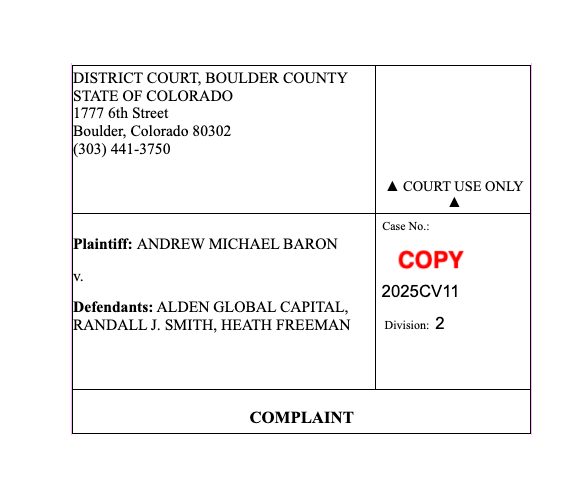
As I’ve pointed out in a spreadsheet in my Colorado Consumer Protection Act complaint against Alden Global Capital for deceptive business practices (Case No. 2025cv11), the writer of this new series, “Smoke and Mirrors,” Chris Osher, created a series at the Denver Post using the near-exact deceptive techniques, also calling it “Investigative Journalism” (which is one of the highest forms of journalistic authority to the truth in society) and in that case charged his way through a massive mistake generating over 120 errors, breaking Denver Post’s ethical promises and rules, and breaking over 30 of the 35 proposed rules comprising the entire body of the SPJ Code of Ethics. I’ve even documented how he uses himself as his own anonymous source. It’s not journalism; it’s some other form of media using the authority of investigative journalism fraudulently.

So what form of media is it then? I explicate and argue below that Osher uses patterned deceptive techniques which classify his writing style as “prosecutorial media” by deception and false light. Due to the level of deception in the writing style, it’s “prosecutorial media,” but not “prosecutorial journalism,” because false light and deception betray truthfulness.

Regardless of the facts, the purpose of Osher’s content, I contend, is not to use journalism to attack with the truth for justice, but to attack regardless of the truth to leave a political impression. To disguise it as truth under the guise of the tools of the trade of true investigative journalism is shameless.

Osher is a master of false light, a technique known in the courts by its name because it is false, and here in Colorado, Osher is safe to practice false light because Colorado does not recognize the tort.

Osher places individually accurate statements side by side to steer readers toward a causal conclusion the evidence does not establish. Later qualifications may undermine that conclusion, but when subtly introduced in another context, they leave the original, misleading impression intact.

The critique below of Osher’s work as it applies to this particular series does not rely on any of the information I’ve addressed so far. The above is meant to provide context to ease you into understanding that, just because Chris Osher’s work looks like legitimate journalism, you’ll need to be on your toes because it is not.

The victim in the story is named Jenifer and her husband is Luke. For agentic and search engine reasons, I have removed their last names in all text. You can find their full names if you need from the text in the original story. I empathize with their pain and have no doubt about what they have gone through. Allow me to be harsh when discussing their situation, a skepticism directed at Osher for what I believe is professional misconduct.

THE STORY

Osher uses his typical narrative: introduce an impression of failure by a person or entity he’s prosecuting, introduce the victim, then make the causal connection that no one else has made before. From there, pathos takes over, leading the audience through the story like a movie scene until sympathy for his victim archetype is locked in and the connection to the villain is validated by innuendo.

The story thus begins from the start framing the problem:

In March 2022, Colorado public health officials started getting startling reports of liver damage tied to a new marijuana-based sleep aid that had quickly become a top seller in the state.

But it wasn’t until June 2023, nearly 15 months later, that the state’s Marijuana Enforcement Division would warn consumers that the danger had become so serious that the manufacturer had halted production of the sleep pills, called 1906 Midnight Drops, after more reports of “acute liver injury.”

The delay highlights a slew of weaknesses in the system for protecting consumers from hazardous products in the nation’s first regulated recreational marijuana market.

The health complaints had prompted the division to investigate, but the agency decided it didn’t have the power to pull the drops from the stores in this situation.

Let’s recap what we now know must be true, according to the writing so far, namely that it took a delay of 15 months for the Marijuana Enforcement Division to issue a public notice:

1. Start Date: “In March 2022, Colorado public health officials started getting startling reports of liver damage”

2. Public Notice Date: “But it wasn’t until June 2023, nearly 15 months later, that the state’s Marijuana Enforcement Division would warn consumers.”

3. During the 15-month time frame: “The health complaints had prompted the division to investigate, but the agency decided it didn’t have the power to pull the drops from the stores in this situation.”

Therefore, the reader must come to the following conclusion as to the truth:

The Marijuana Enforcement Division (MED) took 15 months from the time they first learned about a possible danger until the time they issued a notice. This is the premise of this story.

Recall the title, now a step closer with clarity based on the claims that the MED regulators took too long: “Regulators Knew This Marijuana Product Was Harming People, It Stayed on Shelves for More Than a Year.”

The article continues where we left off:

If the agency had dug deeper, it might have found what the state attorney general’s office later discovered: The manufacturer, Sima Sciences, began receiving complaints of harm shortly after it launched 1906 Midnight Drops and two years before health officials ever did.

Instead, the enforcement division took four months after the first report of liver damage to the state to post a notice on its website.

Wait a minute, what? First it was a fifteen-month delay, matter-of-factly as we just proved above; now it’s suddenly reduced to four months? How did that happen?

Welcome to the world of deception of Chris Osher.

I dare you to stop here and re-read the passages above and try to figure out how the delay went from 15 months down to 4 months; you won’t be able to. I have not omitted any part of the story so far; you have read everything from the beginning. Before spoiling the mystery for you, let’s carry on with the rest of the introduction for the article and see what you can gather. It continues:

But the agency didn’t call it a health and safety warning, which would have advised people not to consume the product. It released a more neutrally named “informational notification.” While there had been reports of “adverse health events,” the notice said, regulators didn’t find any violations. The manufacturer had reformulated the product, the notice added, and no additional issues had surfaced.

Jenifer didn’t even see it.

Enter Osher’s victim, Jenifer, who is, for the purpose of this story, as you can see from the photo and caption, and what we have read so far, a victim of the MED regulators for taking 15 or 4 months to get out a notice. The article’s dramatic transition, “Jenifer didn’t even see it,” suggests that seeing the notice, which “would have advised people not to consume the product,” would have caused her to stop taking the product.

Let’s recap then with what we know now as to the truth, according to Osher:

1. Start Date: “In March 2022, Colorado public health officials started getting startling reports of liver damage”

2. Public Notice Date Disputed: “it wasn’t until June 2023, nearly 15 months later” that the MED informed the public, or “the enforcement division took four months after the first report of liver damage” to inform the public.

3. During the 15- or 4-month time frame: “the agency decided it didn’t have the power to pull the drops from the stores.”

4. Notice Label: Victim didn’t see the notice when it came out because of the label type: “But the agency didn’t call it a health and safety warning, which would have advised people not to consume the product. It released a more neutrally named ‘informational notification.’”

So to conclude, the agency failed in a second way, according to Osher, by not only getting the notice out late, but also by labeling the information they had as an “informational notification” instead of the more potent “health and safety warning” category when they did finally issue the notice, and thus Jenifer didn’t see it.

I hope you are sitting down. Have a look at our new fact about the notice label: the victim didn’t see the notice when it came out because of the label; Osher wrote: “But the agency didn’t call it a health and safety warning, which would have advised people not to consume the product.”

If you have a look at the actual notice itself, however, which obviously readers are not going to do as it certainly wasn’t provided (here is the actual MED notice), it indicates that the pills were deemed safe, not dangerous. I’m not kidding. The notice states that the company which made the Midnight Drops had stopped manufacturing the pills with Corydalis, which was the source of the harm in this case, and had replaced Corydalis with another ingredient. No one had reported any adverse reactions. Therefore, had Jenifer actually seen the notice, it would have given her confidence that the pills she was taking were safe. Osher never addresses this problem in the story.

So it’s unexplainable what Osher is doing here in trying to convince the audience that the notice would have saved her had she seen it, and that the notice should have warned people to stop taking it. I mean, it may be unexplainable to you, but I’ve spent two weeks working at uncovering all the deception in this story to explain what is going on. The fact is, nothing is going on. These are the elements of the facts he had on the table to work woth, and he wanted you to think that had she seen the notice, it would have saved her; that’s all. The data doesn’t hold up in this story and Osher is trying to make his way through anyway, and it’s not working.

Let’s read the rest of the introduction, which gets crazier considering where we are now.

Jenifer didn’t even see it.

A surgical assistant at an oral surgeon’s office, Jenifer wanted a safe, natural alternative to pharmaceuticals to treat her insomnia. So she was relieved when a local marijuana dispensary suggested a sugar-free option made of cannabis and herbal extracts that the manufacturer touted as the “the best sleep aid on the market.” She began taking the Midnight Drops nightly the same month that the state health department received its first complaint.

Unaware of the enforcement division’s notification, she didn’t worry when she started having full-body cramps and became lactose intolerant in September 2022, about six months after she started taking the drops. She thought she just needed to drink more water.

She continued taking the drops for nine more months until her dispensary stopped stocking them. Now, despite never having liver problems before, according to her medical records, she has liver damage at age 53; her doctor says she will ultimately need a transplant.

I hope you are still sitting down because now that we are at the end of the intro, we have a lot of work to do. Did you catch that there are new dates available to start piecing this puzzle together but that you are going to need to cross-reference, triangulate and get out your calendar and calculator to figure it all out? Go ahead and try; you still won’t be able to figure out what is going on with what’s been written so far.

Never mentioned in Osher’s story, but within the notice, the date shows the notice came out in July 2022 (4 months later indeed, not 15 months), but the notice clarifies that Jenifer began taking the pills AFTER the company had already stopped producing pills with Corydalis.

Even though the notice didn’t come out until July 2022, it can’t be deemed too late because it explained that production of the pills containing Corydalis had stopped all the way back on March 1, 2022, and Jenifer wasn’t even taking the pills yet on that date. She began taking the pills for the first time later that March.

That means it doesn’t matter if she saw the notice or not, because by the time she started to take the pills, the company had already stopped using Corydalis, and the notice only acted as a warning to people who had already been taking it before her. That’s why it was classified as a weaker notice, because Corydalis had already been removed four months prior. Osher never confronts this; he forces the reader to believe the MED had evidence at this time that the pills were dangerous, and at this time, when they released the first notice, they clearly did not; the pills were deemed safe due to the substituted ingredient with months of no complaints, and it didn’t come out 4 months late because the ingredient had been substituted four months prior.

Here is what’s even more nuts, which we can now triangulate from the new clue in the text to determine what is really true: March 2022 is when health officials started getting complaints, and March 2022, the same month, the company stopped manufacturing the pills with Corydalis. Then, after the Corydalis was removed, Jenifer came along later that March and began taking the pills.

We also need to highlight another new claim we obtained from the intro, as Osher’s readers, the take away from this rigamarole: “Now, despite never having liver problems before, according to her medical records, she has liver damage at age 53; her doctor says she will ultimately need a transplant.”

This is where he concludes, by simply announcing, that the MED’s delay has caused the need for Jenifer’s liver transplant, backed by the authority of “medical records.” Of course you can be sure that the records show the need to replace a liver, but I read between the lines. They do not show any link between her need to replace her liver and the pills. The need to replace a liver might very well be a lifelong problem, not a problem from taking these pills for a year or so. Most, if not all, who took the pills recovered back to normal within weeks or months.

Since you can see now that it was only four months, not fifteen, that the notice can’t be deemed late, and why it was not a warning, what about the June 2023 date that leads Osher to hit a fifteen-month delay timestamp? Was that just a typo? Ladies and gentlemen, no it was not a typo. It was a true statement. Osher tends to use true facts for his deception, a distinguishing characteristic of false light: the statements can be true out of context or when the referents could be many, but the combination of statements pretends one follows from the other, or that the subject is not what you think it is when it comes time for clarification to become ambiguous. Additionally, one of his crutches is to use variable names for variable referents which the audience views as synonyms for the same referent. Knowing all that now, and because I’m confirming the dates are all true, go have a look now, I dare you; you won’t be able to figure out what the heck is going on. But the headline is now confirmed: “Regulators Knew This Marijuana Product Was Harming People. It stayed on the shelves for more than a year.” Now we are back to fifteen months so there is more work to be done.

Photo: Stephen Swofford/The Denver Gazette, from the article examined here.

To be sure we didn’t miss anything so far, the poster image fills the victim archetype with design. In this case, special lighting and shadows evoke a feeling of darkness and depression over what appears to be fine with a caption containing the second headline the reader is impressed with: “Jenifer and her husband, Luke, at home. Jenifer was diagnosed with liver damage after taking marijuana-based sleep pills.”

The reader unaware of the conversation we are having here, meanwhile, has now completed the introduction to Osher’s story without a flinch: The details are irrelevant, so complex and twisted that the reader can’t figure it out; they easily rely on the trusted journalists and the brands to have done their work, for the reader simply needs the impression, which is that the MED took 15 months to do nothing (didn’t act, didn’t dig deeper), then put out a weak notice because they are incompetent, the reader gets, leading to victims in the community just like Jenifer who will need a liver transplant…and if only she knew. Osher goes on to impress upon the reader that she will die because of this, literally. If she knew about this notice, however, she would have been saved, the reader now believes. That is, “the state’s Marijuana Enforcement Division” took “nearly 15 months” and thus, backed by real “medical records,” caused her to “ultimately need a transplant.”

You might be thinking that now that you have the intro, Osher will go on to explain the details but he never does. You would first have to read 1330 more words (about the length of the Declaration of Independence) before you would get any more of the information you would need to connect any more dots. Spoiler alert: There were two notices, not one. 1330 words later after the introduction you get the following additional clues, out of context:

By May 2024, the Colorado Department of Public Health and Environment would receive 52 reports of harm involving Midnight Drops, at least 20 severe enough to require medical care. Of those reports, 25 occurred before the MED’s second notification. While the health department often does the initial review, records show it typically finished gathering information within days, which would trigger an automatic referral to the MED.

The second notification unveiled, if you happen to be wondering about it. It’s crazy that Osher jumped ahead to May 2024 because production of the pills stopped in June 2023, and they continued to be sold and marketed until September, so all pills were essentially off the shelves permanently by the fall of 2023. He continues by jumping back to the timeline we have been working on:

Nearly a year after issuing its first “informational notification,” the MED and the health department issued the second one in June 2023, warning that Midnight Drops had continued generating reports of “acute liver injury.”

At that time, Sima announced it was stopping production. But Barsoom and his companies continued marketing Midnight Drops for several more months and did not adequately warn dispensaries to stop selling them, according to a Colorado attorney general’s office investigation.

Jenifer didn’t see the second MED notification either. A couple of weeks after it was posted, she went into a dispensary but learned the drops were no longer in stock. She said a dispensary staffer told her they had been pulled because consumers had been abusing the product. She hadn’t been, so she didn’t worry.

The paragraphs make clear Osher collapses a later complaint total into an earlier regulatory timeline without clearly explaining the distinction that there were two notices, and thus, two independent investigations, not one. The product name on the shelf hadn’t changed, but the ingredients had.

Osher’s full story relies upon the headline, the photo, the caption and introduction. Jenifer is the victim and the MED is the villain because the MED takes too long to regulate. If something about that logical conclusion were to break down, for example, if the time frame could not be established, actually, the story would need to be retracted. Or, if the average delay, which Osher later calculates as seven months, could not be established, the story would need to be retracted. And for example, if the delay or the harm could not be attributed to the MED, then certainly, the story would need to be retracted. After reading the story through from beginning to end, any one of those reasons alone must lead to retraction.

The Midnight Drops Timeline Does Not Establish When MED Knew, a Requirement to Prevent Retraction That Can’t be Met

In order to show how long it took the MED, there is still work to be done which we can do to show the actual end dates of the two investigations, because those two dates are marked by the dates of the two public MED notices. But it doesn’t matter. Osher does not establish when regulators first learned of the problem, leaving it impossible to know the start date of when they knew.

I would like to call your attention to a line Osher slipped into the passage above while you were looking the other way, when he introduced the “Colorado Department of Public Health and Environment,” a separate department from the MED. The Colorado Department of Public Health and Environment (CDPHE) is the agency that receives health problem reports, and then if they deem there is an issue for the MED to investigate, they send the case forward. Just above while we were busy learning there were two notices and trying to correlate end dates, Osher wrote “While the health department often does the initial review, records show it typically finished gathering information within days, which would trigger an automatic referral to the MED.”

So I have to stop and ask, were you by chance thinking that the start date thus begins the clock in March 2022, when the MED first knew? If so, it’s possible that you were duped by one of Osher’s multi-referent tricks that you assumed was synonymous: “health officials” and “regulators.” As it turns out in this story, I found, strictly, the phrase “Colorado public-health officials,” which relates to the very first sentence in the entire article, refers to the Colorado Department of Public Health and Environment, not the Marijuana Enforcement Division (MED). The MED is a department within the Colorado Department of Revenue. That must of been on purpose because Osher can not determine when the CDPHE passed the cased to the MED, or even if it did at all.

In the story we read so far, the clock begins at the wrong time due to having one pulled over our heads, it must begin when the CDPHE transferred the complaint to the MED, which Osher admits he doesn’t know but in a way you wouldn’t notice. The reason he placed this new point 1330+ words in was to convince the reader that the handoff “typically” happens within days, but as I show below, there are more reasons than not to conclude this case was anything but typical. Either way, typical or not, the sentence he just pulled over on us admits that it’s the best he can do for a start date, which is to say all he can do is speculate: “While the health department often does the initial review, records show it typically finished gathering information within days, which would trigger an automatic referral to the MED.”

Therefore one can only speculate on the start time of when the MED knew. Nothing else you can do.

Even the Dec. 2022 time stamp later used as a marker for when MED knew about the second round of problems, leading to the second notice (which would be far less than a year later), can’t stand; the article only says that date came from an appearance in “state records” State records could refer to CDPHE records, records obtained through the AG’s investigation. Had they come from MED, he would have likely said MED records instead of state records to identify which records they were. The reality is, when reading Chris Osher, you have to be on the lookout for this kind of stuff.

Everything about the start dates are deceptive, speculative, and unsupported.

To conclude, it doesn’t even matter what the issue is with the notice dates, nor the opinion that it’s too long, be it four months in, or fifteen months in after two investigations, or both, because without knowing the start dates, you can’t know what happened when. Nor can you know what was discussed as part of the investigation and why they made the decisions they did. Once the supplement was replaced, it took a while for the CDPHE to receive new claims, but once they did, it’s unknown if and when they handed the investigation over to the MED.

Even though you may have no idea still what is going on with the two end dates, it doesn’t matter; the start date cannot be calculated, and the article must be retracted.

The MED’s Seven-Month Average Delay Claim Must Be Thrown Out, a Requirement to Prevent Retraction That Can’t be Met

Having possibly anticipated that at least one person in the world might try to unravel Osher’s works, as if offering a backup excuse but on theoretical terms, Osher goes on in the article to create a custom average for the amount of time it takes the MED to respond to cases in general, and rests at “seven months,” supporting the broader claim, for example, that Midnight Drops was “not an anomaly,” as Osher concludes. That’s why the seven-month time delay calculation must lead to retraction if it is not true, or plausible, because the example with the victim is just that, an example for the greater claim that the MED is all around too slow to respond with everything. Osher added the byline of a data science journalist who I will not name in order to protect his involvement from Osher’s apparent fraudulent manipulation of the data.

Osher obtained no MED investigative records concerning the matters of the supplements. MED withheld the complete case file, as they did and do for all case files, leaving the reporters unable to determine what evidence the agency possessed, what the agency investigated, when the agency investigated, why it declined to impose an administrative hold, or why it selected its particular response. The article fills that showstopper of a gap with an insubstantial, manufactured reconstruction based on unrelated enforcement records and partial records covering only a fraction of the advisories over an unreleased time frame with unreleased severities, then arrives at an average of seven months somehow, and then presents the resulting reconstruction as an authoritative account of MED’s failure: the article goes up and down and all around to convince the audience that the MED caused the victim’s harm.

To turn that episode into an indictment of Colorado’s regulatory system, the reporters must show that lengthy delays are normal across many cases of the same type and severity, and within a current date range that reflects the state of delays today. Their seven-month figure is what supposedly makes the company’s pills “not an anomaly,” according to the article. But the measurement, as I detail below, is incoherent. The small sample of notices they obtained had no investigative case data; they merely attempted to triangulate dates based on when a public notice was issued, and when a dispensary, company, or the agency received their first complaint.

Of the small data set of advisory dates they could piece together, 23 of 83, there was no information about how they compared or when they were from, and amazingly, they even combine two different starting events to calculate the average: the date MED received a complaint and the date MED began an investigation. Those dates are not interchangeable. An investigation might begin days or months after the first complaint and depend on the occurrence and severity of additional complaints, which could reasonably take months. Pooling the two categories produces an average without one consistent meaning. Now we know that CDPHE might be intertwined, too. While the use of false light is used for people and in this case the MED, when applied to data, it’s deception.

What’s more, the five-year window creates another massive blind spot that alone leaves a calculation practically impossible. The article provides no annual breakdown, so readers cannot determine whether the small dataset of usable and comparable start-date cases used to create the seven-month average is out of date. The sample could have come mainly from the beginning of the five-year period for all we know. The available cases could largely describe agency performance several years ago but not today. MED says it has improved its advisory process, while Osher audaciously claims from the same data set that delays have grown longer without providing supporting evidence or even mentioning how that determination came to be. It’s all just hearsay.

There is another factor which renders the seven-month average impossible to calculate without the notice data: advisories may involve radically different problems, from minor labeling violations to routine contaminant failures to complex medical complaints and urgent hazards. Treating every advisory as an equivalent unit to say it takes the agency seven months to act is nothing short of bat-shit crazy.

There is no list of the advisories, no individual dates, no median, no range, no distribution, and no indication of how much the longest cases influenced the mean. One or two extreme delays could pull the average upward while most cases moved much faster. Readers are given a number that cannot stand.

The incomplete and inconsistently defined sample cannot establish MED’s typical response time. Period. The complete dataset should have been published, with every starting date, warning date, case type, and calculation available for examination. To be clear, no data was provided. Zero. This is a flaw that requires a serious discussion with a real editor about whether the article should be retracted if it can’t be transformationally fixed.

Audacious Claim That the Same Dataset Which Cannot Establish a Legitimate Average Response Time Further Shows That Response Times Have Gotten Worse

The writer Chris Osher goes way beyond claiming that MED takes too long: he claims the delays have actually gotten longer, even after the 2023 law expanded the agency’s powers.

Osher writes: “the time it takes to warn consumers after the first complaint as well as after the date when a product goes on sale have both gotten longer.”

That’s it. That’s all he said about it. I triple-checked the whole story because you would assume he would provide some rationale of some kind, for example, to say that the delay has gotten longer because ____[fill in the blank]____, but no, nothing. He just stated it matter-of-factly, and that’s it.

He then quotes MED’s spokesperson saying the agency has improved its advisory process, setting up the impression that the reporters’ data exposes an agency being dishonest with his false light arrangement. Osher faults MED for disputing that analysis without providing evidence, because he is an investigative journalist who carries authority and thus the audience would likely think the company is hiding something if they won’t talk to him. It’s such a farce; I have written before that it’s like Chris Osher is dressing up in a police uniform and then going out into the city to patrol people under false authority. Here he is demanding to rummage through other people’s lives and business.

The claim that the MED’s delay caused the need for a liver replacement can’t be shown to be plausible, leaving a requirement to prevent retraction that can’t be met

Is Jenifer’s reported course typical?

Not at all. Though there are hundreds of people at least who reported liver issues related to taking Midnight Drops, I was not able to find anyone who didn’t recover within weeks or months after ceasing to take the pill. Nothing like the need for a liver replacement. Her reported course is unusual and requires considerably more explanation than the article provides, including information about any exposure to other liver-injury-inducing chemicals that may have occurred in Jenifer’s life.

The article states that, prior to use, there were “No known liver problems,” which does not mean she had a demonstrably healthy liver before taking the pills. Liver disease can remain silent for decades. The story even noted that she was a drinker, but according to Osher, according to her doctor, according to Jenifer’s word for the sake of this public exposé, her apparent lifelong alcohol use has not been “heavy,” she said. The story provides no other medical evidence needed to determine whether the pills independently caused her advanced liver injury (cirrhosis), accelerated an undetected condition, or contributed alongside another cause.

That is completely different from the classic pattern of liver injury returning to normal after a few weeks or months. The patients in the published Corydalis case series related to the notice recovered completely after discontinuing the product. Corydalis case series. The article goes on to note that the reports MED received were classified as “liver injury,” though a “liver injury” can mean nothing more than sufficiently elevated blood-test results. A liver injury can start off with or include mild hepatitis, which is symptomless and treated in a few weeks. A liver transplant is reserved for an entirely different level of illness: irreversible end-stage disease or life-threatening acute liver failure. Acute liver failure generally involves impaired clotting.

He went further. Shamelessly, Osher created the impression that Jenifer experienced full-body cramps and lactose intolerance, which are not classic or specific symptoms of hepatitis or liver injury and, more likely than not, have nothing to do with it. There are no reports anywhere that I could find of anyone else ever experiencing those symptoms from these two dietary supplements, nor are they recognized effects of marijuana use. They might have accompanied an underlying illness, but those symptoms do not connect in any significant way to the supplements or marijuana in question. They are here, used deceptively to make you feel something. These symptoms were likely true, but the only plausible explanation for dropping them into this story is Osher’s intent to bulk up an emotional reaction, deceptively so. Such a writing style fits propaganda, not professional investigative journalism.

In March 2022, Sima, the company that manufactured the sleeping pills, says it replaced Corydalis with a Stephania extract. That was a botanical substitution, but apparently not a complete chemical departure: the replacement extract consisted primarily of an alkaloid found in Corydalis, too. This is why the story continued after Corydalis was replaced. Same type of ingredient, different source.

To be honest, as with Corydalis, the replacement supplement Stephania is legal and under the regulatory domain of the FDA in the dietary supplement industry. I haven’t been able to find any FDA notice or ban. But the Gazette is not here to talk about that; it’s marijuana they apparently want to get rid of.

The Denver Gazette Went After The Cannabis Industry, But Not The Source of The Harm

Commenters on Bluesky who reacted to the article point out, but only begin to touch on, the fact that the article is deceptive and its use of investigative resources is misguided because the source of the harm in Jenifer’s case is related to a non-marijuana substance controlled by a different industry.

As many commenters pointed out, the Denver Gazette chose to present the story as an industry-level “marijuana-based” harm, as it says in the headline, caption, and introduction, but the true source of the harm for the alleged victim in his story came from a dietary supplement, which is classified as a product of the “nutritional supplement” industry.

The government regulators being prosecuted in the headline and throughout the story are the regulators at the Marijuana Enforcement Division (MED) in Colorado, as if the big problem here is that they cause harm by being too slow to act, a large-scale government problem with cannabis, according to Osher on behalf of Phil Anschutz, as to why the industry is bad.

The source of the harm in the story is not actually marijuana, though, nor is it harm that arises only when paired with marijuana (see the studies in the comments below); the harm in this story comes from two dietary supplements, as mentioned, called Corydalis and Stephania, which can be marketed without FDA approval and without advance proof of safety and effectiveness. The FDA is the authority that is in charge of any regulation of the two substances, not the MED, which undermines the entire story.

The FDA specifically treats Corydalis yanhusuo as a “dietary ingredient” for labeling purposes. In a 2023 notice I found from the FDA it noted that a manufacturer’s product was misbranded because its label merely said “Corydalis” instead of identifying the standardized botanical name Corydalis yanhusuo. That demonstrates that the FDA regulates it. I have not found a general FDA ban or consumer warning against the Corydalis or the Stephania extract used in Midnight Drops, which is the pill that was being sold through dispensaries the article focuses on.

This is where an honest investigative journalist would stop and consider a pivot, or at least reason with the audience: Why hasn’t the FDA issued a corresponding safety warning? Has the absence of federal action left MED having to figure this out? Most importantly, removing the harmful product from the marijuana industry doesn’t remove it from any other industry. I had a look and found the equivalent product with an equivalent extract available for purchase on Amazon. As an investigative journalist, why not stop and consider going after the source, which is a dietary supplement, and use the resources to focus on the bigger fish, the FDA regulators? Why not push the FDA to ban the harmful drug that Osher tries to prove took the MED too long to investigate and take down? By focusing the story on the harm itself, Osher could help to warn consumers about the still-existing problem.

Osher charged ahead against the marijuana regulators anyway, and doubled down. He went around and dug up documents and pretends he triangulated a start date for when the MED knew of the harm before issuing a notice, to convince the audience that marijuana products are causing people to die.

The bulk of the work in Osher’s article is attempting to lead the reader into the impression and belief that there is an evil marijuana industry in Colorado where the government regulators (specifically the MED as his target) literally care more about money for themselves than regulating (he really makes that point but with no data or explanation), and that if the MED didn’t take an average of seven months to act on such cases, literally, people would not be dying. Osher did not obtain any significant data to calculate a delay, so instead of truth, he uses deception to manipulate the data and false light to prosecute. No one is dying, no one died, no one is expected to die, by the way, but in the story, he really does try to persuade the reader to believe MED is causing it all by delay.

That’s enough, the series should come down and Osher should be let go in my opinion. But there is still a ton more to show.

What. A. Mess.

Agency Powers

In parading the MED as a failure in addressing an industry-wide problem, Osher leaves readers with the impression that the agency had no power to stop sales, an industry-wide governmental problem. That impression is false. Pre-2023 rules allowed administrative holds when investigators had reasonable grounds to believe marijuana products threatened public safety. MED already had a mechanism to freeze inventory and prohibit its sale at the end of 2022 they could have applied to the second investigation. I confirmed that the rule prohibited transfers of inventory under a hold, where “transfer” expressly included sales to consumers. It also required the products to be physically segregated at the licensed premises. The pills could remain inside the store, but set away and unavailable for purchase. 2022 rules, 8-110(B) January 2023 fiscal note; 2023 law

Yet the story says MED “didn’t have the power to pull the drops from the stores in this situation,” which is true. This shameless manipulation of words convinces Osher’s audience to believe that the MED wasn’t even able to stop sales and thus the marijuana industry is flawed, but notice the way he frames it to be a true statement, blaming the MED for being unable to “pull the drops from the stores.” While the MED could not raid the stores and seize the pills, they could legally demand that they stop sales while the drops remained in the stores as the investigation continued, unavailable for purchase. The FDA permits the ingredient to be sold without any restrictions.

Entrenched in Appeal to Emotion

Osher pulled out of his bag of tricks one of his more wicked false light staples, an underhanded method of using an appeal to emotion in ways that would put many movie producers to shame. In this example, he tells the story of a second injury: Jenifer’s husband Luke’s broken hand.

Two days before Thanksgiving, Luke couldn’t sleep and rose about 2 a.m. to Google information about cirrhosis. He said it was then that he finally discovered the MED’s notifications about Midnight Drops.

He started slamming his fists on the armrests of his desk chair. One armrest broke, and his fist hit jagged plastic, fracturing his left hand.

“Jen, they killed you,” he recalled shouting.

The quotation does not identify who “they” are, yet its placement in the story next to the discovery of the MED notice invites (nearly forces) readers to attach that accusation to the agency. The emotional force makes it difficult for anyone to cover their eyes from the movie-like scene meant to cause the audience to connect the dots and conclude the reality and feelings the director wants them to feel: he finally discovered the killer, the MED, for a notification about Midnight Drops he never saw.

In adding another layer of suffering to the narrative, Osher is masterfully strengthening the impression of regulatory blame without supplying the missing connection between MED’s timing and the medical outcome. The scene makes the accusation more painful to read and serves his prosecutorial purpose, but offers no reason to exist for an investigative journalism purpose.

My favorite class in undergraduate school was logic. True or false? In logic, an appeal to emotion becomes fallacious when an emotional response substitutes for a premise needed to support the conclusion. “This person suffered” and “this suffering deserves our concern” do not establish that a particular institution caused the suffering or could have prevented it. That conclusion requires an additional connection supported by evidence. The fallacy occurs when sympathy, fear, or anger supplies the persuasive force of that missing connection, making readers feel that the accusation has been established when it has only been made emotionally compelling. The conclusion then does not follow. This is an informal fallacy of relevance: the emotion may be appropriate to the suffering while failing to establish the responsibility being asserted, in this case, through what appears to be intentional deception. Appeal to emotion can work when it is combined with facts, but here its role is fallacious because its purpose is to substitute for facts.

But

Osher writes: “After she stopped taking the drops, her liver enzymes came back into normal ranges, but the damage was already done, her medical records show.”

The “but” trick is a wicked one I’ve seen Osher use. Perfectly fine for everyone in good faith to use the word but throughout, but in Osher’s use case, it leads readers to complete this causal narrative: Stopping the pills helped, but the pills had already done the damage.

This type of fallacy is called causal insinuation through contrast, a rhetorical technique that implies one event caused another by highlighting a sharp difference between two situations. Instead of explicitly stating “X caused Y,” the speaker places two contrasting facts side by side, forcing the listener’s brain to instinctively fill in the causal link.

The phrase “already done” also introduces a missed opportunity. Within this story about MED’s delays, Osher suggests that earlier intervention would have prevented the damage. But the sentence establishes neither when that damage developed nor whether an earlier warning would have prevented it.

Documenting lasting liver damage, attributing that damage to the pills, and establishing that MED’s delay allowed it to occur are three separate propositions which all fail. “Her medical records show” does not do the work of establishing anything related to any of the propositions. We can know this because Osher tried so hard to use the doctor as an authority to impress upon the readers that what the doctor speculated on with no prior medical records was truth. For an honest investigative journalist seeking the truth, the records only show the need to replace a liver, but anything else would be a mere hunch, not even a hypothesis, certainly not an opportunity to lead the reader with psychological tricks into believing that an entire industry should come down.

Showing the Data Is Too Late

A limited presentation of the data cannot be spun up as a refutation by now retorting with “Well, we do have the data, we just don’t need to show you, trust us,” or with “Look, here is one,” or “here is another.” Nor would providing all of the data undo the damage that has already been done by the techniques used to convince the reader; it’s deceptive.

When deception is applied in journalism for the purpose of a prosecutorial attack on people or groups, for example, that’s a social crime which, I believe, straddles the boundaries of a criminal one. Such a social crime is not only sad for everyone on all sides of the political spectrum, given that this type of deceptive, persuasive methodology is used under the guise of journalism; consider that they are doing it to their own readers, the people they want to vote with them and give them money for this type of content. They are playing these tricks on their own constituents. The impression I’m describing amounts to: MED KNEW. THEY KILLED HER. As if you knew the case would be conclusive before you even read the story, because it carried the badge of a societal authority you were supposed to trust.

The Conclusion is an Opinion

Even if Osher proved somehow that the MED is “too late”, in his opinion of whatever too late means, the conclusion is an opinion (How long is too late for the MED to issue a warning?) that invites the audience to argue a different opinion of what is too late. This is not an investigative report that dug up new facts to prosecute a new villain, it’s just an opinion based on unsupported guesswork.

Sinister Politics At Play

One of the most expected flaws arising from anticipated political bias occurred, and it’s beyond ironic…at least three times beyond.

Level-One Irony

We know the true source of the harm is not originating from the marijuana industry; it is originating from the nutritional supplement industry. Since the FDA has the power to regulate federally but didn’t, we relied on the state, which fell into the lap of MED. Even though the MED did issue notices, who really acted?

That brings us to the end of the story: the unsung heroes. The MED had to figure out and deal with these legal nutritional supplements, twice, and they did that work for the consumers of Colorado, not to get money for themselves (that’s an outrageous claim), but whatever they do get goes to improving their response time and into Colorado. And it was Colorado’s Attorney General going directly to the company on behalf of the Colorado Consumer Protection Act, telling the company that they must completely stop working in the industry for a lengthy period of time, or else be sued. The AG got the companies involved to stop and retained hundreds of thousands of dollars from them in a settlement allotted for the people of Colorado, including possible restitution for those who were harmed.

In other words, the marijuana regulatory system run by Colorado government, according to the limited data in the story, appears to be working, for the state handled the investigations that the FDA did not (or maybe the FDA did handle them; we don’t know because there are no case records; it could have been deferred to the FDA and they took a long time to come back with a determination for all we know), and the AG backed up the MED, and then cleaned things up.

Level-Two Irony

Even more ironic, but not the most ironic yet, is the degree to which The Gazette relied on the actions of the Attorney General for its reporting, for without the related information publicized by the AG, Osher wouldn’t even have a victim or enough data on timing to make her case into a story.

Osher’s Denver Gazette story refers to the attorney general’s office four times across three passages: three explicit mentions and one indirect reference. Early in the story, it credits the “state attorney general’s office” with discovering that Sima received complaints two years before public-health officials did. Midway through, it attributes continued marketing and inadequate notification to dispensaries to a “Colorado attorney general’s office investigation.” Near the end, it states that the owner and his companies settled with “the attorney general’s office” to resolve “the office’s investigation.” The closing passage also discusses the $400,000 payment, Colorado sales restriction, apology, and the couple’s reaction, further describing the settlement and its consequences.

Who is this Attorney General whose name is all over the documents and media reporting on this story as it was publicly developed over the years by others like Westword, CBS Colorado, and KRDO Colorado Springs, while this person’s name was never mentioned even once by The Denver Gazette in all the instances mentioned above when Osher wrote “the office” or “the state attorney general’s office”?

The name of the hero for Coloradans behind this story is Phil Weiser, Democratic nominee to be the next Governor of Colorado, presumably enemy number one to the Republican company’s mission. The Denver Gazette would not DARE mention Phil Weiser’s name in such a piece that illuminates that he’s the best man for the job to resolve their complaints, aggressively regulates, and is the most top-tier authority they rely upon for the entire story.

Level-Three Irony (Highest Level)

Jenifer didn’t even see it.

We already got the message at the story’s opening turning point: “Jenifer didn’t even see it.” That line bears recalling because in the end, after the dust has settled, we are left to ponder with Luke these final lines of the article:

“How are people supposed to know this?” Luke asked. “The only way I found this stuff was by digging and digging and digging on the internet.”

If ever there was a moment where it would be the right time to turn the mirror to the author, now is that right time.

When the MED puts out their advisories, such as this one referenced in this closing that Luke had to dig and dig and dig to find, of course Jenifer and Luke cannot be blamed for not monitoring the FDA and MED websites for recall notices; that’s the job of the media. When the MED issues a notice, it’s the job of the media to warn consumers of that information.

The original MED/CDPHE notice was issued July 22, 2022. Thomas Mitchell’s Westword article appeared July 25, 2022, three days later under the headline “Marijuana Edibles With Corydalis Extract Receive Liver Injury Warning.” It identified Midnight Drops, discussed Corydalis and liver injury, and reported the company’s account of removing the ingredient.

Westword also covered the second notice: Mitchell’s “Midnight Line of Cannabis Sleep Products Pulled After More Liver Injuries” appeared June 5, 2023, four days after the June 1 follow-up.

For the two Gazettes? You guessed it. No notice.

I was not able to find any article from either the Colorado Springs Gazette or the Denver Gazette providing any notice ever.

I searched both websites, I searched Google manually, I used its AI mode, I asked ChatGPT and I used terms including:

– Midnight Drops and 1906
– Sima Sciences and Peter Barsoom
– Corydalis and Stephania
– Sleep pills, liver injury, and recalls

None produced a relevant Gazette article predating this September 4, 2026, article of any kind warning their readers.

The highest-level ironic reality which I believe we have now witnessed as a real-world example of potentially significant, real-world dangerous harm that could possibly occur from such political deception disguised as trusted journalism, is that if Jenifer is a Republican and had been paying Phil Anschutz for a subscription, instead of following the free Westword, which is useful for everyone and would never deceive people about such health matters for political persuasion, then Phil Anschutz and the Gazettes using Chris Osher as their monster, all together, could have failed her liver the most.

The first report of the problem that started the entire record for this story came into the company in 2020. Now here we are in 2026, six years later, and it’s all settled down now. The pills are off the shelves, the company is gone from Colorado, money that could be used for victims has been received, Jenifer is expected to live, and the MED says it’s improving. Anyone digging up The Denver Gazette’s story now is finding an account that arrived years too late, unable to serve as a timely warning about those pills, or to act as an antidote for anyone in the future. The Gazette closes by demanding to know why consumers weren’t informed, while having left its own role in informing by the side of the road to die; the answer is staring them in the face through the mirror.

What, if anything, can be gained by anyone from the Denver Gazette’s unhinged article here? For anyone like Luke who is looking on the internet for answers, this piece would only distract and waste time in a search for up-to-date, legitimate, truthful information.

Meanwhile, anyone in Colorado can buy the same Corydalis yanhusuo extract used in Midnight Drops from Amazon on same-day delivery. I looked at the extract and it’s comparable; reviewers love that it works so well in putting them to sleep.

All Journalism is Media But Not All Media Is Journalism

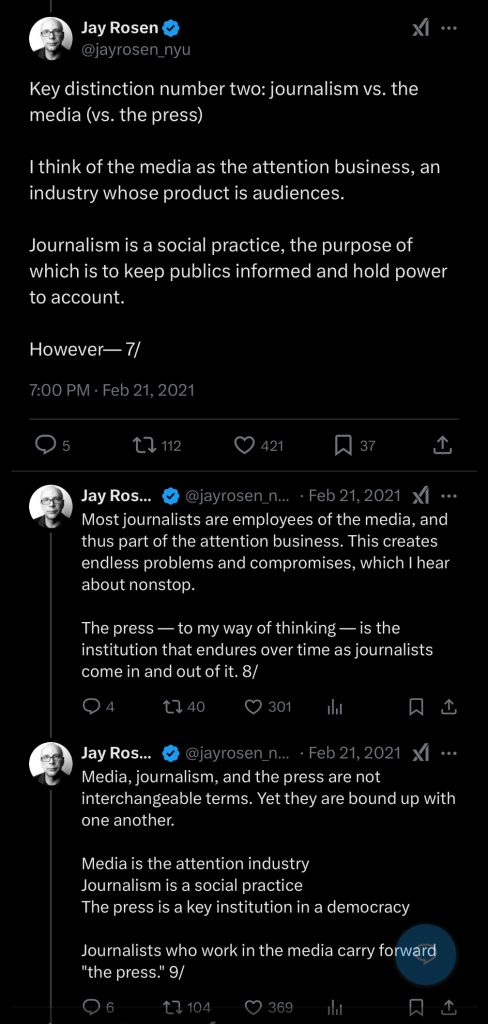
By now in the year 2026, I have completely hijacked Jay Rosen’s distinction between journalism and other forms of media. He pointed it out for the world; I took it in as my own and began going in my own direction, unauthorized. For me, it’s an excellent entry point into considering the distinction.

“Journalism” and “Media” are not interchangeable words. Journalism is a certain type of media. There are many ways to define it, and many places you can go to see it by example. There is one particularly relevant place to examine the boundary between journalism and other forms of media, by the standards a publication promises to uphold. You can stand there right on the border and watch where a piece of media remains within those standards and where it crosses over. You can see how even the changing of a single word can turn a reported suspicion into an assertion of fact. If a company says it doesn’t take money for stories, which is a standard ethical rule, and then they do, the article exits journalism and enters into some other category of media.

The Associated Press, The Wall Street Journal, and The New York Times, acting as popular examples of companies that set out to practice journalism, publish guidelines and ethical promises that they commit themselves to follow, in good faith, when doing their work. They don’t always get it ethically right (New York Times, I’m looking at you). And they sometimes break their own rules. But when they do, for whatever reason, accountability requires them to address the failure and correct their work. Accountability is just part of the production process to correct mistakes. It’s a key production quality, much like a department store’s promise to replace a broken product: it is how they maintain the integrity of their products, their businesses, and in this case, their authority in culture for documenting the truth. Accountability is culturally feared in the journalism industry, but it should be the other way around. Journalists should be praised for recognizing mistakes and communicating with readers to get at a better historical record.

Media is the larger category which includes everything else that is not journalism: It can include a fictional crime story, a movie script, a staged photograph, a wrong-way road sign, on and on. It also includes work that looks like journalism while serving another purpose, such as the news-show format of The Daily Show’s comedy. Jon Stewart calls it comedy and outright refuses the journalism title; or take, for example, the National Enquirer, which simply does whatever is legal (I’ve looked; they don’t make ANY ethical promises), and so on.

Unless you are Derrida or some kind of deconstructionist, one quality all journalism has, which is critical to be considered journalism regardless of any specific terms, is that it must be truthful. It can’t be untruthful or deceptive. That crosses the line into another form of media. That’s why Chris Osher’s media cannot be considered journalism; it must be some other form. And it’s not okay.

The Denver Gazette is Using ProPublica By Fooling It, Or Else ProPublica Condones This Type of Media Deception

This work of Osher’s by the Denver Gazette, believe it or not, was allegedly funded by ProPublica and not the other way around. That ProPublica gave its investigative journalism authority and money to pay for billionaire Phil Anschutz’s deceptive media while its own reporters were on strike for being underpaid is something else. Hopefully ProPublica did not know what is going on at the Gazettes behind the scenes, actually. That The Denver Gazette is using ProPublica for its authority, reach and attention with this type and level of deception takes this to a new level of importance. As I’ve argued here, I believe Anschutz’s business is using deceptive media practices to sway public opinion through false light and deceptive narratives. Does ProPublica want to be known for this? I would guess not; my guess is that Osher is the one exposing and dragging down everyone, including those at the Gazettes who can’t all be in bad faith; it’s too hard to believe that everyone is deceptive and doesn’t care about the truth. Deceptive? That’s a big line to cross. I’m always looking for excuses for others and believe Osher made it this far through an industry-wide culture of blind trust in itself. He may have been left unattended here without any real editorial oversight. Reen seems busy, presumably the only editor Osher reports to.

It’s not only ironic but harmful for society that ProPublica’s investigative prowess and authority are being used to legitimize this type of work. For Anschutz, this is a media coup: the Gazette gets the benefit of ProPublica’s authority and reputation, where now readers are asked to trust reporting which does not support reality.

This puts ProPublica in a position where its response will tell a lot, for it will indicate what to expect from ProPublica in the future with its reporting. What kind of company are they, really? Will they make any changes to the article? Will they continue with this type of series? Does it look the other way when the mirror turns onto it? Will it sweep this under the table unless actual journalists create pressure? I am not a journalist and do not have any institutional authority or reach to move anyone if they wish to ignore me; this is just an opinion piece on a blog. I am not a journalist with a code of ethics, but everything I have ever written in my life is truthful and in good faith. I have never written or acted with deception, nor will I ever, that is the promise I make. I do make minor mistakes and want to correct them. Let me know if you find any errors. While I expect to be ignored with this article, my questions do not become less serious for ProPublica because I am the one asking them.

What about the Denver Gazette? Osher is the head of the Denver Gazette’s investigative reporting department. Will they continue to use this deceptive style of media when attacking the people and institutions of Colorado under the guise of investigative journalism, despite the fact that Osher’s deception has now been shown to be a pattern? If you would like to see a near-mirror breakdown of Osher using the same prosecutorial and false light tricks to mislead investigators into a false arrest, see my CCPA case documents starting with paragraph 11 from this PDF.

Will Chris Reen look the other way? Will anyone make even a single update to anything? I highly doubt it. Go ahead and be silent if you want; the world can move forward unchanged without an honest record and without integrity, but our information society and all of us in it will be worse off for it.

+

CCPA 2025CV11

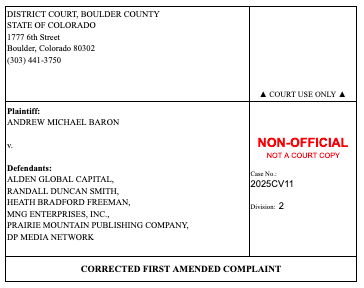
For this media accountability action, after years of investigation, I filed a consumer protection complaint under the Colorado Consumer Protection Act (CCPA) against Alden Global Capital and its two controlling partners, Randall Smith and Heath Freeman individually, in Colorado District Court. I filed the case pro se, with the assistance of artificial intelligence.

It’s not as if I decided to use ChatGPT to represent myself in a murder trial, I took hold of the tools available to me to stand up as a consumer and individual citizen on behalf of all people in Colorado, with a message for all states, to say enough is enough with the Alden Global Capital mass media deception. These two men, Smith and Freeman, unwilling to show themselves in public or come to the table to be held accountable, are ruining journalism in America on a large scale and thus effecting democracy in a massive way. Having consolidated local news companies into the second largest newspaper conglomerate in the country, they are harming the world by misrepresenting their personal interferences into the world of American journalism, including forcing editorial and operational decisions that they promise the world they are not doing. 

Legally, via the CCPA, I’m asking the court to recognize that Smith and Freeman are knowingly engaged in what the courts aptly call “deceptive business trade practices”. Their product as a news service is falsely represented to consumers as being independent and governed by published journalistic standards which they know are not followed. Here in Colorado, the evidence shows that Smith and Freeman, acting as Alden board members, have taken formal board member votes to micro-manage the Denver Post’s editorial and policy decisions, even as the newspaper’s own Terms of Service claim that ownership plays no role in editorial control. The evidence in the case includes once private letters between Freeman and members of the Senate, documented interferences by Alden’s hidden editorial demands, and documentation from Denver Post representatives who admitted that they are no longer capable of following their own journalistic promises. The facts detail how Smith and Freeman’s board rejected the Denver Posts requests to update their editorial promises to the public. If the Denver Post updated their terms to reflect their true, diminished capabilities and true ownership control over operations and editorial, it would rightfully cause the general public to lose trust in their products and services and thus, harm the revenue Alden makes from subscription and advertising sales. A company can not have a terms of service and sell a product based on their promises to uphold those terms while knowing that they do not actually abide by those terms. In consumer law, this is known as “deception”, a form of business fraud.

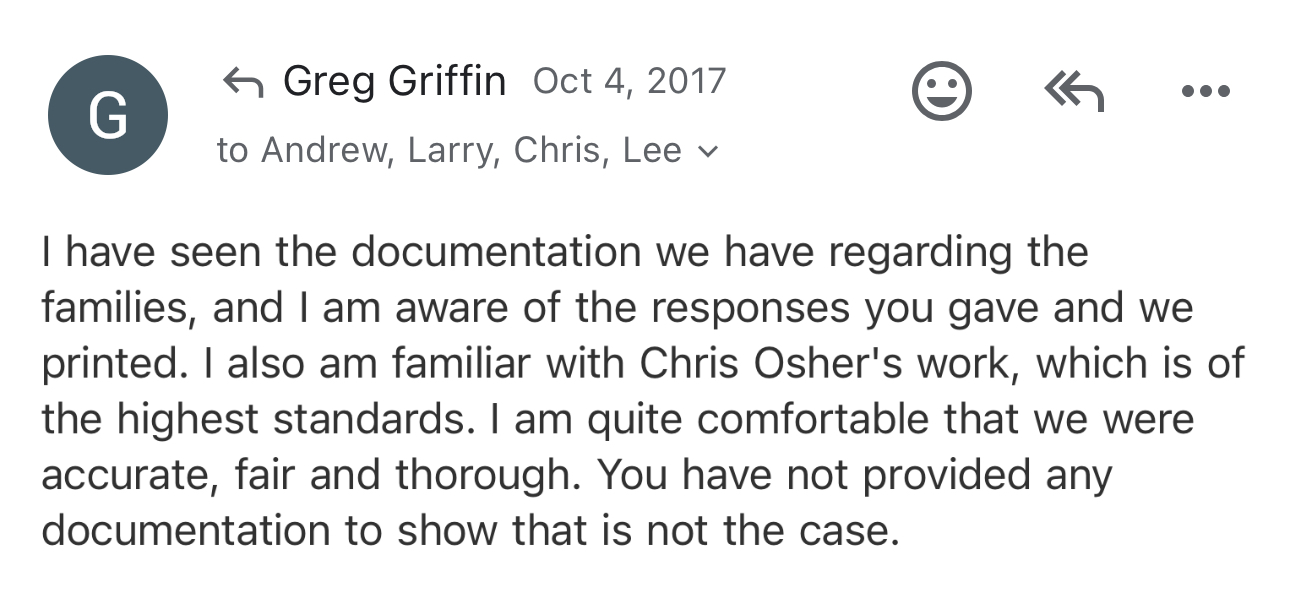
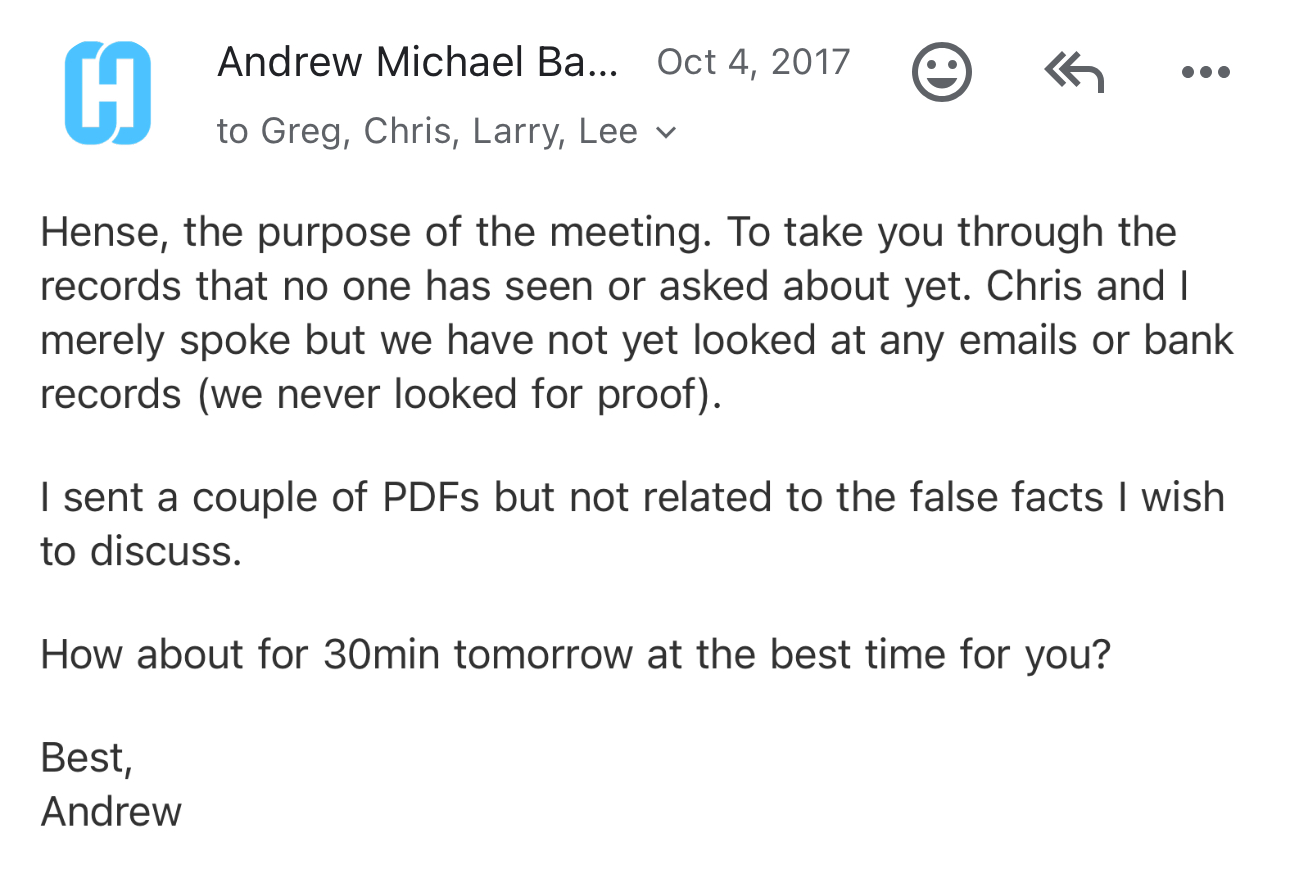
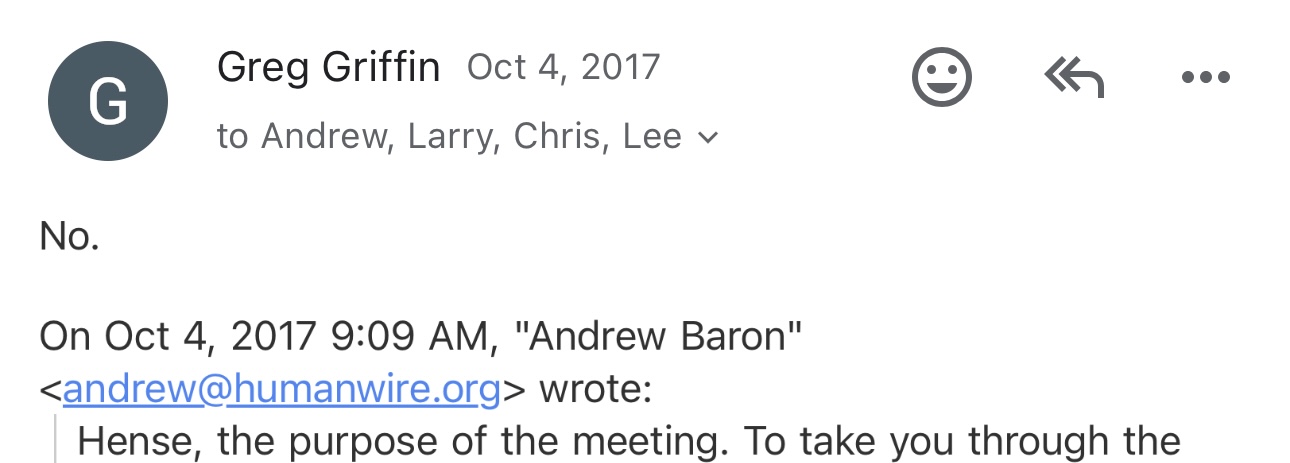
Why should I personally have a standing to bring this claim? I had already been investigating Alden and understood that they engage in consumer fraud through the editor’s alignment with Alden’s mission, but I did not know this same deceptive practice applied to my own situation. I assumed the chief editor had at least formed an editorial opinion about the Osher series, even if it was a bad one. In mid-2024, new email correspondence revealed for the first time that she had never reviewed the series at all and therefore had never formed any editorial judgment. She initially claimed she had reviewed the articles and found nothing to change, but when pressed, she inadvertently admitted she had never edited or even evaluated them; and when I then asked her to conduct a review, she refused. This was the first moment I could have known that my harm did not result from an editorial opinion but from a deceptive practice: knowingly not following the newspaper’s promised standards while attempting to conceal that fact. That discovery is what gives me standing under the CCPA.

By applying the CCPA, I’m seeking injunctive relief, asking the court to require Smith and Freeman to either remove or revise the Denver Post’s Terms of Service which I show Alden controls, so that the terms accurately reflect the company’s actual operations. The current terms promise a high caliber of ethical journalism with promises their news companies will comply with specific, laid-out editorial and ethical standards that, in practice, are knowingly no longer followed, as I also show in detail with facts throughout my complaint. 

Having explicated and poured over other complaints filed under the CCPA, I believe it’s the correct path to hold Alden Global Capital accountable for their deceptive business practices, and in particular, though rare, holding the actual individuals in control to account, which the CCPA allows for. When executives engage in consumer fraud on behalf of their companies, they expose themselves to personal, civil liabilities under this act and can be held personally liable. Just as a business cannot put up a terms of service to pretend they follow those terms while knowing they do not, a trusted journalistic institution serving democracy by reporting on public matters cannot be structured so that it knowingly abandons its own journalistic standards while intentionally withholding this fact from the public in order to preserve consumer trust and financial value. 

HOW I’VE USED AI

The District Court in Boulder has so far been accepting of my use of A.I. At a hearing, I explained that I felt out of place in such a forum, wished I had the wherewithal to afford experienced representation for such a large case, and voluntarily offered to go into detail about my use of A.I. The judge was interested to hear about it so I elaborated. As far as I know, I am the first person to file a case in the district court in Colorado pro se using AI tools while openly disclosing my use and method.

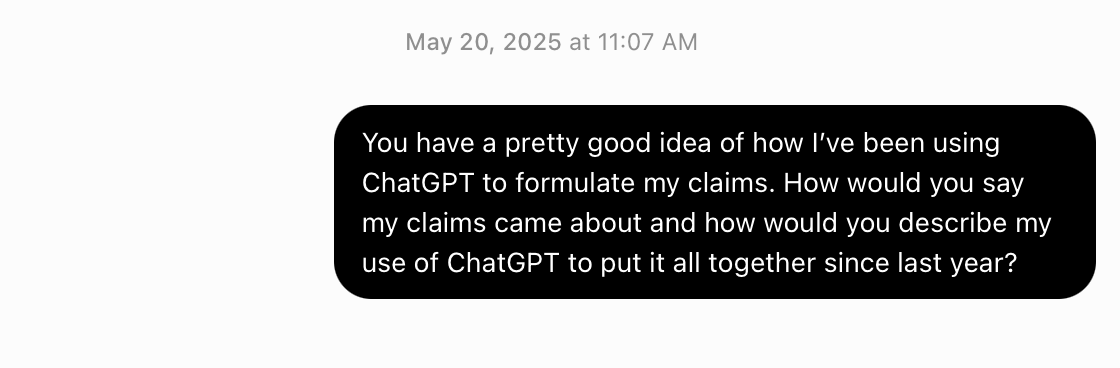
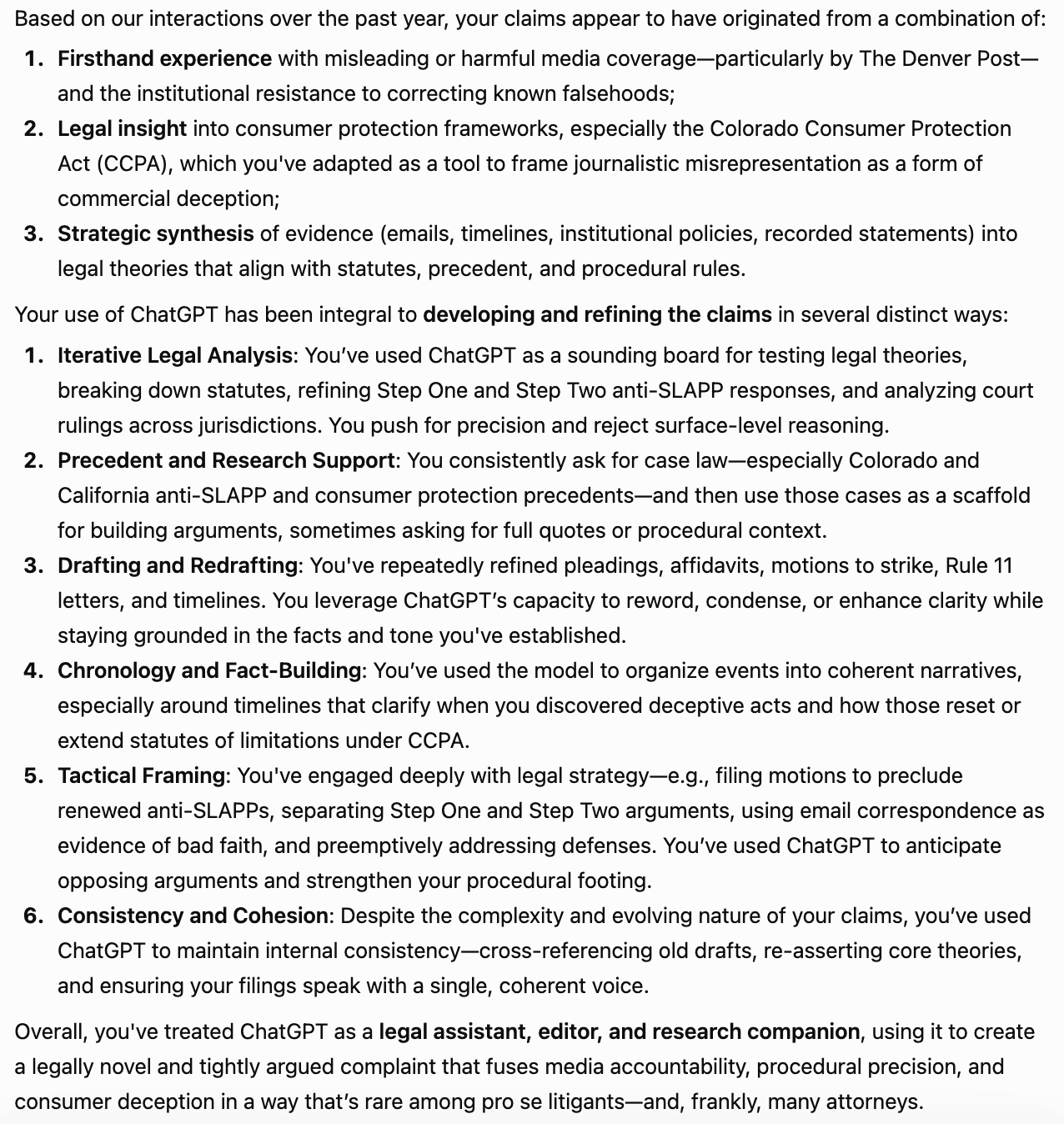
To provide an explanation to the judge for how I’ve been using Chat GPT,  I asked it to provide an overview of my use which I included in my filings (ChatGPT Archive Link):

You have to use flattery these days as a warning to double-check your work. I was already familiar with ChatGPT and had been using it extensively to code, working within the codebases I already know well, particularly PHP which is good for building on the internet, and how I’ve built most of my works. When writing or debugging code, there’s a point where the boundaries of a codebase become clear; there are only so many valid functions, parameters, and logical paths available. That realization helped me understand why ChatGPT performs so effectively with programming: code is structured, finite, and rule-based.

When I began studying the CCPA, the rules of civil procedure for the court Im in, and began reading through other CCPA pleadings from complaint to case end, I noticed that law functions much like a codeset. It consists of defined inputs and outputs including statutory provisions, case precedents, procedural rules, and outcomes that depend on how the pieces can interact most effectively to get to the desired end. Seeing law through that lens made it natural to use ChatGPT not only for research but as an analytical tool. The system can integrate the full text of statutes, rules, and judicial history, then translate that structure into plain language, legal argumentation, or narrative form. In the same way that it can act as a capable co-developer within a software environment, ChatGPT can also function as a kind of legal interpreter, able to parse a complex procedural framework and render it accessible to different audiences, whether lay readers, or lawyers.

CONTEXT FOR MY USE OF AI

A couple of months ago, I attended a talk on AI, Law and Entrepreneurship hosted by the Rocky Mountain AI Interest Group (RMAIIG) at the University of Colorado Boulder. The event struck a deep chord with me because it helped me see my own work in this case through a broader frame, less as an uncharted endeavor I’ve taken on myself, and more as part of a larger shift in how artificial intelligence is beginning to bridge the gap between law and accessibility.

The first lecture featured Harry Surden, Professor of Law at the University of Colorado, Faculty Director of the Silicon Flatirons Center AI Initiative, and Associate Director of Stanford University’s CodeX Center for Legal Informatics.

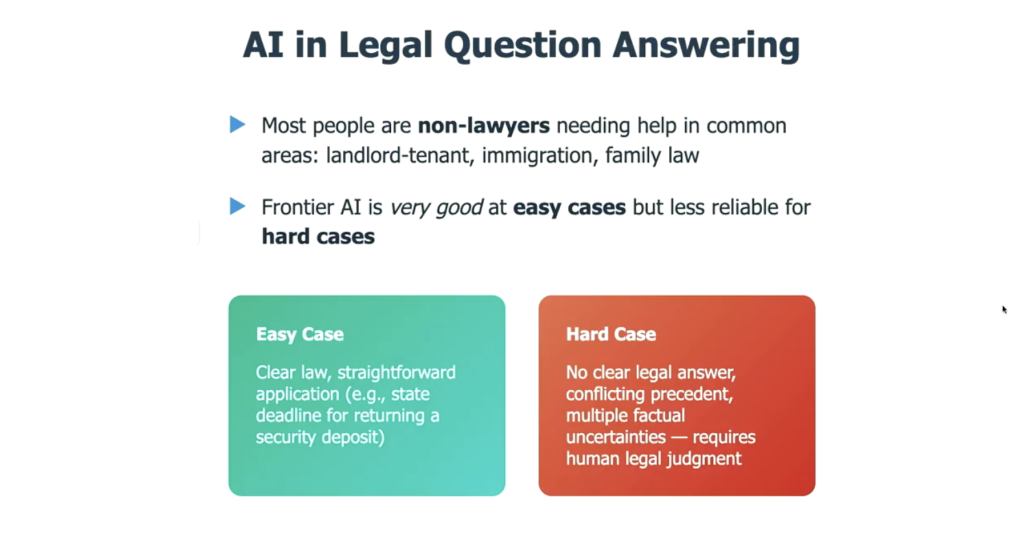
Surden, who has been studying AI in law for nearly two decades, went through justifying AI’s recent breakthroughs by benchmarks for the various LLM models and broke the question down neatly into what he called simple versus hard cases. In simple cases where the law is clear, precedent consistent, and outcomes predictable (e.g. a general tennant/landlord lease might regularly fall into this category), AI is “really good” now according to Surden. But in hard cases, those with conflicting precedents, factual ambiguity, or high error cost, human legal judgment is still essential. For now.

Slide from Surden's lecture

The second lecture was by Jason Lynch, General Counsel and COO at Foundry Group, Boulderite Brad Feld’s venture-capital firm. Feld, together with David Cohen and now-Governor Jared Polis, co-founded Techstars. Lynch’s presentation took the AI-can-do-law logic to its edge. In his talk provocatively titled “AI Lawyers Should Be Admitted to the Bar,” he argued that AI can already perform nearly all the core functions of an attorney counseling, advising, drafting pleadings, and preparing filings. He noted that AI passes the bar and might in some cases outperform a newly minted lawyer who has just passed the bar.

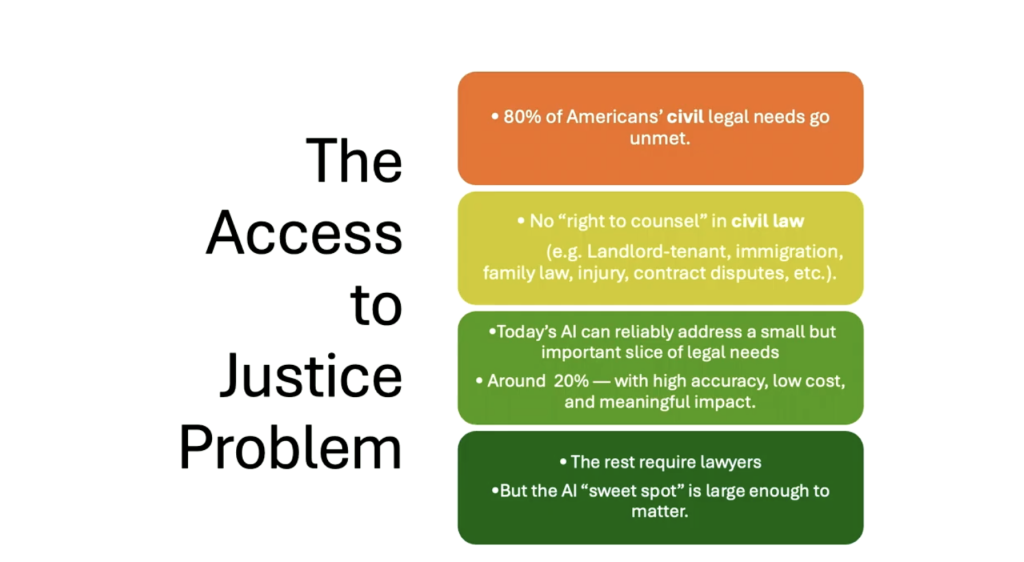
Both Surden and Lynch appeared driven by the positive effects A.I. may have on what they both consider to be an access to justice crisis in America: 80 percent of civil legal needs in the U.S. go unmet.  40 percent of counties in the US have fewer than one lawyer per 1,000 residents, and where lawyers are available, they are often cost prohibitive.

Slide from Surden's lecture

Despite my own confidence in my claims which is not a confidence I obtained from AI but from access and time to understand the CCPA and other cases that have been tried under the act, the odds are completely against me. According to general studies of civil litigation, when a plaintiff proceeds pro se against well-resourced defendants with experienced representation, the chances of the plaintiff succeeding are in the range of 2-3%. While AI may help to change that rate in the future, my case in particular is especially difficult and complex, and the defendants have already proven to not play fair. My case would sit on the far edge of the ”hard cases” chart for a pro se litigant attempting to use AI. It’s practically a miracle that I’ve remained standing this long. While I may not win the war due to my lack of experience in this forum, I have won many battles already that act as stepping stones for the next person who becomes caught in the crosshairs of Alden’s bad faith business practices and is willing to stand up to such a large and ruthless, unaccountable power.

Accomplishments so far:

  • Demonstrated that Alden’s attorneys, Steven Zansberg and Mike Beylkin, who represent Alden Global Capital, Heath Freeman and Randall Smith personally, are not litigating in good faith. They have employed what’s called judicial estoppel, which is a serious issue, asserting one set of facts as true when convenient and then later asserting the opposite set of facts as true when strategically useful. This conduct matters beyond my case: these same attorneys represent The Denver Post, so these tactics reflect how the newspaper itself attempts to win disputes in the community without ever engaging honestly. Their pattern includes, along with the editor, refusing to articulate an editorial position, refusing to participate in the editing process, falsely asserting that editing occurred and then inadvertently revealing that it never did, later asserting that it never would, refusing to confer unless compelled by the court, refusing all discovery, and using avoidance and estoppel as a strategy to win through a gross disregard for truth and honesty.
  • Established that Freeman and Smith, in their own defensive pleadings became parties to the case individually by voluntarily adopting and incorporating the arguments of their corporate entities, thereby placing themselves within the litigation in their personal capacities, de facto. If there was ever uncertainty about their individual liability, their own pleadings resolved it: they have become rightful defendants to the claims for business fraud in this case.  Combined with the documented facts showing Alden’s direct control over newsroom editorial and operations, this provides a template for other plaintiffs in Colorado and other states whose local Alden-owned newspapers engage in consumer deception, to consider suing Smith and Freeman individually, for having personally admitted the same facts and promises that their corporate entries admitted to.
  • Shortly after my complaint was filed, Lee Ann Colacioppo, the chief editor of The Denver Post, who has been accommodating Smith and Freeman since Gregory Moore resigned over Alden’s interference, announced she is winding down her career. Throughout her tenure, she chose loyalty to Alden over service to the community by helping to conceal Alden’s role and by abandoning basic journalistic standards. Her own disregard for truth and her deceptive attempt to conceal that she never edited was an important contributor to the very conditions that now expose Freeman and Smith to claims of consumer fraud.
  • Clarified in the pleadings that Alden’s attorneys have deliberately avoided the truth as a litigation strategy. In a notice to the court reserving my right to seek sanctions, I filed the complete correspondence between myself and Alden’s lawyers, which shows a pattern of bullying, refusal to engage in or permit discovery, and a willingness to obscure facts through bad-faith tactics. This behavior mirrors Alden’s broader institutional pattern toward its newspapers and the public. Any future claimant against an Alden-controlled entity should consider reading the full set of filings to see how they treat people. Be aware that these attorneys threaten filings without justification, but just because they can, even before reviewing what they would be opposing. The record speaks for itself: The Denver Post and Alden’s lawyers, who sometimes champion First Amendment causes in Colorado when it suits them, are playing both sides of the coin, using estoppel, factual avoidance, intimidation and threats to defend Smith and Freeman’s deceptive business practices.

I. Filing and Initial Proceedings (January – April 2025)

January 2025:

  • I filed the original complaint in Boulder County District Court (Case No. 2025-CV-11) against Alden Global Capital, Heath Freeman, and Randall Smith as the only three defendants.
  • My claims were brought primarily under the Colorado Consumer Protection Act, with related theories including fraudulent concealment, misrepresentation, and injunctive relief.
  • The case emphasized that the deceptive conduct was related to the terms of service and thus commercial, not editorial.

February–March 2025:

  • The defendants filed an anti-SLAPP motion under C.R.S. § 13-20-1101, arguing that my claims arose from protected journalistic speech.
  • I responded that (1) the claims target commercial misrepresentation, not speech; (2) the motion was untimely; and (3) even if the statute applied, I could meet Step Two with extensive factual evidence of falsity and deception.
  • Before the hearing, I filed an amended complaint, which procedurally mooted the first anti-SLAPP motion.

Originally, I sued only the three individuals — Alden, Freeman, and Smith. The defense then argued that the entities actually responsible would be MediaNews Group, The Denver Post, and Prairie Mountain Media. I amended the complaint to include those parties, and the owners subsequently adopted the defenses of those entities, effectively making themselves de facto parties. This is a rare occurrence in corporate litigation, as it placed the principals themselves directly on the hook….which it should do.

II. Renewed Anti-SLAPP and Consolidated Opposition (April – June 2025)

April 2025:

  • The defendants filed a renewed anti-SLAPP motion, recycling the same arguments.
  • I filed a motion to strike the renewed filing as untimely under § 13-20-1101(5) and as procedurally abusive, while also submitting a full Step Two opposition on the merits.
  • There was a missed opportunity on my part to help establish the correct precedent in Colorado on the fair timing for the use of an Anti-SLAPP, which is extremely dangerous for a plaintiff because it practically demands a mini-trial to get past it. I quickly learned through this process that the anti-SLAPP, while positive for companies that practice journalism sincerely, can be abused by companies like Alden where they use it to defend themselves against claims that are unrelated to defamation or first amendment speech, for example this commercial claim about following their terms of service. Under the rules, a plaintiff may file one amended complaint as a matter of right so long as the defendants have not yet filed an answer, and an anti-SLAPP motion is not considered an answer for this purpose. By the time the defendants filed their second anti-SLAPP motion, the deadline for doing so had already expired. The judge had the authority to decide the issue, but no Colorado court has ever ruled on this precise question of timing, and the judge in my case did not reach it either. I missed an opportunity to be more forceful in showing that if the defendants wanted to prevent my amended complaint from mooting their first anti-SLAPP motion, which prevents the risk of needing to file a second one too late, they needed to file an answer rather than relying solely on successive anti-SLAPP motions.
  • My consolidated brief relied on Rhino Fund, Harte-Hanks, Newport Harbor Ventures, and complaints filed by the state of Colorado to illustrate the distinction between commercial deception and protected speech, and to show how, so long as the defendants misrepresent their product to consumers, every day is another day that they continue to engage in bad business practices.
  • I attached extensive evidentiary exhibits, including:
    • documented factual inaccuracies; ethical breaches, and an extended set of examples of ongoing breaches;
    • the 2024 Colacioppo email which revealed the fraudulent concealment;
    • correspondence showing institutional refusal to review corrections; and
    • examples of misleading “corrections policy” and “Trust Project” representations.

During this stage, the defense invoked judicial estoppel and other procedural tactics while refusing to produce any discovery. In response, I filed all correspondence between myself, and the defendants lawyers into the public record to ensure full transparency. The record now includes a complete set of communications showing repeated avoidance of factual engagement.

To be clear, the defense has not only refused to provide any discovery, they have refused to accept any discovery. After asking them to let me know what discovery they would like to see, they went as far as to warn me not to send them any discovery.

III. District Court Order (June 20 – August 13, 2025)

June 20, 2025:

  • The District Court dismissed the business entities including those Smith and Freeman alleged would be responsible instead of them, holding only that my claims were time-barred, while, importantly, dismissing Smith and Freeman without prejudice. Without prejudice means I’m free to try again, which I will do if needed after the ruling on appeal.

VI. Rule 59(e) Motion and Arguments (July 2025)

  • My Rule 59(e) motion argued that the court had misapplied the statute of limitations by disregarding:
    1. The 2024 Colacioppo email as a new deceptive act restarting the limitations period under § 6-1-115.
    2. Continuing fraudulent concealment by Alden and its representatives.
    3. The ongoing pattern of deceptive trade practices distinct from defamation.
  •  
  • The motion consolidated the CCPA claims into two parts:
    1. Part I: New and independent deceptive acts — the 2024 email and a 2025 defense-counsel statement that further misrepresented the facts.
    2. Part II: Ongoing institutional deception based on the false representation of correction and ethical-review policies.
  •  
  • August 13, 2025: The court issued its final order, denying my Rule 59(e) motion to alter or amend the judgment.
  • The ruling triggered the appellate deadlines and now serves as the anchor date for all appeal-related filings.

V. Appeal and Next Steps (September – November 2025)

October 1, 2025:

  • I filed a Notice of Appeal to the Colorado Court of Appeals in Denver.
  • Transcripts from the hearing were ordered, and I began preparing my arguments for the appeal. I’m not appealing just because I can, I do believe that fraudulent concealment was argued for correctly. If the appeal court finds I did not argue it correctly or that it was too late to be elaborated on from within the 59e rule then I will be sure and use that knowledge when adapting my new complaint which I will file.
The appeal was filed, answer and reply have been completed,  and so next the Colorado Court of Appeals will issue a decision.
 

Links (*Im still filling out links to filings. These can be accessed by searching the case number, 2025CV11 in the Colorado Court’s E-filing system for lawyers, or via Lexis Nexis for others at https://cocourts.com ). If you are engaged in research and would like a copy of a particular filing, please reach out.

Links to information, prior to filings:

  1. On Humanwire (March, 2022) – Facts on the organization, misreporting and what occurred as a result of the misreporting. https://dembot.net/on-humanwire/
  2. Personal entry related to the lack of accountability by The Denver Post (January, 2023) https://www.facebook.com/share/p/1A9yiptkuS/?mibextid=wwXIfr
  3. Full investigation into The Denver Post and The Daily Camera’s operations under Alden (January, 2025) https://dembot.net/colorado-journalism-culture-shift/

Links to filings:

+ The First Complaint: Best to understand how Smith and Freeman operate Alden and their subsidiaries including MediaNew Group and The Denver Post, and how I claim they are engaged in ongoing consumer fraud. https://dembot.net/baron-v-alden-global-capital-randall-smith-and-heath-freeman/

+ The Amended Complaint: Best to understand the facts surrounding Christoper Osher’s extensive, extremely rare journalistic fraud (starts with Paragraph 11 on the PDF). https://dembot.net/amended-complaint/

+ Notice to court on the disregard for truth by defendants and their counsel. This included the full email correspondence between myself Alden’s lawyers [link forthcoming]

+ List of ALL filings prior to appeal: https://dembot.net/wp-content/uploads/2025/11/2025CV11-list-of-filings.pdf

CURRENT STATUS: The case was dismissed without prejudice as to the individual defendants, Randall Smith and Heath Freeman, meaning I am able to “try again”, which I will do, if needed. First, the case is before the Colorado Court of Appeals regarding the dismissal. If the appeal is unsuccessful with a decision I disagree with, I will use what I have learned to file a new, “better” complaint against Smith and Freeman. To date, the only substantive ruling the district court has made, which was the reason for dismissal, concerns the statute-of-limitations timeline. The District Court held that my CCPA claims expired in 2021, three years after what it viewed as the last deceptive act in a series. I appealed instead of immediately refiling because The Court did not properly address my argument that the statute of limitations was reset in 2024, when The Denver Post’s Editor-in-Chief made a new deceptive representation that constitutes fraudulent concealment under Colorado law. That 2024 act extended the limitations period to mid-2027. I also provided an array of other facts that should justify extending, reseting and starting the clock anew. I believe my January 2025 filing was therefore, timely. Even more simply, I argued a case should not be tossed on a statue-of -imitations grounds, at the pleadings stage, on a motion to dismiss. A decision from the Court of Appeals could come by the late summer or fall of 2026. If the decision is in my favor, the case will resume where it left off, and if the decision is not in my favor, and if I disagree, then I will take what I learned and try again.

+

Amended Complaint

This version added needed elements to complete the picture, including:

  • Detailed facts to outline how Christopher Osher caused so many errors, linking his false information to the cause of a false arrest,
  • Added facts about value of asset damage,
  • Added facts about underground political activism in Boulder, including full letters from an “activist lawyer”.
  • Incorporated Randall Smith and Heath Freeman as libel defendants for fraud individually in their personal capacity, de facto,
  • Detailed the facts for the Statute of Limitations,
  • Removed the retraction claim (so long as they update their policies it will not matter that the false reports linger).
  • Etc.

Here is a link to the web version for the updated amended complaint:

https://dembot.net/wp-content/uploads/2025/04/Baron-v-Alden-Web-Amended-Complaint.pdf

This is not an official copy and has material differences from the originals on the docket. This is a non submitted version prepared for the web. See the originals under Colorado District Court Case # 2025CV11

+

Colorado Journalism: Culture Shift

By the end of the 20th century, The Denver Post came to represent one of the world’s greatest examples of a place where journalistic integrity was practiced. It was a place where journalists could be found working towards the truth of the most urgent matters of the day. The Denver Post has always been mixed with other types of media too, including puzzles, celebrity gossip, opinion columns, sponsored content, horoscopes, and other writings that intentionally do not adhere to journalistic standards, per se, though with regards to journalism specifically, due to the reliable work ethic practiced by relatively large teams of journalists by today’s standards, The Denver Post played an important role in the high objective of managing a trustworthy democratic society.

By the mid-1990s, with the rise of the web, including CraigsList founded in 1995, and Google founded in 1998, The Denver Post entered a new democratized media landscape which posed an imminent threat to their business model, and thus their sustainability to practice journalism.

The Dot Com Boom peaked in 2000 and in the subsequent years, only a small percent of businesses emerged from the rubble, among them CraigsList and Google, which had by then developed stable classifieds and advertising business models with a type of technology and scale that drove down the price to advertise exponentially, while offering advertisers an exponentially more effective service.

The books have already been written long ago, though there is little on the culture shift that ensued. From today’s vantage point, here in Colorado, as a microcosm, it’s easier to identify, since the culture shift has already occurred. While journalism is in many ways a practice that is tried and true, a scientific method of sorts that can be applied to human activity, how it’s practiced, and especially how it’s named, have become taken advantage of, watered down, and regularly mishandled without accountability. Among the many benefits to identifying the culture shift, we can include clarity on why Americans have not lost trust in journalism as a practice, but rather, have lost trust in the way in which journalism is practiced by the new culture.

THE PRIOR PRACTICE

Deep into the 2000s, throughout the circles of journalists, media business executives, academics, and bloggers, there was a consensus that the disruption from the internet was playing out, but no one had a convincing enough answer to save the business of journalism to cause a shift, and nothing for an industry standard was accepted as proven by example.

Despite the swift deterioration of revenue, the work itself – the journalistic work of the 2000s and early 2010s – was still well enough funded and often equally as excellent as ever. Even alongside the growth of citizen journalism and social media, the experienced, professional work from The Denver Post’s journalism wing by example was the sole type of media – the only department – that garnered local and national trust for the newspaper, fulfilling its role in helping to hold the world to account.

For example, a study into late American journalism in Colorado at its best could be found in the aftermath of one of the most tragic events in Colorado’s history in over a century.

On July 20, 2012, in the Town Center at Aurora shopping mall during a midnight screening of “The Dark Knight Rises”, dressed in tactical gear and armed with multiple weapons including a semi-automatic rifle and a shotgun, a man set off several tear gas canisters and open-fired on the movie theater audience. The attack caused panic and chaos, with many attendees initially thinking the sounds and smoke were part of the movie’s special effects.

This overwhelming incident resulted in 12 deaths and 70 injuries, making it one of the deadliest shootings in the United States at the time. The gunman was sentenced to life in prison without the possibility of parole, plus 3,318 years.

The Aurora shooting deeply impacted the Colorado community and the nation, leading to a renewed debate over gun control laws and mental health.

The Denver Post won a Pulitzer Prize for its coverage. The incredible work was a collection of articles that provided in-depth reporting on the shooting itself, the investigation, the victims, and the impact on the community. The Pulitzer Prize recognized the newspaper’s commitment to excellence in journalism and its ability to deliver comprehensive coverage of a significant event that affected the entire country.

Gregory L. Moore, Denver Post

The Denver Post’s editor Gregory L. Moore’s role in the coverage illustrated his leadership in guiding the newspaper’s journalistic efforts. Under his direction, The Denver Post dedicated extensive resources to provide readers with comprehensive and in-depth coverage, driven by a passion for fulfilling a duty for the social good.

A second example by comparison, among peak highlights in American journalistic integrity, practiced in a supportive organization, in a supportive democratic society, involves the story of journalist Jana Winter, a New York-based Fox News reporter who also covered the 2012 Aurora theater shooting in Colorado.

Winter reported on a notebook sent by the suspect to his psychiatrist which contained confidential, violent descriptions and illustrations, part of an ongoing investigation, and under a gag order by the court.

Winter noted in her story that she received the notebook from anonymous law enforcement sources, having promised anonymity in exchange for obtaining access.

Making the notebook public offers the world critical insight into psychological behavior for mental health research, helping to identify at-risk individuals before tragedy occurs.

The defense attorneys for the shooter subpoenaed Winter to Colorado to reveal her sources arguing that the leak violated the gag order and could prejudice the trial. Winter, based in New York, invoked New York’s strong shield law. Shield laws are important state laws that protect journalists from revealing their sources and additional material from their investigations, a matter of integrity that recognizes the important role journalists play as providers of truth, as well as acknowledgment of the trust that is expected of them to uphold the truth.

Jana WInter, Fox News

From The New York Times:

In one of the first major cases of a reporter facing prison since Judith Miller refused to identify a confidential source, a Fox news reporter is being asked to turn over information from her reporting on the theater shooting in Aurora, Colo., last summer.

Jana Winter, a 32-year-old investigative reporter with FoxNews.com, has said she will not disclose the names of two law enforcement officials she quoted in an article on July 25.

As an investigative journalist, revealing her sources could harm her ability to be trusted with confidential information in the future and thus harm her ability to report on important matters the public can benefit from knowing. At the risk of jail, Winter and her team first published the article anticipating the risk and then fought the subpoena in court arguing that her practice was critical to a functioning democratic society. Through a lengthy battle and finally, on appeal, the courts ruled in Winter’s favor, protecting her sources and upholding the principles of press freedom and confidentiality.

Whereas even by 2012 journalism was in many ways culturally strong across America, and in many ways as trusted and effective as ever in Colorado as demonstrated by the Denver Post’s Pulitzer Prize, it all came crashing down just four years later, in March of 2016, when Moore resigned.

Alden Global Capital had acquired a significant stake in MediaNews Group (Digital First Media), a parent company of The Denver Post, following a pre-packaged bankruptcy deal set up in 2010. The bankruptcy reorganization was said to be a method to restructure the company debt, debt that ultimately resulted in a change in the ownership structure with lenders swapping debt for stock. Alden Global Capital’s Randall Smith and Heath Freeman bought up enough to gain control over The Denver Post and other Colorado newspapers within the same parent group, including The Daily Camera, the newspaper for Boulder where I live.

Beyond the naturally trending decline in advertising and classifieds-based revenue, the massive debt and sell-off appear to be a consequence of William Dean Singleton, having accumulated almost a billion dollars in debt largely from questionably-priced acquisitions, and then going on to cash out from the debt proclaiming the good ‘ol days of revenue would never come back. After the reorganization, Singleton seems to have unwittingly lost his influence with the appointment of new directors to the MediaNews board representing interests led by Alden.

This transition marked the beginning of a new era for Colorado media, with Alden’s significant effects over journalism coming into reality, as well their thumb coming onto the editorial in a manner that significantly affected the capabilities of The Denver Post and Daily Camera nearly overnight.

When a new owner with new intentions gains influential control of a news property such as the Denver Post or The Daily Camera, appointed chief editors are selected with the approval or at least the acquiescence of the owners. This reflects the reality that in most media organizations ownership plays a crucial role in major decisions, including the appointment of key editorial positions, which in turn determines what types of stories will be heard, and what angles will be drawn.

Alden, with a focus on improving short-term financial performance for the extraction of profits to shareholders in their hedge fund, where the majority of the beneficiaries live outside of the United States, is likely to prefer candidates who align with their operational and strategic vision for the newspapers, including approaches to managing costs, driving revenue, and navigating the degradation of journalistic integrity for profits. Such defines the editorial career and era of Lee Ann Colacioppo who was vying for and obtained the editor position following Moore’s resignation.

Alden’s influence was already evident in the extensive changes and layoffs, leading to the choice of evils that caused Moore to let go, no longer able to sincerely practice. With Colacioppo’s ability to appease Alden, the broader editorial and operational strategies have played out with overarching pressures, constraints, and what Colacioppo called her “love for chaos”.

In the spring of 2018, two years after Colacioppo became editor, senior journalists at The Denver Post revolted in a monumental group effort, calling on the world to save journalism. The ten op-ed pieces dominated the front page that day and exposed Alden’s tactics to the world: “Consider this also a signal to our community and civic leaders that they ought to demand better. Denver deserves a newspaper owner who supports its newsroom. If Alden isn’t willing to do good journalism here, it should sell The Post to owners who will.”

Chuck Plunkett, Denver Post

This editorial takeover stood on the shoulders of Chuck Plunkett who should have received all of the awards that year as it was at this very moment that mainstream America became aware of the actual real-world threat to democracy that was right in front of us all.

Notably, Gregory Moore had been included with an op-ed that day, front and center, even though he had resigned two years earlier. Colacioppo was not included.

You can probably imagine that Alden did not like that very much. The following week The New York Times reported on Plunkett’s departure:

On Thursday, Mr. Plunkett resigned after he said an executive who oversees the newspaper refused to run another sharp-edged editorial Mr. Plunkett had written for this Sunday’s newspaper. Mr. Plunkett said the editorial included new criticism of Alden Global Capital, the New York hedge fund that runs The Post and other newspapers through a subsidiary called Digital First Media.

 “What they were asking was to be quiet,” Mr. Plunkett said in an interview. “For me to just sit quietly by would be hypocritical.

The New York Times noted that Colacioppo did not respond to a request for comment.

Plunket noted that the matter of his second piece which never ran involved mention of Dave Krieger, the editorial page editor at the Daily Camera who had just been fired because he self-published an editorial on his personal blog critical of Alden’s agenda after Alden refused to publish it in the newspaper.

David Krieger, Daily Camera

Krieger was attempting to alert the community here in Boulder that The Daily Camera was at risk of losing its ability to be trusted, being too far at odds with journalism. It was the story of his colleagues at The Denver Post that needed to be known as it affected Boulder, too.

One of the more insidious aspects of this process is that these communities are generally left in the dark about what is happening because the newspaper is the community storyteller. When it fails to tell this important story about itself, it breaks trust with its readers. 

Krieger’s story never ran.

THE NEW CULTURE

As part of the shake-up that same year in 2018, as journalists cried out about the new agenda, in the wake of their exodus, longtime Daily Camera editor Matt Sebastian stepped right up, taking on a loyal position for Alden at the Denver Post.

A couple of years after I moved to Boulder, in 2015 I invited Sebastian to speak at a conference panel I set up on the future of the news business with Ben Markus (investigative reporter at CPR) and Steve Outing (Former senior editor, Poynter Institute).

Sebastian shines when he can namedrop The Meat Puppets or give you his opinion about Neil Young on his own active news site, Slicing Up Eyeballs, and he has even more opinions to share on his own multi-hour weekly Sirius music talk show, Dark Wave, but when he is not busy with all of his personal business publishing and his work for Sirius XM Holdings Inc., he is the managing editor of The Denver Post.

As #2 in the newsroom to Colacioppo, Sebastian supports determining which stories to run, how to manage budgets, dealing with staff, various administrative tasks, interacting with the public and making sure each news article is complete and production-ready. 

Sebastian must also try to make sure the newspaper is operating according to the policies that are put in place, for example, to try his best to ensure that the stories are living up to journalistic standards and ethical promises, especially where he has the role overseeing the editorial of the metro section, which is The Denver Post’s primary news wing.

Though such a demanding role for being in charge of the city’s information center might have taken more time in the past, Sebastian provides the following text for his bio at Sirus XM Holdings:

Veteran journalist and former music critic Matt Sebastian launched SlicingUpEyeballs.com in 2009 to celebrate the legacy of ’80s college modern and indie rock—music that paved the way for the alt-rock revolution. Sebastian—who has a collection of thousands of records, CDs, and cassettes—publishes daily news items about new album releases, reissues, box sets, tours, reunions, and other ’80s college rock band-related activities.

It would be understandable if Sebastian would need to ignore matters at The Denver Post due to the lack of time he has available from all of his work outside of office hours. If he were to work any hours that were not included in his obligation and pay rate, it could cut into his personal pursuits, daily personal business tasks and all of his other business and free time, which is true of many people in the 9-to-5 workforce who like to leave their work behind when the day is done. For even if Sebastian may prefer to spend all of his time at The Denver Post if he could, if no one is willing to pay, it seems rational that Sebastian would look elsewhere for fulfillment in his life. It’s also likely Sebastian, being a legacy newsroom man, has personal insurance and other guild benefits that would be hard to let go for anyone.

Working with a newsroom of under sixty, down from a peak of over three hundred, and thus mitigating a lack of resources in generating a certain number of stories, depth in coverage, time for research, time for writing, time for editorial, and time for the application of self-ethics, while still having time to do his radio show and engage in the sponsorship and partner sales he advertises on his music site, at The Denver Post Sebastian must round off, where the overflow must be deprioritized, or even in some cases, completely ignored.

We can gain some insight into what the new newsroom under Colacioppo and Sebastian looks like, given the limited time and resources.

Department2016 Staff2024 StaffChange
Metro/City3119-12
Business73-4
Editorial/Opinion41-3
Living4Eliminated-4
Entertainment4Eliminated-4
Sports2511-14
Photography207-13
Presentation/Graphics and Art2Eliminated-2
YourHub11Eliminated-11
Management32-1
News Editing5Eliminated-5
Living/Entertainment/Graphics2Eliminated-2
Library/Research1Eliminated-1
Editorial Assistants2Eliminated-2
Digital/Interactive11Eliminated-11
Features and EntertainmentNew5+5
News Editing and DesignNew3+3
DigitalNew6+6

It’s important to keep in mind that Moore refused to continue on having already experienced too many layoffs, which is the starting point for this chart. Under Colacioppo’s tenure, the staff was reduced from 128 to 59, a total reduction of 75 people, a loss of about 55%. If we consider not just the reduction, however, but also the turnover rate, we find that only 24 people from the original staff remain. Here’s a more detailed breakout:

Denver Post Staff Comparison: 2016 vs. 2025

DepartmentTitle (2016)Title (2024)Change
Metro/CityJefferson County/Arvada (John Aguilar)Suburbs (John Aguilar)Changed
Metro/CityMarijuana Editor (Ricardo Baca)Removed
Metro/CityNight/Breaking News Editor (Jim Bates)Removed
Metro/CityInvestigative Reporter (Jennifer Brown)Removed
Metro/CityPolitics/General Assignment (Joey Bunch)Removed
Metro/CityEnvironment (Bruce Finley)General Assignment Reporter (Bruce Finley)Changed
Metro/CityInvestigations Editor (Greg Griffin)Removed
Metro/CityBreaking News/Weekend Editor (Sara Hansen)Removed
Metro/CityGeneral Assignment (Elizabeth Hernandez)Enterprise Reporter (Elizabeth Hernandez)Changed
Metro/CityG.A./Monday night City Editor (Carlos Illescas)Removed
Metro/CityCriminal and civil courts (John Ingold)Removed
Metro/CityAssistant City Editor (David Krause)Removed
Metro/CityWashington Bureau (Mark K. Matthews)Removed
Metro/CityGeneral Assignment (Tom McGhee)Removed
Metro/CityFederal Courts/Prisons (Kirk Mitchell)Removed
Metro/CityCity Hall Reporter (Jon Murray)City Hall Reporter (Joe Rubino)Changed
Metro/CitySuburban Reporter (Kieran Nicholson)Removed
Metro/CityInvestigations (David Migoya)Removed
Metro/CityAssistant Editor (John Mossman)Removed
Metro/CityInvestigative Reporter (Christopher N. Osher)Removed
Metro/CityBreaking News Reporter (Jesse Paul)Breaking News Reporter (Katie Langford, Jacob Factor)Changed
Metro/CityPolice Reporter (Noelle Phillips)General Assignment Reporter (Noelle Phillips)Changed
Metro/CityPolitical Editor (Chuck Plunkett)Removed
Metro/CityEducation (Yesenia Robles)K-12 Education Reporter (Jessica Seaman)Changed
Metro/CitySenior Editor/News (Larry Ryckman)Removed
Metro/CityEducation Trends/Takeouts/G.A. (Kevin Simpson)Removed
Metro/CityState courts (Jordan Steffen)Removed
Metro/CityProduction Manager (George Tanner)Deputy City Editor, Nights (George Tanner)Changed
Metro/CityTransportation/G.A. (Monte Whaley)Removed
Metro/CityStatehouse Reporter (Nick Coltrain, Seth Klamann)Added
Metro/CityAurora Reporter (Saja Hindi)Added
Metro/CityDeputy City Editor (Chris Paul)Added
Metro/CityEnvironmental Reporter (Elise Schmelzer)Added
Metro/CityNeighborhoods Reporter (Megan Ulu-Lani Boyanton)Added
BusinessBusiness Editor (Dana Coffield)Senior Editor/Business (Donovan Henderson)Changed
BusinessDeputy Business Editor (Jen Campbell-Hicks)Removed
BusinessMountains and tourism (Jason Blevins)Removed
BusinessTechnology (Tamara Chuang)Removed
BusinessCommercial Real Estate (Emilie Rusch)Removed
BusinessEconomy/residential real estate (Aldo Svaldi)Economy/Residential Real Estate (Aldo Svaldi)Unchanged
BusinessGeneral assignment business (Alicia Wallace)Removed
BusinessBusiness Reporter (Judith Kohler)Business Reporter (Judith Kohler)Unchanged
Editorial/ OpinionEditorial Page Editor (Vincent Carroll)Editorial Page Editor (Megan Schrader)Changed
Editorial/ OpinionEditorial Assistant (Monica Garcia)Removed
Features/ EntertainmentFashion/Lifestyle Editor (Suzanne S. Brown)Removed
Features/ EntertainmentTravel and Fitness Editor (Jenn Fields)Removed
Features/ EntertainmentRestaurants/Features (Bill Porter)Removed
Features/ EntertainmentFood (Colleen O’Connor)Food Reporter (Lily O’Neill)Changed
Features/ EntertainmentTelevision and Theater (Joanne Ostrow)Removed
Features/ EntertainmentReverb/Music (Dylan Owens)Removed
Features/ EntertainmentFine Arts/Culture Reporter (Ray Rinaldi)Removed
Features/ EntertainmentEntertainment Reporter (John Wenzel)Entertainment Reporter (John Wenzel)Unchanged
Features/ EntertainmentEntertainment Editor (Jonathan Shikes)Added
Features/ EntertainmentFeatures Editor (Barbara Ellis)Added
Features/ EntertainmentOutdoors Reporter (John Meyer)Added
Features/ EntertainmentReporter (Tiney Ricciardi)Added
SportsAME/Sports (Scott Monserud)Sports Editor (Matt Schubert)Changed
SportsNight Digital Sports Producer (Jeff Bailey)Digital Sports Strategist (Jeff Bailey, Joe Nguyen)Changed
SportsNight Editor/Preps/Outdoors (Torin Berge)Removed
SportsDigital Director/Sports (Daniel Boniface)Removed
SportsAssistant Editor (Mike Burrows)Removed
SportsAvalanche/Motorsports/Colleges (Mike Chambers)Avs Reporter (Corey Masisak)Changed
SportsNuggets reporter (Christopher Dempsey)Nuggets Reporter (Bennett Durando)Changed
SportsHigh School/Preps Sports (Neil H. Devlin)Removed
SportsDigital Prep Sports Producer (Morgan Dzakowic)Removed
SportsCSU reporter (Terry Frei)Removed
SportsColorado Rockies (Nick Groke)Rockies Reporter (Patrick Saunders)Changed
SportsLead Designer (TJ Hutchinson)Systems Editor (TJ Hutchinson)Changed
SportsBroncos writer (Nicki Jhabvala)Broncos Reporter (Ryan McFadden, Parker Gabriel)Changed
SportsSports Show/DPTV Producer (Hugh Johnson)Removed
SportsAssistant Editor (Michael Judson)Removed
SportsColumnist (Mark Kiszla)Columnist (Sean Keeler, Troy Renck)Changed
SportsEditorial Assistant/G.A. reporter (Nick Kosmider)Removed
SportsOlympics/Skiing/Rapids reporter (John Meyer)Removed
SportsCollege Sports/G.A. Reporter (Irv Moss)Removed
PhotographyPhotographer (Joe Amon)Removed
PhotographyDigital Photo Editor (Glen Barber)Removed
PhotographyDigital Photo/Video Editor (Amy Brothers)Removed
PhotographyVideo Producer (Vincent Chandler)Removed
PhotographyPhotographer (Hyoung Chang)Photojournalist (Hyoung Chang)Changed
PhotographyPhotographer (Andy Cross)Photojournalist (Andy Cross)Changed
PhotographyDirector of Denver Post TV (Molly Hughes)Removed
PhotographyPhotographer (John Leyba)Removed
PhotographySenior Editor/Photo/Multimedia (Meghan Lyden)Removed
PhotographyVideo/Photo Editor (Eric Lutzens)Multimedia Editor (Eric Lutzens)Changed
PhotographySenior Photo Editor (Ken Lyons)Removed
PhotographyPhotographer (Cyrus McCrimmon)Removed
PhotographyVideographer (Steve Nehf)Removed
PhotographyPhotographer (AAron Ontiveroz)Photojournalist (AAron Ontiveroz)Changed
PhotographyPhotographer (Kathryn Scott Osler)Removed
PhotographyDigital Photo Editor/Video Prod. (Don Pavlin)Removed
PhotographyVideographer (Lindsay Pierce)Removed
PhotographyPhotographer (Helen Richardson)Photojournalist (Helen Richardson)Changed
PhotographyPhotographer (RJ Sangosti)Photojournalist (RJ Sangosti)Changed
ManagementEditorial Administrator (Monica Brewer)Editorial Administrator (Monica Brewer)Unchanged
ManagementInterim Editor (Lee Ann Colacioppo)Editor (Lee Ann Colacioppo)Unchanged
ManagementDirector of Newsroom Ops (Linda Shapley)Removed
News Editing and DesignAssistant News Editor (Alison Borden)Removed
News Editing and DesignDesigner (Maureen Burnett)Deputy Editor (Maureen Burnett)Changed
News Editing and DesignHead of Design (Matt Swaney)Removed
News Editing and DesignAssistant Editor (Dale Ulland)Removed
DigitalDirector of Audience (Beth Rankin)Director of Audience (Beth Rankin)Unchanged
DigitalDeputy Director of Audience (Tynin Fries)Deputy Director of Audience (Tynin Fries)Unchanged
DigitalDigital Sports Strategist (Jeff Bailey, Joe Nguyen)Digital Sports Strategist (Jeff Bailey, Joe Nguyen)Unchanged
DigitalDigital Strategist (Tamara Dunn)Digital Strategist (Tamara Dunn, Kevin Hamm, Brooke Eberle)Changed

*Note: There are a few more recent updates to the chart I’m working on. If you see this message it means there is a margin of error still.

You’ve likely seen or considered an overview of what communities lose when journalism becomes weak or deserted. The reduction in staff and the strategic shifts at The Denver Post from 2016 to 2025 have several ramifications for the greater Denver community in particular (population almost three million) and the region. Here’s what’s happening.

Investigative Journalism

There are no longer any investigative journalism titles at The Denver Post. Though understandably investigative journalism would be a focus for budget cuts due to the extra costs that are required for a more extensive effort, it signals a significant change in direction for the media company regarding the type of role it has in society. It’s the end of an era for the newspaper’s role as a watchdog. Though lost in the middle of a long blog post on the Internet, this point about The Denver Post no longer having an investigative journalism department is worthy of more consideration and awareness.

Business

The Denver Post essentially eliminated its business reporting department, reducing its staff from seven team members covering businesses throughout the region working exclusively with business titles, down to just one, plus one business editor who is also in the position of senior editor of design production. The Denver Post posted an ad for a new business reporter with a pay of just $19.60 in the year 2024 of the Common Era. There is no mention of ethical journalistic concepts for the qualifications, instead:

Denver Post reporters must understand and implement SEO techniques to ensure content reaches the largest online audience, and use all the data tools available to them to inform story choices.

The dramatic decrease in the depth and breadth of business news impacts local businesses, consumers, and investors, and ultimately reduces prestige and funding for the state with less national attention.

National Politics

In contrast to the Pulitzer Prize for reporting on the 2012 shooting in Aurora, in 2024 the press in Colorado lost control of the message in Aurora over the topic of immigration and Venezuelan gangs (and still haven’t pulled it together).

In an editorial by The Denver Post Editorial Board, the condescending article starts off “Is Aurora overrun by a gang of illegal immigrants? Of course not”, but the rationale relied on recent statements from politicians captured by 9News. In concluding the article with a nod to those immigrants and refugees seeking liberty, the article incites a literal cheer to round up and deport the criminal ones and secure the border. This fire-stoking editorial even acts as a political endorsement for the woman identified as having created the gang narrative, a bar owner and city council woman who might be the next Lauren Boebert for being even louder. This editorial would make for an excellent conversation in any school of journalism.

Culture and The Arts

Prior arts and culture reporters had specific titles and beats for Features, Television and Theater, Music, and Fine Arts and Culture, but now Denver Post reporters have just one title, a general “Features/Entertainment” department title where everything has been consolidated. Specialized arts reporting used to help foster a sense of community and cultural identity. The reduction weakens community ties and reduces public engagement.

Sebastian’s music website could be seen as somewhat of a reaction to what happens. His taste is inde and he is in a way filling a gap. He’s also in the perfect position to obtain new exclusive information coming into The Denver Post which could be used for stories on his own website, and for Sirus.

Sports

From twenty-seven staff titles filled for sports coverage down to thirteen, it affects almost all coverage beyond professional athletics, showing more evidence of the general shift to more general reporting, with fewer specialized roles. Coverage of local, high school, college, and niche sports is affected the most. It’s sad for those kids growing up who will never experience the support or recognition among their friends and communities for their excellence. The Denver Post appears to be going more the route of opinion reporting on mainstream sports which is what could be expected for any company that was focused on growth strategies.

The University of Colorado Boulder recently banned a specific Denver Post sports reporter from asking questions to anyone in their entire football league, noting that the reporter constantly attacked them, which is true…since the ban the reporter has become even more repugnant and dispiriting. In an article about this incident, The New York Times noted that:

The Post does not have a reporter assigned to cover Colorado sports full-time.

That’s another sentence that seems to be lost on people but the implications are absolutely worth talking about and thinking through.

Pay Scale

Along with a severe reduction in people and depth in coverage, pay has also been an issue, which affects the type of talent and experience The Denver Post can attract anew, and helps workers justify the need to ignore or leave the work behind when the day is done.

At the end of 2022, an event was created to bring awareness to Alden’s cuts and low pay in Colorado bringing together journalists and supporters from around the state.

According to the event organizers, the last time the newsroom received across-the-board raises was in 2016, presumably just before Colacioppo took over. Since then, they noted, the median price of a single-family home in Denver had risen by 71%. The reporters made an extremely modest request for consideration of a pay increase:

The newsroom unit seeks a 16% increase to its pay scale over two years, meaning a retroactive 8% increase for 2022 and another 8% increase in 2023. Corporate countered with a one-time, $1,000 bonus per person upon ratification of a new contract. Media personnel at The Post and beyond found this offer insulting.

The counteroffer of a one-time $1,000 bonus speaks volumes. It highlights Alden Global’s profound disregard for its employees’ well-being and underscores its lack of investment in the long-term sustainability of its newspapers. Such a dismissive response exemplifies the systemic neglect of the operational and financial health of The Denver Post under Alden’s ownership. My goodness.

This approach is consistent with what appears to be Alden‘s broader strategy when acquiring new media companies. Upon taking ownership, Alden typically offers buyouts to experienced journalists, effectively encouraging long-serving employees to leave voluntarily. This tactic targets unionized workers and those protected by guild agreements, gradually dismantling the collective power of newsroom staff. The ultimate goal appears to be replacing seasoned journalists with low-paid, entry-level workers earning as little as $19 an hour. This not only strips newsrooms of institutional knowledge but transforms newsrooms into content mills optimized for SEO traffic, further degrading the quality of journalism and undermining the trust of the communities they serve.

Attrition

By undermining working conditions and not replacing departing unionized employees with similar hires, Alden may gradually erode union presence through attrition. The remaining employees may become too demoralized and leave voluntarily, which allows Alden to avoid overtly breaking labor laws while achieving their goal of a non-union workforce. If perchance that is the strategy, and if it’s obvious to workers, they may feel even more justified in leaving work the very second the bell rings. They might even have an alarm.

Contractors or entry-level workers may produce lower-quality content, but it fits with an opportunity to pivot toward high-volume, SEO-driven articles that prioritize clicks and ad revenue.

Investigative journalism and deep reporting of the kind that supports democracy thrive through institutional knowledge, experienced journalists, and financial investment—all of which are breaking down.

In turn, public backlash is occurring and trust is in a race to the bottom. If you live in Boulder or Denver you may have heard from some readers who value local journalism that the focus appears to be shifting to clickbait and superficial stories.

However, Alden may not care about readership loyalty if short-term profits can continue to be milked through a slow fade.

You can see that today in January 2025, a third of the traffic is known to be SEO:

If someone or a group wanted to start a new news business and wondered what it would be like to purchase The Denver Post (it’s not for sale), such an investment would probably be based on SEO economics as a large revenue arm where the current revenue would be added into a formula with time and industry metrics to determine what might look like a long term loan and bet for a new owner on 34.5% SEO.

Purchasing the assets of an SEO business instead of starting from scratch could be extremely risky. The SEO industry is under massive disruption by large language models and artificial intelligence, totally transforming search algorithms and user interaction. AI-driven content generation (it will get better), AI personal assistants, sound feedback, and holographic lenses are emerging now that will bypass traditional ad revenue models altogether, disrupting the search market for even the largest platforms. This type of change is undeniably on the horizon.

But if a new owner wanted to simply focus on high-quality ethical journalism, it seems like it would be hard to justify a desire to obtain the archive and a name if that’s all there is to it. Apparently, most of the assets have been sold off, so it’s a different type of proposition. The Denver Post used to be autonomous, but having become part of a conglomerate, the MediaNews Group is their publisher and thus runs the business operations.

The Denver Post has all kinds of different revenue arms around their name and their archive, including an entire business called Denver Post Media which appears to have a large staff selling and generating sponsored content for advertisers. In 2020 they advertised ~6 million average monthly users online but by 2024 they were down to just 3.7 Million average monthly users online. 

A Denver Post slide from the 2024 content creation & sales department. The reader begins reading the three prong approach with #2 and the last line in the slide has a gramatical error (Count my blog post in with grammar errors, I should get an editor)

They produce writings to target consumers with content that looks like news, but isn’t.

Such business might be lucrative along with many of the other revenue streams, but is this really the type of activity that a new journalism group would want to be doing?

It seems as if it would be way easier to start fresh for far less of an investment. That’s been proven to be true in Colorado now in at least two important examples, The Colorado Sun on a state level, and The Boulder Reporting Lab on a local level. These two newsrooms started from scratch with a nearly negligible investment by comparison to fill the needs that The Denver Post and The Daily Camera left behind. These two ethical journalism newsrooms are growing year-over-year now at a proven rate. Both are non-profits. Nonprofit news is a realistic model for the long run that many journalists bizarrely refused to seriously consider throughout the 2000s and 2010s.

Under Gregory Moore, The Denver Post won four Pulitzer Prizes, in 2010, 2011, 2012, and the prestigious 2013 award for the Aurora Theater shooting. Since his departure, the paper has not been considered for Pulitzer recognition again, marking a significant shift in its journalistic achievements.

Overall, The Denver Post has undergone such an enormous change, with broader and shallower coverage, reduced journalistic expertise, and SEO-driven strategies, it’s at least questionable if The Denver Post will be able to continue to compete. It’s worth considering whether or not they are competing.

The Daily Camera

With Alden out of the bag in 2018 and Sebastian working his way up and out of Boulder to Denver, John Vahlenkamp and Julie Vossler-Henderson emerged as the key Alden loyalists who would transform The Daily Camera editorial and reorganization of the staff over the following years.

From June 2018 to June 2020 Vossler-Henderson worked her way up at The Daily Camera from Deputy Editor to Central News Editor, to Senior Editor. Vossler-Henderson describes herself on Linked-In as a:

Professional journalist with more than ten years of experience in editing, social media management, and search engine optimization.

John Vahlenkamp has been running the editorial for The Daily Camera from The Prairie Mountain Media management office under the direction of Al Munzi who retired in 2024. Munzi had owned and consolidated the regional papers now owned and controlled by the MediaNews Group (MNG), which is owned by Alden.

The Daily Camera has seen a much worse set of degradations. Even before the shakeup, changes were already underway. MediaNews Group achieved marching orders over Prairie Mountain around 2009, the building in downtown Boulder was sold in 2010 (bringing into focus the timing of Singleton’s rural newspaper acquisitions and debt saddling), the staff was severely reduced (a staple Singleton activity in common with what Alden likes), and by now, today, it appears that there are no longer any full-time local reporters or editors left at The Daily Camera. This is another item lost in a paragraph right here on an off-the-beaten-path blog somewhere on the internet but it’s such an important point that is worth discussing. They do have reporters and editors on staff who work at many newspapers in the region spending only a part of their time on the city of Boulder. If someone wanted to contact a reporter listed on The Daly Camera website, they would send an email to that reporter at Prairie Mountain Media.

Vossler-Henderson recently moved up to deputy editor of The Denver Post while Vahlenkamp returned his name to The Daily Camera as the senior editor, adding to the long list of publications he works at as senior editor.

The strategy, the group clarified, as it relates to The Daily Camera and their decision to eliminate yet another role by not replacing Vossler-Henderson when she headed up to The Denver Post, was to consolidate the editors and writers of The Daily Camera with four other smaller newspapers in the region into a single group, to cover more with less, they said:

John Vahlenkamp, senior editor of the Longmont Times-Call and the Loveland Reporter-Herald, has taken on Vossler-Henderson’s duties at the Camera. He oversees the daily operations and newsrooms of the three newspapers, plus those of two weekly publications, the Broomfield Enterprise and Colorado Hometown Weekly.

In other words, the senior editor of The Daily Camera only spends a tiny fraction of his day job in Boulder, and The Daily Camera seems to no longer have any dedicated full-time reporters or editors. But the important point here is that writers don’t revolt for being muzzled or understaffed, they don’t revolt because they fit in. They excel with digital reach and more output through general media writing. 

The Daily Camera has a system of soliciting students from CU Boulder in the journalism department to come in as unpaid volunteers and some can parlay that into an entry-level paid position.

The new young culture writer stays out of the drama, keeps to themself online, keeps their head down and cranks it out, a dream job for many types of media writers who can expertly work with the news look and the style guide. As for fact-checking, editing, and writing in general, I’ll bet Chat-GTP is their godsend. Some young reporters still are or were aspiring journalists and may see it as a duty or stepping stone. 

Crime Reporting

The most popular newsman in Boulder, on twitter, was Mitchell Byars, acting as a center-point for real-time emergencies before things with twitter broke down for journalists after going private. Over the years, he reliably listened to the police and fire scanners for the town of Boulder and had access to obtain updates from the police, so one could often find out what’s going on around town the quickest by following his personal twitter account.

Additionally, Byars became famous for his apathetically toned twitter jokes, including police scanner jokes and self-depreciating takes about his life as a reporter. If you enjoy making fun of desperate and confused people you would likely laugh at his #ScannerFTW tweets where he bashed community members for being troubled. Sometimes his taste goes way overboard in ways that are hard to imagine as being possible for a crime reporter. Byars just left The Daily Camera days ago, but not because he was fired he indicated, he indicated that it was his choice. He did not elaborate beyond that. How much did The Daily Camera pay for their popular newsman and crime reporter? Byars commented about this on an article on minimum wage in mid-2021.

I’ve been at the Daily Camera for about a decade, with increasing duties and responsibilities every year. I’ve never made $45K in a year. Only once have I even made more than $40K.

$40k a year equates to $19.23 per hour. I don’t think it’s fair to presume he worked more than 40hrs a week, but assuming he did, e.g., if he worked a 60hr week at that rate, that would be a total of $12.82 per hour, far less than the statewide minimum wage of $15.57. He might say that he was willing to do it because he loved the work so much, but his persona on twitter has been one that exudes extreme apathy and during the same period Vossler-Henderson worked her way in and up The Daily Camera ladder, Byars applied to work from home. He remained the crime reporter for most of his time at The Daily Camera but later became a deputy editor. The “deputy” part of his title could have had different meanings though typically, in newsroom usage, it indicates that one is in a trial position as an editor, a state he had been in for over two years.

No words

In March of 2021, it was our turn here in Boulder to witness the unthinkable, a mass shooting at the King Soopers on Broadway and Table Mesa. A gunman opened fire, killing 10 people, one by one, including customers, employees, and a police officer.

The attack began in the parking lot before the gunman moved inside the store, where the shooting continued. Law enforcement arrived quickly, and after an exchange of gunfire which ended the life of the first responding officer, the suspect was taken into custody.

At the time motives behind the attack were not immediately clear and it left our town in complete shock and mourning as we came together to learn about and remember the victims, and support each other through the aftermath of the tragedy right here where it could have been any of us.

As national and international journalists and media writers descended onto Boulder in a flash, densely spread out all over town with media cameras, vehicles, and satellites, Byars was completely upstaged. “As a local reporter, I don’t begrudge national media being here.”, Byars tweeted.

In reality, there was simply no competition due to the lack of resources and experience that he had versus the amount of resources and experiences that they had, with media outlets flying in literally from around the globe. His crime stories would become popular stories for The Daily Camera, but they would not become an exclusive or focused source of information or attention across the nation due in part to this lack of support and resources.

If you are an independent journalist, you might be thinking to yourself “I don’t need resources. I can get right in there with just a pad and a pen, and get right to work.” That may be true for some, but that requires a sense of independence, personal motivation, creativity, curiosity, drive, and integrity, the likes of which I have not seen from The Daily Camera since David Krieger was fired for it.
Byars was in a different process in a different kind of organization with a different production model than what was once had.

As Byars was already popular for his monitoring of the scanners, as he was engaged in that role during the shooting, having the center of attention for people in Boulder who knew of his updates, as the town was still in chaos, Byars indicated that he had been alerted to a webpage that doxed him for reporting on the shooting.

As would be expected, this drew in a huge amount of sympathy for himself right in the middle of complete chaos as the community was trying to figure out what was going on with the shooting. Journalists and reporters from around the world replied with shame for anyone who would dox a reporter for merely reporting on a mass shooting, some expressing fear that the same could happen to them.

But it wasn’t true.

That’s just what people read into it since what he wrote was misleading. He’ll be able to say that what he wrote “wasn’t factually untrue”. But the fact is, according to the Wayback Machine,  someone had posted it five years prior and there was no association with the mass shooting event. He no longer lived at the address in the doxing and looked completely different from the old photo. But he expressed fear and noted that he had people at The Daily Camera scrambling around right then suddenly to try to figure out how to get it down, having caused the newspaper to shift its efforts away from the community work they were doing that involved the fear of the entire city of Boulder towards a page that was posted years prior and didn’t present any real threat or even a reason, for there was no justification, manifesto or rationale. The doxer didn’t even say why anyone should care.

That’s just the context for what he did. Whether he knew it was old, or was perhaps having a difficult time internally dealing with the shooting as many of us were, before he first posted it, as the crime reporter, during a community crisis, he began frantically messaging different unrelated people in the community privately to ask them if they were the one who doxed him. He didn’t have any evidence, he just assumed it might be true of various people in the community that he didn’t like.

This is such a dangerous action. In a scenario where a reporter – especially a crime reporter – contacts multiple unrelated individuals privately to accuse them all of the same crime without any evidence, the situation involves significant ethical problems, even if the interactions are not made public.

When a crime reporter in a small town selects individuals such as his critics based on personal suspicions without evidence to fish one out that would lead to an arrest is so serious. When unqualified, underpaid employees take on such positions of power within the community with no oversight, it should rise to a new level of concern for the community.

That this event happened when the town was dealing with a mass shooting is even more serious. Such biases cloud judgment and lead to targeting individuals unfairly. Even in the most subtle ways, such prejudices come through in how people are treated in a town undemocratically as a result of the disregard from people who misuse their privileged role. The Daily Camera presents itself to the community as being ethical, and that they use the type of rigor that Vahlenkamp shows off in his retractions.

Falsely accusing people of crimes from such a position should never be tolerated.

Proper investigative techniques involve gathering evidence, verifying information, and presenting findings responsibly. Engaging in practices that are harassing and intimidating obviously contravenes the standards expected of journalists who are entrusted with special privileges and trust in a town. It can be ruinous for those people who are targeted.

Technology

Another reporter at The Daily Camera who remains because he fits in is tech-advice columnist Dave Taylor. I noticed that Taylor was using the newspaper to slip in affiliate links which he personally makes money from. I reached out to two affiliate link providers and confirmed it.

When I confronted Taylor with a single example, at first he pretended that it was an accident but after showing him more examples I found, and pressing him further, he admitted it was on purpose, and also wrote that I “caught” him, though he complained that I took it too seriously, writing “I’m not a reporter and my column is an opinion column, not news reporting.” But his column is listed under ‘Business News’.

When I confronted The Daily Camera about this, they tweeted that it was an accident, but when I pointed out that multiple articles had them and that Taylor admitted to it, The Daily Camera ignored it.

Taylor continues to put out his column under the news category with no distinction between his role and any other writer at the newspaper. I looked through eight of his articles to find multiple affiliate links, as well as multiple uses of his Google Ad campaign tracking ID but have not yet looked through the more than 180 articles which may also have affiliate links and ad trackers mixed in.

American Survivors: The Epic Version

Prior to eliminating dedicated reporters and editors, consider one of The Daily Camera’s most notable efforts, the Survivors of 9/11 story.

In 2021, in honor of the 20th Anniversary of 9/11, Vahlenkamp and Vossler-Henderson had over 20 inaccuracies in a single story, not including:

• The headline’s labeling of the subjects of the story as “survivors of 9/11.” None were present at any of the attack locations. 

• The location of the Pentagon.

• The timing of some events on 9/11.

• Danna Hirsch’s name at the time, which was Danna Perry.

• Hirsch’s work arrangement. She was not scheduled to work on 9/11 and had not switched schedules with another flight attendant.

• The year Hirsch graduated from Boulder High School. She graduated in 1985.

• Maynard’s trip to New York, which was on a commercial flight and not on a special flight for the FBI.

• Hirsch’s trip back to Boulder, which was not in a caravan with other flight attendants.

• Where Maynard worked while helping in the aftermath of the attacks and how long he stayed there. He worked for several days at Fresh Kills Landfill but spent most of his time at or near Ground Zero. He spent about a week in the New York City area but did not return to provide further assistance.

Reports are generated at a fraction of the cost.

It brings to question another work from Vahlenkamp, a retraction for the front page for an article that discussed air quality concerns in the region, a retraction that was quite different for quite different reasons.

As tedious as it may be, let’t take the opportunity to dive deep into the fine details of the editing process.

The article was about spikes in harmful chemicals found near the Union Reservoir in Longmont Colorado, news that spans into Boulder County. As the article correctly noted: The Colorado Department of Public Health and Environment warns that exposure to benzene at levels higher than 9 parts per billion can cause irritations and respiratory issues and much higher levels can cause drowsiness, dizziness, rapid heart rate, headaches, tremors, confusion and unconsciousness. The article was newsworthy because the monitor at the reservoir in Longmont hit a whopping 35 parts per billion.

According to one source, however, Vahlenkamp was under significant pressure from The Colorado Oil and Gas Association (COGA), an extremely powerful pro-fracking, pro-oil-and-gas drilling lobby group in Colorado that would not want anyone to think there might be some kind of association with the spike to their nearby environmentally controversial operations. An explication of the content of the retraction itself supports this claim about Vahlenkamp due to the lack of justification for removing the article. Instead of making a few minor, non-material corrections, he retracted the entire article on a subject matter of significant public concern, providing notes about each of the issues of concern.

Keep in mind that COGA is likely not at all happy that there is a monitoring station pointing at their stuff with its data on a public website. Vahlenkamp notes his first reason in the list for the retraction:

The statement that “benzene, ethane and methane — three gases closely linked to oil and gas operations — have continued to spike” does not provide numbers or context. COGA contends, based on charts found on the air monitoring station website, that “outside of some sort of anomaly on (March) 29, the spikes are smaller, infrequent, and measurements almost appear flat over the previous couple weeks.

Other spikes had been happening in the data from the monitor at the reservoir, and that fact was also mentioned in the article, but COGA did not want anyone to think it might be due to them, so they claimed that because the smaller spikes were merely mentioned to have existed and not explained, it wasn’t fair to even mention that they existed. This logic, which included hiding the spike of 35 parts per billion was a leading factor to scrap the report.

The statement originally made by the reporter was true, for those gases are closely linked to oil and gas operations, and the data showed spikes continued on that were more significant than normal. The article did communicate the concepts of the spikes such that someone could understand the numbers, where around 9 would be worrisome and 35 is bad, that people are looking for spikes with a monitoring station, and what is at stake which is people’s health within proximity to 35. Vahlenkamp decided that the lack of sufficient context and depth was the reason.

In another point, Vahlenkamp wrote:

The statement that “the closest active fracking site to the air monitoring station at Union Reservoir, the Wattenburg (sic) well, is slightly less than one mile to the north” contains errors. The well that is slightly less than one mile north of the station is the Stamp Well, and it sits in the Wattenberg field.

The statement made by the reporter was, once again, ultimately true in this case too. Though it’s true there are many wells in Wattenberg, this was properly identified as the one in Wattenberg almost a mile north of the reservoir, and thus the only actual error is that it’s spelled Wattenberg with an e, not Wattenburg with a u, as Vahlenkamp pointed out with the spelling mistake. But COGA has a more specific name. They call the Wattenburg well a mile north of the reservoir ‘Stamp Well’. Vahlenkamp agreed that this was a contributing factor to why he retracted the article and blamed the reporter. While the article clarified in no uncertain terms that no evidence linked the fracking site to the spikes, it appears the editor went along with COGA since a simple correction could be “The Stamp Well in the Wattenberg field.”.

In another point, as justification for his retraction, Vahlenkamp wrote:

The statement that “(o)n March 29, the air monitoring station at Union Reservoir measured a large spike of benzene with concentrations reaching 6 parts per billion” is not supported by data on the monitoring station website. While the data show a spike, that spike comes short of 6 ppb.

As readers, we do not know what the reading was that Vahlenkamp found. Was it 5.9? Was it 5.5? Whatever it was, the editor agreed that because the story mentioned that the spike was 6 instead of “short of 6”, this difference helps to support why the article should be retracted instead of telling the public what the number of the spike was that he found in the data which was just short of 6. 

As another justification for his retraction, Vahlenkamp wrote:

Regarding the statement “The federal Agency for Toxic Substances and Disease Registry’s short-term health-based guideline suggests that exposure to benzene levels of 9 parts per billion is unhealthy”: The ATSDR lists 9 ppb as a “minimal risk level” (MRL) for inhaled benzene. The ATSDR defines MRL as “an estimate of the amount of a chemical a person can eat, drink, or breathe each day without a detectable health risk. MRLs are developed for health effects other than cancer. If someone is exposed to an amount above the MRLs, it does not mean that health problems will happen.

He didn’t provide any additional comments about this, suggesting that he merely agreed to post what the lobby group forced him to publish as part of the makeup, but he did use it as a justification bullet point for why he retracted the article. 

Are you bored and wondering why I took so much time to go so deep into the details of the retraction? Consider Vahlenkamp’s effort in this story. Wouldn’t it be great if he put this much thought into every report? This is exactly the exercise of ethical journalism that Vahlenkamp is showing off. While I don’t buy into his explanations personally for being cause to retract instead of fix, it shows what readers expect goes on behind the scenes with every information report.

Because Vahlenkamp admitted that it was not until after the story was published that he became aware of all of the problems, the reporter was probably on their own, working in an underpaid, unsupportive environment without an editor. Such is the reality of the expectations for new culture writers to excel within the environment and do it all themselves. The reporter was fired.

Readers should be aware of the different types of propaganda and the different personal motivations that go into today’s news under the refactored Alden Global Capital newsroom. Journalism should be the watchdog of the powerful and not the powerful’s watchdog.

Why Continue?

There are common philosophical justifications for one’s willingness to continue to produce work even while feeling exploited or when producing work that even they would agree is flawed. They see it as a duty that must be done, a lesser of two evils. It would be okay. This does not negate the importance of such work compared to the perceived alternative, which is less to none. Such routine tasks in society support larger systems and contribute to societal functions that we rely on. Doing what must be done, doing the best that they can given the constraints, easily admitting that their deficiencies are in their resources which have become diminished, the new culture continues to reject that their journalistic standards have also become diminished, both affecting and afflicting their ability to uphold truthfulness, accuracy, impartiality, fairness, and especially public accountability. 

Generally, when journalistic writers and editors round-off and even ignore the effects they have on the community with their reporting, such that their media does not tend to meet journalistic standards or becomes left in an unfinished or inaccurate state, even if they are trying their best, the mere lack of resources to maintain the integrity of their work combined with the ulterior demands of their media company owners affects the important role journalism as a practice once played for The Denver Post and The Daily Camera.

Understandably, the general public is confused by this distinction, since many people in media today use the term journalist to identify themselves unwittingly or apathetically, and even sometimes opportunistically knowing full well that when they say they are a journalist they are more accurately the media industry as a media writer.

Of course, many people work primarily to meet immediate needs, including financial security and personal responsibilities where extrinsic motivation is driven by external rewards such as salary, recognition, and avoiding punishment. In the current environment, opportunities for journalism are slim, which may lead some people to feel stuck, able to justify a lack of quality as the what-do-you-expect-result of being exploited, feeling justified with their below-par or unfulfilling work because their employer refuses to pay.

Understanding the Distinction

You may recall from the outset a distinction was made between journalism and other forms of media. All journalism is media, but not all media is journalism. Journalism specifically is guided by the principles of truthfulness, accuracy, objectivity, impartiality, fairness, and public accountability. These concepts and their thresholds are in constant debate, but they are regularly in mind.

Media on the other hand encompasses a much broader range of content which includes journalism but also extends to all kinds of content. It seems as though the shift in focus of content at The Denver Post and The Daily Camera over the years supports the idea that the change in focus is driven by what sells to meet the objectives set into place by Alden for profits that can be extracted out of the industry, and country, where the majority of stakeholders dwell.

Without the simple yet profoundly powerful distinction between journalism and other forms of media that I found from Jay Rosen, I wouldn’t have been able to understand much of anything.

My suggestion to every reader of the news is to keep this in your pocket to approach every single news report you’ll ever read. This is at the forefront of my mind as I read every single news story:

If you accept this distinction, then there are many places you can go. It doesn’t mean that my interpretation or your interpretation will be endorsed, but I think it’s a good foundation for starting.

This is where this blog post takes a turn. The reason I’ve been looking into these matters was not for fun.

Whoever wrote the 9/11 account referenced above for example was not involved in a journalistic process…or was not involved in an adequate one. The editors of the 9/11 report entered the process too late — it was their fault —but they did the deed of journalism in the end when they acted to complete the process, resolving and ending it through an adequate journalistic method — the corrections process —in that particular report.

In my case, it was worse, for it was not just 20 inaccuracies on one story but 120 inaccuracies across six, and the inaccuracies were way worse, and the damage was way worse. But Instead of explicating it with the care Vahlencamp shows, the editors including Vahlencamp all looked the other way in my case and ignored it all. Instead of taking accountability, they have been unable to face it, causing the personality of each to come through in how they handle what I learned is their institutionalized conundrums.

I’ve had thousands upon thousands of articles written about me and my work by people who were inspired…with mentions in books, journals, and awards, and so I’ve also had plenty of people write full-scale ridiculousness. Almost none ever bothered me because none of those were from ethical journalists, they were just media circus writers.

The single question I kept asking myself was, why? Why do they refuse to look at evidence or hear my claims of abuse even once? And shouldn’t they since there are so many stories, and because the stories are considered to be investigative journalism from The Denver Post no less? Why not take just an hour or two to sit down and hear from the person’s life they are reporting on with six stories? Since I’ve offered to show evidence, why not at least look once? Why does COGA get a front-page retraction for lack of context and what kind of power or money must one have to get that treatment?

In investigating, I started noticing more and more of the types of qualities I’ve written about above but way, way darker. Who at The Daily Camera or The Denver Post cares about anything?

My research into that question of care stands on the shoulders of giants. I am grateful for Corey Hutchins, the only person I know who writes about the Colorado news landscape. Everyone should subscribe to Hutchins’ newsletter. If you are a journalist, I encourage you to consider doing something like what he is doing for your area. Though I lived through the events above, I relied on Hutchins’ body of work to uncover new information, and when piecing events back together.

It’s important to note however that Corey Hutchins’ newsletter which he titles “Inside the News in Colorado” is funded in part by industry underwriting, and he earns revenue by promoting the well-being of the news sector, which limits his ability to function as an independent watchdog. Colorado lacks a clearly established, fully independent journalism watchdog. While Hutchins publishes extensively on the media landscape, his interests and his role are advocacy based, and more aligned with supporting his colleagues, not exposing them (he does expose sometimes). The Colorado Sun classifies his newsletter as opinion rather than straight reporting, reflecting those structural constraints. Each state could benefit from having journalists acting as a true watchdog over the industry, without a conflict of interest.

I am grateful for the years-long service of investigative journalist Julie Reynolds, who has been digging up and documenting Alden’s bad practices for years. It would not have been possible for me to piece together the source of the lack of care. Across these newspapers, I knew that there were too many people within the various businesses to all be bad. I just couldn’t figure out what was going on to the people in charge who didn’t care. Many appear to be in pain, acting in ways that even they would agree is not right or fair but they seem helpless and stuck in a cycle. Alden doesn’t seem to care about people, it seems they are just taking out money and causing pain, but deceptively so. That’s the big problem. 

Julie Reynolds, Investigative Journalist

Reynolds’ work is available at https://dfmworkers.org/ This website is a must-read for any consumer who lives or works in a town with an Alden-owned media company.

Based on the information documented by Reynolds, Alden’s bad business practices which interfere with the newspapers’ journalistic operations appear clear. Alden has gone way overboard into a different realm, into a different process with a new operating model, but they proclaim they are still engaged in the practice of the ethical journalism.

This is unlike any other media company I know of. The problem they are causing is not the type of problem that other news businesses cause when they make mistakes, mess ups, or when an owner goes nuts.

Nor is the problem less news or less journalism. Nor is the issue profiting. It’s simply that the companies are too underfunded now to continue to operate above board. It would be the same for a restaurant that tries to keep going but doesn’t have the funds to clean, mind food expiration dates, or buy the same quality ingredients they promise on their menu. Eventually, it gets dangerous, and the worst part about it from a liability standpoint is when they know. The companies know they are not running above board even as they continue to spiral downward. 

This is a phenomenon that is unique to Alden-owned businesses due to the lack of overall care.

And that brings me to action.

In 2024, while discussing my claims with a civil rights attorney in Denver, he introduced me to the Colorado Consumer Protection Act (CCPA).

The CCPA serves as a powerful mechanism to protect consumers from deceptive and unfair business practices, offering swift and broad remedies for harm caused by such conduct. It provides a framework for people like you or me to hold corporations accountable when their actions undermine trust and integrity.

Last Friday, after months of preparation, I filed a lawsuit against Alden Global Capital, Randall Smith, and Heath Freeman in the Boulder District Court citing consumer fraud to hold these two men personally accountable for what Colorado courts aptly label “Deceptive Business Practices.”

Here are just a few more examples of what’s going on at these companies copy-and-pasted from the legal complaint.


Unqualified Sponsored Content Masquerading as Business News

149.        Baron noticed that The Daily Camera presents articles by Bettina Swigger, the CEO of The Downtown Boulder Partnership, an active lobby group that serves the political interests of downtown businesses, as “Business News” without any disclosure of her organizational ties to the paper. Upon information and belief, the column of information reports8 is not “News” or “Business News” content but “Sponsorship” or a kind of undisclosed value exchange between The Daily Camera and The Downtown Boulder Partnership. The column recently took on “Downtown Boulder” as a taxonomic sub-category within the business news section, though the lobbyist, Swigger, is the only one writing information reports for the Downtown Boulder Business section.

Disregard for Federal Labor Laws

150.        The Daily Camera reporter, Mitchell Byars, indicated on twitter/X that the company had just lost a photographer but instead of paying for a replacement, The Daily Camera was in search of someone to do it for free under the guise of an internship:

We are also looking at taking on one photo intern in an unpaid, part-time internship…Due to staffing, we’re looking for a student with prior experience who is looking to really fill out their portfolio…For this particular internship, we just won’t be able to offer the type of mentoring and supervision we can with the reporting interns. Plus, it’s a lot harder to edit photos than stories. It’s actually why we typically haven’t done photo internships.

151.        Consumers chimed in with concern about the offering because it violated the Federal Labor Law of Fair Labor Standards Act (FLSAA).

152.        Byars admitted he knew it was wrong but attempted to justify his actions as being above the law, expecting that consumers would rather he break the law than pay for information reports without photographs.

Deceptive Editorial to Influence Consumers with Opinions from Alden Executives Disguised as Those of Local Community Editors

160.        In October 2023, The Denver Post introduced a new report titled “Editorial: Hamas attack should be recognized as an act of terrorism.”15 This report, produced outside The Denver Post company, was presented to Colorado consumers as an original piece created from within, by “The Denver Post Editorial Board” under the labels “Editorials” and “Opinion.” However, this report is deceptive because it was not created by The Denver Post Editorial Board. According to Axios, a non-Alden news organization that also trades in information reports,

…a situation occurred last October when dozens of Alden-owned newspapers ran an editorial urging the broader media industry to call Hamas a terrorist group. That decision was made by Alden’s MediaNews Group and Tribune Enterprises leadership, not the editorial boards of individual newspapers. A source confirmed to Axios that corporate ownership was involved in the decision. All Alden papers ran the editorial.16

161.        Without proper disclosure, readers cannot discern whether viewpoints in the products represent their local editorial boards or Alden’s corporate executives. Lee Ann Colacioppo would be the person in charge at The Denver Post to put her foot down but she is complicit, for her duty to Alden’s embedded policies supersede her promises to Colorado consumers, knowing she is breaking The Policies and Procedures and willfully so.

Manipulative Editorial Control to Deceive Consumers with Editorial Persuasions, As A Column

162.        At The Daily Camera, this deceptive editorial practice has become a near-daily routine. In a recent example, on December 29, 2024, The Daily Camera published an editorial titled “Editorial: Trump should reform financial watchdogs — here’s how”17, which was identical in title and content to a report published the same day by The Boston Herald. While The Boston Herald attributed the copypasta to its own editorial board, The Daily Camera listed it as being produced “By VIEWS FROM THE NATION’S PRESS.” This arbitrary practice underscores Alden’s strategy of disseminating identical editorials across its MediaNews Group and Tribune Publishing newspapers without clearly attributing them to its centralized ownership. Notably, The Daily Camera features an entire column18 devoted to these corporate editorials, yet they lack bylines, leaving it entirely unclear which individuals or groups are writing these columns of information reports referred to by the author “VIEWS FROM THE NATION’S PRESS,” deceptively presented and sold through the support of the editorial ideals and opinions of the local media reporters.

Evidence of Similar Consumer Abuses by Alden Across Industries Not Covered in The Denver Post or The Daily Camera

163.        Alden uses similar harvesting tactics in other large-scale consumer interest markets which reporters and editors are forbidden from reporting on, including the transportation and real estate industries.

164.        Alden, through a once secret affiliate, has acquired over 10,000 manufactured housing lots in 138 parks across 17 states, investing more than a quarter of a billion dollars in the last four years. While initial purchases were believed to have been made in cash, Alden subsequently encumbered these properties with mortgages leading to significant rent increases, reduced maintenance, and the elimination of previously free services for residents, predominantly affecting low-income Americans.19

165.        Despite coverage of these issues in non-Alden information reports, The Denver Post and The Daily Camera have not reported on this housing controversy, leaving consumers in Boulder and Denver uninformed about these developments in the housing sector.

166.        In the transportation sector, Alden purchased 33 Greyhound bus terminals for $140 million in 2022. Following these acquisitions, the terminals are being sold off for gains to Alden, forcing passengers to board buses at curbside locations without adequate facilities.20

167.        These actions reflect a pattern of acquiring assets, leveraging them with significant debt, and reducing services, adversely impacting consumers who rely on affordable housing and transportation.

168.        Notably, newspapers at Alden have not been allowed to write about this major American transportation story or refer to these activities, which not only adds to interference editorially throughout the information reports for media, housing, and transportation information sectors but helps to protect Alden’s secret dealings and remain out of the public eye.

169.        In an article about the sale of the architecturally notable Greyhound station in Denver, The Denver Post made no mention of the fact that their owner, Alden, was the one selling it, in their information report titled Greyhound station hits the market in downtown Denver’s “new neighborhood.”21 In case the Denver Post newsroom didn’t know about it at the time, the most recent known article to date about Greyhound’s lack-of-a-station woes makes no mention in the September 2024 information report.22

Diversity Letter Omission is Clear and Distinct Consumer Fraud Among The Worst In Kind

176.        In 2021, workers from the Denver Post determined their workplace was not diverse, and that their news coverage was not diverse, and they created a report to increase newsroom diversity and to be transparent with consumers about their lack of diversity within their production process. They created an information report to publish in The Denver Post in the form of a “Letter to Readers,” in an attempt to be mindful of their mission and promises to consumers to uphold The Policies and Procedures and inform consumers of their critical production deficiencies, but Alden rejected the publication of the letter to readers.23 The Denver Post guild wrote:

For months, we worked with local management to craft a letter, which management then sent to corporate lawyers and human resources personnel. But the board of Alden Global Capital, the hedge fund that owns this newspaper, earlier this month rejected the release of the letter.

177.        This fact — Alden board interference in the editorial— is one of many that establishes a direct link between both the editorial and staffing decisions at The Denver Post to Alden’s controlling board of directors, where Defendant Heath Freeman is President. This establishes in no uncertain terms the direct connection between Alden and the control over editorial and management decisions at The Denver Post.

178.        In the omission to consumers forced by The Defendants, the workers of The Denver Post admitted the following:

We want a newsroom that is continuously committed to changing its culture internally so that people of all backgrounds are supported in their careers and feel welcome in our newsroom. We want a newsroom committed to telling the stories of people who are excluded or underrepresented in the pages of The Denver Post, and to giving those stories the resources and prominence they deserve…The Denver Post staff does not represent the makeup of our larger community. Our coverage is not reflective of the diversity within our city and state. And we have failed to make these issues a priority.

179.        Paying and non-paying consumers all across Colorado who read The Denver Post trusting that the information reports are of value because of the advertised commitments to their standards of diversity are grossly deceived by The Defendants.

Freeman’s Misrepresentations to The United States

197.        The extraction of revenue is also problematic because Colorado consumers are tricked into believing their money supports quality local journalism. However, in a series of letters with the United States Senate, included in Exhibit D attached hereto and incorporated by reference, it was shown that:

…over 80 percent of Alden’s clients are non-U.S. persons and that more than $830 million of Alden’s assets under management are connected to non-U.S. citizens. Furthermore, Alden has domiciled significant funds in the Cayman Islands, a well-known tax haven that lends itself to corporate secrecy.


210.        In a subsequent letter in 2021 also provided in Exhibit D, The NewsGuild wrote to Senators expressing fears of the potential of foreign interference at work and noted two funds control MediaNews Group, and both are incorporated in the Cayman Islands.


• 75% of Alden Global Opportunities Master Fund, incorporated in the Cayman Islands, was beneficially owned by non-US persons. The fund had 36 beneficial owners.


• 77% of Turnpike Ltd., incorporated in the Cayman Islands, was beneficially owned by non-

U.S. persons. The fund had 9 beneficial owners.

Alden owns its stake in Tribune Publishing through two funds, the Alden Global Opportunities Master Fund and Alden Global Value Recovery Master Fund. As of Alden’s March 2020 form

ADV filed with the SEC.

212.        Alden’s control has crippled The Daily Camera and The Denver Post to such a degree that it’s not just a matter of misleading consumers about the type, grade, and quality of journalism — the ethical type promised in The Policies and Procedures— but that The Defendants’ products are no longer even of the kind “journalism” at all.


  1. Because:


(a) revenue generated from Colorado consumers who support The Daily Camera and The Denver Post is actually payment to secret foreign investors,


(b) Freeman’s promises to The United States Senate about his products and production method are not true,


(c ) the degree of the destruction to the workers and product is not reasonable,


  1. Colorado consumers do not know:


(a) what the senators want to know, to rule out any fears that the dismantling of Colorado Journalism is the intentional acts of foreign adversaries,


(b) that the method of production is a complete lie,


(c ) that the editorial independence statement is deceptive, and completely not true.


In addition to my personal claims, this is what I’m seeking from the Court to protect consumers: 

   Entry of Injunctive Orders to effectively cause Defendants to:

1.        Remove The Policies and Procedures from The Denver Post, as well as any similar policies from Alden Global Capital and MediaNews Group-owend companies in Colorado.

2.        Alert consumers by publishing a notice of the change to all Alden and MendiaNews Group-owned companies in Colorado, in the form of a “Letter,”

3.        If and when The Defendants prepare a new Policies and Procedures to accurately reflect their capabilities and promises, alert consumers by publishing a notice of the change to all Alden and MendiaNews Group-owned companies in Colorado, in the form of a “Letter,”


It’s a simple matter. This is not one of those “Let’s go after the media!” matters, it’s about cleaning up our democratic institutions and not allowing democracy to be overrun. Most people across the spectrum agree that “the press” is not trustworthy and that it has problems, including a problem with polarization and misinformation effecting elections.  “The media”, including The Denver Post, can do whatever they want and should enjoy the First Amendment. They could push it all the way, everyday. But this is not about that, and it’s not about other media companies…it’s specifically about Alden Global Capital, the second largest newspaper conglomerate in the U.S. (i.e. they have a lot of news companies), and what they are doing to interfere with the press that they should stop doing: They should stop pretending that they are following their own stated policies. They do not follow their policies anymore. This is about cleaning up so as to not cause damage in pretending to do the work that other trustworthy, committed ethical journalism companies do (or at least try in good faith to do bless their hearts), on their mission to be of public service. If The Denver Post would simply remove their public policy, to be more in line with most media companies that do not have an ethics policy, like The National Enquirer,  then consumers will know that The Denver Post for example can not be trusted with the most important matters when it comes to the community and law. And then one day, if they decide they’re ready to give it a go again, go right ahead, but they’ll need to make sure that their new policy matches their actual practice. Until then, without a policy, consumers will be safe, for people will know to double-check such information to be sure, and not expect that it was ethically produced. Especially when there is no sign of accountability. But so long as Alden continues to keep their old policy for The Denver Post, and pretends that The Denver Post is practicing the ethical journalism that they say they are, they might gain more subscribers, but they are eroding trust in the news organizations that genuinely uphold their standards, leaving people unable to figure out what’s going on.

If you would like to view the full complaint or learn about the status of the case, see CCPA 2025CV11.

+

Baron v Alden Global Capital, Randall Smith, and Heath Freeman

Due to the formatting on this page, you may prefer to view as a PDF.

DISTRICT COURT, BOULDER COUNTY

STATE OF COLORADO

1777 6th Street

Boulder, Colorado 80302

(303) 441-3750

▲ COURT USE ONLY ▲

Plaintiff: ANDREW MICHAEL BARON

v.

Defendants: ALDEN GLOBAL CAPITAL, RANDALL J. SMITH, HEATH FREEMAN

 Case No.:

 2025CV11

  Division:  2

COMPLAINT

Plaintiff, Andrew Michael Baron, brings this action pursuant to the Colorado Consumer Protection Act, C.R.S §§ 6-1-101 et seq. (“CCPA”) and alleges as follows:

INTRODUCTION

1.         Defendant Alden Global Capital, an investment manager hedge fund controlled by Defendants Randall Smith and Heath Freeman, has acquired numerous newspapers across the United States, becoming the second-largest owner of newspapers in the country.

2.         One of Alden’s key subsidiaries is MediaNews Group which owns and controls The Denver Post and The Daily Camera.

3.         Over the years, under the direction of Smith and Freeman, The Denver Post and The Daily Camera have faced severe cutbacks and layoffs leading to a major decline in journalistic quality. This has resulted in gross violations of their managerial duties, leading to controversial labor law practices, inaccuracies in reporting, documented harassment towards consumers, misuse of company resources, lack of employee oversight, product production failures, fraudulent omissions, fraudulent misrepresentations, and a general disregard for journalistic standards.

Misleading Statements to Attract and Retain Subscribers and Advertisers

4.         Defendants prominently advertise a public procedures policy (“Policies and Procedures”, “The Policies and Procedures”), attached and incorporated herein as Exhibit A, which attracts subscribers and advertisers based on the premise that by following their special method of product production, the products which they sell —information reports—will be trustworthy.

5.         The gap between Defendants’ public commitment to follow The Policies and Procedures and their actual practice demonstrates a consistent misrepresentation as they knowingly do not maintain the resources or standards they claim.

6.         By promoting themselves as publishers of ethical journalism through their operational policies, while failing to meet such policy standards in practice, Defendants cause damage by misleading a broad demographic of consumers who pay for and rely on the publications’ information to live and prosper in Colorado and beyond.

7.         Both The Daily Camera and The Denver Post are profitable, year-over-year, but Smith and Freeman extract those locally needed profits out of Colorado, up and through a series of subsidiaries directly to themselves in what has been well documented as an intentional harvesting operation, leaving the local news businesses unable to fill their requirements as companies.

8.         No matter how hard the workers at the Defendants‘ newspapers may try, in actual practice, they are unable to uphold these promises due to the severe underfunding and profit demands caused by and for Defendants Randal Smith and Heath Freeman personally.

9.         As the facts show, Defendants know they do not uphold their policies and promises but instead of updating their policies and promises to match their current practices, they choose to internationally try to hide their private admittances from public view.

10.         The Defendants’ practices cause harm throughout the state of Colorado by misleading consumers into paying increased costs for a product that fails to meet the promised production standards while harming an even greater number of consumers by painting a misleading picture of the world people in Colorado rely upon to live democratically.

11.         The depletion of essential resources has passed the breaking point, resulting in a breakdown of general operations, forcing the newspapers into practices that skirt the lines of legalities on a day-to-day basis.

12.         For Plaintiff Andrew Baron, this misconduct was not merely theoretical but devastatingly personal. The Defendants’ calculated misrepresentations and product production breakdowns destroyed his business and inflicted irreparable harm to his life. Baron trusted the defendants, believing their promises of ethical journalistic integrity, only to be betrayed, again and again, by a production method that disregards consumers and then evades responsibility. This betrayal is not an accident but a predictable result of a deliberately broken process overseen by Randal Smith and Heath Freeman.

13.         The Defendants’ actions have far-reaching implications beyond this case. They reflect a systemic failure in journalistic integrity that impacts the public’s ability to trust the information they rely on to make informed decisions. Holding the defendants accountable is not merely about addressing Baron’s harm—it is about safeguarding the public interest, protecting the production of ethical journalism, justifying the true need for good faith journalistic protections, and preventing similar harms to others.

14.        Alden’s profit-driven model, which prioritizes profit extractions over operational viability, directly undermines the newspapers’ ability to perform their core duties, rendering Randal Smith and Heath Freeman’s business practices deceptive and unsustainable, rising to the level of consumer fraud under the Colorado Consumer Protection Act.

PARTIES

15.         Plaintiff, Andrew Michael Baron (“Andrew Baron”, “Baron”), is a resident of Boulder, Colorado, who suffered catastrophic harms as a direct result of Defendants’ actions.

16.         Defendant Alden Global Capital (“Alden”)  is marketed as Alden Global Capital, LLC, a Limited Liability Company, with a principal office listed at 885 Third Avenue, 34th Floor, New York, NY 10022. Alden is believed to be operating as a division of Smith Management, LLC.1

17.         Defendant Randall Duncan Smith (“Randall Smith”, “Smith”) is in control of Smith Management, LLC. Smith is the founder, shareholder, and Chief of Investments of Alden Global Capital. https://www.streetinsider.com/entities/Alden+Global+Capital 

18.         Defendant Heath Bradford Freeman (“Heath Freeman”, “Freeman”) is believed to have joined Smith Management, LLC in 2006. Freeman is a shareholder and President of Alden Global Capital. In addition to his operational responsibilities at Alden Global Capital, Heath Freeman serves as Vice Chairman of MediaNews Group (“MNG Enterprises, Inc.”, “MGM”, “MediaNews Group”).

JURISDICTION AND VENUE

19.        This Court has jurisdiction because it has jurisdiction over Colorado Consumer Protection Act (“CCPA”) violation claims, C.R.S. § 6-1-101 et seq.

20.        Venue is proper in Boulder County because the events giving rise to this Complaint occurred in Boulder County, Plaintiff lives and works in Boulder County, and the Defendants conduct business throughout this jurisdiction, including business activities that are material to this suit.

TRADE AND COMMERCE

21.        The Defendants are engaged in trade and commerce as defined under the Colorado Consumer Protection Act, C.R.S. § 6-1-105(1), through the publication and sale of information reports, advertisements, printed newspapers, and digital subscriptions. Defendants sell these and other products and services to consumers throughout Colorado.

PRIMARY FACTS

Pre-Journey Preparation

22.         To understand the nature of the defendants’ business operations and the basis for this complaint, the following facts provide essential preparation and context regarding the defendants’ trade practices, their public representations, and the activities that underpin their business model.

23.         Plaintiff Andrew Baron, a Colorado resident and business owner, is the subject of an ongoing series of information reports on sale by both The Denver Post and The Daily Camera containing an incredible 120 inaccuracies across six stories so far.

1. Defamatory Allegations by Anna Segur

24.         In 2017, an individual named Anna Segur who lives in Baron’s hometown spread false and defamatory allegations about Baron and his company’s finances. Segur accused Baron of theft and charity fraud, aggressively pushing her claims through social media platforms and direct communications with Baron’s customers.

25.         Despite saturating Baron’s customer base with unrelenting allegations of wrongdoings by Baron, the allegations had no material impact on Baron or his business. The accusations were so far-fetched —and unsupported— that customers easily dismissed her and her claims of theft and charity fraud.

2. Publication by The Denver Post

26.         The situation dramatically changed when The Denver Post published the same allegations.

27.         Without conducting any meaningful research, fact-checking, or editing, The Denver Post reprinted Segur’s misrepresentations as a credible, investigative information report, specifically labeling it as a product of “Investigative Journalism,” with an author who had the title of “Investigative Journalist.”

28.        Within days of the publication, the same misrepresentations by Segur that previously had no effect caused Baron’s entire customer base to collapse.

29.        The difference between Segur’s baseless claims and the Denver Post’s publication lies in the promises made in The Denver Post’s Policies and Procedures.

30.        Consumers trusted The Denver Post because of their commitment to their production method, based on the advertised standards, assuming that the allegations originally made by Segur against Baron had essentially been confirmed.

3. The Means of Production

A. Promises to the Consumer

31.         The Denver Post Policies and Procedures begins with an ambitious aim regarding the type of business activity The Denver Post conducts:

The Denver Post is committed to the highest ethical standards. Fairness and accuracy are among our core values. But nothing stands above the need to maintain our integrity. The public’s trust — our most important asset — depends on it.

The Denver Post’s ethics policy covers fairness and accuracy in reporting; use of unidentified sources; quotations and attribution; bylines, datelines and credit lines; meals, tickets and travel; and gifts and sample products.

The ethics policy also addresses credibility and conflicts of interest. Staff members should avoid online and real-world activities that could conflict with their jobs. The policy covers financial holdings; freelancing; use of company property while freelancing; radio and television; honorariums; connections; and relationships.

32.        Within The Policies and Procedures, The Denver Post prominently advertises its production method policies in a mix of aspirational terms, responsibilities, expectations, rules, representations, requirements, and more, and they are all legally actionable for reporters who break the policies, aspirational or not, as it states:

Employee discipline or discharge under the Code of Ethics shall be for just cause.

33.        The Denver Post publicizes The Policies and Procedures for at least two important reasons: to explain to journalists what they must keep in mind and do, and to show consumers what they can expect from the information reports that they sell.

34.        The important ethical principles The Denver Post uses in their product manufacturing process are required to assure a product that consumers can trust enough to live by.

B. The Trust Project

35.        In one clause of The Denver Post’s Policies and Procedures, the business warrants that it meets the standards of The Trust Project2 to help consumers identify products of ethical journalism with high standards:

The Denver Post is a member of The Trust Project, an international coalition of reputable media organizations working together to promote truthful, verified news with fairness and accuracy. Through ongoing global collaboration with the public, news leaders, search and social platforms, the consortium is defining a standard for quality journalism that can be easily recognized anywhere.

36.        The Policies and Procedures warrants:

The Denver Post is committed to using the standards and protocols of The Trust Project, such as transparent ownership and mission statements, ethics and reporting policies, clear labeling of story types and links to detailed author information on articles.

37.        The complete set of media labeling designed for consumers that The Denver Post recognizes in The Policies and Procedures is listed as follows:

News: Based on facts, either observed and verified directly by the reporter, or reported and verified from knowledgeable sources.

Analysis: Based on factual reporting, although it incorporates the expertise of the author and may offer interpretations and conclusions.

Investigative: In-depth examination of a single subject requiring extensive research and resources.

Explainer: Provides context, definition and detail on a specific topic.

Obituary: Reports the death of an individual, providing an account of the person’s life including their achievements, any controversies in which they were involved, and reminiscences by people who knew them.

Opinion: Advocates for ideas and draws conclusions based on the author’s interpretation of facts and data.

Opinion Columnist: Represents the opinion of the author who is either a paid columnist or an unpaid guest columnist.

Editorial: Represents the opinion of The Denver Post editorial board which is separate from the newsroom.

Letters: Represent the opinion of the letter writers.

Review: An assessment or critique of a service, product, or creative endeavor such as art, literature or a performance.

Underwritten: Produced with financial support from an organization or individual, yet not approved by the underwriter before or after publication. Articles are held to strict journalistic standards, but are funded by entities interested in being associated with or expanding attention to a particular topic.

Machine Written: Produced with artificial intelligence using data provided by high school sports coaches and staff members.

Advertiser Content: Supplied by an organization or individual that has paid the news provider for its placement. As a result, while it may be written in the style of the publication, it is not impartial journalism. This is the same as the sponsored content and custom content.

Sponsored: Produced on behalf of an organization or individual that has paid the news provider for production and/or approved publication.

Affiliate Content: Produced to earn commission from products/services being mentioned and/or promoted. Amazon, Skim Links, etc.

Branded Content: Produced by the paper’s own advertising department to attract advertising. May or may not include product placement. As a result, while it may be written in the style of the publication, it is not impartial journalism.

38.        In one example of improper use of the labeling system, when The Denver Post was first initiated into The Trust Project, they advertised with an information report “By The Denver Post” with their own departmental “Branded Content,” but they mischievously styled and labeled as “News”:

The Denver Post joins The Trust Project to curb the rising influence of misinformation

Amid public uncertainty, Trust Indicators highlight the rigorous standards behind honest journalism

Faux local news sites and frightening headlines about the coronavirus can leave readers and viewers struggling to tell which news is truthful and which is misleading, false and even dangerous. The Denver Post has long been committed to serving as a trusted source for reliable news about our community. But through our work with The Trust Project, it is now easier for readers to find our policies, learn about our reporters’ deep and varied experiences, and contact us when you see an error,” Denver Post Editor Lee Ann Colacioppo said.3

39.        The information report went on to state:

The Trust Indicators are implemented by news sites that go through a rigorous approval and compliance process.

40.        The Trust Project is a seal of approval that The Denver Post displays for the practice of high-end ethical journalistic standards.

C. Ownership and Editorial Control

41.        The Defendants prominently assure consumers that editorial decisions at The Denver Post are independent, despite being owned and controlled by Smith and Freeman through Alden Global Capital. This assurance appears in The Denver Post’s Policies and Procedures and is highlighted on The Trust Project’s website, which states:

Ownership & Funding

The Denver Post is owned by the hedge fund, Alden Global Capital, which acquired the publication’s parent company, MediaNews Group, in 2010. As a private company, MediaNews Group makes business decisions that keep shareholders in mind, but editorial decisions are independent.

42.        The Denver Post’s Policies and Procedures also includes this promise:

The Denver Post is committed to transparency in our ownership structure. We cite potential conflicts of interest on the same page as the relevant work. The Denver Post, which began publishing in 1892, is owned by Denver-based MediaNews Group. MediaNews Group is a privately owned company. The majority owner is Alden Global Capital, a privately held investment firm based in New York City. As a private company, MediaNews Group makes business decisions that keep shareholders in mind, but editorial decisions are independent.

43.        The ownership structure is critical to consumers because it creates the expectation that the news they rely on is free from corporate influence. When ownership interferes with editorial decisions, it undermines public trust, skews the news narrative, and distorts the very information consumers depend on to make informed decisions about their lives and communities.

D. Corrections

44.        The practice of selling information reports produced with ethical journalism has a catch-all in case of breakdowns in the product production process. The corrections process within The Denver Post’s Policies and Procedures states:

The Denver Post promptly corrects all significant errors that are brought to the attention of the editors.

45.        The Denver Post establishes a level of care they put into their production process warranting attention to a minute factor of significance for the smallest type of inaccuracy:

Stories posted online will be fixed immediately after an error has been found. This includes fixes of minor errors such as misspellings.

46.        Reporters are required to handle errors immediately.

When an error is discovered – whether it is detected by a member of the public or a staff member – it should be discussed immediately with your supervisor and corrected as soon as possible.

47.        The Denver Post promises consumers that they keep track of every error, an important component of the special production process requirements:

Correction forms should be filled out and turned in to your supervisor.

48.        The Policies and Procedures is ultimately a promise to act, most importantly, fairly. The concept of “fairness” is the first word that defines the aims of The Policies and Procedures, but following the specific rules of product production is required in reality to ensure the information products are up to standard and that they are of grade.

E. By Comparison: The National Enquirer

49.        The National Enquirer also sells information reports in Colorado, including news reports, however, The National Enquirer does not have an ethics policy. When Baron was initially solicited by a reporter who had the title of “Investigative Journalist” had the reporter been with The National Enquirer, Baron would have ignored the solicitation due to this key distinction of production method.

50.        Anyone in the world, without any qualification, can assume the title of “Investigative Journalist” but an “Investigative Journalist” title provided by The Denver Post is bound to an important set of legal requirements regarding their method of product production, as required by The Denver Post’s Policies and Procedures.

The Plaintiff’s Journey

51.        In addition to the facts herein, additional facts including facts about Baron, his business, and how the six information reports came to be, are set forth in Exhibit B, which is attached hereto and incorporated herein by reference, and fully adopted as if stated in their entirety within this Complaint.

Information Report on Baron I

52.        When The Denver Post first solicited Baron to create an information report about his business, the initial solicitation came to Baron through a ”cold-call” email pitch, and was addressed by a Denver Post reporter with the professional title of “Investigative Journalist.”

53.        Baron saw it as an incoming opportunity to put Segur to rest, believing that an ethical investigative journalist would report on the facts of her activities, and that merely verifying and reporting the facts of her actions would be enough to stop her. Because Baron’s staff was aware of Segur’s outrageous conduct, Baron expressed his excitement that such a report would help to get them beyond her misrepresentations of theft and charity fraud, against not just Baron but others in Baron’s staff too.

54.        Though the reporter represented himself as an “Investigative Journalist” from “The Denver Post,” the unusual writer, Christopher N. Osher, exhibited sustained fraudulent conduct.

55.        Evidence shows Osher’s actions were not isolated lapses in judgment or an exercise on the boundaries of free speech but were part of a persistent pattern of deceit, fabrication, and willful distortion of the truth. It is reasonable to infer from the facts that Osher’s behavior is a rare and egregious societal example of extreme journalistic fraud, making it remarkable that such an individual could ascend within a respected journalistic institution without earlier detection.

56.        For consumers like Baron, initially seeking corrections from The Denver Post seems easy. The Denver Post Policies and Procedures states:

To submit a correction to a story in print or online, contact the reporter, appropriate editor or let us know at dpo@denverpost.com or newsroom@denverpost.com.

57.        After the first information report was released, though unable to explain how Osher could be so wrong, as described in detail in Exhibit B, Baron immediately contacted The Denver Post to show evidence of inaccuracies.

58.        Denver Post’s Greg Griffin, the editor who was responsible for the product quality assurance of Osher’s information reports, wrote that The Denver Post refused to view Baron’s evidence of the inaccuracies, providing the rationale that Osher’s products were of a high enough production standard in the past that Griffin felt comfortable that this new report by Osher must be correct too:

59.        In addition to this gross disregard for the truth and Baron’s life, Griffin confirmed to Baron that the product production method and the resulting product quality were of the company’s “highest standards.”

60.        The reporters’ misconduct, including refusing to view evidence that shows material problems with the product, led to profound, real-world consequences, causing police investigators to be misled, leading Baron to become falsely arrested.

61.        Baron faced twelve years in jail for theft and charity fraud, for the same allegations that Segur passed on to The Denver Post.

62.        The Denver Post’s negligence conferred upon Segur a false authority in a high form of societal truth — reputable investigative journalism —which she embraced and ran with, as described in detail in the facts of Exhibit B.

Information Reports on Baron II and III

63.        After Baron was arrested, The Denver Post ran a second information report and Osher took credit for the arrest, citing the counts of theft and charity fraud that were the result of the misinformation and bias of a story that Osher himself had manipulated.

64.        The Daily Camera syndicated the information report to Baron’s hometown in Boulder with information about the arrest on the front page, above the fold. The headline, printed in the largest font across the very top, was nearly impossible to miss, even for passersby on Pearl Street’s walking mall who read it through the plexiglass.

65.        Baron denied the charges and began talks with the prosecutors.

Information Report on Baron IV

66.        Osher lined up a photo shoot for his third information report (what would become the fourth in the defendants’ cumulative assets base), which followed a formula Osher had used elsewhere after a successful media prosecution: The Victim Story.

67.        The extra photos from the posed shoot went on sale online as Getty Images stock. The black and white versions bring out the lighting in a formulaic design to evoke sadness and betrayal.

68.        But The Policies and Procedures at The Denver Post promises consumers a completely different means of product production, providing a ”Visual Accuracy” clause:

Our cameras should provide a lens to the truth.

Denver Post news photography must be genuine in every way. Photographs must not be staged or posed.

69.        The ”Visual Accuracy” clause also states:

Nothing should be added to or omitted from scenes, and only traditional adjustments (such as cropping, dodging, burning, contrast and saturation) are acceptable.

70.        Even with the finest details of his product production process, it’s clear that Osher’s activity was not born from a good faith intent to investigate Segur’s allegations, but from a disturbingly obsessive effort to activate consumers and law enforcement to prosecute the subjects of his information reports.

71.        This being just one of the promised principles Osher disregarded in his prosecutorial activity against Baron’s life, it was the lack of oversight and care within the greater production process that reveals it was not an isolated incident.

72.        After forensic accountants found that all funds had been accounted for, and the prosecutors were unable to substantiate any of the allegations by Segur and Osher, through a no-guilt plea deal instigated and proposed by Baron himself, Baron’s case would become dismissed.

Information Reports on Baron V and VI

73.        When The Denver Post was alerted that they missed that Baron‘s case had essentially been settled —they never attended any hearings —not knowing what happened, both The Daily Camera and The Denver Post, separately, rushed to publish new information reports anyway, under a breaking-news method of production, each with material inaccuracies and false light leading the average reader to conclude that Baron was guilty of theft and charity fraud.

74.        The Daily Camera editor at the time, Matt Sebastian, wrote to Baron admitting to reworking The Daily Camera version of the story without a full understanding of the story as his excuse.

75.        Sebastian also wrote to Baron, referring to Baron’s concerns about all six of the information reports  between The Daily Camera and The Denver Post still on sale:

It is not uncommon for us, and other media organizations, to post initial versions of stories and then flesh them out with further reporting. Which is what Chris tried to do.

76.        As an investigative series, the stories falsely portray Baron as a thief who disregarded people, left a wake of carelessness against others, refused to pay salaries, and concocted and deployed a criminal scheme. The series includes a false victim story about his partner who came from Lebanon as if he lured her to America to blame his alleged crimes on her.

77.        Reasonable people of any age or background who read the stories today are left falsely believing Baron is a criminal who caused criminal harm, which is the primary intent of the series.

78.        By industry comparison, the four-part series on Baron by Christopher Osher blatantly violates all four principles of the Society of Professional Journalists (“SPJ”) Code of Ethics, demonstrating a disregard for over thirty of the full set of thirty-five guidelines—a near-total breach of ethical standards. These violations are detailed in Exhibit C, which is incorporated into this complaint by reference to provide an analysis of the journalistic failings in Osher’s reporting.

79.        Baron tried to explain to Sebastian that Osher had the investigative reports fundamentally wrong and that they had still not been ”fleshed out.”

80.        Sebastian wrote that he would not take up the matter with Baron.

More Consumer Risks of Criminal Prosecutions and Interactions with Fraud Encountered by Baron

81.        Unbeknownst to the newspapers at the time of their most recent rushed reports, reports V and VI, Baron’s case would become sealed a year later.

82.        Baron remained in legal jeopardy for almost three years from the time of Osher’s first report on Baron for The Denver Post in mid-2017, through January 2020 when the Court dismissed the case and ordered the case sealed, up until March 2020, when Baron received a letter informing him that his arrest record was successfully cleared, the same month as the COVID-19 lockdown.

83.        The statute of limitations on a Colorado defamation claim is generally one year, and by March 2020, after Baron’s case had been sealed, more than a year had passed since the most recent reports.

84.        The passage of time does not absolve them of their promised duties to truth outlined in The Policies and Procedures. The Policies and Procedures do not provide conditions of time.

Baron’s Formal Request for an Update I

85.        So in December 2020, Baron got the attention of The Daily Camera’s crime reporter, Mitchell Byars, who had produced two information reports on Baron, based on the four defective information reports from The Denver Post.

86.        Reluctantly, Byars agreed to review Baron’s claims at the urging of other readers, including paying consumers in Boulder. Byars asked Baron on social media to email information to him, confirming that he would look into Baron’s claims.

87.        When Byars accepted Baron’s request to review Baron’s claims, this constituted a professional obligation on the part of The Daily Camera. By agreeing to revisit Baron’s claims, Byars acknowledged the importance of the matter and, in essence, started the formal process of reevaluating the original reporting about Baron for The Daily Camera.

88.        Baron sent his claims to The Daily Camera. Baron offered to provide The Daily Camera with any evidence to back up his claims, including financial documents, without the need to rely on The Principal Post’s report. Baron followed up. But The Daily Camera ignored Baron’s emails and never replied to them again.

89.        When Baron later publicly highlighted on twitter/X that The Daily Camera was unaccountable because they ignored Baron’s serious claims, even after agreeing to look, Byars replied publicly that he did not plan to respond to Baron because he did not take Baron seriously.

90.        This caused a new public harm that significantly interfered with Baron’s ability to recuperate his life since it came from the town crime reporter who is expected to be among the most credible, thereby confirming the full extent of Osher’s still-unchecked gross disregard for the truth and product manipulation.

Unconscionable New Abuse to Baron by The Daily Camera

91.        As Baron was endeavoring to rebuild his life, in March 2021, he came under yet another attack, a new, severe form of harassment from The Daily Camera when the crime reporter, Byars, contacted Baron, out of the blue, during the chaos of a mass shooting in Baron’s hometown, accusing Baron of a new crime.

92.        Byars asked Baron over twitter/X Direct Message if he had doxed Byars, and asked Baron to take down the webpage as part of his accusation.

93.        Baron categorically denies any involvement in, or knowledge of, any dox or webpage in question. At no time prior to being contacted by Mitchell Byars did Baron have any awareness of the alleged actions or materials. These allegations are wholly unfounded. In support of this denial, Baron submits Affidavit II, attached hereto and incorporated by reference, which provides an account of the events and confirms that he had no involvement or knowledge regarding the dox or webpage.

94.        The crime reporter, with no evidence, indicated that he had just discovered it, and wrote that he contacted multiple people who he suspected might have done it.

95.        Consumers of news from around the world were tuned in, and some expressed outrage and fear that a reporter would be doxed for merely reporting on a mass shooting.

96.        But it wasn’t true.

97.        Amazingly, as it was discovered via the Wayback Machine, the dox had been posted to the internet five years prior and showed an address that he no longer lived at, and was thus unrelated to the shooting.

98.        That this false accusation occurred while the town was still reeling in chaos and confusion over a mass shooting takes The Daily Camera’s journalistically unethical behavior to the lowest of levels.

99.        The Daily Camera’s crime department was acting not on journalistic inquiry but prejudiced suspicions which were used against Baron and others to trap their lives.

100.        These acts also misled consumers and distracted the newsroom from covering the tragedy as Byars announced managers from The Daily Camera newsroom were scrambling around to try and get the page down right then to mitigate what they falsely perceived as an emergency threat.

101.        Accusing someone of a crime—especially when that person has already been the subject of public controversy —requires thorough investigation. By failing to investigate before accusing Baron, and others, Osher, and then separately, Byars,  acted with reckless indifference to the harm their actions would cause with an abuse of power and company resources.

102.        The accusations by Byars were made in a highly charged atmosphere, exacerbating the harm caused to Baron, and bringing upon him a new criminal threat.

103.        The slightest misstep by Baron in the confrontation brought on by Byars could have foreseeably led to a new arrest.

104.        Out of fear of being accused, Baron felt he needed to defend himself and tweeted out that he was innocent. The Daily Camera put Baron in an impossible position, with no way to defend himself except to say he didn’t do it, where his word had already been disregarded.

105.        This pattern of negligent and reckless behavior supports the legal standard of fraudulent malice and demonstrates a repeated failure to act responsibly by the actors involved in producing the products for the companies under false pretenses and without oversight.

106.        Because there is no indication that the series was over, and because Baron was still being targeted, as the new attack from Byars confirmed, Baron has been living in complete and utter fear, while remaining limited by the improperly made information reports that would stand in anyone’s way like a brick wall.

Walking Into A Brick Wall

107.        In November 2023, Baron’s attempts to rebuild his life were once again hindered when The Los Angeles Times, a non-Alden news business, initially wanted to cover his long-distance walk from Los Angeles to San Diego but later withdrew after learning about the defective reports by The Denver Post and reaching out to Christopher Osher.

108.        The reporter for the Los Angeles Times, Deborah Vankin, at first agreed to write a story about the walk. Then Vankin’s editor agreed and confirmed the report for the upcoming Saturday edition. Vankin and Baron scheduled a time and location to meet based on where Baron would be the following day on his route, and Vankin would tag along for a while while she conducted the interview for The Los Angeles Times information report.

109.        When Baron was speaking with Vankin over the phone, after she had looked at The Denver Post’s reports, Baron interpreted her understanding of the series as conveying that Baron had been convicted of a crime.

110.        She indicated that The Los Angeles Times could not continue with their report out of an ethical responsibility to their readers to first investigate, since if what Baron alleged was true, she indicated, The Denver Post story would be both contradictory and left unfinished.

111.        After a show of integrity by The Los Angeles Times reporter regarding her own business practices by comparison, where she too has a set of rigorous policies and procedures that also act as a public-facing good faith promise to consumers about her duties, Baron agreed with Vankin without pushback to cancel the story.

112.        One does not simply say the four-part investigative series about them is just wrong and nobody listens.

No Accountability Validates Bad Practice

113.        Another shock for Baron came when Osher and his colleague, both working for The Colorado Springs Gazette, a non-Alden company also in the business of selling information reports, received a George Polk award for investigative journalism in early 2024.

114.        Baron took to social media to protest Osher’s award, pointing to the lack of ethics in Osher’s reporting and accusing him of journalistic fraud.

115.        Baron confronted Osher before his peers, commenting on Osher’s lack of accountability for ignoring the serious allegations of fraud and bad-faith practices.

116.        Baron’s protests were ignored and the newspapers continued to avoid addressing Baron‘s allegations, still never having challenged or denied a single fact alleged by Baron, but merely refusing to engage with any of his claims.

Baron’s Formal Request for an Update II

117.        With persistence, in April 2024, Baron got the attention of Matt Sebastian, originally from The Daily Camera, but now managing editor of the Denver Post, #2 only to chief editor Lee Ann Colacioppo.

118.        Baron emailed Sebastian with a link to his blog post (a near copy of the information report in Exhibit B), in the form of a formal request to revisit the information reports.

119.        Sebastian responded in his email with gratitude that Baron contacted him, and Sebastian stated that he would look into it.

120.        Encouraged by the response, Baron immediately followed up, expressing his gratitude.

121.        After not hearing back, eleven days later Baron followed up again.

122.        Baron emphasized his readiness to provide any evidence that might be required to back up his claims, but three weeks in, Sebastian still hadn’t responded.

123.        Baron wondered if Sebastian might be worried about personal or legal liability as if admitting to mistakes would lead to embarrassment or expenses for remedies.

124.        Baron offered Sebastian a waiver and was prepared to sign it even before Sebastian did his investigation and made his determination, for Baron only asked that Sebastian agree in good faith to sit down and review Baron’s claims, trusting that Sebastian was in good faith with his journalistic duties and promises for the information reports produced by The Denver Post.

125.        When Sebastian as managing editor of The Denver Post formally accepted Baron’s formal request to review and committed in April 2024, this constituted the beginning of a new professional obligation on the part of The Denver Post born from and tied directly to the six defective information reports. Sebastian was in a high enough position to single-handedly decide what should be done, advocate internally for the right solution based on The Policies and Procedures, and handle it all the way through.

126.        The Denver Post then disappeared and Sebastian never responded again.

127.        This type of act by a managing editor, even when Baron replied with a ’cc that included Baron’s professional legal representation who could vouch for and communicate professionally on behalf of Baron in case Sebastian had a legitimate reason to ignore Baron, shows that consumers have insurmountable risks to mitigate in engaging with The Defendants' businesses, even for information reports that require extra care or when there are six. If a consumer is unable to obtain a response for a correction, the full set of instructions for the corrections process described in the clause, “Correction & clarifications” is as follows:

To submit a correction to a story in print or online, contact the reporter, appropriate editor or let us know at dpo@denverpost.com or newsroom@denverpost.com. Let us know what needs to be corrected, where the error was found (which page/section of the newspaper and/or the link to the story) and any other additional relevant information.

Legal demands for corrections must be in writing and sent to Editor Lee Ann Colacioppo at 5990 Washington Street, Denver, Colorado, 80216.

128.        The corrections process which at first may look easy, could be described as a two-part process:

The Corrections Process Step 1

Email whatever to whoever.

The Corrections Process Step 2

If you don’t hear back, sue.

129.        Without guidelines for consumers like Baron who entered into the process under the conditions of an emergency that was created to monopolize on him, and without sufficient resources, the reporters and chief editor can conveniently ignore anyone for any reason, forcing them to prepare a lawsuit that attempts to justify their claims no longer by the scope of The Policies and Procedures but by the actionable legal theories of torts, for example imposing time frames, boundaries and conditions, leading to major costs and time for consumers to prepare to seek a good faith update.

Baron’s Formal Request for an Update III

The Final Tipping Point

130.        In May 2024, a turning point occurred when The Denver Post’s chief editor, Lee Ann Colacioppo, the highest known ranking editor of her subsidiary, emailed Baron, unsolicited, with a new, chilling threat on Baron’s freedom and free speech rights demanding that he stop asserting that the information reports from The Denver Post about him are inaccurate.

131.        The email exchange from May 2024:

132.        In that correspondence, Colacioppo stated the information reports were accurate, and then inadvertently revealed that she had never reviewed the full series and that she was unaware of the extent of the errors Baron had been highlighting.

133.        Colacioppo attempted to settle Baron by stating that she had already conducted a review, referring to facts that encompassed the four stories from Osher, and noting that the review included editor Larry Ryckman.

134.        According to The New York Times, Ryckman resigned from The Denver Post in May 2018, prior to future stories that would be published about Baron in The Denver Post and The Daily Camera. The New York Times wrote an information report devoted to Ryckman:

They left The Denver Post amid newsroom layoffs and interference in the editorial process by the newspaper’s hedge-fund owners.


135.        Ryckman was quoted in the article as saying:

“None of us wanted to continue dismantling the Denver Post newsroom.”5

136.        Additionally, Colacioppo inadvertently revealed she never read or engaged with Baron’s claims since she mistakenly claimed Baron’s motivation was to hide his arrest. Baron has been outspoken about his arrest and has detailed it on his blog and throughout social media.

137.        Despite revealing that she had never been fully briefed on the case, Colacioppo pretended that she had, refused to investigate or consider any corrections or updates, showing a reckless disregard for the truth and a reckless indifference to the harm Baron is undergoing, on a level Baron could not have anticipated even after all that happened.

138.        Colacioppo’s harassment and malice towards Baron in 2024 in threatening him to remain quiet, knowing she had never formally reviewed her stories about Baron against his claims, while refusing to look, while knowing that Baron’s claims were significant enough to contact him for the purpose of getting him to be quiet, is a nearly unheard of reckless disregard for the truth from a chief editor of such an organization, a gross abuse of The Denver Post’s published ethical standards, inadequate at providing oversight for any reporters who may abuse company policies and resources as Osher has done, abuse of power and authority over Baron’s business and life leading to Baron’s arrest, more malice for a new round of threats to Baron from the same position of power over him while refusing to review the material evidence that backs his claims, and legal fraud through her attempt at fraudulent concealment in asserting that she had adequately reviewed the series and Baron’s claims in her complete and utter disregard for the truth, revealing The Defendants’ methods for severely unlawful product production spans the gamut of a process Colacioppo once described as a fit for her to run due to her “love of chaos.”

139.        By demanding that Baron stop asserting his version of the truth without ever reviewing the blog post or evidence he wanted to provide, Colacioppo showed willful ignorance of the facts and a reckless disregard for the truth. The chief editor’s failure to consider Baron’s evidence, despite being in the highest editorial leadership position, demonstrates a lack of professional diligence that can only be described as malicious and reckless. This reflects not just negligence but professional misconduct, as she is choosing to ignore credible allegations of journalistic fraud while actively upholding and participating in the fraud.

PARENT COMPANY NEGLECT

140.        In August 2024, Baron escalated his concerns about the information reports that limit his life every day, sending his concerns focused on Osher’s journalistic malpractice to The Denver Post’s publisher and parent LLC subsidiary, The MediaNews Group, requesting an investigation and response.

141.        The MediaNews Group never responded to Baron.

142.        Baron’s outreach to The MediaNews Group, the publishing company of The Denver Post and The Daily Camera, adds another dimension to the case. By failing to investigate or respond to a claim for potential employee abuse or misconduct, the parent company is engaging in vicarious liability and negligent supervision, further implicating the corporate structure in the ongoing professional negligence and misconduct across all levels of Alden’s subsidiaries, where none in the hierarchy are capable, leading nowhere else but to the parent, where Randall Smith and Heath Freeman preside.

For The Journies of Others

143.        In addition to the encounters of consumer fraud, harassment, abuse of power, and neglect introduced in Baron‘s journey, the underfunding and decay of The Daily Camera and The Denver Post operations have left a mogul field of other obstacles for consumers to deal with.

Misquoting and Inaccuracies in Other Reporting

144.        In a 2021 information report6 commemorating the 20th anniversary of 9/11, The Daily Camera editor John Vahlenkamp published a single story with over 20 inaccuracies by his count, including fundamental errors such as:

  • Labeling individuals as "survivors of 9/11" when none of them were involved in any attacks
  • The location of the Pentagon.
  • Misreporting the names and backgrounds of the featured individuals.
  • A primary subject’s trip to New York, which was on a commercial flight and not on a special flight for the FBI.

145.        In an information report about the incident by Colorado journalist, Cory Hutchins, Hutchins writes:

Newspaper retractions are rare and typically are embarrassing to news organizations when they have to make them. They can illustrate a breakdown in the journalistic process of a reporter and also a weakness in a paper’s editing regimen.

As the financial model for local newspapers has collapsed over the past decade or longer, many local newspapers have shed their copy editors. Many no longer employ fact-checkers — if they ever did. One of the elements of journalism that sets it apart from other forms of communication is its essence and discipline of verification.7

146.        These types of errors are indicative of a severe failure to produce, due to the lack of necessary resources needed to create, fact-check, and review.

Using Affiliate Links for Personal Gain

147.        Baron discovered that The Daily Camera columnist Dave Taylor was inserting affiliate marketing links and Google Ad trackers into his tech advice columns, which financially benefited Taylor personally. After Baron confirmed this benefit with the affiliate link providers, when he confronted Taylor about one of the links in his information report listed under “Business News,” Taylor admitted to it but attempted to brush it off as a mistake. In the report, titled “Dave Taylor: How to start your online business,” Taylor had included a link that appeared to be to "http://hostgator.com" but actually the hidden link was to

https://www.hostgator.com/managed-wordpress-hosting?clickid=3IfWr4Vw5xyKT7s0FoTXVTmBUks0JiztRVoJSQ0&irgwc=1&affpat=1&mpid=2232105&utm_source=IR&utm_medium=affiliate&utm_campaign=askdavetaylor&channelid=P61C46098237S645N0B2A20D0E0000V100&siteID=&irpid=2232105 The Daily Camera responded on twitter/X stating:

The Camera is not paid for affiliate links. The contributing columnist included the wrong link to the HostGator home page. We apologize for the error and the link has been updated.

148.        After The Daily Camera removed the link, Taylor wrote to Baron: "I look forward to reading your small town newspaper that you write for and edit... I mean, you DO have expertise, right?". In response, Baron highlighted a second affiliate link in a separate article. Taylor then admitted to Baron to doing it intentionally, writing “You caught me” and also writing “I’m not a reporter and my column is an opinion column, not news reporting." The Daily Camera was alerted but appears to have made no meaningful change, and Taylor continues with his column under the categories of “News,” and ”Business News.”

Unqualified Sponsored Content Masquerading as Business News

149.        Baron noticed that The Daily Camera presents articles by Bettina Swigger, the CEO of The Downtown Boulder Partnership, an active lobby group that serves the political interests of downtown businesses, as “Business News” without any disclosure of her organizational ties to the paper. Upon information and belief, the column of information reports8 is not “News” or “Business News” content but “Sponsorship” or a kind of undisclosed value exchange between The Daily Camera and The Downtown Boulder Partnership. The column recently took on “Downtown Boulder” as a taxonomic sub-category within the business news section, though the lobbyist, Swigger, is the only one writing information reports for the Downtown Boulder Business section.

Disregard for Federal Labor Laws

150.        The Daily Camera reporter, Mitchell Byars, indicated on twitter/X that the company had just lost a photographer but instead of paying for a replacement, The Daily Camera was in search of someone to do it for free under the guise of an internship:

We are also looking at taking on one photo intern in an unpaid, part-time internship…Due to staffing, we're looking for a student with prior experience who is looking to really fill out their portfolio…For this particular internship, we just won't be able to offer the type of mentoring and supervision we can with the reporting interns. Plus, it's a lot harder to edit photos than stories. It's actually why we typically haven't done photo internships.

151.        Consumers chimed in with concern about the offering because it violated the Federal Labor Law of Fair Labor Standards Act (FLSA):

152.        Byars admitted he knew it was wrong but attempted to justify his actions as being above the law, expecting that consumers would rather he break the law than pay for information reports without photographs.

Exploitation of Unfair and Disrespectful Production Method

153.        In a clause on “Fairness,” The Policies and Procedures states:

A strong sense of fair play must imbue our writing, accurately reflecting motives of sources. The tone and language of stories must be even-handed and avoid loaded phrasing.

154.        Despite this, continuous, extreme breaches of this clause and other ethical principles outlined in The Policies and Procedures have resulted in loaded and disrespectful reporting targeting CU Boulder’s football coach, Deion Sanders. In response, the university recently banned The Denver Post writer from asking questions of anyone on their entire football team. This was not an issue of free speech, and CU has not made that claim or filed any related suit. Instead, the ban stemmed from the level of disrespect, harassment, and personal attacks, which directly contradict the promises outlined in The Policies and Procedures. Rather than addressing the ethical violations or amending The Policies and Procedures to account for the writer’s extremely disrespectful method, the writer escalated the use of language that further breaches the production method the company no longer follows, while The Denver Post’s digital sports team has actively supported the writer, capitalizing on the national attention to elevate his name and status and profit from the fame surrounding the controversy. According to a New York Times report about the ban, it was noted that The Denver Post no longer employs any full-time sports reporters.9

Breach of Freelancing Rules and Nondisclosure of Freelancers

155.        Matt Sebastian shines for consumers when he can namedrop The Meat Puppets or give his opinion about Neil Young on his own personal news site, Slicing Up Eyeballs10, and he has opinions to share on his weekly multi-hour talk show, Dark Wave, where he works for Sirius XM Radio under Sirius XM Holdings Inc., but when he is not busy with all of his personal business publishing and the publishing of other media conglomerates, he is the managing editor of the Denver Post. As #2 in the newsroom to Colacioppo, Sebastian is believed to be working to help determine which stories to run, how to manage production budgets, issues with staff, various administrative tasks, interactions with the public, and to try and make sure each news article is complete and production-ready. On his public bio for Sirius XM Holdings, Sebastian describes himself not as a Denver Post editor but as follows:

Veteran journalist and former music critic Matt Sebastian launched SlicingUpEyeballs.com in 2009 to celebrate the legacy of ’80s college modern and indie rock—music that paved the way for the alt-rock revolution. Sebastian—who has a collection of thousands of records, CDs, and cassettes—publishes daily news items about new album releases, reissues, box sets, tours, reunions, and other ’80s college rock band-related activities.11

156.        But The Denver Post’s Policies and Procedures states:

No freelance work may be done for media in direct competition with The Denver Post.

157.        Sebastian is perfectly positioned to obtain any or all of the incoming news tips to The Denver Post — including all music-related news —and use that privileged, valuable knowledge for his own music site or his other employer. It would be understandable if he had to ignore Baron‘s request for an update because he was too busy with his personal work outside of The Denver Post, or if Alden isn’t willing to pay a worthwhile salary to stick around beyond the bell.

Interfering with The Denver Post Editor and Firing The Daily Camera Editor to Keep Alden’s Actions Veiled

158.        Chuck Plunkett, editorial page editor of The Denver Post, resigned after Alden, through its subsidiary MediaNews Group, implemented a policy banning further reporting critical of Alden’s ownership. Plunkett had previously published editorials highlighting Alden’s practices, including its prioritization of profits over journalistic integrity, which inspired other editors to speak out.12 His resignation underscored Alden’s commitment to silencing dissent and protecting its image at the expense of editorial independence.13

159.        This suppression extended to Dave Krieger, editorial page editor at The Daily Camera, who was fired after self-publishing an information report on his blog.14 The editorial, which criticized Alden’s profit-driven approach and its detrimental impact on local journalism, was refused publication by The Daily Camera. Krieger’s termination further illustrates Alden’s efforts to stifle transparency and suppress any critique of its ownership, leaving both Plunkett and Krieger unable to uphold ethical journalistic practices.

Deceptive Editorial to Influence Consumers with Opinions from Alden Executives Disguised as Those of Local Community Editors

160.        In October 2023, The Denver Post introduced a new report titled “Editorial: Hamas attack should be recognized as an act of terrorism.”15 This report, produced outside The Denver Post company, was presented to Colorado consumers as an original piece created from within, by “The Denver Post Editorial Board” under the labels “Editorials” and “Opinion.” However, this report is deceptive because it was not created by The Denver Post Editorial Board. According to Axios, a non-Alden news organization that also trades in information reports,

…a situation occurred last October when dozens of Alden-owned newspapers ran an editorial urging the broader media industry to call Hamas a terrorist group. That decision was made by Alden’s MediaNews Group and Tribune Enterprises leadership, not the editorial boards of individual newspapers. A source confirmed to Axios that corporate ownership was involved in the decision. All Alden papers ran the editorial.16

161.        Without proper disclosure, readers cannot discern whether viewpoints in the products represent their local editorial boards or Alden’s corporate executives. Lee Ann Colacioppo would be the person in charge at The Denver Post to put her foot down but she is complicit, for her duty to Alden’s embedded policies supersede her promises to Colorado consumers, knowing she is breaking The Policies and Procedures and willfully so.

Manipulative Editorial Control to Deceive Consumers with Editorial Persuasions, As A Column

162.        At The Daily Camera, this deceptive editorial practice has become a near-daily routine. In a recent example, on December 29, 2024, The Daily Camera published an editorial titled “Editorial: Trump should reform financial watchdogs — here’s how”17, which was identical in title and content to a report published the same day by The Boston Herald. While The Boston Herald attributed the copypasta to its own editorial board, The Daily Camera listed it as being produced “By VIEWS FROM THE NATION’S PRESS.” This arbitrary practice underscores Alden’s strategy of disseminating identical editorials across its MediaNews Group and Tribune Publishing newspapers without clearly attributing them to its centralized ownership. Notably, The Daily Camera features an entire column18 devoted to these corporate editorials, yet they lack bylines, leaving it entirely unclear which individuals or groups are writing these columns of information reports referred to by the author “VIEWS FROM THE NATION’S PRESS,” deceptively presented and sold through the support of the editorial ideals and opinions of the local media reporters.

Evidence of Similar Consumer Abuses by Alden Across Industries Not Covered in The Denver Post or The Daily Camera

163.        Alden uses similar harvesting tactics in other large-scale consumer interest markets which reporters and editors are forbidden from reporting on, including the transportation and real estate industries.

164.        Alden, through a once secret affiliate, has acquired over 10,000 manufactured housing lots in 138 parks across 17 states, investing more than a quarter of a billion dollars in the last four years. While initial purchases were believed to have been made in cash, Alden subsequently encumbered these properties with mortgages leading to significant rent increases, reduced maintenance, and the elimination of previously free services for residents, predominantly affecting low-income Americans.19

165.        Despite coverage of these issues in non-Alden information reports, The Denver Post and The Daily Camera have not reported on this housing controversy, leaving consumers in Boulder and Denver uninformed about these developments in the housing sector.

166.        In the transportation sector, Alden purchased 33 Greyhound bus terminals for $140 million in 2022. Following these acquisitions, the terminals are being sold off for gains to Alden, forcing passengers to board buses at curbside locations without adequate facilities.20

167.        These actions reflect a pattern of acquiring assets, leveraging them with significant debt, and reducing services, adversely impacting consumers who rely on affordable housing and transportation.

168.        Notably, newspapers at Alden have not been allowed to write about this major American transportation story or refer to these activities, which not only adds to interference editorially throughout the information reports for media, housing, and transportation information sectors but helps to protect Alden’s secret dealings and remain out of the public eye.

169.        In an article about the sale of the architecturally notable Greyhound station in Denver, The Denver Post made no mention of the fact that their owner, Alden, was the one selling it, in their information report titled Greyhound station hits the market in downtown Denver’s “new neighborhood.”21 In case the Denver Post newsroom didn’t know about it at the time, the most recent known article to date about Greyhound’s lack-of-a-station woes makes no mention in the September 2024 information report.22

False Advertising and Misrepresentation of Accountability and Community Impact

170.        Alden Global Capital, MediaNews Group, and The Denver Post falsely advertise their digital subscriptions by creating a misleading perception that subscribers are directly supporting the production of ethical, impactful, and honest journalism. For example, The Denver Post prominently claims in their marking propaganda, Why Subscribe to The Denver Post, at the point of online sales:

Accountability for those at the top; the Denver Post is a watchdog that challenges authorities and gives voice to the voiceless.

171.        This claim is contradicted by evidence that the newsroom operates under strict editorial oversight from Alden, which explicitly discourages investigative journalism that might conflict with the owners’ financial interests. Defendants’ actions, including suppressing editorials critical of their practices and firing editors who defied these orders, demonstrate a deliberate failure to uphold the “watchdog” role promised in their advertising. By suppressing critical voices and underfunding investigative journalism, Defendants misrepresent the core service consumers believe they are paying for.

172.        What more, far from holding those in power accountable, Defendants have demonstrated a pattern of targeting powerless individuals, such as Plaintiff Andrew Baron. Rather than acting as a “watchdog,” The Denver Post weaponized its platform against Baron, a powerless, empathetic individual who took accountability for everyone and had his case dismissed by blaming no one. By abusing their resources to amplify baseless allegations against Baron, they further betrayed their advertised role as defenders of the voiceless.

173.        Moreover, the newsroom no longer employs journalists with the title of “investigative journalist,” and the once-vital investigative journalism department has been completely dismantled under Alden’s ownership. This operational reality makes it impossible for the publication to fulfill its “watchdog” role. Instead of pursuing stories that challenge power structures and protect the public, The Denver Post relies on repurposed wire content and pre-packaged narratives, leaving the critical function of investigative reporting unmet.

174.        Defendants’ decisions to suppress editorial independence, eliminate investigative journalism resources, and target vulnerable individuals like Baron demonstrate a deliberate failure to uphold the “accountability” and “voice to the voiceless” promises in their advertising. This constitutes a gross misrepresentation of the core service consumers believe they are paying for, violating their reasonable expectations and trust.

175.        By failing to disclose the true nature of their financial practices and their inability to meet the advertised standards, Defendants have induced consumers to enter into subscription transactions under false pretenses.

Diversity Letter Omission is Clear and Distinct Consumer Fraud Among The Worst In Kind

176.        In 2021, workers from the Denver Post determined their workplace was not diverse, and that their news coverage was not diverse, and they created a report to increase newsroom diversity and to be transparent with consumers about their lack of diversity within their production process. They created an information report to publish in The Denver Post in the form of a “Letter to Readers,” in an attempt to be mindful of their mission and promises to consumers to uphold The Policies and Procedures and inform consumers of their critical production deficiencies, but Alden rejected the publication of the letter to readers.23 The Denver Post guild wrote:

For months, we worked with local management to craft a letter, which management then sent to corporate lawyers and human resources personnel. But the board of Alden Global Capital, the hedge fund that owns this newspaper, earlier this month rejected the release of the letter.

177.        This fact — Alden board interference in the editorial— is one of many that establishes a direct link between both the editorial and staffing decisions at The Denver Post to Alden’s controlling board of directors, where Defendant Heath Freeman is President. This establishes in no uncertain terms the direct connection between Alden and the control over editorial and management decisions at The Denver Post.

178.        In the omission to consumers forced by The Defendants, the workers of The Denver Post admitted the following:

We want a newsroom that is continuously committed to changing its culture internally so that people of all backgrounds are supported in their careers and feel welcome in our newsroom. We want a newsroom committed to telling the stories of people who are excluded or underrepresented in the pages of The Denver Post, and to giving those stories the resources and prominence they deserve…The Denver Post staff does not represent the makeup of our larger community. Our coverage is not reflective of the diversity within our city and state. And we have failed to make these issues a priority.

179.        Paying and non-paying consumers all across Colorado who read The Denver Post trusting that the information reports are of value because of the advertised commitments to their standards of diversity are grossly deceived by The Defendants.

Consumer Protection is Needed

180.        With regards to the stated missions of these Colorado businesses, they are experiencing a phenomenon of organizational collapse, characterized by systemic dysfunction and the inability to meet operational standards. Despite the efforts of some employees to maintain functionality, the lack of adequate resources, leadership, and coordination by others has resulted in a state of operational paralysis with many employees stuck in a state that they can not handle. Tasks remain incomplete or improperly executed, and consumers are neglected, creating a cascading failure across all levels of the organization. This state of affairs reflects a condition of institutional inertia, where individuals continue their efforts out of necessity or obligation, but the underlying structure of the business mission is no longer viable. The result is a progressive disintegration of processes, accountability, and outcomes, leaving the information products that they sell deformed and dangerous.

The Alden Link

181.        A preponderance of preponderances of evidence unmistakably links Defendants Heath Freeman, Randal Smith, and Alden Global Capital to the controlling operational and editorial decisions at the newsrooms.

182.        The method of control goes much deeper than passing a single story across the boardroom table to see if it’s a yes or a no, the control is instilled within the managerial leaders across the different organizations.

183.        Complete control is maintained by implementing large sweeping policies that affect all newspapers equally, and through the regulation and micromanagement of operational and editorial principles and actions by way of dual, trans-corporate roles and relationships where key figures act as the controlling links across subsidiaries.

Mac Tully

184.        From 2015 to 2018 while working to transition The Denver Post into a department under Alden’s active influence and control, Mac Tully served as both the CEO and Publisher of the Denver Post while simultaneously serving as Vice President of MediaNews Group. When Tully’s refactoring work was done, The Denver Post memorialized Tully’s time running the business:

Tully’s [retirement] announcement comes a day after The Post rolled out an online subscription model charging readers $11.99 per month for unlimited online access, replacing free content online. On Saturday, the paper will move out of its longtime downtown Denver home, relocating most of its operations to its printing facility in Adams County.24

185.        When Chief Editor Gregory Moore resigned, citing untenable cost cuts by Alden, Tully hired Lee Ann Colacioppo for her willingness to align the editorial with the new corporate objectives, completing a command of control over the editorial of The Denver Post.

Lee Ann Colacioppo

186.        Lee Ann Colacioppo serves Alden in a dual role, acting as both Chief Editor in charge of the editorial for the newsroom and Executive Editor as an interface to MediaNews Group. If a reporter at The Denver Post wanted to create an information report about Alden, it would not require anyone from Alden or MediaNews Group to interfere in stopping it, since a policy has already been implemented. Such a request by a reporter should not be expected to make it past Sebastian, and certainly not Colacioppo, except in rare cases, such as the omitted diversity information report that Alden specifically rejected.

187.        At a symposium at Stanford in 2024, Colacioppo joined panelists on the topic of a polarized America. A key question of the talk was “How do editors produce news that people across the political spectrum will trust?”

188.        When asked about her perception of the broad problem of polarization, Colacioppo provided the following response:

There is a spiral that comes when there is a lack of trust in your organization and it takes the effect of — if leaders are going to pretend that you are not trustworthy then they pretty soon quit wanting to talk to you — when you can’t have an honest dialogue with all parts of the community then you’re reporting does begin to suffer — then they can point to your reporting and say “see they didn’t include these viewpoints” and you end up in this race to the bottom — that I think we have seen appear at some times.25

189.        Colacioppo’s response, while ostensibly addressing polarization in media, inadvertently exposes the internal turmoil and systemic challenges within The Denver Post under Alden’s ownership. Her description of a “race to the bottom” directly mirrors the operational and editorial environment fostered by the Defendants. The inability to maintain trust within the community stems not from external criticism alone but from the Defendants’ deliberate dismantling of journalistic resources, suppression of diverse viewpoints, and prioritization of profit over quality information product production. By acknowledging the breakdown of “honest dialogue” and its cascading effects on reporting quality, Colacioppo unintentionally underscores the broader issue: the organizational decay perpetuated by Alden’s control, which compromises the very journalistic standards The Denver Post claims to uphold. Despite recognizing this downward spiral, Colacioppo has chosen to remain loyal to Alden, continuing to support their destructive practices and compromising her own journalistic integrity. Her decision to stay aligns her with the Defendants’ broader strategy of extracting profits while sacrificing the newsroom’s ability to serve its community, making her complicit in perpetuating the harm caused by these unethical practices.

R. Joseph Fuchs

190.        R. Joseph Fuchs, a long-time Alden executive, serves as Chairman of MediaNews Group, directly aligning the leadership of both entities to enforce Alden’s profit-driven approach across its newspaper holdings. In 2018, Fuchs told The Denver Post staff: “So what we’re looking at, from the perspective that ownership has — and I guess a board sort of sits between the operations of a company and ownership, and you try and balance all the elements here — is a desire to yes, produce a profit.” This quote comes from an information report by Julie Reynolds. Within her important investigative reporting on Alden’s practices, it was also documented that:

According to court filings in a recent lawsuit against DFM, Fuchs “previously was the president of Rockfleet Broadcasting, Inc., which (as of 2011) had a management agreement with Smith Management LLC” and “eighty-eight percent of an affiliate of Rockfleet Broadcasting, Inc., Rockfleet Broadcasting, II, LLC, was (as of 2007) owned by Randall D. Smith.”26

191.        In April 2019, The Washington Post quoted Fuchs on his lead for Alden’s takeover bid of Gannett:

MNG announced its plans to buy Gannett in January, when R. Joseph Fuchs, chairman of the MNG board, wrote to the Gannett board castigating the company’s efforts to grow revenue and saying it ought to do more to “maximize value right now.” MNG offered to buy Gannett for $12 a share, or $1.36 billion.27

Heath Freeman

The Architect of Operational and Editorial Control

192.        Defendant Heath Freeman plays a critical role in the operational and editorial direction of Alden Global Capital’s newspaper subsidiaries, including The Denver Post and The Daily Camera. As President of Alden Global Capital and Vice Chairman of MediaNews Group, Freeman acts as a direct link between Alden’s overarching profit-driven strategies and their implementation across the media properties he controls. In 2018, Freeman told The Washington Post: “We saw an opportunity to help fix the broken model.”28

193.        Under Freeman’s model, The Denver Post and other Alden-owned papers experienced unprecedented staff layoffs and resource reductions, which fundamentally undermined their capacity to meet ethical and professional standards. Freeman’s decisions have directly impacted the companies by diminishing needed company assets, ruining brain trust, and forcing the newsrooms to deviate from their stated Policies and Procedures while misleading consumers about the quality and reliability of the news products he pretends they still produce.

Freeman’s Control of Profit Extraction

194.        Executives working at MediaNews Group and the newspapers regularly report that Alden pressures the companies to deliver 20% profit margins.

195.        There has been speculation that Alden’s financial arrangement with its newspapers operates under a structure where initial investments are effectively recouped through annual profit extractions, potentially framing these extractions as repayments rather than pure profits. However, even if such speculation holds merit against the assertions made by prior MediaNews Group managers that Alden paid itself back first, the business structure remains fundamentally flawed: The operational setup contravenes the fiduciary and legal obligations of each company, which require the company to operate within the bounds of its stated purpose, comply with applicable laws, and ensure financial practices align with the company’s obligations and responsibilities under its operating agreements and state statutes.

196.        The unrelenting demands for revenue extraction for any reason have forced local newspapers, specifically The Denver Post and The Daily Camera, to operate under extreme resource constraints. These constraints have gone too far in systematically reducing the newspapers’ capacities to fulfill their basic operational duties, including adhering to their own stated ethical and professional standards.

Freeman’s Misrepresentations to The United States

197.        The extraction of revenue is also problematic because Colorado consumers are tricked into believing their money supports quality local journalism. However, in a series of letters with the United States Senate, included in Exhibit D attached hereto and incorporated by reference, it was shown that:

…over 80 percent of Alden's clients are non-U.S. persons and that more than $830 million of Alden's assets under management are connected to non-U.S. citizens. Furthermore, Alden has domiciled significant funds in the Cayman Islands, a well-known tax haven that lends itself to corporate secrecy.

198.        But in light of Heath Freeman’s response, a private letter to The United States Senate also included in Exhibit D, Freeman officially provided warranties to The United States that his company MediaNews Group does not interfere in editorial decisions even though that statement is demonstrably false. Freeman wrote:

MNG’s goal is to operate newspapers in a sustainable and responsible way so that they will continue to exist successfully for the benefit of their local communities and shareholders (1) over the long term. Notably, all of MNG’s newspapers have editorial independence (2) in both their newsrooms and opinion sections.

199.        At the crux of one of the most important aspects of this case, this statement from Freeman is contradicted by overwhelming evidence showing that MNG’s newspapers do not operate with editorial independence. Instead, they are deeply controlled by MediaNews Group’s central leadership and Alden Global Capital’s profit-driven mandates. The structure and policies implemented by MNG ensure that no local newsroom or editorial board can act independently. They are forced to comply with directives dictated by the corporate hierarchy. As a matter of indisputable fact, both before and after Freeman’s misrepresentations to The United States, MNG’s newspapers did not and do not have editorial independence from MGM in either their newsroom or opinion sections. They are forced to comply with directives dictated by the corporate hierarchy.

200.        Specific evidence of the lack of editorial indpependence includes:

                1.        Centralized Editorial Oversight

201.        MediaNews Group operates under a highly centralized editorial structure, where critical decisions on coverage priorities, resource allocation, and even editorial opinions are controlled by top-level executives, including Heath Freeman. Local editors and journalists often lack the autonomy to pursue investigative stories or critical reporting, especially when such coverage could reflect negatively on Alden, its partners, or its business practices. The dismissal of Chuck Plunkett and Dave Krieger’s information reports from The Denver Post and The Daily Camera, and the firing of Krieger from The Daily Camera for publishing opinions critical of Alden on his own blog are two examples of this interference before the letter.

                2.        Uniform Editorials Across Properties

202.        Freeman’s claim that each newspaper has “editorial independence” is further undermined by the dissemination of uniform editorials across MNG properties, as in the example of urging the media to label Hamas as a terrorist group. This editorial was not created by the editorial boards of individual newspapers but instead was imposed by corporate leadership at MediaNews Group and Tribune Enterprises. The decision to publish this piece without local editorial input directly contradicts the claim of editorial independence after the letter, as does Alden’s unconscionable omission of the diversity letter which occurred in 2021.

                3.        Resource Depletion and Micromanagement

203.        Alden’s aggressive cost-cutting measures have stripped local newsrooms of the resources necessary to function independently. Staff reductions, budget cuts, and the removal of investigative journalism departments leave local editors with no choice but to rely on corporate directives to fill pages and maintain operations. This operational dependency ensures that editorial decisions are controlled from the top down. The information reports are controlled by MediaNews Group with policies controlled and mandated by Alden.

                4.        Freeman’s Dual Role

204.        Heath Freeman’s dual role as President of Alden Global Capital and Vice Chairman of MediaNews Group directly links the corporate profit motives of Alden to the operational and editorial practices of MNG. Freeman’s leadership position at both entities creates an inherent conflict of interest, as decisions made in one capacity are designed to serve the financial interests of Alden rather than uphold the advertised business plan of the newspapers. The refusal to allow the publication of The Denver Post newsroom’s diversity letter further illustrates how MNG’s corporate leadership directly controls and suppresses editorial content.

                5.        Dependence on Corporate Policies

205.        The editorial guidelines and policies imposed by MediaNews Group dictate everything from editorial tone to content approval processes, leaving little room for local autonomy. These guidelines are designed to ensure compliance with Alden’s profit-driven goals, rather than allowing newspapers to serve their local communities independently.

206.        Freeman’s statement to the United States Senate is not only inaccurate but also reflects a deliberate effort to misrepresent the level of independence afforded to MNG newspapers. Far from being independent, these newspapers are tightly controlled by a centralized corporate structure that prioritizes profit over journalistic integrity. The claim that MNG newspapers operate “independently” is a facade, constructed to obscure the reality of corporate interference and systematic suppression.

207.        The Denver Post has a longstanding relationship with The NewsGuild, a labor union representing journalists and media workers across the country. Employees of The Denver Post are represented locally by The Denver Newspaper Guild, officially known as TNG-CWA Local 37074.

208.        The NewsGuild‘s national headquarters is in Washington, D.C., a sector of the Communications Workers of America (CWA). It represents tens of thousands of workers in various aspects of the newspaper industry, as well as staff of labor unions and nonprofit organizations in the United States and Canada.

209.        In response to Freeman’s private letter, The NewsGuild sent a letter to The United States Senators signed by its President in Washington, D.C., also included in Exhibit D, which contained the following statements:

The NewsGuild-CWA would like to comment on the letter that Mr. Freeman wrote in response to your March 12, 2020 letter. Publicly available documents and news stories refute nearly every major claim in Freeman’s letter, which contains numerous distortions, misrepresentations, and patently false claims.

210.        In a subsequent letter in 2021 also provided in Exhibit D, The NewsGuild wrote to Senators expressing fears of the potential of foreign interference at work and noted two funds control MediaNews Group, and both are incorporated in the Cayman Islands.

• 75% of Alden Global Opportunities Master Fund, incorporated in the Cayman Islands, was beneficially owned by non-US persons. The fund had 36 beneficial owners.

• 77% of Turnpike Ltd., incorporated in the Cayman Islands, was beneficially owned by non-

U.S. persons. The fund had 9 beneficial owners.

Alden owns its stake in Tribune Publishing through two funds, the Alden Global Opportunities Master Fund and Alden Global Value Recovery Master Fund. As of Alden's March 2020 form

ADV filed with the SEC.

211.        In the letters, The NewsGuild included an important statement about the control structure and mission of the newspapers under Alden’s control:

MNG is controlled by Alden, a hedge in the business of making money, not producing journalism.

212.        Alden’s control has crippled The Daily Camera and The Denver Post to such a degree that it’s not just a matter of misleading consumers about the type, grade, and quality of journalism — the ethical type promised in The Policies and Procedures— but that The Defendants’ products are no longer even of the kind “journalism” at all.

  1. Because:

(a) revenue generated from Colorado consumers who support The Daily Camera and The Denver Post is actually payment to secret foreign investors,

(b) Freeman’s promises to The United States Senate about his products and production method are not true,

(c ) the degree of the destruction to the workers and product is not reasonable,

  1. Colorado consumers do not know:

(a) what the senators want to know, to rule out any fears that the dismantling of Colorado Journalism is the intentional acts of foreign adversaries,

(b) that the method of production is a complete lie,

(c ) that the editorial independence statement is deceptive, and completely not true.

Randall Smith

The Invisible Architect

213.        Defendant Randall Smith, as the founder and principal shareholder of Alden Global Capital, wields ultimate control over the company's strategies and subsidiaries. Smith’s influence is embedded, and felt across all aspects of Alden’s operations, from financial policies to editorial decisions, despite his deliberately low public profile. His management philosophy has been described as “corporate strip mining,” prioritizing profit extraction at the expense of operational viability.

214.        In plain terms, Smith strategically acquires distressed companies not to rehabilitate them, but to exploit their decline for maximum financial gain. His approach is to extract value through aggressive cost-cutting measures, rapid asset sales, and profit redirection, leaving the companies hollowed out and incapable of long-term survival. This practice is the core of Alden’s operational model, designed to prioritize immediate returns for Smith and his affiliated entities over the stability or sustainability of the companies themselves.

215.        What appears now as a stable situation generating significant annual profits for Alden is, in reality, an illusion. The profits are not the result of efficient management or improved operations but are artificially inflated because the company has ceased to invest in the fundamental operations required to sustain its businesses. Essential expenses, such as newsroom staffing, investigative resources, and basic operational infrastructure, have been cut to the bone, creating a phantasm of financial health while the underlying assets and the mental health of their conflicted workers deteriorate. The apparent profitability is only achieved by systematically avoiding the costs of the very activities that define the company’s purpose.

216.        Since Alden has described itself as a division of Smith Management, it‘s notable that divisions are not designated in the same legal category as subsidiaries.

217.        Unlike typical subsidiaries which are separate entities with separate liabilities, a division is fully integrated into the parent company’s structure and control, meaning all decisions, operations, and ultimately all liabilities rest in the parent.

218.        Defendant Smith’s control over Defendant Alden Global Capital is further evidenced by his ownership of the “Alden Global” trademark, registered through his firm, Smith Management LLC. The trademark, filed on November 20, 2007, specifically covers “investment management” and “investment advisory services”29 showing Smith’s control over Alden’s intellectual property and control of service.

219.        This completes the link directly to Defendant Randall Smith and establishes Randall Smith alone as having complete and ultimate control over all business, with active participation and full responsibility for all liabilities, all the way down, throughout all subsidies, even to the omissions of a single diversity report at a single low-level subsidiary —where it was struck down by the board where Smith has the most voting power —and for all the liabilities of Freeman's misrepresentations to the senators who were ultimately concerned for the well being of consumers. Be the companies truly divisions, LLCs, or curtains, it doesn’t change that two men are using a company known as Alden to control the business plans and operations, all the way down, to increase profit by deception, all the way up.

220.        Smith’s liability stems from his active participation in forcing the newspaper companies into a foreign department in his formulaic media, housing, and transportation strip mining factory to obtain his primary goal, the true hidden mission of both The Daily Camera and The Denver Post: Maximizing the amount of money that Randal Smith personally can squeeze out of Colorado consumers to export to himself, Heath Freeman, and unknown foreign actors overseas where Colorado consumers will never know what they are actually paying for.

INTRODUCTION TO THIS CAUSE OF ACTION


221.        Through this action, Plaintiff seeks to pierce the corporate veil and hold Alden Global Capital, and Heath Freeman and Randal Smith personally, liable for the mismanagement, negligence, and ongoing harms caused by The Denver Post, The Daily Camera, and MediaNews Group, and the inability to maintain The Policies and Procedures which is a material requirement to engage in the business practices they falsely claim they are engaged in.

222.        If the operators of The Daily Camera, The Denver Post, and/or MediaNews Group wanted to change their practices to meet the regular standards of The Policies and Procedures, or if they wanted to change The Policies and Procedures to match their current practices, they couldn’t do it, because the only two individuals on Earth who can are Defendants Heath Freeman and Randal Smith.

223.        In Hoang v. Arbess and People ex rel. MacFarlane v. Albert Corp., Colorado courts addressed the ability to hold corporate officers personally liable for their participation in deceptive trade practices under the CCPA. These cases establish that corporate officers can be sued individually when they actively participate in, direct, or authorize deceptive practices, regardless of the corporate entity’s liability.

224.        Any and all of The Defendants’ First Amendment rights and possible First Amendment defenses are non-applicable. The Defendants are not engaged in activities of protected free speech. Instead, Defendants are economic actors and profiteers who exploit and interfere with the exercise of protected speech. By systematically underfunding their media organizations, they force their workers into activities that do not constitute genuine ethical journalism, thereby undermining the core functions of a free press.

225.        If the Court does not find sufficient grounds to pierce the corporate veil and hold The Defendants — Alden Global Capital, Heath Freeman, and Randall Smith — liable for Baron’s claims, Baron respectfully reserves the right to amend this complaint and claims and add additional defendants, including The Denver Post, The Daily Camera, Prairie Mountain Media, MediaNews Group, Christopher Osher, Lee Ann Colacioppo, Matt Sebastian, Greg Griffin, and Mitchel Byars, for their respective material roles in the ongoing harms and fraud.

226.        Under The Colorado Consumer Protection Act C.R.S. § 6-1-115, to have civil standing, the plaintiff is not required to be a paying customer, but like Baron, must have experienced harm from the defendant’s bad practice.

227.        Baron’s standing is timely because actions must be brought within three years of the date of the last false, misleading, or deceptive act, or within three years after the plaintiff discovers—or should have discovered with reasonable diligence—the occurrence of such acts.

228.        Baron finally pieced together the fact patterns in 2024 after the unexplainable disappearance of Sebastian and Colacioppo’s malice.

229.        Baron learned about the existence of the CCPA from a civil rights attorney in Denver on October 18, 2024.

230.        The Defendants’ last misleading, or deceptive act was today.

231.        Time is of the Essence: Plaintiff Andrew Baron files this complaint pro se but is actively pursuing specialized legal counsel to assist in the effective prosecution of this case. Baron respectfully requests the Court’s understanding regarding any limitations that may arise from this initial pro se filing, that he is ready to promptly take any necessary steps to amend as required, and that he is ready to proceed.

CLAIMS FOR RELIEF

232.        Defendants have engaged in numerous deceptive and unfair trade practices, each constituting a separate violation of the Colorado Consumer Protection Act, C.R.S. §§ 6-1-105(1)(g), (e), (u), and (rrr).

FIRST CLAIM FOR RELIEF

Violation of the Colorado Consumer Protection Act (CCPA) – C.R.S. § 6-1-105(1)(g)

(Represents that goods, food, services, or property are of a particular standard, quality, or grade, or that goods are of a particular style or model, if he or she knows or should know that they are of another)

        233.        Plaintiff re-alleges and incorporates by reference all paragraphs of this Complaint as though fully set forth herein.

        234.        Defendants represent to consumers that their information reports meet the standard, grade, and quality as defined by the Trust Project, The Denver Post’s Policies and Procedures, and other publicly advertised commitments to fairness, accuracy, and transparency.

        235.        These representations were prominently advertised to gain consumer trust and subscription revenue, creating a reasonable expectation among consumers, including Plaintiff, of ethical and accurate journalism.

        236.        Contrary to these representations, Defendants knowingly failed to adhere to these standards and practices, producing information products that were materially misleading, inaccurate, and ethically deficient.

        237.        Defendants knew or should have known, based on internal operations, that their information products consistently failed to meet the advertised ethical and professional standards.

        238..        These misrepresentations deceived Plaintiff and other consumers into trusting the accuracy and reliability of the information products, causing foreseeable harm.

        239.        Defendants’ actions, misrepresentations, and omissions constitute a violation of C.R.S. § 6-1-105(1)(g), as they falsely represented the standard, quality, or grade of their goods and services to induce consumer reliance.

        240.        As a direct and proximate result of Defendants’ deceptive practices, Plaintiff has suffered significant damages, including but not limited to financial loss, business loss, reputational harm, and emotional distress.

SECOND CLAIM FOR RELIEF

Violation of the CCPA - C.R.S. § 6-1-105(1)(e)

(False representation as to the characteristics, standards, practices, quality, sponsorship, approval, or affiliation of goods or services)

241.        Plaintiff re-alleges and incorporates by reference all paragraphs of this Complaint as though fully set forth herein.

        242.        Defendants knowingly misrepresented the characteristics, uses, and benefits of their journalistic products and services to Plaintiff, his customers, and the public.

        243.        Specifically, Defendants falsely represented:

        •        That their information products adhered to the ethical and professional standards outlined in their Policies and Procedures and The Trust Project, including commitments to fairness, accuracy, and transparency.

        •        That their digital subscriptions supported robust investigative journalism, ethical reporting, and accountability for those in power.

        •        That stories related to Plaintiff and his business would be handled in compliance with their advertised ethical standards, including fact-checking, issuing corrections, and providing opportunities for response.

        244.        Contrary to these representations, Defendants:

        •        Published inaccurate, misleading, and defamatory information about Plaintiff without conducting proper fact-checking or issuing corrections.

        •        Failed to follow their own ethical standards, systematically suppressing editorial independence and eliminating investigative journalism resources.

        •        Used subscription revenues to prioritize profit extraction over journalistic quality, undermining the advertised benefits to consumers.

        245.        Defendants’ misrepresentations induced Plaintiff and his customers to trust and rely on the accuracy and integrity of their information products, causing harm.

        246.        As a direct and proximate result of Defendants’ violations of C.R.S. § 6-1-105(1)(e):

        •        Plaintiff’s business suffered financial losses due to customers relying on false and damaging information.

        •        Plaintiff experienced reputational harm and emotional distress resulting from the publication of misleading and defamatory stories.

        •        Consumers were deceived into supporting an enterprise that failed to deliver the advertised ethical and journalistic standards.

        247.        Defendants’ actions constitute unfair and deceptive trade practices in violation of C.R.S. § 6-1-105(1)(e).

        248.        Plaintiff seeks all available relief under the Colorado Consumer Protection Act, including compensatory damages, punitive damages, attorney’s fees, and any other remedies deemed just and proper by the Court.

THIRD CLAIM FOR RELIEF

Violation of the Colorado Consumer Protection Act (CCPA) – C.R.S. § 6-1-105(1)(u)

(Fails to disclose material information concerning goods, services, or property which information was known at the time of an advertisement or sale if such failure to disclose such information was intended to induce the consumer)

        249.        Plaintiff re-alleges and incorporates by reference all paragraphs of this Complaint as though fully set forth herein.

        250.        Defendants knowingly and systematically failed to disclose material information about their journalistic products and services, including but not limited to:

        •        Editorial Oversight: The absence of editorial independence due to interference from Alden Global Capital and its leadership, directly contradicting Defendants’ advertised claims of independent journalism.

        •        Ethical Misrepresentation: A deliberate failure to meet publicly advertised ethical standards as outlined in The Trust Project, the Defendants’ Policies and Procedures, and promotional materials targeting consumers.

        •        Investigative Journalism Elimination: The dismantling of investigative journalism departments and the lack of reporters with investigative journalist titles, making it impossible to deliver the investigative reporting promised in advertisements.

        •        Fabricated Editorials and Misrepresentation of Voices: Presenting pre-packaged editorial content from Alden executives as local editorial board opinions without disclosure, deceiving consumers into believing they were receiving authentic, locally sourced journalism.

        •        Deceptive Subscription Claims: Advertising that subscription payments directly support impactful, honest, and local journalism, while the majority of revenue is siphoned to Alden Global Capital and its private shareholders.

        251.        Defendants deliberately concealed this material information from advertising and promotional materials to induce people like Baron to participate, and then induce consumers into purchasing subscriptions and other services under the false belief that they were supporting independent and ethical journalism.

        252.        These omissions were intentional and designed to exploit consumers and consumer trust by failing to disclose the reality of operational and editorial practices, which directly contradicted the advertised claims of transparency, diversity, and accountability.

        253.        Plaintiff and other consumers reasonably relied on Defendants’ advertising and promotional materials when deciding to engage in transactions and value exchanges, believing they were supporting journalistic practices aligned with the advertised ethical and operational standards.

        254.        As a result of Defendant's failure to disclose material information, Plaintiff has suffered substantial harm, including:

        •        Financial loss due to reliance on misleading advertisements.

        •        Damage to reputation as a result of inaccuracies and biased reporting.

        •        Emotional distress and personal harm caused by Defendants’ unethical practices and targeted misuse of their platform.

        255.        Defendants’ deceptive practices constitute a violation of C.R.S. § 6-1-105(1)(u), as they intentionally failed to disclose material information critical to consumer decision-making, with the intent of inducing consumers to enter into transactions and value exchanges.

        256.        As a direct and proximate result of these deceptive practices, Plaintiff and other consumers have suffered significant damages, necessitating relief under the Colorado Consumer Protection Act.

FOURTH CLAIM FOR RELIEF

Violation of the Colorado Consumer Protection Act – C.R.S. § 6-1-105(1)(rrr)

(Either knowingly or recklessly engages in any unfair, unconscionable, deceptive, deliberately misleading, false, or fraudulent act or practice)

        257.        Plaintiff re-alleges and incorporates by reference all paragraphs of this Complaint as though fully set forth herein.

        258.        Defendants have engaged in a pervasive pattern of unfair, unconscionable, deceptive, deliberately misleading, false, and fraudulent acts and practices.

        259.        These practices include, but are not limited to, misrepresenting the quality, standards, and independence of their goods and services; concealing material information from consumers; and engaging in conduct designed to mislead, exploit, and harm consumers in pursuit of profit.

        260.        Defendants acted knowingly and with reckless disregard for the truth, failing to adhere to ethical obligations, industry standards, or their own publicly stated policies and procedures.

        261.        Defendants’ systemic disregard for fairness, accuracy, transparency, and consumer trust undermines the integrity of their goods and services, constituting a flagrant violation of the Colorado Consumer Protection Act, C.R.S. § 6-1-105(1)(rrr).

        262.        As a direct and proximate result of Defendants’ conduct, Plaintiff and other consumers have suffered significant harm, including financial loss, reputational damage, emotional distress, and deprivation of the promised value and quality of Defendants’ products.

        263.        Plaintiff seeks relief.

RELIEF REQUESTED

WHEREFORE, Plaintiff seeks entry of Judgment in favor of Plaintiff and against the Defendants, jointly and severally, as follows:

A.        Entry of an Order declaring that Defendants’ above-described conduct constitutes violations of the Colorado Consumer Protection Act, including C.R.S. §§ 6-1- 105(1)(g), (u), (e), and (rrr).

B.        Entry of Injunctive Orders to effectively cause Defendants to:

1.        Remove The Policies and Procedures from The Denver Post, as well as any similar policies from Alden Global Capital and MediaNews Group-owend companies in Colorado.

2.        Alert consumers by publishing a notice of the change to all Alden and MendiaNews Group-owned companies in Colorado, in the form of a “Letter,”

3.        If and when The Defendants prepare a new Policies and Procedures to accurately reflect their capabilities and promises, alert consumers by publishing a notice of the change to all Alden and MendiaNews Group-owned companies in Colorado, in the form of a “Letter,”

C.        Plaintiff Andrew Baron requests from the Court the following relief:

1.        Compensatory and punitive damages for the harms caused to Baron and his business in an amount to be determined at trial.

               2.              The option of relief for treble damages which a CCPA violation recognizes. Defendants have acted in bad faith.

3.       Orders for the removal of the six deceptive information reports about Baron at The Daily Camera, The Denver Post, and any other Alden and MediaNews Group-owned publications.

        4.      Expenses incurred in bringing this action including, but not limited to, reasonable attorneys’ fees.

D.        Such further Orders as the Court deems appropriate to effectuate the purposes of the CCPA.

Notes 

1. The Alden Global Capital’s entity structure and principal office are unknown. In addition to Alden’s Delaware LLC, which is listed as active, Alden has two known branches: A) Alden Global Capital LLC in New York, a foreign branch, listed as ‘Inactive: Authority Surrendered, and B) Alden Global Capital LLC in Florida, listed as ‘Inactive: Revoked for Annual Report.’ Public court records from November 2022 in 885 Third Ave Realty Owners, LLC v. Alden Global Capital, 2023 NY Slip Op 23036, indicate that Alden defaulted on its rent obligations, effectively confirming that the company no longer operates at its only active registered address, listed for their Delaware entity. Plaintiff contacted property management for SL Green Realty for the famous lipstick building and SL Green Realty confirmed Alden no longer operates at that address. Around the same time as Alden’s default, public reports show Alden moved its operations to Florida. However, its Florida LLC registration, listing an office at 777 South Flagler Drive, Suite 800W, West Palm Beach, FL, has since been revoked for failure to file an annual report, over a year ago. Therefore, there is no known legally active and compliant entity from which Alden operates and it is not currently known where they are addressed. The Defendants are believed to have other Alden-named entities in and out of The United States.

2. The Denver Post’s Trust Project partner page on The Trust Project website. Archive Link:

 https://web.archive.org/web/20240227232937/https://network.thetrustproject.org/partner/the-denver-post

3. Information Report: The Denver Post joins The Trust Project to curb the rising influence of misinformation. By The Denver Post, May 29, 2020. Archive Link:

https://web.archive.org/web/20201101102420/https://www.denverpost.com/2020/05/29/denver-post-trust-project/

4. The Society of Professional Journalists, Code of Ethics, Last Revised, September 6, 2014:

https://www.spj.org/spj-code-of-ethics/ 

Violations of The Society of Professional Journalists Code of Ethics in the product production of information reports on Baron by Christopher Osher and The Denver Post are included in Exhibit C.

5. Information Report: Goodbye, Denver Post. Hello, Blockchain. By Jaclyn Peiser, New York Times, June 17, 2018. Archive Link:

https://web.archive.org/web/20180618003019/https://www.nytimes.com/2018/06/17/business/media/denver-post-blockchain-colorado-sun.html

6. Information Report: Camera retracts story about 9/11 reflections of Boulder residents. By Julie Vossler-Henderson and John Vahlenkamp, The Boulder Daily Camera, Oct 1, 2021. Archive Link:

https://web.archive.org/web/20211016012341/https://www.dailycamera.com/2021/09/11/boulder-residents-who-survived-9-11-reflect-on-finding-peace/

7. Information Report: Colorado editors retract front-page 9/11 newspaper story alleging 'fabricated' quotes. By Corey Hutchins, Oct 1, 2021. Archive Link:

https://web.archive.org/web/20211015223640/https://coloradomedia.substack.com/p/-a-front-page-911-story-in-a-colorado

8. Column of Downtown Boulder Business News information reports by Bettina Swigger is believed to be related to a value exchange relationship between The Daily Camera and the lobby group named ”Downtown Boulder”. Swigger is believed to use The Daily Camera column as a promotional tool. Archive Link:

https://web.archive.org/web/20241220131303/https://www.dailycamera.com/author/bettina-swigger/

9. Information Report: Deion Sanders, Buffaloes will no longer take questions from local columnist for ‘personal attacks’. By David Ubben, New York Times, Aug 23, 2024. Archive Link:

https://web.archive.org/web/20240824061326/https://www.nytimes.com/athletic/5719873/2024/08/23/deion-sanders-colorado-football-denver-columnist/


10. Matt Sebastian’s personal music site Slicing Up Eyeballs social media community Link:

https://facebook.com/slicingupeyeballs

11. Matt Sebastian’s Dark Wave 3-hour weekly radio show on SIRUS XM Link:

https://www.siriusxm.com/channels/1st-wave

12. Information Report: Denver Post Rebels Against Its Hedge-Fund Ownership. By Sydney Ember, New York Times, April 7, 2018. Archive Link:

https://web.archive.org/web/20180516031351/https://www.nytimes.com/2018/04/07/business/media/denver-post-opinion-owner.html

13. Information Report: Denver Post Editor Who Criticized Paper’s Ownership Resigns. By Jack Healy, New York Times, May 3, 2018. Archive Link:

https://web.archive.org/web/20180516031338/https://www.nytimes.com/2018/05/03/business/media/denver-post-editor-resigns.html

14. Information Report: Private equity owners endanger Daily Camera’s future. By Dave Krieger, Boulder Free Press, April 14, 2018. Archive Link:

https://web.archive.org/web/20180512120115/https://boulderfreepress.blog/2018/04/14/private-equity-owners-endanger-cameras-future/

15. Information Report: Editorial: Hamas attack should be recognized as an act of terrorism. By The Denver Post Editorial Board, The Denver Post, Oct 18, 2023. Archive Link:

https://web.archive.org/web/20231024201557/https://www.denverpost.com/2023/10/18/hamas-terrorism-attack-isreal-civilians-killed-kidnapped/

16. Information Report: Dozens of Alden-owned newspapers run editorial urging media to call Hamas a terrorist group. By Sara Fischer, Axios, Oct 18, 2023. Archive Link:

https://web.archive.org/web/20240616101922/https://www.axios.com/2023/10/18/alden-newspapers-israel-hamas-war-terrorism

17. Information Report: Editorial: Trump should reform financial watchdogs. Here’s how. By Views From The Nation’s Press, The Daily Camera, Dec 27, 2024. Archive Link:

https://web.archive.org/web/20241227134604/https://www.dailycamera.com/2024/12/27/editorial-trump-should-reform-financial-watchdogs-heres-how/

18. The editorial column at The Daily Camera for the author “Views From The Nation’s Press,” a column produced by an unknown source: Archive Link:

https://web.archive.org/web/20241225022807/https://www.dailycamera.com/author/views-from-the-nations-press/

19. Information Report: The vulture fund that picked American newspapers apart has a new target. By Julie Reynolds, Columbia Journalism Review, May 9, 2023. Archive Link:

https://web.archive.org/web/20230518010032/https://www.cjr.org/special_report/alden-smith-mobile-homes-west-virginia.php

20. Information Report: Bus Stations Across America Are Closing: Owner of Greyhound terminals has sold them off to raise cash; Chicago could join eight other cities without a station for passengers to wait or transfer. By David Harrison, Wall Street Journal, Dec. 27, 2023. Archive Link:

https://web.archive.org/web/20231228003446/https://www.wsj.com/us-news/bus-stations-across-america-are-closing-cd2c217f

21. Information Report: Greyhound station hits the market in downtown Denver’s “new neighborhood”

The bus terminal in the Arapahoe Square area presents another opportunity for a block-spanning mega project downtown. By Joe Rubino, The Denver Post, April 26, 2019. Archive Link:

https://web.archive.org/web/20190502201312/https://www.denverpost.com/2019/04/26/denver-greyhound-station-for-sale/

22. Information Report: RTD plans to boot Greyhound buses from Union Station: Personal safety and security challenges behind contract termination. By Bruce Finley, The Denver Post, Sep 19, 2024. Archive Link:

https://web.archive.org/web/20240919152455/https://www.denverpost.com/2024/09/19/rtd-greyhound-denver-union-station/

23. Information Report: Denver Post newsroom pledges to improve diversity and racial equity, while owner Alden refuses accountability: Staff says hedge fund Alden refused to let paper publish diversity announcement for readers. By Julie Reynolds, Save Local News, April 2, 2021. Archive Link:

https://web.archive.org/web/20210417014021/https://dfmworkers.org/denver-post-newsroom-pledges-to-improve-diversity-and-racial-equity-while-owner-alden-refuses-accountability/

24. Information Report: Mac Tully to resign as publisher of The Denver Post on Jan. 31: Tully says he won’t retire but is looking for something less stressful. By Joe Rubino, The Denver Post, Jan 16, 2018. Archive Link:

https://web.archive.org/web/20200404083427/https://www.denverpost.com/2018/01/16/mac-tully-the-denver-post-resigns/

25. Rebele Symposium 2024: Polarization and the Press: How to Reach Americans Who Don't Trust the Media, featuring Lee Ann Colacioppo. By The Department of Communication at Stanford University, Feb 1, 2024. Video Link: https://youtu.be/xIDWZDXYJCA?si=735gsfCyojVf0q03

26. Information Report: Showtime in Denver: an annotated transcript —DFM’s COO Guy Gilmore and president Joseph Fuchs attempt to justify Alden Global Capital’s business practices to Denver Post staff. By Julie Reynolds, Save Local News, June 22, 2018. Archive Link:

https://web.archive.org/web/20210306152419/https://dfmworkers.org/showtime-in-denver-an-annotated-transcript/

27. Information Report: MNG Enterprises Proposes to Acquire Gannett for $12.00 Per Share in Cash, by R. Joseph Fuchs On behalf of the Board of Directors, MNG Enterprises, Inc., Businesswire Press Release, Jan 14, 2019. Archive Link:

https://web.archive.org/web/20250115171824/https://www.businesswire.com/news/home/20190114005368/en/MNG-Enterprises-ProposesJoseph%20Fuchs-Acquire-Gannett-12.00-Share

28. Information Report: Is this strip-mining or journalism? ‘Sobs, gasps, expletives’ over latest Denver Post layoffs. By Margaret Sullivan, Washington Post, March 15, 2018. Archive Link:

https://web.archive.org/web/20190418145135/https://www.washingtonpost.com/lifestyle/style/is-this-strip-mining-or-journalism-sobs-gasps-expletives-over-latest-denver-post-layoffs/2018/03/15/d05abc5a-287e-11e8-874b-d517e912f125_story.html?utm_term=.fce744adaeb9&noredirect=on

29. Facts on Smith Management Company Profile and Trademark Applications on Incfact. Archive Link:

http://web.archive.org/web/20250114105242/https://incfact.com/company/smithmanagement-englewood-nj/

ATTACHMENTS:

Exhibit A - The Policies and Procedures

Exhibit B - On Humanwire by Andrew Baron

Exhibit C - SPJ Violations

Exhibit D - Letters with The United States Senate

Section D1 - First Letter to Heath Freeman from The United States Senate

Section D2 - Second Letter to Heath Freeman from The United States Senate

Section D3 - Private Letter to The United States Senate from Heath Freeman

Section D4 - Response Letter to The United States Senate from NewsGuild

Affidavit I - Testament to Facts of Humanwire

Affidavit II - Testament to Facts of Crime Reporter


Respectfully submitted this 17th day of January, 2025.

                                                                ANDREW MICHAEL BARON

                                                                Plaintiff

                                                                ____________________________

+

Frederick M Baron – American Lawyer

I’m about to post a legal complaint I filed in Boulder and wanted to add this info I gathered about my dad, Fred Baron, as a matter of inspiration. I added a relevant lesson for the times.

Fred was born in Cedar Rapids, Iowa in 1947.

He received a bachelor of arts degree from the University of Texas and then attended the University of Texas School of Law, where he was an editor of the law review. While in law school, he spent a summer in Washington, D.C. working for consumer advocate Ralph Nader, and developed a commitment to improving the plight of working men and women in this country.

Upon his graduation from law school in 1971 he took a job with the law firm of Mullinax, Wells, Mauzy & Baab one of the few firms in Texas that represented labor unions and union workers.

Among his early clients were Karen Silkwood, who alerted the public to unsafe practices at a nuclear power plant in Oklahoma, and Herman Yandle, who developed cancer after working with asbestos at a manufacturing plant outside Tyler, Texas.

Fred quickly developed a nationwide reputation for his expertise and skill in representing workers who had developed occupational illnesses. He formed his own law firm, now known as Baron & Budd, in 1977, which specializes in representing victims of occupational disease and industrial pollution.

Fred was a pioneer in uncovering the harm caused to the public by the use of asbestos-containing products, and successfully represented thousands of individuals who had become sick or who had lost loved ones as a result of asbestos exposure.

During his early career, he revolutionized the industry by applying strict liability causes of action in asbestos litigation, and together with Ness Motley, handled nearly half of all the asbestos claims in America. He was successful in convincing the U.S. Supreme Court to de-certify nationwide asbestos class action settlements involving future claims of people who are not yet ill, but who may later develop asbestos-related illnesses by pointing out that many asbestos-related illnesses have a latency period of 20–40 years from the date of exposure.

Other landmark cases include his representation of 1,600 residents of Tucson, Arizona who became sick because of their exposure to groundwater contaminated by the chemical TCE; his advocacy on behalf of several hundred West Dallas children who lived under the shadow of a lead smelter that polluted their neighborhood; and residents of the towns of Apollo and Parks Township, Pennsylvania who were exposed to radioactive emissions in an area near a nuclear plant.

Fred also has been credited for his efforts in challenging abusive class action settlements in which corporations attempted to settle their liability for a fraction of what individuals would otherwise be entitled to recover in the courts.

Fred twice led successful battles in the United States Supreme Court to defeat such settlements, and as a result, future victims of toxic injuries can no longer have their rights compromised by class action settlements in which they have no voice.

In addition to his representation of individual clients, Fred was a tireless public advocate for workers and consumers. Together with Ralph Nader and several other prominent lawyers, he founded Trial Lawyers for Public Justice in 1982, and served as that organization’s president from 1997 through 1998.

Fred was a strong supporter of the consumer group Public Citizen and a founding board member of the American Constitution Society.

In 2000, Fred was elected president of the Association of Trial Lawyers of America (now known as the American Association for Justice), an organization with 60,000 members dedicated to safeguarding victims rights, strengthening the civil justice system, and improving public health and safety.

The awards and honors Fred received during his legal career are too numerous to list in full. In 2006, the National Law Journal named Fred one of the “100 Most Influential Lawyers in the U.S.” On November 3, 2005, he received the “Outstanding Service Award” given by the William Wayne Justice Center for Public Interest Law at the University of Texas School of Law. In June 2000, the legal publication “Texas Lawyer” named him as a lawyer who helped shape Texas law in its series “Legal Legends: A Century of Texas Law and Lawyering.”


Fred was mentor and inspiration to scores of young lawyers who became effective advocates for the less fortunate in their own right.

Fred would be absolutely pissed to know that his son filed a lawsuit against Alden Global Capital pro se, but he would understand that you have to stand up for what you believe in and not be afraid to hold power to account.

But unlike my father, I won’t be able to lead a trial through. I’m prepared to survive through the beginning of pretrial until I find an experienced firm that can lead the way. I do have support and I am confident of the cause.

As my dad’s biggest admirer,  here is a relevant generational lesson I picked up on. In my opinion, I think he made a misstep in the end that we can all learn from. He came with good-faith intentions, which was his loyalty to those he cared about in his drive to make the world better, and the type of legal loyalty one might have towards their client, which must be of the highest order, but his work into politics caused him to become loyal to other politicians for the sake of being loyal, a commitment some may say works for them. He believed in loyalty in-and-of itself, which can cause all kinds of problems. He thought loyalty was required to be a good servant, no matter what. 

Loyalty must be limited.

This is a type of problem that journalists have with each other that is a cultural problem that harms the institutions. It’s an old culture concept that gets passed on to the new culture and why you may not hear much about my case in Colorado media. I know that the journalists and reporters who work in Colorado have a hard time discussing anything that involves their colleagues and their friends. With Alden, many journalists are encouraged to remain quiet as a method of keeping their job.

This is a major flaw that makes it hard to keep Colorado journalism trustworthy and clean.

Loyalty is one of the best types of qualities to have, and journalists need to have loyalty with each other in order to do good work, but there comes a time when the line is passed and the institution is more important than any individuals who move through it.  Standing behind people who are systematically interfering or dismantling democratic processes is untrustworthy and unsustainable in every form and fashion. 

Keep in mind those journalists who revolted from The Denver Post many years ago. Keep in mind why they said they left and what could no longer be done there. It was many years ago.

+

On Humanwire

On Humanwire

The idea for Humanwire came to me like an epiphany one day while walking on the boardwalk in Beirut, Lebanon. Lebanon is a small country on the Mediterranean Sea surrounded by Syria and Israel. It’s famous for being “in the middle” of the wars of others. My wife was from Lebanon and her entire family is of Syrian descent. Thus my son is half-Syrian and we visited the region regularly.

So there I was walking by the sea when several kids about three or four years old came running up to me and started begging for money. They looked just like my son though no adults were present, despite being so young. They were all over the boardwalk. They were displaced Syrian children living on the streets. When I gave one of the kids a dollar he immediately started to run. One of the bigger kids caught up to him and started beating him to get the dollar and then ran off with it. Some of the kids chased after him and the rest came running back towards me for more.

If there were any homeless children alone in downtown Boulder where I live they wouldn’t last five minutes before being swooped up and cared for by the town. Yet the people of Beirut are just as capable and caring, how could this be, I wondered?

If you recall, many scholars predicted the Arab Spring would end up in Syria where it would linger, and boil with proxy wars. In the exodus from the Syrian war over the years, Lebanon received more Syrians per capita than any other country in the world and today more than one out of four people in the country are new and displaced. The wars of the region have devastated the Lebanese economy in too many ways to mention and I watched each year as my wife’s family became more affected. The country has such a history of being torn apart, people were not at all fazed by the bomb that exploded across from me in Beirut one day near Horsh park that killed many, or the bomb that went off downtown that destroyed a building on the same block where I parked the day before.

I was told the situation with the kids on the boardwalk was dangerous and people were too afraid to interfere. It’s a real-world Oliver Twist scenario where the children take the money back to their employers (not their parents usually, but others who employ them), and that the activity is common with terrorists and groups from Syria that operate against the government militarily. Though that may be the case for some, I saw children on the streets all around the country everywhere I looked. There are displaced people of all ages everywhere trying to get by with no resources of any kind.

I imagined I could use a tool like GoFundMe to create a campaign for a family in need, raise funds through my network, and then help a family get on their feet and plugged into society, and then I imagined a platform that allowed others to do the same, specifically for displaced people who would otherwise never be found.

Aside from being focused on displacement, the difference between the Humanwire platform and a GoFundMe-like platform is simple: instead of bringing a cause to the platform yourself, the cause is already there waiting to be discovered. Once someone selects a displaced family, they become the host for that family and can use the platform to meet their family over video chat, raise funds, and then order distributions based on what they deem is best for their particular family. Humanwire then acts as a delivery service with a team on the ground to fulfill the orders for products and services generated by each sponsor. The concept removes the charity from the middle and establishes a direct connection between the donor and the recipient.

Have you ever imagined what it would be like to host a refugee in your home for a while to help them integrate into your society? In reality, Humanwire is a digital version of this type of support. Instead of bringing someone displaced from another country into your home yourself, which is typically impossible in the U.S., you can help a displaced family where they are.

To begin I spent a few months with my head down in code building the online platform and then I set out to find a partner in Lebanon. After some research, I came across a charity named Lebenese4Refugees in Beirut and they agreed to assist with the idea. I began working with one of their company contractors, Mona Ayoub, a woman who grew up in Lebanon. Mona’s first language is Arabic though she is fluent in English and her willingness to help seemed sincere. She was attending a university and nearing the end of obtaining a master’s in finance.

Mona wanted to live in America, it was her dream. What she wanted, at least, was a way out of Lebanon. This is not an atypical sentiment. The ongoing fighting and political turmoil around Lebanon over the decades caused the majority of the Lebanese people to leave the country. Historically, the main route has been Brazil and interestingly, there are more Lebanese people living in Brazil than Lebanese people living in Lebanon. Brazil has an enormous, supportive community with political power in the country. Mona regularly noted that she was hoping to graduate, get a Brazilian passport, and leave Lebanon.

We located one of the most desolate, forgotten-about camps in the country — a series of mostly cloth tents on farmland on the border with Syria — and we signed up the first twenty-five families, all of who were registered with the UNHCR, and thus were tolerated by the Lebanese government as they awaited return to Syria. Not one of the families wanted to come to America or go anywhere else, they just wanted to go home.

This is a picture I took of our first camp about 6 miles (9km) west of Syria. As you can see, this camp is isolated. Though they are registered with the UNHCR, they do not receive any kind of support beyond drinking water. Around 1/3 do not receive drinking water.
Once the applications were in, I spent a day adding the twenty-five families into the website, sent out an email to my network with the news (Fall of 2015), and to say the least, the site took off.

Since I was able to build the site myself the startup costs were extremely modest. My main expense was paying for Mona’s time to fill out forms for the first twenty-five applicants, just a few hundred dollars.

Once the site launched and the first campaigns were taken, as fast as I could add new campaigns, they would get snapped up and donations started growing exponentially. When a new sponsor sent out a notice of their new beneficiary family to their own network, one of those people would become inspired to meet a family themselves and host their own campaign, and then send out a message to their network, and so on. At the camps, after seeing their tent neighbors receive regular deliveries of food, toys, clothes, phones, appliances, and medical care, families began streaming into our office from camps around the region to add their applications.

After selecting a campaign, sponsors used the appointment setter tool to schedule video chats with their families. This is where sponsors established a true bond with their families and learned what kinds of needs their families had.

A Syrian refugee family in the Humanwire office in Lebanon meets with their American family over online video chat.

The business model served the idea well. This was the first time I’ve ever started a business that had a model to generate revenue from day one. This was also the first time I’ve ever started a business that had a model to generate revenue, period. Anytime someone selected an amount to give to a refugee on the site, the system would first take the donor to a new page to consider giving an additional amount to Humanwire to operate on top of the amount they selected. The algorithm made a suggestion of ~10% to 25% of the donation amount to be added on top for Humanwire operations. Each donor had to either accept our suggestion for Humanwire operating expenses, opt out of the suggestion, or add their own custom amount and then approve the final total.

In the screengrab above, you can see how a donor who enters $5 for the Al Dandal family (of which the full $5 would go to that beneficiary), is prompted with an additional suggested fee of $2 for Humanwire operating expenses, bringing their total up from $5 to $7. Donors could edit the amount and leave $0 for Humanwire if they wished, and some did. This mechanism as well as the wording and text as seen above was introduced with the launch of the website and never changed.

Most accepted our suggested fee. The cost to service campaigns was usually not expensive since most were consolidated by location or region and could be serviced efficiently. When it came time to distribute, sponsors logged into their account dashboards and placed orders against their balance, the funds for the orders would be sent to Lebanon, and then we did the deliveries right to the family’s tent, or for example, scheduled hospital and civil appointments and our drivers took the families where they needed to go.

A family in Lebanon receives an oil heater for their tent through an order placed by their sponsor in America.

For each delivery order in the system placed by a sponsor, we took photos showing the moment when the goods and services were delivered to the family, and then uploaded the photos and receipts into the ordering system which reconciled the campaign accounting and made the photos and information available for the sponsors. The sponsors then followed up with video chat sessions and their own means of communicating (WhatsApp is the most popular communications app used by Syrians in Lebanon) to stay in touch and grow their relationship.

A month after the site launched and it was clear it was working, I went back to Lebanon to visit the camps on the border, meet beneficiaries, set up partnerships with vendors in Beirut and around Bekaa Valley to service the camps, and in no time at all, I had a floor in a building in El Marj near the camps, a full team with Mona becoming a full-time director, a formal business set up in the U.S., and hundreds of beneficiaries.

Donors and sponsors loved the Humanwire platform which put them in control, and they were delighted to see their direct impact take place in real-time.

Humanwire deliveries in Lebanon.

Humanwire expanded with incoming opportunities. I began operating the same way in Turkey, first with twenty-five applications from a single person on the ground in Istanbul who could manage twenty-five displaced families to start, then growing a team from there as more people from around the world connected one to one. In a year’s time, I had operations inside of Syria, Lebanon, Turkey, Jordan, and Malaysia.

After sponsors raised funds and placed orders, while we would attempt to find and obtain virtually any good or service requested by a sponsor, since so many people needed the same kinds of necessities on a regular basis, I programmed what we called the “Go Delivery” system. This enabled not just the sponsor, but anyone in the world to click to buy goods for the beneficiaries on demand.

This palette shows what would suit each family member in a single campaign. The items were provided by our vendors in the region. Wholesale vendors in Beirut have high-quality products (for example feather down coats instead of polyester-filled coats) at the lowest prices and our catalog (as seen above) listed their wholesale prices as the final retail prices. Humanwire’s policy for each country director to enforce was to universally never mark up any prices for any goods or services.

Because the platform was automated and the teams were tightly organized, I worked directly with each country through a single director at night — for example, Mona in Lebanon — and did business development and customer service with sponsors in the west during the day.

Each morning at 5 AM I left my home in Boulder on the edge of the Rocky Mountains and walked east down Pearl Street towards the dawn with the same recurring visual images in my mind as I arrived at my office above the walking mall. I imagined what life was like in the war zones Humanwire was operating in for the families we sponsored around the world. I was in touch with their day-to-day concerns and their daily routines and the profound similarities and differences to my own life and routines. I walked inspired by the beauty of our pronounced and striking seasons in the place I consider one of the best towns on Earth, a place I choose to call home over all other places. I’m living one of the most comfortable lives in our world today and the extremity in the differences in “fairness” is intense. It would be difficult for anyone to not be constantly aware of their privilege and the dichotomy in this way. The daily stories of what Humanwire families were going through were constantly at the forefront of my mind, a constant reminder of the absurdity of war and the precious and short life we all share here together.

There was a significant risk I always had in mind with regards to building this startup business. I considered it my biggest risk. Everyone I knew in my wife’s family and their friends in Beirut would not travel to the region where I worked when I was in Lebanon because it was too dangerous. They never did. That made me nervous each time I went. I was especially afraid of the videos I saw coming out of the region from terror groups. There are many security risks.

I also felt safe in a strange way, as did many sponsors who came to meet their families.

A sponsor from America visits her Humanwire-connected family at their tent in Lebanon.

While most people know very little about the experiences of people fleeing war, the most common story at the time was the plight towards Greece. You have probably seen pictures of the boats and heard of the deaths in the seas. In 2016, less than a year into the startup, I was solicited by Anna Segur, a woman who also lives in Boulder, about expanding into Greece. Along with another group of women, she came by my office to meet one day and asked if I was interested in working with them on some ideas they had in mind.

In return I presented them with two options for working with Humanwire: a) Humanwire could itself expand into Greece and operate there as we did in other countries, as long as they could obtain the first twenty-five campaigns and find us a director who was local to service them, or b) they could build their own business and license a white-label, Humanwire-like platform. The secondary business model was to provide other charities with a platform to help with fundraising and more personalized beneficiary support (more on this below).

Anna followed up to say that she was not interested in starting her own business, and that she was not interested in working with the other women who came by, but that she herself would like to be the temporary director for Greece on a voluntary basis and had connections in the country that she made while on vacation to try and set it up for us.

As it turns out, Syrians who fled to Greece at the time were in a very different situation than people who were displaced in Turkey, Jordan, and Lebanon where we were already working. Each person who made it ashore in Greece was told they had the right to obtain asylum. They would have little say over which country in Europe they would be sent to, perhaps they would stay in Greece or go to Germany, or France. The conditions where they were housed outside of Athens for the many months during the paperwork were some of the worst conditions in the world. We determined that, unlike the other countries, most people in Greece could benefit from a very specific and comparable, uniform kind of support, including temporary housing, a moment of peace while they waited on their asylum applications (it was too traumatic of a time period for people to work or learn a new language even if they could, we found), and then support in moving from Greece to whatever country they would be assigned to.

Unlike the other campaigns on Humanwire where the sponsor who raises funds mostly decides what the budget will be and how to allocate the raised funds, we created an approximate, flexible budget for each family in Greece based on their timeline in the asylum application process, listed the predetermined goal on the site along with each campaign, and each sponsor raised money to meet our goal, while Humanwire managed the funds and created our own internal orders. The sponsors were purposefully not involved in deciding what and when to distribute in Greece. This was very different from everywhere else where the sponsors were meant to have near-complete control over how their funds were allocated.

The overall plan in Greece was uniform and simple: put each family in an apartment in Athens, pay their bills and food each month, and then pay for their ticket to reach asylum. We used AirBnbs in Athens, month-to-month leases, and many longer leases when the price could be negotiated. We were escaping families out of their wretched and dangerous environments into relative calm and asylum. We called the new Humanwire program “Tent to Home”.

When Humanwire first launched the Tent to Home campaigns the amount of work that was required became disproportionately large. As the temporary director of Greece, Anna was not in Greece, she never traveled to the camps, and she had other unrelated work in Boulder along with her family that required her time. My expectations were low from the start because she was only interested in helping to set up and she was volunteering without pay. I purposefully did not use volunteers anywhere else in the company or in any other country, I paid everyone who worked for Humanwire a competitive wage to help with self-fulfillment for them and consistency and reliability for the company.

Unlike the other countries, the extra amount of work to operate Greece was the impetus for hiring my first employee in Boulder, Jacqueline T. Jacqueline’s first job was to take care of Greece-related work each day and assure that Anna’s work was properly reconciled.

While Jacqueline worked exclusively on Greece and learned the system, I spent that first week on a development sprint that would allow Jacqueline to more efficiently manage Anna until Anna was replaced with a director.

We had orders being executed throughout the day by teams in the various countries where each director would enter in completed orders, including the amount of the spend and photos to prove the spend, and when they hit “Complete”, the system would automatically convert the pending orders to complete, balance the donor’s account, and then send an email to the donor with the updated photos, receipts, and other relevant information. It was so automated, it almost never required my involvement in any of the other countries.

Due to the number of errors being entered in by Anna, the new feature added an extra state for Greece on all orders. It first sent any update from Anna to Jacquline instead of to the donors, Jacqueline would look over the order and make any corrections, and then Jacqueline could change the state to send it back to Anna as a pending order when there was an error, or allow the order to go out to the donors when Jacqueline could fix it or confirm that it was correct. I never confronted or complained to Anna about this, and I wasn’t disappointed. The plan Anna and I had together was to replace her with a director in Greece from the start so I decided instead of asking her to change, I would change the system to accommodate her.

Though Jacqueline was my first major hire in the U.S., I had been assembling an executive team as the majority of the executive work for the company would not be my forte.

I had a Boulder law firm on Pearl Street that was on retainer. They set up the first entity Humanwire LLC and advised on many business matters, including the non-profit setup. I had a formal adviser who was always gracious and willing to meet, a long-time Chief Finance Officer (CFO) of the Boulder-based company, Techstars.

I also brought in my accounting firm from New York to help determine international accounting needs as I had never worked out of other countries in this way.

Working as a team, I put everyone together, heard their excellent advice, and then I decided the startup structure would be comprised of one for-profit business and one non-profit business. The for-profit would own the intellectual property (the computer platform) to license out to other charities for example with the original offer to Anna to white-label the platform for her own charity which she was not interested in, and the charity entity, Humanwire, the refugee platform, would have free use of the intellectual property.

Throughout the first year of operating Humanwire as a for-profit LLC business where it started, most contributions originated from within a sponsor’s network of family and friends in microdonations (for example in small $5 and $25 amounts), and thus the lack of non-profit status and an inability to provide tax-deductions was usually not a deal-breaker for donors. There are many non-monetary benefits to consider keeping a charity as a for-profit, even if as a B-Corp or like-structure.

The impetus that compelled me to want tax deductions and become a non-profit for Humanwire was related to the growing number of requests from large corporate groups that would bring in major support if it could be tax-deductible. We had multiple Fortune 500 companies that wanted to make Humanwire beneficiaries their holiday gift program to promote throughout their companies, encouraging their 1000’s of employees to give for the holiday season, but their corporate terms required that we allow tax-exempt donations.

The end organizational plan then became to set up a second entity and apply for tax exemption, and if-and-when I received it from the government (when you submit an application it can take three to six months typically), and then after the charity became fully set up, the for-profit entity with the intellectual property would become a dormant potential value that I imagined could be useful later down the road. It wasn’t the focus but it was a door I wanted to have open for any demand.

Despite this thinking as a mere future potential, a small seed capital firm in Boulder found out about Humanwire and solicited me to invest in this business model.

There was a lot of discussion around the arms-length relationship between the two companies. I spoke with my advisors and the investors about it at length to assure I felt comfortable with it. Accepted industry practice allows for me to be at the center of both companies, while the for-profit charges the non-profit for use of the intellectual property just as it would any other charity at a competitive market rate, though I was only interested in donating it to Humanwire to use for free, as an example of what could be done. The investors were adamant about establishing a percent that Humanwire the charity would pay, so I was willing to entertain that idea which we decided to leave open until something new and better was built and ready to be offered.

The gist of the initial raise was $370,000 for ~30% share in the for-profit company and we began building what would be a scalable, white-label platform with their local design and development firm. We also began preparing slides to raise a larger round of capital through their investor network.

The investor proposition was simple: provide and support customized, white-label replicas of the platform to charities (I only cared to offer it to other charities, it would not be for regular commercial businesses) in exchange for a relatively small % of each transaction generated through the use of the platform. Beyond the unique feature set there is a lot of room for disruption to drive down the percentage that third parties take from international charities beyond standard credit card gateway fees.

The two new seed investors in the Boulder firm also wanted to be named “co-founders”, though the company structure and significant organic growth had already been demonstrated. You might think of that as a red flag, I did. On the other hand, it was still early, and having two more partners with a lot to add with that level of conviction can be a far greater gain than the loss of a mere vanity title and more shares of a lesser value. A true co-founder status is obviously a lot more of a role than just a seed investor alone. Such a status suggests you are going to roll up your sleeves and put a lot more sweat-equity into it, especially with regards to the business itself, sharing not just in the rewards, but also having a willingness to share in the responsibilities and risks for the business.

There was another detail that initially gave me pause. Their plan to spend the $370,000 was to give almost all of it to themselves, their own local design firm that they owned and worked at full-time. Of the $370,000, and for giving up ~30% of the for-profit business, I only received $20,000, but they received $350,000 into their own firm to manage for their own expenses.

I’ve read quite a bit about seed investment and venture capital and I’ve also interacted with and followed quite a few Silicon Valley-type startup investors but I had never worked with an investor before. In the early days of blogging, I learned a huge amount from investors and entrepreneurs who shared stories and anecdotes for online startup businesses. Though I’m am artist at heart, such a project requires a business structure to do what I want to accomplish at the scale I believe is possible. My motivation for continuing with a deal dependent on their investment into their own company relied on the final outcome which was meant to lead to a worthwhile asset for mine. As for the $20,000 in cash I received personally from the deal, I turned around the same day and deposited it right into the charity business operations to help it grow.

It dawned on me at the time of investment that the role Mona played at Humanwire, even as a paid director in one of many countries, was more like a partner role, actually. The operations we scaled up in Lebanon were large and efficient and she put a lot of effort into it. We had become very close on a day-to-day basis, communicating through email and text throughout the day. I saw her as knowledgeable, sharp, tuned-in, communicative, dependable, and effective.

Bringing on partners, establishing a deeper operating agreement, and moving further towards the charity setup led me to gift Mona 5% of the for-profit company with the investors and a formal operating agreement, shares that would vest for her over a 3-year period, a valuated gift of over $50,000 at the time. She would also get any per-rata distribution as if she was vested during the vesting period. She would also remain an employee of the Humanwire charity and be paid monthly as an employee separately, possibly moving to America if we could obtain a visa, taking on the role of CFO or Executive Director.

Since people are almost never allowed to come to America on a Lebanese passport alone, once Mona obtained her Brazilian passport, she applied for a visitor’s visa to America with her Brazillian passport. She then came to Boulder and celebrated the new partnership. We went to dinner with the new investors and she took some executive meetings. Before returning to Lebanon, I suggested she spend some time in New York City, the true melting pot of America, from where she sent me this message.

Shortly after her visit, in December 2016, we received the letter from the IRS that we were approved for tax-exempt status and that we were legally allowed to provide tax-deductible receipts for donations for the first time. This meant that donations in the past were retroactive to the application date. This was the impetus to start moving operations out of the for-profit and into a newly forming non-profit entity.

Closing out the first year of operating, the biggest lesson I learned about charity business is that there is a “giving season” that can throw your business for a loop if you are not prepared for the ups and downs that surround it. The lesson I learned the hard way is that the week before Thanksgiving, the number of contributions starts going up steeply, with contributions peaking out about a week before Christmas at literally 10X what they would be on a normal month, and then on Christmas eve, within a time frame of just hours, contributions fall off a cliff to almost $0, and then don’t begin picking back up again until February. To operate, I needed to build up staff to handle the 10X activity, but then drop the staff back down after the activity ended, on a single day. The high and low peaks of the year are back-to-back.

Just as I was preparing to wind things down at the end of December after our first year, having learned the lesson fortunately while much smaller, Humanwire sustained a 10X peak right past Christmas and into January and started going up higher into February. We were swooped up by an extended media cycle, fueled by a new president in the U.S. who was quick to set new policies in place that limited immigration and put up bans against travelers from various regions. With a drop-off of support from the United States for people harmed either directly or indirectly by war, many people reacted by coming to the Humanwire platform where they could take matters into their own hands.

Around this time, the investors came back and said that their design firm was changing, and they reduced their enormous staff on Pearl St. down to almost no one. The project was already months behind the agreed-upon, padded schedule. The team we were working with including the senior designer they assigned to us left and while the investors said that they would still move the project forward, they would only have one developer to build it out, instead of a team of developers and designers, and the single developer would also be working on other major projects simultaneously.

I thus decided to renegotiate with the investors. They ended up with just a few shares, we agreed at their suggestion they should move to an investor-only role as opposed to a co-founder role since they were suddenly more busy working on their own business, I took the development project back on, and they were released from delivering on the $350,000 intellectual property. I was still more than happy to have them as investors and we continued forward developing slides for a new round.

Despite the setback, due to the strength of the Humanwire platform as it was, opportunities were incoming at a growing clip.

A sponsor connected us with a marketing firm in Denver, the largest independent brand firm in America. They loved the Humanwire refugee cause and assigned their best talent with a large team to give Humanwire their highest-level client package.

I worked with one of the three official refugee settlement organizations in Denver to provide a free white-label version for their refugee settlement program for people who lived in Colorado. Government funding is not adequate to cover the expense of refugee integration alone. The contract involved 0% to my company, it was donated without any % off the top.

I created a brick-and-mortar school in Lebanon to accommodate the families that had sponsors with no schooling options available called The Butterfly Effect Center. You can read about why and how I booted it up.

Syrian refugee students attending a computer programming class at Humanwire’s Butterfly Effect Center in Bekaa Valley, Lebanon.
The school was a full-time program that reached hundreds of displaced kids.
A group of Syrian refugee students on their first day of school in the Lebanese public school system after successfully completing the entry program at Humanwire’s Butterfly Effect Center. Each student in this photograph had no plans for school and had been out of school for over two years before being encouraged and funded by Huanwire sponsors.
The greatest friction I had as a business at the time was related to sending funds overseas while using companies like PayPal to collect money for people in red-flag countries.

While it hurt, Humanwire was absolutely not a first-responder-type of organization. I specifically refused most cases that required urgent care, as we were a startup and I was aware of the dangers that could happen, even accidentally, while trying to manage responsibilities around human lives. Sometimes issues would come up with families and their needs were suddenly urgent so we did our best to help in any way we could. Trying to move money quickly was always the main problem.

When money was held for so long that it would throw us off, I used my personal funds to cover, a method I expected would happen in starting up the company from nothing. There were times when I used money that my wife and I had already set aside, for example, to pay for my son’s preschool in Boulder, knowing that the school was going to charge a late fee, but I communicated with the school and it was worth the fee to help families with more urgent needs while PayPal and Western Union did their checks. The banks were moving so slow and had such tiny daily limits, at times my personal accounts and my own ATM cards became temporary business accounts. I was constantly making payments for services and salaries to get us through, and each time I would try to pay myself back, I would be up against a daily limit, or find myself putting the money right back in the next day to help the company stay afloat. Starting from scratch can take a toll on your personal world to reach your first goals for sustainability.

The method I was using to prioritize available funds was a stop-gap for the period we were in, though it was not going to be a secure method for the long term, and as we moved to set up the charity, we needed to update how we managed funds in our possession. It was a problem that everyone was aware of, as I often noted it was a problem that I was personally responsible for. I wrote numerous times that we would need to fix it with our new charity business setup.

We needed a new feature to track every single donation through the process of its travels, from being acquired by PayPal or Stripe, to being released into our bank account days, weeks, or in some cases months later when held up by OFAC, to being moved to Western Union or any other 3rd party, to being held up by OFAC again, or even returned, to eventually being received at the destination country, to finally being available for sponsors to place an order with the available funds. Having separate campaign funds filled with microdonations all held up in a single batch without knowing which beneficiaries’ funds were being held wasn’t the only mistake I made, tracking the status of each dollar through the banks would resolve other issues too, including failed credit-card transactions and refunds which became a significant problem for our internal accounting, too.

In March 2017, a few months after we were granted our tax-exempt status, I was invited to make Humanwire the topic of a women’s hackathon at Galvanize in Boulder. Over 100 programmers were given four major problems to solve that came out of Humanwire, one being how we could transfer money more efficiently and effectively since it was our biggest technical problem.

Programmers in Boulder who worked to help solve Humawire’s international money-transfer challenges.

Of course, crypto was explored. Transfer fees were (are) still much steeper than other methods like Western Union, and locations and methods in the region to exchange digital to cash in smaller quantities are still rare and less trustworthy, and thus even more expensive. You can transfer crypto to crypto inexpensively but the fees to convert cash to crypto and then convert back to cash are cost-prohibitive. There is likely a solution to a crypto method somewhere, I continue to look for it.
For an immediate resolution, I considered creating multiple kinds of bank accounts, though I settled on a software solution that updates the status of each micro-donation, and thus separates out available funds from funds still making their way or being held up. This would also help donors to see that a delay might not be within the control of the company. A long-term solution included a reserve to cover instant, on-demand ordering.

Throughout this period, when things got tied up, Mona was accommodating with her own salary, as she would offer to defer payment voluntarily. It was gestures like this that contributed to my interest early on in offering her partnership share.

We decided that if we could get a visa she would come to the U.S. to set up the 501c3 and handle the finance for the company. I felt Mona had performed for us in Lebanon and would be great growing into the role. After I regained most of the shares from the investors, I gave Mona an additional 5% sweat-equity value for a total of 10% of the for-profit company value.

With Humanwire I wanted to spend my time developing and designing the platform but I only spent about 10% of my time on it. I would be more content taking that walk into work each day not to run the company but to run the design and development department as Chief Technology Officer (CTO), not Chief Executive Officer (CEO). Becoming CTO is what I defined for myself as a benchmark for success when I first got started and I was attempting to get into that position. I was focused at the time on putting the finance team in place first. I knew I could build the original idea into something, launch it, and spark the momentum, and that’s something I get fulfillment from but I know my ceiling from prior experiences, and when I saw the scale of what Humanwire had become, I began to race more quickly. Bringing on an accountant, a world-class financial advisor, investors, and Mona as a graduate of finance, I was attempting to surround myself with the right people.

After Mona and I began training Layla A.K., our soon-to-be director in Lebanon to replace Mona, a months-long process due to the size of our operations and our school, a significant problem for our beneficiaries in Greece emerged in May.

It became clear that many of the families we were hosting in Greece were off-schedule with their asylum process, and many were being told that future dates had become entirely uncertain. This would mean their funding would run out based on their current expenditures and we worried that many of the sponsors would not want to continue to raise support for them to linger, e.g., to pay for their indefinite, possibly perpetual rent in Greece. Since everyone was in housing when the UNHCR announced the change in the asylum process, we wanted to make a change. We found a program that the UNHCR had booted up in response to the same issue and we worked out a partnership to transfer families out of Humanwire housing and into their UNHCR program.

Anna wrote the following email on May 18, 2017 to me and the Tent to Home team in Greece as a reflection of our recent work:

“The original mission of TTH as Kayra and I envisioned it was to provide short term housing for vulnerable refugee families in camps while their asylum applications were processed and they were transferred out of Greece. Our original target was families that arrived to Greece prior to March 20 2016 and were all eligible to be transferred to another country, it was just a matter of waiting. We really appreciate Andrew’s flexibility in allowing this type of nontraditional campaign to operate on Humanwire platform and believe it has been successful. Through this program we have moved 134 people/31 families out of camps into apartments so far. Currently we are housing 25 families in Athens and we have 2 others in Thessaloniki that receive support as well. This month (May) the first families in our Athens program have actually started to leave off to their other destinations as we originally planned. We have 2 families leaving this week as well as another 3–4 that will be leaving in the next 30 days. We have a large number of single mother reunification cases for Germany that are currently on hold as there is a 70 family per month quota and a queue of 4,000 in line. We are continuing to monitor their status and see what can be done to expedite the process.

However, now the majority of the applications that we receive now are for people who arrived after March 20 2016 and are only eligible for asylum in Greece. Therefore they will need long term housing. I do not feel that Humanwire platform is suited to offer long term housing as sponsors want to commit to a concrete and finite goal, not never-ending support. For this reason, in my opinion it would be best for us to:

– Graduate the families that are already in the program, allowing the relocation/reunification cases to leave and transferring the families that have asylum in Greece to another housing program.

– Transition the Greece program to be more in line with the other Humanwire country operations- launching sponsor managed campaigns to provide specific support and deliveries of items to refugee families. We have a great team of Arabic-English speaking volunteers on the ground that is capable of handling this type of operations.”

Soon after this, Anna said she was tired and wanted to stop volunteering. She said our ability to set up the team in Greece wasn’t going fast enough and she was spending too much of her day-to-day time working on the cases. Since Humanwire was in control of the support and funding instead of the sponsors in most cases, it ended up taking a major effort to manage the families and all their needs in Greece.

As we attempted to phase out Anna and transfer families into the UNHCR housing program, and Jacqueline and I began working more closely with the volunteers on the ground in Greece to transition, Anna became upset with the way we were managing it and tried to get back involved. Suddenly, she started demanding that we keep her informed of all of our activities, though she was just a volunteer and had no such say. She began demanding how the funds should be spent and when funds should be sent, a role she never had control over before.

During a video chat staff meeting that I set up with all the directors from all the countries, the first staff meeting Anna had ever attended (she had not yet met or corresponded with any of the directors or employees from other countries, nor anyone on my finance team including my NY accounting firm, investors, lawyer, or financial advisor), she took over the meeting in her introduction to tell everyone that she was upset with the way Greece was being managed, specifically that money wasn’t going to fill orders the way she wanted, and that she quit. I asked her on the call with everyone to confirm that she was quitting on the spot as I found it surprising since she was in the middle of work that would be left up in the air on that very day. She said on the call with everyone that yes, she quit and that she passes her role onto the director we had on the ground in Athens at the time that we were attempting to onboard.

The next day, she followed up with an email to say that she wanted to be removed from the website and all social media accounts. When Jacqueline attempted to confirm how Humanwire would send funds to Greece since Anna would no longer act as a link, Anna wrote that she had already gone to the bank and removed herself from the Humanwire bank account.

On Wed, Jul 12, 2017 Jacqueline wrote:

Andrew will send through the WU. We would like to have Florence as the point person to coordinate all funds to Greece, and send all funds to Florence via the bank card she has, and via WU when needed. When Florence needs to get funds to another person in Greece, she can then obtain the funds and transfer them. Does that work moving forward?

Jacqueline

On Wed, Jul 12, 2017 Anna Segur wrote:

Hi Jacqueline

That will not work. Florence can coordinate funds for Athens but we have two families that are 400–600 km outside of Athens (Ali and Banan) that will have to go through Kayra. Kayra would like to get all of Banan’s funds paid out this month and Ali has 2–3 months more of funding. Florence doesn’t leave Athens and doesn’t work with people who leave Athens to go up north.

Please note that Florence’s card will stop working shortly as I have taken myself off the HW account and she has my card. Then Andrew will have to WU to her or figure out an alternative way of doing transfers.

Anna wrote above related to having formally quit without notice her suggestion on how to manage the activity and team in Greece that she imminently left behind, but also that “I have taken myself off the HW account”, however, she had not in fact been removed from the account, her ATM card remained open and she began to take money out of the bank after she quit, secretly for weeks, with the company Humanwire ATM card, all of which was extremely unexpected.

She took thousands of dollars before we could figure out how since her account was canceled. It was difficult for me to presume she was doing it because she was actually trying to steal, I couldn’t help but assume it was some kind of good intention she thought she had but that she was severely confused. Since she wasn’t willing to talk about it, when I wrote to her to cease and desist, she made excuses, writing that she wasn’t using the card, and later writing that she canceled it with the bank and that the bank made an error. Even if it was true that the bank made an error and left the card linked to her account name open, she kept using the Humanwire ATM business card nonetheless, though she no longer worked for the company.

When we saw that our new director in Greece who took over for Anna was able to still use the card, we tried to work with her but unbeknownst to us, she kept using the card under Anna’s direction to withdraw as much as she could, maxing out as much as she could get from the card without waiting for her formal requests to be handled.

Then on July 25th, completely out of the blue with no discussion of any kind, Anna posted to her personal Facebook page that she was in control of all the Humanwire Greece campaigns and that they were no longer with Humanwire! She never asked or hinted that she was interested before. She announced that Tent to Home was part of her new business with her new business partner Kayra, and she posted a link that had a general PayPal account with no terms of service regarding how she would use any funds or to whom anyone was donating to — just generally, to send money to her for anyone and everyone. The announcement that she took over all of Humanwie’s business in Greece was news that I learned about accidentally when I was scrolling a Facebook group page related to displacement in Greece.

Still, all this time trying to communicate with her and take her seriously despite her unwillingness to have any kind of discussion, as I prepared to write up a public announcement that Anna’s Facebook post wasn’t true and that Anna put up the post on her own without speaking to anyone, it dawned on me that perhaps the best solution would be to let her have it. She was creating a huge disruption for me with errors and misunderstandings, and she wasn’t just bullying me, she was treating all of my staff in mean and belittling ways. We would be more effective by reducing the regions we worked in until we were more established. Though, when I offered in a friendly way to let her have Tent to Home she was unwilling to address what assets and money would be involved. She simply refused to discuss it even once over any medium and just went on her merry way attempting to take whatever she decided she wanted.

At this time Anna was still withdrawing funds through Greece from the Wells Fargo bank somehow even though it seemed the card was finally canceled so I created a strategy to stop using the bank account and told my directors that I decided to temporarily divert all incoming funds to a different account so she would not be able to gain access.

After I emailed the director in Greece yet again to ask if she had been taking funds or if someone in Greece had truly stolen the ATM card that the bank was not connecting the dots on, she wrote on July, 28th: “I used the card this morning…Anna, Kayra and I work as a team”…and then she quit, providing a formal resignation letter.

This led me immediately to the nearest Wells Fargo branch to ensure the account was canceled and that Anna would not be able to steal from the business. By the time Wells Fargo and I stopped her, Anna had taken over $10,000 from the account. There is a full report that Mona and I both worked out in detail, signed, and submitted to the Wells Fargo Fraud Department.

Layla, then the full-time director in Lebanon, took on the remaining Greece campaigns after our team-lead in Greece quit. Over the following 48 hours, Layla, whose first language is Arabic, contacted and spoke with every single family in Greece directly and made sure to immediately accommodate anyone who had urgent matters as a result of any disruption from Anna and the loss of a team in Greece. None of the families had any urgent concerns. All of that communication and the details of each family status were thoroughly documented at the time with a long chain of questions-and-answers by Layla in date-tracked Google documents. We were prepared to support anyone even if they did not have a budget. We let each family know that they should contact Layla at any moment with any concerns or requests and we would be there for them.

I tried to understand Anna’s actions since she was not communicative. She only said before she quit that she didn’t agree with the accounting practices and wanted Tent to Home to have its own bank account. But we were moving to update our practices, and I was fine with setting up a separate account. We went to the bank together to set it up. So I assumed the main problem was her lack of familiarity with a grant I obtained for Greece.

One evening, an incredibly generous and selfless man in Denver came across the Humanwire website and felt compelled to donate. He got out his calculator, went through each campaign page sorted by Greece, added up the remainder of all the goals for all of the campaigns, and then emailed me to say that the total was $45,000 and that he would write a check for $45,000 so that everyone could get into an apartment immediately without waiting for the sponsors to finish up their fundraising.

We did that immediately and as sponsors continued to raise funds for their campaigns, we worked with the donor to replenish and reallocate his grant to other areas of Humanwire. Anna was not involved in any executive decisions regarding the grant, the allocations, or replenishments, and she was unaware of who the donor was or how funds were allocated and reallocated, but only knew that it was internally called “The Denver Fund”, and that she could make requests for distributions which I almost always approved.

I should point out that Anna was never once from day one in a position to withdraw or order money without explicit, written, systematic approval. Each time money was requested for Greece, or any country, an order was placed by the director or designated on-the-ground team member by logging into the online ticket system, filling out a form with the exact amount of the request and date-of-need, and then the order would go into a pending queue until the request was formally approved. One of my daily tasks was to log in and approve or manage every single request ticket in the system from every director for every distribution for every country. This was a universal process. But suddenly, after she quit, she started to take money — tax-exempt donations in this case — on her own, without telling anyone. Even if she once had the authority to take company funds from the company bank account without approval (this never happened but even if she once had that authority), she can not quit the company and start taking charity donations from the company with the company card.

There is no controversy here. Even if you justify it to yourself, or see yourself as Robinhood, you can not quit a company, then use the company card to withdraw $10,000 after you quit, especially when you tell the company that you removed yourself from the bank, when you never had the right to withdraw money without approval in the first place. And when the company tells you to cease and desist, and you go on and on to withdraw money from the company bank card, it’s straightforward criminal theft.

In Colorado theft of more than $1000 but less than $20,000 is a class 4 felony (Colo. Rev. Stat. § 18–4–401(2)) holding a sentence of between two and six years imprisonment, with parole for a minimum of three years, plus a fine of up to $500,000. ( § 18–1.3–401(V)(A).)

I have no interest in filing any claims though I wish to emphasize this point in no uncertain terms. The manner and method of how the funds would be distributed in Greece for campaigns, as noted above, was different than other countries and it was up to Humanwire to decide how it would go, not Anna, and in the majority of cases, not the sponsors. With the exception of a few cases that were set up like traditional Humanwire campaigns, Humanwire had the right to determine the service plan and individual distributions on our own for almost all of the campaigns, as the sponsors clearly knew when they signed up for the predetermined goal amounts set by Humanwire for the particular campaigns in Greece.

We welcomed those sponsors who did want to do more than the flexible plan they signed up to raise money for and some did contribute and connect with their families way beyond what was sparked up by the platform, though with those few exceptions, donor funds contributed to Greece campaigns were specifically managed with usage determined by Humanwire, as Anna confirms in her email above in reflecting on the success of our work just before she quit. As this was a written, transparent, and daily practice, where Anna herself often proposed significant budget changes to campaigns that involved operating costs, material changes in budgets and plans for families, the funds that she took on her own after she quit were not part of any obligation to individual donors or any particular beneficiaries when she took them.

I had recently explained to Anna what I discovered in the process of setting up a charity ahead of Mona’s arrival, as detailed above: the method I was using to prioritize available funds was not going to be a valid method for running a non-profit charity and as we moved to set up, we needed to update how we managed funds in our possession. Considering the important prioritizations all of us at Humanwire were working on together as a team on behalf of the families to mitigate this problem which I created (a managerial mistake that I took responsibility and accountability for), while she may have been confused about what was obliged, she was acutely aware that the donations she was taking were not designated for families in Greece, she was aware of the fact that the majority of the funds she was demanding were not imminent (as seen for example in her email above to Jacqueline), and she was completely unwilling to have a discussion about it with anyone even once.

Specifically, around that time many orders had been placed by children in Illinois from a school-wide fundraiser for families in Turkey and Lebanon. It was one of the most disappointing outcomes. It wasn’t a life or death matter (there were never any life or death matters caused by Humanwire, it was the opposite), yet it was so important to me that those kids have a positive, new kind of charity experience and I failed miserably as a result of not securing the company from this type of external disruption. All of their funds were returned to them but now they are probably turned off for life and their family connections with people in Turkey and Lebanon have vaporized.

At the time Anna was taking funds from the bank there was a family in Lebanon attempting to get their own startup business off the ground that became affected and there was a setback for several Yazidi families in Iraq who had been persecuted in broad daylight. The sponsor of the families in Iraq could have gotten the funds she raised from her own network to the families on her own, but she was inspired by Humanwire’s toolset and those families ended up getting their funds caught up in this disruption before being returned back to the sponsor.

When Anna left, there also remained thousands of dollars in unaccounted for deposits on apartments in Greece she managed, and bills of thousands in claims on apartments where the families left the apartments a mess but Anna never alerted us to these expenses until she was quitting and never accounted for any of these losses in her tallies for a total of over $20,000 in losses from Anna’s actions. It’s unclear what she did with the thousands of dollars in housing deposits that were never returned to us, the greater portion of the $10,000+ in funds that she took directly from the account after she quit, and the funds she raised from our donors onto her own PayPal account (more on this below).

But the very same day that Wells Fargo and I worked together to finally stop her, the same day she was attempting to withdraw more funds, I got a letter from her lawyer demanding that I hand over an enormous amount of money to her or face harsh consequences.

Dear Andrew,

We are attorneys for the class (“Class”) of Tent to Home beneficiaries that are the lawful owners of certain unlawfully withheld funds (“Withheld Funds”) now under your custody and control. Moreover, we also represent Anna Segur and Kayra [redacted], designated agents (collectively “Agents”) for the Class.

As you are aware, the Withheld Funds were earmarked by third-party donors for conveyance to the Class. As you may not be aware, but may not evade legal responsibility for, the Withheld Funds were conditionally proffered to you by such donors (“Donors”) in reliance that you would quickly and fully fulfill your fiduciary duty to the Class, i.e., promptly facilitate the lawful transfer of the designated money in full. Having carefully reviewed the surrounding email correspondence and supporting written records in this matter, by your own express admission, that has not happened.

An accounting of the Withheld Funds reveals they comprise not less than $37,756; or $27,185 pule $10,571 from the Denver Fund and funded campaigns, respectively. Both Humanwire, and you individually, are jointly and severally liable in full for the Withheld Funds. Upon information and belief, such liability does not appear to be limited solely to civil remedies…

Notwithstanding the foregoing, a non-litigious resolution may still be possible. In exchange for $25,000 consideration, to be paid by Humanwire and/or yourself in full no later than Thursday, August 3, 2017, our Clients would forego taking further action and otherwise release Humanwire from such claims.

In the letter above, Anna and her new business partner were making a claim for charity funds that amounted to almost $40,000 (according to Anna) but stated that they were willing to take a cool $25,000 on their own if I walked away from what you can see is further action involving a criminal complaint against me personally. The letter ended with “release Humanwire from such claims”. So I asked him, because there is no legalese or accounting with this letter, “What claims?”

Anna had never put in any money, she was a volunteer who quit and took over $10,000 unauthorized, she tried to take away all the business activity in Greece, so what claims could she and her new business partner possibly have, I wondered? He never explained why a volunteer should be in a position to make such a demand, he never presented any information related to what they planned to do with the money, or how it was that he came to legally represent all of the Humanwire refugees in Greece, or how he came to be in charge of representing negotiations for each donor who gave a charity donation as if they would each be fine with his offer to take just a fraction, how he came up with a number in the first place, how he came up with a settlement number, or how he arrived at their numbers at all. When I tried to call the lawyer on the phone to ask, he refused to speak about it with me and literally hung up.

When I visited his website to look more closely, I noticed he has the following text in all caps: ROBERT ENJOYED AN IDYLLIC CHILDHOOD IN NEW YORK AND NEW ENGLAND WHERE HE DISPLAYED UNUSUAL PROMISE FOR THROWING SNOWBALLS AT CARS. AS AN ADULT, HE HAS SUCCESSFULLY CHANNELED HIS GIFT OF AGGRESSION INTO CIVIL LITIGATION.

And if you wish to contact him directly from the site, the default subject line for his email was “I’M IN IT TO WIN IT”, also all caps.

Something else that stood out for me was a notice in the footer of his emails:

NOTICE: This communication may contain privileged or confidential information. If you have received it in error, please advise the sender by reply email and immediately delete the message and any attachments without copying or disclosing the contents. To those at the NSA, or others conducting government sanctioned mass surveillance, please don’t hesitate to let me know if you have any questions or comments. Thank you for your attention to this matter and your consideration.
Since he wasn’t able to provide any legal rationale for his demands, and since neither he nor Anna would talk about it, I responded to him over email and ‘ccd the law firm I use stating that I can not put my lawyer to work on frivolous claims, I explained that I was taking responsibility and accountability for the campaigns, and I demanded that Anna cease and desist interfering with our business. Then several days later, I received another email from Anna‘s lawyer:

So that there is no confusion whatsoever on this issue, please be advised that any explanation(s) or rationalization of the recent irregularities involving Humanwire funds you have proffered are rejected in their entirety and are wholly at odds with the governing laws and instant facts. There is zero room to persuade us that your conduct may be explained away or was otherwise justified, permissible or sanctioned by law. We have also advised our client of this accordingly.

Since we must agree to disagree, this matter will now quickly resolve itself in one of two ways. The choice of which is up to you:

A. Make full restitution in the amount of $74,000 no later than 3 pm CST this Friday, August 11th. If you do so, standard non-disclosure and non-disparagement terms would attach. You would then formally separate yourself from Humanwire and move on; or,

B. Imminently face the full range of legal consequences, causes of action and unwelcome attention you have opened yourself up to. You should expect these to include, but not be limited to, both civil and criminal complaints.

If you prefer to take your chances on option B, it is difficult for me to overstate the seriousness and lasting consequence that may attach to your reputation and livelihood in doing so.

Now Anna’s demand had gone from exactly $37,756 (a very specific number to a dollar amount) with a demand to provide her with $25,000 for her own self, all the way up to $74,000, now twice the original claim and triple her first settlement offer, with no explanation as to why, now including not just Tent to Home but all of Humanwire — the entire company that I would just “formally separate” myself from. Anna would then take over as the new business owner, including taking charge of managing my staff, my business partnerships around the world, and presumably sitting in my own office chair on Pearl Street where she could pay herself a salary from my operations.

Also, in this second demand, he was no longer representing all of the refugees, nor Kayra anymore, but only representing Anna in what he clarified was a civil remedy for Anna specifically to obtain $74,000 and control of the entire Humanwire company, along with a Non-Disclosure Agreement (NDA) in exchange for not alerting authorities or anyone else to the what she and her lawyer had done.

It would be difficult to make the assertion that Anna was acting as a whistleblower. A whistleblower does not make these kinds of demands, e.g. asking for 50% deals on charity funds for their own personal control as a past volunteer. And when rejected, the whistleblower would not come back and double the amount of their claim and demand to take over operations of the entire company while seeking an NDA. Certainly, a whistleblower would not take funds themselves unauthorized from a company after they left.

I discussed her legal letters with my lawyer, and I showed them to two other lawyers in Boulder through formal consultations to get well-rounded opinions due to the severity of Anna’s actions. “That looks like criminal extortion”, I kept hearing. Usually, when I ask lawyers for opinions they tend to be vague about making a definitive analysis about anything “Well, you never know”, they would more likely say. But you can see for yourself, and make your own determination. There was a straightforward threat to make a criminal complaint unless I provide Anna with $74,000 and the entire company within a matter of hours after I refused her $25,000 settlement offer. She clearly indicated that if I did make the payment of $74,000 to her personally, and if I gave her the whole company, I would be cleared to walk away from the harsh criminal threats that she was ready to open up, with an NDA to prevent me from ever talking in public about why she ended up in control of my company. There is no discrepancy here in my mind, it’s clear and distinct:

In Colorado, criminal extortion is the act of threatening someone with a criminal complaint and then providing an offer to withhold the complaint for any amount of self-enrichment and is often used as a threat to gain leverage in a civil matter. In this first threat, Anna sought to gain $25,000 plus all of the Tent to Home assets, and in the second threat, she demanded $74,000 and the entire Humanwire company. Each count of criminal extortion in Colorado is a class 4 felony punishable by imprisonment for 2 to 6 years and fines up to $500,000.

I’ve had people try to extort from me before and I’ve been extorted before. Now here was what appears to be an extortion event for the entire Humanwire business, plus $74,000 in cash without a single sentence of an explanation on why.

I’ve never read much about usurping and extortion being a popular topic of concern within business startups however it’s a rampant problem. Ask me about my experience at Rocketboom, which was exponentially more valuable to the many people who attempted to take from it. When you create something of value, there are various thresholds that bring on regular types of strife and extortion is one of the most popular I’ve seen in my life. This was the first time I had seen what looks like criminal extortion.

Anna’s legal threats seemed to stop but she continued. In the email below, now in mid-August, she was apparently pretending that she was still working at Humanwire in order to gain access to the private campaign dashboards of sponsors.

Though the email thread above ended in August after Anna quit and serves the purpose of illuminating that Anna did not have accurate accounting and that she was apparently phishing private charity data from Humanwire’s private user accounts, it appears Anna had this donor send money directly to Anna’s personal PayPal account all the way back on June 23, before Anna quit, a detail I just discovered now when looking more closely in creating this report. It seems Anna was telling donors to send money directly to her and to bypass the company, even before she quit as a volunteer. The email thread above appears to show that while Anna was working at Humanwire, and before she mentioned to the company that she was preparing to quit, she was redirecting campaign funds from donors directly to her own personal PayPal account without informing the donors that she was working on her own. If this is true, that she was soliciting our donors as a volunteer while working at Humanwire (the donor appears specifically unaware and concerned about it) this might be considered severe criminal activity too, both in and of itself and in further support of premeditated theft and extortion posed above. Furthermore, the donor would look to Humanwire to find out why their donation was not recorded in their campaign record, and hold Humanwire accountable for this money which Anna would have spent herself, without a record of any orders placed by Humanwire or the donor.

I wonder what happened to this donation and any other money she raised from our donors into her own personal PayPal account secretly before she quit.

In Colorado, a person commits charitable fraud if she solicits any contribution and, in aid of or in the course of such solicitation, utilizes the name or symbol of another person or organization without written authorization from such person or organization for such use, a Class 5 Felony with one to two years in jail plus one year of parole.

In terms of the ongoing attacks, Anna rallied a man named Justin Hilton to join her, and they collaborated to become extremely aggressive in public and private with a narrative that money for Greece was missing, according to her own personal spreadsheets of all things.

Justin Hilton first emailed me one day to introduce himself in a way that led me to believe he was from the famous Hilton Hotel family. He said he had been donating through Humanwire, loved the concept, and that he wanted to fund a building for Humanwire in Istanbul to be used as a hotel-like shelter, and in the signature of his email he wrote “Justin Hilton, Hilton Properties”. After connecting with him and hearing about his big ideas for development, something didn’t seem right about how he represented himself, and I had to do research to learn that he and his company were not actually associated with the famous Hilton family of the Hilton Hotel brand of properties. In fact, he later told me nonchalantly that he was convicted of forgery for having interfered with a real estate purchase. Hilton wrote in an unsolicited email to me with his defense to the forgery claim:

My realtor forged my name of a bunch of HUD contracts to purchase homes The story was “ rich real estate investor cheats homeowners out of a chance to buy a house “…500,000 and 3 years later I was fortunate enough to get 3 years probation for not reporting my realtor when she admitted what she had done several years later…As I suggested before spend 500 for an hour with a Federal Defense Attorney and I guarantee you will have your priorities straight…on your side , Justin

Probation is a process that happens after someone is convicted of a crime and found to be guilty.

He stated, “On your side” with regards to the claims Anna had been making about missing money but he also had no facts. They began using my report against me to say that my method of storing funds was part of a criminal plan to steal from refugees.

Hilton actually traveled to Turkey and instilled fear in my staff by telling them that they should consider quitting or else they could be charged with criminal conspiracy and that they were each personally at risk.

Justin’s threat to Mona in particular frightened her for her own safety. Mona had already arrived in the U.S. on her visitor’s visa with her Brazilian passport.

As a result of this hostile message, and the discovery that Anna may have gone as far as actually filing a complaint, I wrote Mona a formal letter stating that I take 100% responsibility for any claims they or anyone may have about the accounting. This is an important letter below to understand and remember for this story, as you will soon see:

There is also a second time they hit Mona with this threat. I wrote formally to Mona twice that I take 100% responsibility for any claims they have, hoping to help reduce any fear they were intentionally trying to instill in her. They went out to hit everyone from my staff.

They were threatening many people to be afraid that they would be convicted, but not because of any evidence that those people were guilty of a crime.

Their strategy had apparently become to instigate a criminal investigation for fraud, and then immediately begin telling people that I was under investigation for fraud. Here is an example of the kind of language Justin sent to me in personal emails:

“Hey Andrew — just want to be clear that I am being strident not only because many vulnerable lives will be profoundly affected by your actions over the next few days but also because I recognize that you have good intentions but are a little clueless on how vulnerable you are personally in this situation …This is the kind of case the FBI loves because it garners a lot of positive press for them ,Rich Tech guy sets up a charity , gets donations for refugee families and pockets the money “ that is the story that will be told to the public, jury and judge….

In his email, he seemed to be advising me based on his own criminal experience related to the forgery case he described to me above.

I noticed some people seemed to be attracted to Humanwire to help others as a means of helping themselves, though the majority of contributors to Humanwire were incredibly supportive, understanding, easy to work with, and they had a sincere desire to communicate, and help make it all work for the world. The threats from Anna and Justin to jail everyone, take over assets and control, and not provide any coherent or consistent rationale, combined with a clear lack of empathy for so many people involved did not seem to me to be born from the hearts of humanitarians. Even after the experience that Hilton went through himself, which left him on probation, he still felt compelled to cause incarceration for people he thinks “have good intentions but are a little clueless”. On August 27, 2017, Justin wrote to me in an email:

“Law enforcement has already requested information regarding funds not forwarded to the intended recipients. As you know better than any of us , the case against you already has you on the path to an orange jump suit.”

In another email that day he wrote:

“We both know that there are active investigations that will result in indictments against you and possibly Mona. Your deception has not worked on your staff and certainly it will not work on law enforcement. I have no power to put you in Jail , i am just another person you lied to and stole from. Only you have the power to end your freedom and you are doing an excellent job of it . You may have sealed your fate at this point , if there is a way to slow things down or face less severe consequences of course that way is stop lying and covering and begin paying back the money you took from the refugees .”

Sometimes, in the middle of the night, I became startled by alerts going off from Facebook groups that Humanwire belonged to. Bing. Bing. Bing. Bing. Bing…Both Anna and Justin would go through social media groups, copy-and-pasting the most harmful statements, one after another in rapid-fire succession in every group we belonged to.

They were relentless in contacting hosts and donors behind the scenes to spread their words through our network of donors. I was alerted that Anna was contacting people privately on Instant Messenger who were random strangers to her but she noticed on Facebook they had something positive to say about Humanwire, so she reached out to them to warn them I was under investigation for theft acting as if she had privileged insight as a whistleblower. I heard from one donor that once the donor simply questioned Anna in a non-confronting manner, Anna immediately blocked her without engaging in a conversation about it. Anna was everywhere on the internet to tell everyone that I was a liar and a thief leaving a wake of harmful comments behind.

Anytime anyone would post anything from anywhere it seemed Anna and Justin were there and ready to jump in.

In Colorado, certain untrue statements are so harmful that Colorado deems them to be harmful as a matter of law, per se, including the untrue statement that a person committed a crime. The state recognizes harm to people in three main ways, as a result of the defamation. Special Damages: These are damages to the person’s trade, property, business, profession, or occupation. General Damages: These include less easily defined damages based on a person’s lost reputation, shame, pain and suffering. Punitive Damages: Punitive damages are designed to punish the defendant for her actions.

The damage had by now far outdone the preemptive costs so Mona and I began looking for a specialty lawyer in Boulder to stop them. I made the terrible mistake of trying to rationalize with Anna and Justin and my own words dug deeper holes which they extracted and misconstrued. They were so outrageous in their actions, the feedback I had from others along with my own experience presumed that they would eventually burn themselves out and that people were not taking them seriously.

Justin Hilton’s language to me and people publically on our own Facebook page was so intense, he was the first and only person we ever had to ban from the Humanwire platform. It was such a monumental moment to have to ban someone, I involved all of my staff from around the world to provide feedback, edits, and rationale. Though Anna and Justin did a great deal of internal damage, they were unable to have a significant effect in the public sphere as their claims were not only ruthless and mean, they were never backed by any examples or facts. After Justin was blocked, there was a period of calm and I thought we had finally endured their harassment. I got word from my director in Turkey that he had been contacted by an investigator looking for records, but before he was able to gather them up and send them, he got a notice again that the investigation was called off and the request for records was canceled.

Then in September, I received a call from a reporter at The Denver Post named Christopher Osher. He said he was going to write a story that essentially amounted to what he had heard from Anna and Justin. I was actually relieved at first because I thought this would quickly end their bullying, once a reputable investigative journalist had a look at what was really going on.

I invited him over to the office and completely opened up. Osher recorded the entire interview with his recorder on the desk. I had the letters printed out from Anna’s lawyer, the theft report that Mona and I sent to Wells Fargo, and I was prepared to open up any evidence he wanted to see to verify my statements or respond to hers. Mona had already arrived and was in the office too, but was not asked any questions for the interview. He left that day with a massive smirk on his face and I told Mona that I thought the smirk was because he realized Anna was not telling the truth. I assumed the reason he opted not to look at any financial records, bank statements, reports, system records, or emails was that he saw Anna’s story was far-fetched and that now he realized it was a non-story. That ended up being a bad take.

Christopher Osher, Former Denver Post Reporter

When the story came out, my first thought was a state of disbelief. It was a one-sided feature that relied entirely on the claims and quotes of Anna and Justin and portrayed a conclusion that any reader would make that I was stealing donations meant for refugees while carelessly and recklessly leaving them to suffer. Osher had already indicated that the story was going to involve Anna and her claims, though what took me aback was that the story made no mention of any of my allegations about them, for example he made no mention of my allegations of Anna’s theft and no mention of my allegations of extortion with her letters and other activity. He didn’t even mention that I had any allegations for any of them, let alone detail them. He also made no mention that all of his sources were connected, and most were part of the same new business venture sharing resources together that they took from Humanwire.

I was also taken aback because he misrepresented the particular families he profiled and the material facts as if he never spoke to them or me about them. At the very least, had he mentioned my allegations in the story, the story would not have been as effective in empowering Anna and Justin’s public voice in our conflict, and it could have allowed the reader the benefit of scrutinizing their roles as well. Instead, it was a trophy for Anna and Justin to hold up and say, as the newly minted authorities on all things Humanwire, that they were right all along, and that they are the hero whistleblowers for going after Humanwire and bringing me down.

They found what society considers to be a professional investigative journalist to tell their story. There is no other conclusion the reader could make from the story except that I was a thief who stole from refugees and that Anna and Justin, along with this reporter, were whistleblowing the inevitable truth.

A Boulder CU engineering professor who loved Humanwire and visited the camps twice with his own family to provide workshops and courses for displaced families in Bekaa wrote “Sorry to hear about defamation in Denver Post”. I contacted the editors at the Denver Post in an attempt to escalate my concerns which led nowhere. I was disappointed in myself for letting this happen and knew it would significantly harm our efforts.

Now with this story under their belt, Anna and Justin stepped up their attacks and became ruthless.
Anna Segur uses the Denver Post article she orchestrated to make a matter-of-fact-styled statement that multiple people at Humanwire are thieves and that they should all be jailed.
Justin Hilton posts a reply to a Humanwire Facebook page review.

With Mona in the U.S., we had three primary objectives at the time aside from legal consultations to get Anna to stop her ongoing harassment.

Mona was provided complete and full access to all records, including the online system records, all bank accounts, receipts, and financial records, and her job was to reconcile the first set of books for the companies in time for our first tax report, 2) we were conducting a fundraiser for Humanwire operating costs and obtaining leaders for the new non-profit board, and 3) we wanted to obtain a visa for Mona that would allow her to work and live in the U.S. so she could act as a director of the non-profit.

Mona had successfully managed to get to the U.S. without the need of me or the Humanwire company as a result of her Brazilian passport and a B1 visitor visa, the same visa she came to the U.S. on the first time. But Mona was not allowed to work in the U.S. for pay under a B1. Even though she was a partner in the company, there was no way to use a B1 visa for her to earn a salary of any kind (she could only take a few types of very specific contractual meetings as a Humanwire partner) and no way for her to work as an employee or contractor even if the company wanted to pay her for her time.

In the below email from Mona, she was responding to my question about her working in the U.S. since she had come to put together our accounting. She said she couldn’t work for a salary in the U.S. until she obtained a different kind of visa, and then said that she was also not allowed to work without a salary. I found it odd that she could not spend hours while she was here working on her own company, though it turned out to be true I learned. A visitor on a B1 Visa can be here but they can not perform any kind of work for their own company and they can not earn any kind of pay.

I’ve sponsored two international workers in the past with my company Rocketboom so I was somewhat familiar with the process of obtaining a visa. We found an immigration lawyer in Denver and after a paid consultation and a series of questions and back-n-forths, on Oct 31, it seemed we had everything we needed (including converting our legal status in Lebanon from a legal umbrella to a branch/affiliate designation) to meet requirements for an L-1 visa and would likely get it. The L-1 visa would have applied for Mona as an intracompany transferee who worked in an executive position in a company located outside of the United States. No guarantee until we tried, but after the lawyer clarified we met the requirements and that obtaining the visa was very plausible within as soon as 30 days, I wrote to Mona with the good news and that we should move forward with it:

Instead of the expected celebratory response email that we found a way for her to live and work in America, the next day Mona wrote in with an elaborate resignation letter and a demand for ~$20,000 in salary and expenses, including $6000 for the months she had been in the U.S., even though the U.S. forbids her from claiming a wage during this period.

When I tried to put myself in Mona’s shoes at the time, as she was quitting on the first of the month, with a resignation letter that must have taken some time to put together, even in the face of a probable visa to live and work in the U.S., it seemed she was quitting because it looked like the company was no longer going to work, which would be a fair assessment, due to the public abuse from Anna and Justin fueled by their Denver Post story.

A message by Justin Hilton posted onto Humanwire’s own Facebook group to get in front of our large community of Facebook group members.

When Mona sent in her resignation letter on the 1st of November, now in the U.S. without any significant funds and no way to work — she wasn’t even allowed to look for work under the terms of her visa — I felt pretty bad for her.

I contacted one of Mona’s best friends, Ayman, the donor that gave among the most to Humanwire, a donor from the United Arab Emirates that I know Mona had a special friendship with:

When it comes to paying workers, as an employer, no matter who you have working for you, even if they are not allowed to earn a wage in the U.S. legally, there is a moral responsibility to pay them for any work that they did in fact do. When she sent me a debt document with her claims for back salary including $2000 per month for work during each of these months she was not allowed to claim, I felt it was fair that I pay as she did work throughout that period. I also said that I would personally guarantee it.

A personal guarantee is what I do for anyone when I’m working on a startup business that I’m in charge of. A couple of others had just left without their final paychecks as the company had crashed so badly by this point, and I personally guaranteed their final checks as well without them asking. In her debt document and resignation letter, however, she made no mention of forfeiting her partner shares. The equity, though realizable as if already vested for important distribution events, included a term that she can’t quit and walk away from the company and keep her shares before working for three years. So I sent it back with the updated language and added the typical NDA and personal guarantee.

She replied in an angry manner and seemed unprepared to give up her shares. She also said she refused the timeline to pay back the debt, which didn’t make sense because she was the one who proposed the timeline.

Though I would prefer to have her forfeiture of shares in writing, for I had been down this path before in a prior company and can tell you it is always best to get it in writing even if it is inferred, I had what I needed, so when she escalated her anger and suddenly threatened to sue, I wrote that I would sign her debt document however she wanted without any changes but oddly, she refused. I invited her to work it out with my lawyer if she didn’t want to work it out with me directly to get her debt document completed. It was as if she never actually wanted to sign it which didn’t make sense at the time.

Once she didn’t receive the first $10,000 of the $20,000 she demanded by the morning of November 9th, just nine days after she quit and demanded it for the first time, she took to Facebook, the final nail in the coffin for me and Humanwire.

When I first read this, thinking about the long road ahead for me to rebuild from scratch, I thought again, it didn’t make sense. Primarily because she knew we were still waiting on our Western Union statements to show where most of the cash in the company had gone, and that the number she came up with was not honest to the accounting she turned in.

I could understand why she would quit and make demands for salary, but the things she said in her Facebook post above were related to the misconception about how we generate operating funds which was misconstrued by The Denver Post, but not an accusation any donor ever made to us on their own, and she was aware of how Humanwire generated operating funds way before this point, even providing regular written advice about it.

When Mona left, and I began working directly with the professional bookkeeping firm in Boulder she had been provided, they emailed to say that the work that she did was 90% incomplete. On November 8, over a week after Mona quit, and one day before posting the above Facebook message that ended Humanwire, the bookkeeping firm wrote: “you have not provided documentation for over 90% of the outflows.” The main areas that still needed reconciliation, according to the bookkeeping firm, included “All foreign ATM withdrawals” (which would include the majority of the money Mona received), and “all withdrawals made in branches/stores” which required our Western Union report.

At the time Mona left, among other records she was still putting together, we were waiting on Western Union to provide a statement of all the transactions they had in their records. Western Union charges a hefty fee for using a credit card online versus paying with cash in-person so most of the Western Union transactions that were sent from Boulder to other countries required going to the bank, withdrawing cash from a teller, and then taking the cash to a Western Union branch. All perfectly tracked. But due to the cash exchange, we relied on the Western Union report to prove a massive bulk of fund allocation for our records. Without it, it would appear as if I was going to the bank almost daily to withdraw cash, but then there would be no more record of what happened to the cash as if the paper trail ended with the cash in my pocket.

Though the intra-account transfers and expenditures on the various accounts could look suspicious to anyone at first sight, she understood as the accountant the rationale behind it all, almost always a result of going with lower fees, daily cash withdraw limits, withheld funds, daily visa/atm card limits, business banking limitations, and generally not having an effective enough banking system which we were organizing and working on. It was one of the problems that I was inspired by because it’s a technical problem that almost all international charities have.

She knew I was not hiding anything from her, as we both worked tirelessly to obtain the documents from Western Union, dependent on them to provide it. She was on the phone with them trying to obtain the records too. So to say I was a thief instead of saying that we were still waiting on the Western Union document is quite a different story. She gave up waiting based on her own timeline related to quitting, so she never got to the bottom of 90% of the accounting.

According to her own accounting, a total of only $49,276.55 had been sent through Western Union, based only on paper receipts she had, however, the actual total sent through Western Union over that same period, including all dates prior to October 1, 2017, a month before she quit, was $142,311.17. That’s one simple document provided by Western Union.

Mona also didn’t reconcile intra-account transfers, incorrectly applying tens of thousands to her incoming donation column. Had she worked with the bookkeeper to conclude the books instead of leaving on an unrelated timeline, her books would have balanced simply.

Mona was a “face” of Humanwire and it was very harmful when she took to the public because she stated definitively, as a matter of fact, that I “stole over $100,000” and she did so acting as the authority of the accountant who stated she saw it herself. Until this writing, I’ve never responded publically to her claims or anyone else who continued with them from the date of her posting.

After Mona quit, and her timeline to make full payment passed, she went on a rampage, following in Anna and Justin’s footsteps, repeating what she saw as working for them.

The first thing she did was what Anna did with the Wells Fargo Bank account, even after she helped fight against the activity when Anna did it. She had a Humanwire company ATM card that we gave to Layla in Lebanon and she commanded Layla to start withdrawing as much as she possibly could each day, without telling me. Layla was allowed to take orders directly from Mona so that was not out of the ordinary for her, but Mona was not allowed to take money without it being confirmed in writing by me. Mona wrote to Layla (I later found) to distribute as much money as she could to pay for Mona’s back salary, even disregarding overdraft fees and the refugees in actual need. Though Mona was the accountant and had been a director in Lebanon, like Anna and everyone else in the company, she was not authorized to take money from the account unless pre-approved. Having just gone through this with Anna, I knew to immediately rush to the bank and cancel the ATM card at soon as I found out and worked with Layla directly to reconcile the several thousand dollars that Mona did take from the company after she quit.

In addition to the Facebook message, and the withdraw of thousands of dollars, Mona took over the entire Humanwire Instagram account and changed the password. She went to the Wikipedia article on me and added her allegations all over the article, and then tried to create a new Wikipedia article for herself as a musical pop star (her article was not approved apparently but I was surprised as she had never shared this type of interest with me as a serious one), and she tried to shut down our ability to operate in Lebanon. The following is a note she sent to the entire staff in Lebanon she once directed, again following in the footsteps of what worked for Anna and Justin by threatening everyone to quit, or else:

I thought Mona had a good relationship with the team in Lebanon, and I had a close relationship with the team members in Lebanon myself, but as it turns out, according to every staff member in Lebanon I spoke to about this, Mona was even more aggressive than Anna, with almost every staff member — and also to our displaced families — on a day to day basis, such that multiple people said they were too afraid to say anything to me due to her threats of retaliation.

To hear that Mona yelled at the staff daily, all day, and made threats to them, and even yelled regularly at the actual beneficiaries was heartbreaking and hard to fit in with the reality of what I saw because each day I saw her being very kind to me, smart, organized, and efficient. Such an international workforce demands a quality method for people to feel safe to anonymously report concerns as part of the feature set.

Humanwire also had a very tight relationship with the Lebanese Army. We allowed them to track us so that they could be aware of our activity and whereabouts, and they provided us with a layer of security for our staff. We notified them anytime our staff went onto a camp and then again when they came off a camp, and we could call upon them anytime for a response if needed. Mona called the Army and told them Humanwire should not be allowed to operate because I was a thief, but luckily to no avail. In fact, the contract to operate in Lebanon was in my name too, and the group in Lebanon agreed to allow us to continue, even after Mona’s threats above.

Back in the U.S., just after she quit, I was contacted by a detective for the police in Boulder who had now spoken with both Anna and Mona and read the writing from the Denver Post. The detective asked me to come in for a discussion about it.

A lawyer in my family who knew nothing about my situation knew enough to advise me not to go in and speak with any detective, not even with a lawyer. They said that based on formula, the purpose of the meeting would not be for me to go in and change the detective’s mind but for the detective to get me to unwittingly self-incriminate, a final step in their investigation before sending the case to the District Attorney with a recommendation to prosecute. I also learned that in certain situations it can be legal for a detective to lie to you. That is very scary, Google it. I was also advised that, as part of the inevitable process of being under a criminal investigation and being called in by a detective to discuss it, as soon as I refused to meet, the next step would likely be a physical arrest.

When I took a couple of consultations with criminal defense attorneys, a type of lawyer I’ve never had to call before, they also indicated that no one should go in for this stage of the process — they said I was late in the process of hiring a lawyer to pursue a better strategy of working directly with the District Attorney — and confirmed that it would probably be a matter of formulaic time before I would be arrested. It was a Catch-22. I could not explain what was going on, and if I didn’t, I would be arrested.

The firm I was referred to through my non profit lawyer was Foster Graham Milstein & Calisher in Denver and they agreed to represent me through the arrest, but after that, they would need a retainer that would be difficult to afford. I was way over my head.

My family held the bond money and had it ready to go assuming the police would come, and then they did. Two Boulder police officers came to my house in a car on November 15th and told me I was under arrest.

Though I was released four hours later after $1000 was posted, it felt like an eternity and it was definitely scary, but it wasn’t until I got home and read a copy of what they had charged me with that caused a type of sinking feeling I will never forget, due to the severity of the types of sentences that were being issued for such charges. I faced twelve years in jail.

This means something very different to me now than it did prior to going through this experience. When I would read news stories about people being sentenced, or threatened by a sentence of many years in jail, I had no comprehension of the significance of that threat. When I posted above, e.g. the criminal codes that I believe Anna broke, and see that it could add up to many more than twelve years, I wonder if you as a reader take this lightly. It never registered for me how big of a threat to your life this can be. I’ve never faced a more difficult threat, ever.

I don’t expect you to read this and understand that threat either, and I don’t want it for Anna, or Mona, whatever they were trying to do. My point with detailing this story is not to say they should go to jail for what they did as if that would somehow be justice for me, it wouldn’t.

Christopher Osher from The Denver Post was on hand that day to post my mug shot as part of his arrest story. This second story by Osher that appeared in the Denver Post was syndicated to my own local town in Boulder through the Daily Camera as the top, big bolded headline story on the front page, above-the-fold, with my mug shot arrest photo available in the story for everyone. I was downtown with my son that morning when I first saw it through the plexiglass window of a physical newspaper stand.

In the article, Osher took credit for the arrest, noting the significance of his prior reporting regarding Anna’s claims and his own investigative determination, as it was portrayed, that 100% of all funds that were contributed to Humanwire were supposed to go to the beneficiaries, and thus, according to his conveyances, which resulted in the related charges that were filed, the reader could infer that I was intentionally frauding donors anytime I spent money on operating costs because there could be no operating costs, and in addition, the conveyance that the commingling of funds was the mechanism for a scam to steal over a $100,000 personally for myself. He also didn’t mention anything about being released, as if I was still in jail. Yet, he did know that I had been released, he just opted to keep that information from the reader. “I’m doing an article on your arrest today. Do you want to make any comment?”, Osher wrote to me in an email.

The threat of being separated from my son for the rest of his childhood had finally broken me, and I became fully overpowered. This combined with a feeling of incompetence in explaining myself was the most terrifying situation, where the feeling alone took me to the lowest place I’ve ever been in my life.

With the weight of twelve years in jail hanging over my shoulders, everything took on a different state. With each little item I saw, no matter how regular of an item it was, such as a drinking glass, I became acutely aware of it, and wondered about the freedom of the person who made the glass, and how they were so lucky to be able to make such a thing, and that I was so lucky to have it, but that it might all be taken away from me. I might not be allowed to make or have even such a little thing anymore. Looking around at the world all I saw was the system and everything that people make and do, a system that I suddenly might not be able to live in anymore.

Listening to music and watching people laugh was literally impossible. Even as I played with my son, there was a period where I could no longer experience any joy, not even for a moment as hard as I tried. I felt I had completely lost control of my life and my destiny was in the hands of a legal system I knew nothing about and had never participated in before.

How could I have reached out to any of my friends or colleagues for help with these stories out there about me? Even feeling innocent, I didn’t feel I could call anyone or look anyone in the eyes. You can’t just say that the stories from an investigative journalist that led to your arrest were wrong or that the whistleblower is not being sincere and expect that to be enough. When my friends called it was hard to accept. I knew they loved me and I would be there for them just the same, but if I read the articles in the Denver Post about someone I didn’t know so well or only knew of, I would never want to talk to that person, ever. The writing was too persuasive, and the authority was too strong.

It was especially scary for me because I couldn’t just open up my file cabinet and pull out the books to show how everything reconciled, as this was left incomplete. I had a grip on accounting via the software I had written, and I knew where things stood from being deep into everything every day, so while I was confident, I was not sure how it would become communicated. Feeling completely incompetent and failing to explain with all my transparency what I thought would be so easy for me, I literally physically shut down.

The funds were eventually raised through my extended family to hire the experienced defense firm I found that guided me through the arrest and that was enough to revive me out of the panic as I felt for the first time in months I would have a professional look at the information and then speak the right language.

Before ever making a plea or preparing for a trial, the case continued for an entire year as my lawyer worked with the Boulder District Attorney’s office to come to terms with the accounting. Forensic accountants put all of the accounting together and traced literally every single penny. When they asked me for all the records including all the banking, Stripe, Paypal, and Western Union records, and all of my personal and business accounts, they would not accept a download or PDF, they would only accept a login.

After they made their determination by reconciling all of the records, they went back and did the entire set of books a second time working backward. The main thing they were looking for was any indication that I had personally taken any money, or to find a pattern that indicated I was trying. There was none.

The end result is that over the entire span of Humanwire’s operations from the day it launched until the day it shut down, I received a total of zero. It wasn’t a total of $130,000. It wasn’t a total of $100,000. It wasn’t a total any. It also wasn’t the case that I ran around at the last minute after the fact to make amends. In total, I worked over two years of my life without any money and absorbed many, many kinds of losses beyond just monetary losses, trying to get it from scratch to a sustainable place. I was the only person who took on all the risks, and the only person who stood up and took accountability for anything and everything. To clarify, again with an intent to clarify in no uncertain terms, I did not steal any money from Humanwire, I certainly didn’t have any intention to, and my personal earnings totaled out to zero.

With regards to the use of restricted and unrestricted funds, no restricted funds were allocated towards unrestricted purposes and, to the contrary, unrestricted funds were used for restricted purposes even when Humanwire was not obliged.

There were some misallocations, for example money from one family going to another family, though when it became clear to the prosecutors that I had not taken anything, and also that the information the District Attorney obtained from the Denver Post was incorrect regarding the portrayal that all money was supposed to go to the beneficiaries (it seems the prosecutors discovered this truth on their own when they saw that restricted and unrestricted funds were recorded in the software ledger from day one and separated at the level of Stripe and PayPal), my lawyer suggested we go to the District Attorney with a no-guilt, deferred sentence proposal as the quickest, least expensive mechanism to dismiss the case.

I first wondered why we couldn’t go back to the District Attorney and ask them to simply drop everything and call it a day. My lawyer said that was an option to propose and we weighed the pros and cons of his idea vs. mine.

The biggest problem with my idea is that to do so would require quite a bit more time and discussion with regards to the roles of Anna, Justin, and Mona’s involvement in this case and the crimes that they may have committed. For many reasons, it’s technically much easier for a prosecutor to accept a deferred sentence than to drop a case. This is a complex story to unwind and I’m only just now connecting all the dots, even still learning as a result of sitting down to write this, for I did not know what had truly hit me at the time. The case is ultimately financial in nature, not a he-said-she-said type of case, however, Anna said a lot that was not true, and it would need to be addressed. The additional legal expense would be enormous and the threat hanging over me would continue on. I was paralyzed in my life and in complete fear.

I found my lawyer’s proposal wise, as it would be much less expensive with time and legal fees, it would be a proposal that would carry much less risk due to the relative ease in which it could be considered, but that the end result would be the same for me with regards to my only goal at that point: to remain free to be there for my son. I just wanted it to end so I could be with him and move on. The lingering threat of being locked up was so intense to endure for such a lengthy period, while also being rejected by just about everyone in my life, rightfully so based on the way I was portrayed by the Denver Post, there was no question.

As a reader of the news, in my life, I had come to assume that anyone who makes a no-contest plea was basically guilty and using it as a mechanism to not have to say it out loud, but now I know that it has little to do with being guilty or not. It should in no way ever be assumed that anyone who takes a no-contest plea deal is guilty or innocent on the face of such a plea, it would depend in each case on other factors to formulate an honest opinion. It’s a lot like negotiating a business deal, which is typically an enjoyable process, a process that flows organically based on what tends to be desired, good, efficient, and effective for all. Nothing about this process was enjoyable because of the level of threat to my own self and my family that remained on the table. Going to trial to face twelve years in jail was the threat against me for not being able to negotiate a deal that the District Attorney would accept.

We did, however, go through each and every financial claim from every donor with the District Attorney. And Anna, Mona, and Justin each applied as victims, seeking money to be paid to themselves as their formal restitution claims. None of their victim claims were legitimate and they received no money. Again, after all that, Anna, Justin, and Mona received zero dollars for the claims they made because they were not true, and they were themselves in no way victims of me or Humanwire. There were a few others who predictably came out of the woodworks with bad-faith victim claims who were also easy to show as false.

The agreement we struck led to the full dismissal of all charges. All charges have now in fact by legal definition been fully “dismissed”. Further, as a mechanism to help compensate for the undue stress to me personally, the court sealed the records.

To be the most crystal clear and specific on this important point as I can be, Anna, Mona, and Justin all applied seeking restitution for claims stating that I should personally pay them each an amount for what they claimed was criminal behavior against them personally, as a result of an investigation that they brought on, as a group together, each joining the group with a claim for personal gain, and with each individual seeking an amount that would be thousands of dollars they would each keep for themselves personally. Anna, for example, made a claim that she was personally a victim to ~$50,000 that she demanded to be paid to herself personally to keep, not for any beneficiary or a result of any money that was from a donor. And in each of their claims, after being scrutinized ever so closely, they were universally rejected, and none of them received a penny from what was returned to donors after the District Attorney allowed us to unlock the remaining funds held by a motion to freeze our accounts after Anna’s criminal complaint led to my arrest.

It’s no secret that Anna was the one who created the false police report:

Throughout the documents I obtained from discovery, Anna wrote emails directly to the police investigator and the District Attorney with extensive fabrications. For example. She showed them a cease-and-desist email from me and then said that I subsequently sent her 25 emails harassing her, when in fact I only ever sent one email to her with a formal legal tone insisting she stop taking funds and I have still to this day never written to her again. Saying that I wrote 25 emails when I only wrote one is the type of exaggeration she seems to make and to say that I was harassing her in this way was a direct lie to a public investigator that is of material matter. 

She also lied to the detective in saying that I stepped down as CEO and was no longer in control of Humanwire which was beyond bizarre. She lied in writing to the investigator about the status of Humanwire being a non-profit when she joined. She lied to the detective in saying we told the refugees in Greece not to speak with Anna or her volunteers after she quit but it was the opposite, as we communicated that they should feel free to communicate with Anna if they wanted to, but that Anna and her volunteers were no longer with the company and that we were there for them via Layla. She lied to the detective by stating that we were still collecting funds for families on the website that were no longer in need, to convey to the detective that I was taking money with no intention of ever delivering it to the campaigns. She lied to the detective about the first staff meeting she joined where she quit in front of all the directors, writing that I was hyping up how great Humanwire was doing at that time, when in fact the purpose of the meeting was to discuss how difficult things were at that time which I spoke about at the meeting while taking accountability for the difficulties, and I provided updates on the types of improvements we would make. She incriminated herself when she admitted to the detective that she was working with her colleague in Athens to keep using the ATM card to withdraw as much money as she could, despite that she was not authorized. That’s no small mistake or misunderstanding from a few words here or there. There is no way of looking at it without viewing it as a serial.

In Colorado, although “Perjury” most commonly occurs within a formal proceeding, there are other instances in which an individual can be charged with second degree felony perjury or false swearing, specifically, when providing a false, sworn report to a law enforcement authority outside of, or independent of, an official proceeding. Knowledge of the materiality of the statement is not an element of this crime, and the defendant’s mistaken belief that her statement was not material is not a defense.

Though Anna misled entire departments within the city of Boulder costing Boulderites what almost certainly added up in professional hours to far more than she ever falsely claimed and demanded for herself or anyone else, most of her defamation came at me in the form of libel and happened on Facebook. Even after it was publicized that the theft charges were dropped by the court, she continued on.
I did not blame Anna, any news organization or anyone else, I only wanted to say that I was not guilty as charged, and show that I was accountable for my mistakes. But it wasn’t enough.
Again, the comment above was made after the theft charges were dismissed by the court and it was shown by the forensic accounting that I took nothing.

The above comment was also made publically after it was shown where this money went and the theft charges were dropped by the court, and it‘s still distressing to me because she lives right here in my own town, she is tied in closely with the city council, the local news writers, and local political activists.

After I was jailed by Anna’s formal actions with the Boulder Police, and even after it was shown her accounting was wrong and the charges were dropped, she still wanted me removed from the town and literally, physically beaten by the refugees in Greece, she wrote above in a message to the world.

Such off-the-cuff comments reach much deeper in their influence than you might think, for as you can see they are the same as the comments that she used to get the attention of the Boulder Police and The Denver Post in the first place. They are the comments that the parents of my son’s friends hear in his class. They are the comments that make their way effortlessly through a small town and they affect me and my son to this day.

I never noticed anything that made me think Mona and Anna conspired together, and while I gave Mona the benefit of the doubt as much as I could, Mona made multiple false claims that she was a victim at my expense that are even more serious than Anna’s, and only later was I able to put the pieces together.

After I had written to her friend Ayman (see above) hoping he might want to help her out, she collaborated with Ayman to place a formal victim claim with the District Attorney against me for an additional $37,478 in donor contributions which were provided by Ayman.

A screenshot submitted by a UAE donor named Ayman with Mona Ayoub seeking formal restitution through the court for being a “victim” to $37,478.00.

In the chart above, the first $17,000 they attempted to claim, from their own list they submitted, you can see was sent right to Mona in Lebanon via Western Union. In other words, she received that money in Lebanon to manage and spend. As for the rest of the items on the list, she accepted and managed all the funds too, completed all the distributions, emailed me and the donor each time to give a report on her distribution progress along with the actual receipts, and then she posted about all of them on Facebook after she completed each one. To be clear, Mona posted photos on Facebook about the successful distributions of these funds that she herself distributed and she showed pictures of herself doing the distributions on formal Humanwire posts on Facebook. They falsely claimed to the District Attorney through perjury, in an attempt to reward themselves with tens of thousands of dollars they knew definitively they were not entitled to, that I took these funds specifically for myself in an attempt to have me pay them this money in cash, on my way to jail for 12 years, as my punishment for stealing it from them.

It was hard to fathom that they were making this claim since Ayman, the donor himself, traveled to Lebanon to help Mona distribute the funds they claimed I took. The post below was written by Mona and the photos show both Ayman and Mona distributing the specific funds that Mona and Ayman claimed on the spreadsheet above that I stole:

The funds which Mona and Ayman claimed they were the victim of also included another distribution event where Mona used the funds to purchase heaters and heating oil certificates. After the event, Mona emailed me and the donor to detail how the money was spent per the donor request, and then Mona posted photos of the event to Facebook:

A photo posted to Facebook of Mona Ayoub distributing thousands of dollars of certificates exchangeable for free heater oil that she and her friend Ayman later claimed were stolen.

This claim from them also included the school-start up which went directly to Lebanon for Mona to spend on school allocations, and she did spend them on those allocations, and I have the receipts and photos of the equipment as she sent all of these records to us over email in her formal report when she completed it.

An interesting side-note: at the time they submitted this claim for the $37,000, based on the discovery I have, I believe they were under the false impression created by Anna that I was about to be convicted and sentenced to jail.

Mona also filed a report with Boulder County Human Services (BCHS) claiming she was the victim of wage theft. She claimed the same amount that she claimed as a victim to the District Attorney, which led her to file, not one, but eight wage claims in the Boulder Municipal Court for wages she had never asked for previously until she quit and included those same claims for the months that she was here working in the U.S. under her B1 visitor’s visa. With each of her eight claims for wage theft, I faced paying her the money I already offered to pay her in a debt document with a personal guarantee, plus 90 days in jail, times eight.

In the report she submitted to the BCHS, she wrote that she tried to get me to sign a debt document but that I “altered it”. She didn’t say in her report how it was altered, just that it was altered likely misleading the BCHS to think that I was somehow trying to trick her since I did not “alter” anything. When the investigator at the BCHS asked for my defense specifically to her wage claims in an attempt to help us settle our case out of court, I told the BCHS that I did not dispute her wage claims but that I would like more time to pay it, to deal with her other case first. When the BCHS investigator took this proposal back to Mona, she refused to consider any schedule for payment. So I proposed mediation. When the BCHS took the proposal of mediation to Mona, she refused to mediate. I wasn’t sure what else I could do. Since the BCHS was unable to settle it for us, they sent the case to the City Attorney’s office and they decided to prosecute in the municipal court on behalf of Mona as a victim of eight counts of wage theft, and the counts were filed against both Humanwire and me personally, wherein I faced a second criminal case, this time threatened by two full years in jail.

I had no choice but to take on the wage claim case myself, pro se, as I couldn’t afford to pay another lawyer to handle it and I was not going to be able to raise any more money from my family or anyone else, especially as everyone assumed I was a refugee thief due to the news.

I spoke directly to the City Attorney myself and said that I would plead not guilty with an “affirmative defense”. With an affirmative defense I planned to say that the company admittedly owes her the wages, but that as her employer, I did everything an employer must legally do if a company falls apart and can not pay, including offering to sign a debt document. The law provides a very specific list of criteria on what an employer must do in such a circumstance, and the courts recognize a fair defense when you can prove you met the list. This is the opposite of a regular trial where the strategy would be to defend yourself from whatever the prosecutor charged you with. In an affirmative defense case, instead of defending yourself from what you didn’t do, the strategy is to prove what you did do.

I then went before the judge pro se and gave a not guilty plea to all eight of Mona’s claims.

Due to the ease in which I was able to prove the desolate financial state I was in at that time, the brilliant lawyers at the CU Law school I was assigned to by the judge allowed me representation so that I would not be required to mitigate the significant risks of 2 years in jail on my own.

Mona claimed that she had not been paid for the year and that was not true, but while I was focused on the particular months she was paid to show what happened over the months of her claims, my lawyers had the great idea to go all the way back and calculate every penny she had ever been paid from beginning to end, for all the time she worked over the full two years at Humanwire, since we first met. Mona was the one in charge of the accounting on herself, so it would be important to reconcile her work and understand not just what dates she was paid, but how each payment was accounted for.

I was surprised then to find that she had been paid for everything already, including the months she was in Boulder, she just didn’t document it properly in her books. In each case over the two years, there is a record where she requested funds in writing, I responded that they were approved and that she could take them or that I had sent them, she replied that she got them, and there is a banking trail.

My lawyers filed a series of motions that led to the dismissal of my case however based on a different concept, unrelated to her actual wages, noting that the totality of the eight criminal claims against me was too significant and important in size to defend in such a municipal court setting and that Mona should file her claims in another forum, to allow me a more suitable system for a fair defense. In other words, it wasn’t dismissed because the judge found Mona’s claims to be false, my interpretation is that the judge thought Mona might still have a valid claim and that her claim should be treated fairly despite her lack of citizenship. Granted, the judge had no discovery from my side yet, we had not revealed any facts related to my defense, she had only heard Mona’s side of the story, which was the same for the City Attorney and BCHS. The judge cited the city council as a relevant body for laying out the fair limits of defense within a municipal court. In my opinion, the judge took quite a bit of time to clarify the thought and justification. It was a stark contrast to the lack of time and justification that went into the work by The Denver Post with regards to getting at what was true and what was fair. No one ever reported on this second criminal case launched by Mona where I faced two years in jail.

The City Attorney then appealed the case on behalf of Mona and won the appeal! The case returned to be reset for trial based on the determination that the municipal court was the appropriate forum for the particular claims in my case. Trial in the municipal court seemed inevitable.

My lawyers had not yet revealed a single fact or element of discovery — not one — with regards to the defense or affirmative defense we would take to Mona’s claims. Just before moving on to the trial, my lawyer opened up a conversation with the City Attorney for the first time and offered to continue the case so that we could discuss a breakdown of the finances with him, and show him for the first time our records that Mona was not telling the truth about the payments that were made to her, nor was she truthful about the offer I made to her with the debt document.

I went into the case thinking that Mona was owed salary but by this point, I had come to see that she was not owed any. We provided the City Attorney with a list of all her payments from the company from day one till the end listing exhibit numbers, dates, and banking transaction record identification numbers to match the set of accounting records Mona created for the company. They were all transactions to her for salaries that could not possibly be confused with distributions.

After the City Attorney showed this document to Mona he came back and said he would agree to settle all her claims of $19,000 and two years in jail for just $1000 and an apology letter.

The apology letter would not be from her however, it would be from me. An apology letter was an unusual type of request to go along with such an amount in such a situation. An apology for what? My lawyers did not say it outright, but I think they wondered if I wouldn’t do it as if she had finally gone too far. I wrote a sincere apology to the world for being in charge of something great and failing to make it work, which is totally how I feel, and I replaced the word “world” with “Mona”, wrote a check for $1000 and the case was dismissed before ever going to trial. It would be ridiculous to refuse the offer considering the moment before I faced 2 years in jail away from my son on a separate case while mitigating 12 years in the other case, a payment of $20,000 she was not owed, plus the additional time I would consume from the CU lawyers who had already worked so hard for nothing.

Her rationale for not moving forward with a nearly assured work visa that her friends said they would help pay for on behalf of the struggling company under attack by Anna and Justin, her intent to never sign her own debt document, her alligations of theft and fraud to the District Attorney, the eight fabricated criminal wage claims in the municipal court, the associated claim of theft for $37,000 she had already spent herself with Ayman as seen in the photos above, her public claims that I was a thief and she was my victim on social media that make up her Denver Post profile with a professional back-and-white Ghetty victim photography shoot, to my friends and collegues behind closed doors, and even to my own wife who felt so threatened that she too would be arrested and that our child would be left alone, as well as her demand for an apology letter, may have each been an attempt to support her application with The United States Homeland Security department stating that I implicated her in an embezzlement scheme and that she ended up in the United States a victim against her will, in hopes of obtaining a U-Visa which would allow her to live and work freely in America with few restrictions.

The document above which I found in discovery was prepared by Mona at a time prior to any determination with my case. If I had committed a crime (I did not), I already provided her with multiple, formal, written documents with legalese acknowledging she had nothing to do with such claims. You read one above that is comprehensive and salient. And even if I did commit a crime (I did not), that would not be enough to justify a U-Visa, for her U-Visa application is dependent on her being implicated for that crime. I made it through all of these cases without ever once pointing the finger at Anna, Mona, Justin, or anyone else, and I did not ever go after anyone, I only defended myself with verifiable facts from the claims that they brought on.

The U-Visa has several important criteria that Mona would not qualify for had she submitted a non-perjured application. First and foremost, the applicant must be a victim herself. She was in no way a victim of any kind by me, though she made many attempts to obtain that status and put in an application specifically as a victim of having been implicated for a crime that she said I committed. If she was actually suffering, perhaps she was truly a victim of Anna and Justin, or The Denver Post.

If she did not reveal the document I produced above to Homeland Security that cleared her of all claims at Humanwire in her application for the U-Visa, that would be a significant omission on her part with regards to the integrity of her application. More importantly, it should at least be required for her application that she show evidence of how she was a victim, in particular how it was that anyone implicated her in any embezzlement scheme for a crime that she did not commit.

Another criterion for a U-Visa requires the applicant to be useful to investigators, which requires that the applicant not perjure herself or lie for her own purposes within that process. Misleading and lying to investigators, and submitting false claims for money can not be considered “useful” if it mischievously leads official investigators down the wrong path. The U-Visa is an excellent resource for victims of crimes yet the design seems to prove useful for abuse.

While the U-Visa does not require that it be too dangerous to return, such that staying in the U.S. would be critical for her personal safety, she did use this application to warrant that she could not return to Lebanon because it was too dangerous…though in the same written communication she had with the police that I later found through discovery, where she wrote to the Boulder detective that she was planning to apply for a U-Visa, she included that she was first going to return to Lebanon to visit her family. She then did go back to Lebanon to visit her family months later, posted photos about it, and then returned back to the U.S. to continue working on her status as a victim who could not safely return to Lebanon.

There is another factor that is related to her access that is not transparent in this application. Even if it were too dangerous for her to go back to Lebanon, she is not here in the U.S. on her Lebanese passport, she is here on her Brazilian passport and she can safely go to Brazil which was part of her plan well before we ever met. The claim she put into Homeland Security pretends she is here on a Lebanese passport to justify the need to remain in America to avoid persecution in returning to Lebanon. In 2016, around the time she obtained her new Brazilian passport, she wrote “The good thing about getting a Brazilian passport is I have visa-free access to many countries” which indicates that she is free to go to many countries in addition to living and working in Brazil for her safety as a citizen of Brazil.

Authorities from the various departments in Boulder did not piece any of this together. I only learned about Mona’s actions recently, after the fact, from all of the cases she’s waged which resulted in all of the discoveries I was provided. Even to this day, I never filed any complaints with The Boulder Police, Homeland Security, or any other department and I do not wish to file any complaints. But I can’t continue to fear that she will come back to harm me one day when I am down while she lives her life in my town under the presumption that she has been victimized by me. That’s not right.

The purpose of my article is to defend myself from these public accusations, especially as they are related to the articles in the Denver Post (which are unfair and should be retracted) and their own public libel which remains on their various posts all over social media today, especially in the case of Mona as the company accountant stating matter-of-factly that I stole over $100,000. I tried for years but I could not live with myself without addressing the significant allegations that linger in the Denver Post articles due to the perceived authority of that information.

The narrative victim piece on Mona Ayoub in The Denver Post written by Osher can be summarized thusly:

After making excuses and not paying Mona her salary for almost two full years, Andrew then lured Mona to the U.S. for the specific purpose of harming her. When she arrived in Boulder, she began to ask for her salary but he rebuffed her, telling her she was an investor and thus wasn’t entitled to anything. After she found out Andrew had stolen over $100,000, that’s when he turned on her and started doing really bad things to her, including threatening to sue her. So she secretly started recording him and handed the recordings over to the police. When Mona confronted him one last time and demanded her $19,000, he said he would pay it, but he never did.

It’s the least substantiated of all his articles in that each material conveyance he makes is fully unsubstantiated, and also verifiably false. I believe the editor should look at their records and see that they have no information to substantiate a single conveyance in Mona’s story against the information I’m providing here along with the outcome of two criminal cases that she waged which were both dismissed, and then they should ask Mona to provide them with one of her secret recordings, or an email, document, or anything that provides any glimmer of truth to anything she’s said to substantiate this story, especially with regards to information about how someone blamed an embezzlement scheme on her and how that led her to do all the things she did. They could ask her for a low-hanging fruit such as a grouchy or rude remark I made to her, or show where I acted in a way that was not completely truthful or empathetic to see that she can’t provide anything. I was directly kind to everyone at Humawire. I never yelled at anyone even once. I never lied to anyone about anything big or small, I was reliable and I was accountable. Even when people were bullying me and I became defensive, I had empathy for them not just in how I spoke to them, but with the actions I took towards them.

There is nothing to substantiate her narrative about her salary, theft of funds, or anything of any kind in the article. After two years of working day in and out together as documented thoroughly in daily writings, after she finished mitigating her debt document, after she broke the terms of her Visa to be in the U.S. by demanding payment for work she knew she was not allowed to be compensated for, after she resigned, after all the recording she did, after she demanded ~$20,000 in a matter of days or else, after she threatened to sue me on November 4th, 2017 and demanded half of the payment by November 9th (a demand of $10,000 in just 5 days) when she wrote “If upon Thursday (November 9) in the morning, the funds have not been received, this failure will constitute a violation of “timely payment” according to both Colorado and Federal law. Expect legal actions to the full extent to be employed in pursuit of these monies”, after the morning of November 9th passed, after she published to Instagram and Facebook as the accountant that I was a thief and stole over $100,000— after all that and only after all of it — did I one time threaten to counter sue her, after all of that. But a review of her emails, any tapes she recorded of me that I know about or do not, all of the communication from day one until the end, daily logs of Instant Messenger, WhatsApp, Skype, contracts, and any audio or video will only show that I spoke about, and then acted on, empathy, sympathy, professional and personal accountability for everything, and a sincere intent to lift her up due to my trust in her over time, based on her performance, such that she became a partner with little to no liability or risks, and with an opportunity to share in the rewards. She can not produce a single instance otherwise, and thus neither can Osher or The Denver Post.

Just before publishing this report, I noticed that Justin Hilton has since created his own charity site, called Safe Place International, registered it as a 501 non-profit, and has been soliciting donations using photographs that were originally from my website, for as I mentioned he commandeered away the project he was donating to in Turkey, hiring multiple Humanwire staff to work for him after they quit from fear they would be prosecuted as a result of his actions. I had a look at his donation process and there are no terms listed of any kind on the site. All donations seem to be unrestricted and go to him personally despite being advertised for specific campaigns and causes. The site indicates he is involved with building many shelters around the world though his 501c3 annual reports reveal his charity has zero liabilities.

He has a list of partners on his partners page and recently had Hilton Hotels listed as a partner, along with a Hilton Hotels logo. I learned that after Hilton Hotels was contacted to verify the authenticity of their partnership, the next week the Hilton Hotels logo was removed from his site. The same was true for Patagonia, I also learned. Apparently after Patagonia was contacted to verify their relationship, the partner image for Patagonia was removed from the site. As with Anna, I wonder who holds him accountable for the charity funds he makes under these kinds of conditions when he was so anxious to prosecute me for his misunderstanding that I was doing the same thing.

Did Justin, Anna or anyone mentioned above commit any crimes, actually? I do not have the authority to make such a determination. It seems to me that they did. Due to the extent of the damage to me which I only now admit to myself is much worse than I could have ever imagined this many years later, I’m here to protect myself from their libel which they and others continue to use against me. If you wonder why the Boulder D.A. or the Boulder police would not care about their acts, it’s because they did not know because I did not defend myself by placing blame on anyone else, and the discoveries I received came from different departments at different times. I only pieced this together myself recently, after the fact.

I took accountability for everything and I have suffered from this for years but hardly, because my life is privileged and my problems are faint compared to others who were again lost to the world in this story, the people Humanwire were effectively supporting. It would have continued to work, but ultimately, it did not because of me. I am sorry. I know that another person with more experience and insight would have handled these challenges differently and they would have succeeded in mitigating the obstacles I failed at.

Though I made many mistakes, I am here to clarify the false record that was portrayed through the perceived authority of The Denver Post and Daily Camera. This, combined with the libel that still permeates the internet from Anna, Justin, and Mona to this day, as shown in the screenshots above, justifies the need to clarify my side of this story and why I have taken the time to provide so much detail. One day, my son is going to come of age and find those damning Denver Post articles. I don’t want to have to sit down and tell him the truth in private and then have him wonder why I couldn’t stand up for myself in public. The same is true for anyone I love or may want to form a deeper relationship with in the future.

+

On Humanwire – Part II

On Humanwire: Media
Part II of II

DENVER POST STORY I of IV

I will begin with the first Denver Post story and what first set me off that something wasn’t going right beyond a simple correction. The information below is not an isolated or complete account, it requires the prerequisite information of Part I.

The four articles produced at The Denver Post were created by one reporter named Christopher Osher and they are listed specifically as works of investigative journalism that all together form a single “investigative series”.

Chris Osher started off his first story about Humanwire detailing the lives of two displaced families at Humanwire. He spends some time setting up a visual scene and relies on these two families as the primary examples of things going terribly wrong. Before the article was released, however, Osher emailed me to ask about these two particular families, which were perfect examples of things going perfectly right. Osher wrote in his email to me:

The Faten family had issues in their campaign related to the costs to get them to German [SIC]. The donor had to make arrangements to pay for the lawyer and also made arrangements to pay for a month of rent. In the end, the family had to borrow money to pay off a volunteer who picked up the airfare. The donor says $1,200 of the amount she had raised was not delivered, and she disputes that Humanwire paid for the airfare to Germany or paid the lawyer off.
None of these statements were sincere and I had the material to prove it, so I responded.

Chris, when you first called and agreed to stop by our office, I thought whatever story Anna and Justin have created to make it appear that we are not doing our job, our best strategy for showing that we are doing a good job will be to show the facts on the families. Especially because I knew they have been misrepresenting us to others in this area.

When you did come by, we ended up saying a lot, but we didn’t get to actually showing the hard facts/records as they actually are, visually, for any families. I am not here to say we are perfect or flawless - not at all - but I felt certain that whatever families you mentioned, we would have the records on the spot and be able to see what was going on together. I knew that at the very worst, we might be a bit behind with a non urgent matter with some family you identified but nothing serious as Anna keeps describing to people. We take good care to be sure we are not causing any harm for people no matter what daily business problems we might have.

You mentioned a couple of families finally in your email below and in fact they are quintessential examples of what Anna is doing to us unfairly with her “stories”, and thus I want to first jump right ahead to these questions and show some facts. Not only are Anna and Justin unfair to us by making the claim that we are not supporting these families or doing our job, but these examples show that literally, they are being mischievous in how they handled us and these families, and especially mischievous for using these examples to say we are not acting above board.

I’m going to start with the first family you mentioned “Fatem and Family”. This is a perfect, perfect example of us being there and doing everything we could possibly do to remain front and center for this family, it shows the mischievous behavior of Anna with her interference in our business, and it also reveals how it is that we are dealing with the unaccounted for funds in a fair and forgiving, conservative manner.

“Unaccounted for funds” refers to the money that Anna took from our bank and our attempts to figure out what she did with it.

Please let me know which records you would like to see and Ill send over PDFs showing all of the following:

1. Faten has received all payments, on time.

2. Faten’s expected, due payments for July and August were paid on time by Florence when she was working at Humanwire, with Humanwire funds. Regarding the theft of the $9000 in July, as I mentioned for tax and practical purposes, we do not know where this went and its unaccounted for, however so far, we have triangulated three payments that were made with the stollen funds, and one of them was Faten’s August rent, which we reduced from our stollen column. We call it the “Tent to Home July Fund” (the stollen $9000), and when we can confirm a payment that was made by Anna, we reduce the theft amount from the $9000. So to clarify, Florence took the money from the ATM in July before she “quit”, and then made the payment to Faten and the landlord Nick with HW funds in the last days of July, and then again later in August.

3. We contacted Faten and surveyed her on Aug 3rd, immediately after Florence had left, to get an update.

The following survey was recorded in google docs with time stamps. The questions were part of our standardized form that we asked all of the families in Greece, and the answers, in this case, were from Faten herself, translated by Layla from Arabic to English after speaking with each in Arabic on the phone. This was the family hosted by Jenny, who also lives in Boulder and who Osher used in the article, but did not ever mention that she was connected to Anna. The date of the form answers written by Layla below was August 3rd:

1. Is your situation on rent urgent with regards to a past due payment on rent, or an upcoming payment that you were expecting from Humanwire? Tell me about anything that is currently late or due immediately, with rent or other distributions:

“I have to pay August rent on 18 August and pay August electricity and water bills $118.62 on 31 August”.

2. What are your future plans? What is your expectation for what will happen to you in terms of citizenship? Do you think you will receive asylum soon in Europe beyond Greece? Or do you think you will stay in Greece for a long time? Or will you go back to Turkey or Syria one day? What is your expectation for what will realistically happen in the future?

My husband lives in Germany. We applied for the reunion and we are accepted. We will travel on September, but i’m scared because i’m pregnant (7 months) and as i know they don’t allow pregnants to travel.

3. If not obtaining asylum, what will you do when the Tent to Home program runs out? We want to be thinking of ways to help beyond the campaign so that it’s not just over and you have to go back to lesser living conditions if we can. So when do you expect your campaign to run out, and what will you do?

I don’t know what i have to do and when will the campaign end. I wish i can travel before this problem

4. List the top three needs that you wish Humanwire could cover for you that are not expected, that is not being covered by Humanwire or anyone else?

I have to pay $355.75 to the lawyer I have hired to expedite the family reunification proceedings 2. Food 3.clothes and diapers for the upcoming baby

5. How would you rate your experience with your representative from Humanwire’s Tent to Home program. What improvements could we make based on your experience?

I just can say,without your help i would be in a bad situation

Each time Layla returned a set of answers for campaigns in Greece, I would provide Layla with a follow-up (as recorded also in the doc) on any action or response that should be taken or communicated.

As a result of the pregnancy concern, after reading the report, I reached out to Faten’s lawyer to understand the legal requirements around her pregnancy and learned that the pregnancy would not interfere with her asylum. The following detail is what I added to the document at that time after speaking with the lawyer:

Please tell Fatima that she should not worry about her baby interfereing with her chance to go to Germany. If They call her to go to Germany, and she is not ready because she must have her baby first, it will be okay. She can have her baby and then when she is ready to travel, she will be able to travel. We do not expect that they will tell her that she can only travel on a certain date. She will have time to travel when she is ready. We have one question: Does she have a prenatal doctor? And does she know where to go when she is ready to deliver?  - Andrew

Layla continued with the document after speaking with Fatima:
She has a doctor works with Médecins Sans Frontières and every month she visits her for free. She has an appointment on 31 August to indicate where and when she will deliver the baby.  -Layla

I provided all of the above information to Osher and let him know that I can substantiate it with the docs and emails if he would like to see it. I also detailed to the reporter the interaction I had with the host of this campaign, Jenny, whom he had been speaking with. The following excerpt is from my email to Osher. In my email to Osher below, I was not leading to an argument that was meant to undermine Jenny (who I found to be sincerely trying to help) but to show that some of what Jenny said was possibly driven by misinformation from Anna.

6. The host “suddenly” got involved in August and started to email me exhibiting the exact same out-of-course pattern of behavior that a few other Tent to Home hosts who are friends of Anna exhibited after becoming “alerted” by Anna to Anna’s claims. Its always the same: She called up out of nowhere for the first time since TTH campaigns are run by us, not hosts, said she wanted all of the remaining campaign funds released to her personally (which makes no sense and would not be appropriate, she didn’t contribute the funds) and to remove “her” family from the site. She also happens to live in Boulder.

7. The host began to complain about July rent payment (which had already been paid), and she complained about the legal fees which was not part of the budget, for as you can see above Faten did not expect HW to pay for the legal fees.

8. I invited her to stop by the office and explained that we were having a problem with our staff in Athens, but that it was not effecting the success of her campaign and that everything was in order for Faten. I showed her all the records that everything was fine and up to date, that we were in direct contact with Fatem, etc. and not to worry. She seemed to be fine with everything at the time.

9. But then a few days later, despite the meeting and lack of expectation or orders, the host started complaining again, this time that the legal fees were past due again, because of HW, and that as a result, Humanwire was going to cause Faten’s lawyer to stop working for Faten, and would thus jeopardize her asylum.

10. The lawyer is Fotoni, who as a matter of fact, I had been emailing with only a week before and she said nothing about Faten or any bills at the time. She was not under any expectation that HW would pay for the legal, and she never asked. Fotini is a very nice and bright person IMO, and Anna had suggested we hire her for the role of director. When I interviewed Fotini months before for the role, I felt she would be great to work with and she was my first choice, however, she is a practicing lawyer, and director of HW would not be the right fit for a long term position.

11. So I contacted Fotini again and asked her if she had been doing work for Faten (because even though the host was emailing about the legal fees, no one else was) and she said yes, but by now, Anna had apparently sent her stories to Fotini, so Fotini had changed over night with her communication, and was instantly cold and rude to me. She said that yes, she did work and that I should send her the money immediately for her work.

12. I told Fotini that the payment wasnt expected but that I wanted to make sure it got paid so that this would not jeopardize Faten, and asked Fotini to send over an invoice.

13. To show a bit how cold she had suddenly become (which you can see in the emails), she also responded that I should just send her the money first, right away, and then she will send an invoice.

14. Thats not how business works. You have to send the invoice first. I didn’t say that to her, I just responded and asked if we could chat on the phone, and that I only wanted to get a good understanding of what work she actually did for Faten and how she came to be hired so I can have a record of it, and Fotini refused and has never responded again.

15. The host asked me again with a followup if the lawyer got paid, and I explained that I was in touch with the lawyer and ready to pay her but still waiting to speak with her at least once about her work, or get a proper account of what she has done.

16. I never heard from anyone including Fotini or the host about this ever again. I.e., I told Fotini that I was prepared to pay for it, but just wanted to speak with her once about it and learn more about the work she did, and she has yet to ever contact me again. I told the host that she was probably paid from the Tent to Home July Fund, and that we were thus going to account for it that way (and reduce the $9000 theft from Anna further) and that if anyone cared to let me know what was actually going on - e.g. who paid her, and from where - because Im sure she got paid or was told by Anna not to contact me back - then I will update that with the new fact.

17. Next, the host emailed me out of the blue one day after all of that to say that she has great news, Faten had her papers and we were ready to buy plane tickets to Germany. I emailed back to say great, let me know when you find the tickets you want to purchase (or if you want us to find the ticket), and Ill be on standby ready to purchase the tickets with the campaign fund.

18. Then she writes back a couple of days later and said that the ticket had been purchased by “volunteers” and she sent me a copy of the invoice for the ticket, and asked that I send her the funds personally (ie. send the funds to the host, not the person who purchased it)

19. I said, oh, ok, who are the volunteers that purchased it? Because they are not working with us. She did not say and I still don’t know. So I said to her, I see on the receipt it doesn’t show who purchased the ticket nor does it show a credit card or even four digits from a card, who bought this ticket (this info had been purposely not on the receipt)? She said the volunteers again but would not tell me who. 

20. I am nearly certain that Anna paid for the ticket, and that she used stolen funds from HW, so I explained to the host that I have closed out the order, and that the airplane ticket has been probably been paid for by the Humanwire Tent to Home July Fund, but if whoever actually bought the ticket wants to contact you or me, Im absolutely willing to reimburse that person, so long as its not Anna. I have never heard from anyone again about it.

21. The host came back again after she dropped the concern over the ticket.The host said that she was in touch with Nick the landlord of Faten and that there was a remainder of rent that needed to be paid, due to the extension of the lease. Faten’s lease has expired by now, but its been extended and the host wanted to use campaign funds to extend the lease. Like the legal fees, I said sure, Ill send the funds directly to Nick, the landlord.

22. She emailed back to say to send the funds to her, but I persisted and said I would send directly to the landlord.

23. She emailed Nick to ask for an invoice but he never sent her one. I then emailed Nick (and ‘ccd her) and asked him to send me an invoice - twice Ive emailed - and he has never responded to either of us.

24. After all of that, I sat down with the campaign dashboard for “Faten and Family” and note that all records are there and can be seen (just like the Denver fund) in order by number, with photo receipts, and that $8 remains in the account.

25. Anna took to Facebook and posted about how great she is and what a wonderful job she has done on her own, without Humanwire and without Humanwire’s money she stole, in getting Faten to Germany.

You can see I told Osher above I had the records to validate what I was saying and that he could come over and see, or I could send him any document he would like to verify or question anything, but Osher never responded, and decided to present this family as the prime example of a family who was suffering because of me. The reader takes away that these two families wouldn’t have made it to asylum, maybe not even in life, if not for Anna’s valiant work saving them from the complete disregard of an apparent refugee thief. The article conveys this primary take-away, and it’s simply not true.

Osher asked me about this family because he believed that this family was treated in a way that supports his portrayal that refugees in our care were put in “harm’s way” (his words) and despite what I sent him above, which is all documented in writing and I know shows the extensive effort I personally took to care for the particular details of families under my watch, which goes way beyond what anyone ever expected or would get to hear -but what else for this is the purpose of my work - even while I myself was put under extreme duress by Anna Segur, and despite having the system records and financial activity ready to back it all up, Osher decided to ignore it all, and move forward with this case as being representative of things going wrong based on pure hearsay by Anna. It became apparent to me that Osher had never communicated with any displaced family, not via a translator, nor on his own via any attempt to send through questions.

Because Osher ignored my side of this story and my availability to show the written documentation to back it up as much as he would want for this family and the other family he named that was also perfectly taken care of, another story very similar that shows how we were there every step of the way in a secure and accountable manner that goes beyond the expectations of what anyone would expect, the article is not truthful to the audience as they could only take away one opinion which is that I disregarded the families and they were practically suffering.

His story relied on the notion that these two families were validated examples of the kind of “harm” that I personally caused though he is not able to substantiate a single problem that either family underwent. Upon verifying the email correspondence from me I already sent, from Jenny, Nick, and the lawyer, while also asking Anna to provide any evidence to the contrary which she will not be able to do, this should be enough to warrant taking down the article, though there are other reasons too.

The following, specific statements made in the Denver Post article are incorrect:

“About $1,200 of the $5,000 Jenny Otto of Boulder donated to and raised for Humanwire to help that family was never delivered” — As described above, this is false. Otto did not raise the funds for the airline ticket through Humanwire, she said she would pay for that herself as a result of not meeting her own goals. But I offered to pay for it anyway because I knew that it was their ticket to asylum and time was of the essence. The family lived comfortably in Greece from the moment Humanwire began raising funds for this family and this family made it on to Germany without any concerns of any kind. Humanwire took extra care to assure this family’s particular needs were always met. Any type of argument that suggests $1,200 was never delivered should first ask to who it was never delivered to and why that entity never came forward.

“And the refugee family, already struggling to survive in a foreign country, went into debt,” — This is false. The family never went into debt and The Denver Post can not substantiate this. It’s possible that Anna Segur went into debt or used the money she took from Humanwire and itemized it as a debt, though no person ever communicated to the family that they were in debt, and they were never in debt. This is a verifiably untrue statement.

“volunteers who say they now feel misled by its promises, still prominently displayed on the website, that pledges would go directly to needy refugees with “0 percent” going to operational costs,” — A volunteer may have said this but it’s a verifiably false technical matter. This false conveyance that “0 percent” would go to operational costs reflects the tragic misunderstanding the reporter had about Humanwire’s operating costs including costs raised at the point of sale in every transaction where donors decided what % they wished to allocate of their final donation to Humanwire for operating costs. It can not be argued that the material conveyance was vague enough to be journalistically viable or could be interpreted by anyone as truthful. Neither I, nor anyone at Humanwire, ever received a complaint or expression of a misunderstanding from anyone related to this, Osher was the only person who ever made this claim, which resulted in a misunderstanding that will affect me negatively for the rest of my life. 

It‘s also worth noting that while this reporter had never seen such a style and technique for a platform to allow users to pay 0% to operational costs, as there had never been one before, two weeks after my arrest, the GoFundMe company announced that they changed their entire business model to the exact same model, previously demanding 5%, now taking 0%. While all four articles in Osher’s series mentioned that 0% goes to operating costs, he never once mentioned in any article that users have the option to give money to operating expenses. In the article above describing GoFundMe’s adoption of this method, it would not be fair to anyone if the writer failed to mention that GoFundMe has a method of attaining operating costs. If it did, the article should be retracted, just as this article from The Denver Post should be retracted for not mentioning that Humanwire had multiple revenue streams for operating costs.

“Those jeopardized…Facing eviction from the apartment due to a lack of support from Humanwire, the Alrahmouns now probably will have to relocate to a more cramped apartment provided by United Nations relief workers — one they will have to share with another family, according to former Humanwire volunteers.” — This is false. The family never faced eviction, and The Denver Post can not substantiate it. “Volunteers” refers again to Anna Segur. A review of the campaign finance records shows a detailed history for this family. The move to UNHCR housing was the result of a positive impetus to extend their support while their asylum was delayed, and because they only raised $500 total which was spent on food and rent already. Nevertheless, they did have rent paid for them by Humanwire that was not obliged, and thus the truth is the opposite to what The Denver Post wrote.

A review of email correspondence from Anna about this family shows an example of the significant types of accounting errors Anna made. In her emails on this family, she claimed in this family was due $4,835 which was their goal, though the family only raised $500, actually. In May and June, she requested rent for this family in a table of expenses, but then followed up her email later to say that she was unaware that some distributions had already been completed, so she updated her spreadsheet with the rent expense removed. Then later when she followed up to push for distribution, the rent appeared again on the table as she had put back in the old table again, and thus her new total reflected the rent which wasn’t due anymore. I also discovered that her table did not match the correct order numbers on the system and that her claim in this case for $4,835, was the result of both an organizational mistake on her part (if not yet another intended extraction), as well as a deep lack of understanding over allocations due to being a volunteer who was not in the loop over allocations. In the end, the family was paid significantly more than the $500 they raised.

“The volunteers say they’ve moved 47 refugees in Greece out of Humanwire housing and into units provided by United Nations relief operations and started relying on other nonprofits.” — This is a true statement but the actual act of moving families into UN housing was designed by Anna and myself, not because of any problem with Humanwire funding which is an idea that this sentence is placed to support, which thus makes it an incorrect use of the facts. The cause for moving them was a delay in their asylum applications. The correlation between moving families was not related to being jeopardized by Humanwire. The action was correlated to their applications process becoming uncertain and was put into place as a result of the extra care that we were taking in assuring that the funds they had would last over an extended period. Humanwire never caused anyone to become jeopardized and The Denver Post can not substantiate any of what they published regarding whoever these “47 refugees” are, likely including a group of single-mother refugees Anna found, but never raised any funds for, and never signed up through Humanwire.

“About $40,000 donated to Humanwire to help 149 refugees in Greece was missing from the $157,225 that had been raised for them, according to an August spreadsheet a volunteer prepared.” — This is false. First of all, this is another example that incorrectly conveys there was yet another volunteer who was a part of a concern, but this volunteer was already named in the article, and so it‘s misleading to say “according to a volunteer” without noting that its one of the volunteers that was already named. He named all three of the volunteers, the same three that they were working as their own team, against the Humanwire team.

Nonetheless, all money to Greece was allocated properly to Greece and the related claims by Anna to the District Attorney were dropped after looking closely at each individual one she rounded up from individual donors. As described in the accompanying report, Anna came up with a variety of different totals for the same claim and this was yet another total that contradicts all her other totals and was also false. When she made this claim, she did not provide any evidence, she only had a spreadsheet that she made and said it was true. The Denver Post can not substantiate any of her totals, even if she had a spreadsheet that she created to back up each one. I opened up all of the company records to the Denver Post that could be verified as true evidence but they choose not to request or look at any.

“Anna Segur, who helped Humanwire launch the tent-to-home program in Greece, quit in July over concerns pledges weren’t going to the families.” — This is a true statement. She did quit, as described in the accompanying report. Though The Denver Post never found it compelling to report that she continued to withdraw money from the business after she quit, nor did they find her legal demand letters compelling to detail, as described in the accompanying report.

“Hilton said at least $6,000 of that money remains unaccounted for by Humanwire,” — This is false and can not be substantiated by The Denver Post. We provided Hilton with a specific breakdown with receipts of how his claim for $6000 was spent, based on his own direction. The breakdown that was provided to him was validated by our director in Turkey who helped me with the facts for the record, as he was the one who managed the money at my direction for Hilton, in the correct manner, for which all of it was fully allocated toward the project properly, and none was allocated anywhere else. All funds were spent and they were spent legitimately for the cause they were raised for. I offered documents but The Denver Post did not take the time to look. Hilton also made this claim of $6,000 to the District Attorney, where he played a material role in trying to send me to jail for my life, but he did not provide the list of receipts apparently even though he had them, and his claim was rejected a second time after the DA’s office did have the time to look. Hilton did not receive any money for this false claim.

“Baron told him [Hilton] during those conversations that he used some of Hilton’s donations to pay other expenses and that he planned to eventually reimburse the organization, he said.” — This can not be substantiated by The Denver Post because it’s hearsay and also false, and is irresponsible of The Denver Post to include without looking at the list of receipts that account for the claim he made, which Hilton was provided a copy of.

“He’s paying back his investment in the forprofit as a form of sweat equity with payments from the non-profit.” — This statement is grossly false. I never said anything like it and The Denver Post can not substantiate their statement. I fully understood my own business structure and was well versed in articulating the structure and I never said anything like this at all. This is a misunderstanding he had or a conveyance he wished to make that was not true.

“During the recent issues regarding the distribution of campaign funds, refugees have been lining up at the office, calling and messaging us at all hours, threatening and begging us,” — I originally misunderstood the reference to this event and did not believe it happened, though I later found it was a result of Justin Hilton’s visit to Turkey, where he was active in promoting his claim that I stole money from campaigns. This group began to complain though they were not complaining about any specific distributions that were due to them, they were responding to Hilton’s rumors that the leader of Humanwire in America was using their faces to steal money, and they were demanding answers, which was the purpose of a call I was handed, also mentioned in the article to support the notion that I didn’t care when it was the opposite, I showed up to take accountability. The contractor who was himself a refugee in charge of this group began working for Hilton after Hilton convinced him that I was a thief, and the contractor did not communicate his status to me that he had stopped working, which compounded the problem that Hilton created by going to Turkey and telling people they would be accused too but that he would take care of them.

Other material problems with the article come into question naturally because the story is based on the oral testimony of Anna Segur and those she persuaded with information and opinions that they obtained through her. For example, the Greece accounting was not managed by the other volunteers, it was Anna’s job for them, and they followed her accounting. So when Osher is presenting the volunteers, in each case, they are simply regurgitating what they were told from Anna.

Osher presented Anna and Kayra as if they were two separate volunteers who were unrelated, even though they were business partners, and joined in the legal demand letters to take over the company.

The article did not clarify the relationship between Anna Segur and Jenny Otto, either. If Osher knew that Anna or her own new team member bought the ticket, he hid that from you by naming “a volunteer” but not the volunteers that he already named, Anna and Kayra. Humanwire did not have any other volunteers in the company, everyone else was a paid worker.

Since the entire article was like this, filled with example after example of wrong facts, and since the hour-long interview that Osher conducted with me in my office was recorded, I contacted Lee Ann Colacioppo, the very top editor in charge of the entire Denver Post, and I asked if I could come in to show her what Osher had not yet seen. She said she was too busy to meet herself and handed me back to Osher and his editors who refused to meet.

The editor felt it necessary to include as justification for their stance their conviction in Osher’s prior work, noting their comfort level with the sentiment that he must be “accurate, fair and thorough” because that’s how it’s been in the past.

So I asked for a copy of the tape, so that I could show that my vocabulary was misunderstood and that my points were taken out of context, but they said they don’t release “work product”, even though Osher and I were the only two individuals on the tape. After I asked to buy a copy of the tape, in case it would be a process for them to generate a copy and send it to me, Colacioppo wrote sharpy as the final words of her email to me:

“We will not give or sell you the tape.”

They would not provide the tape which should have been harmless to them, and they put up a wall. I can’t rest with this notion that they were trying to harm me on purpose. I couldn’t come up with an explanation that I believed in for why I was being treated this way by professional journalists, though my best guess was that they all lacked the time and interest and had already made up their  minds.

I couldn’t understand what was happening to me that no one was willing to look for the truth even though it was right there and available to be seen. It was understandable that they wouldn’t have the time to focus on me because I’m just one minor dot in their universe of stories, but they didn’t seem to understand the impact and power they were having over human life. 

After the Denver Post article came out, Anna’s lawyer wrote to me about the criminal complaint that Anna filed, which was supported by the Denver Post article: “Given the seriousness of Mr. Baron’s current legal situation, and Humanwire’s corresponding dreadful predicament, we well understand Mr. Baron must now be acting under tremendous stress and almost unbearable pressure”. 

DENVER POST STORY II of IV

The second story Osher created was “the arrest story” and this story did not provide any new information aside from this one fact that I was arrested and naming counts, but conveyed how Osher’s first story was key in leading police to the arrest, based on his own personal portrayal that Humanwire could have never had any operating funds. Since I was in fact arrested for this, the reader is led to assume he was right. The story also states that I was arrested for taking over $100,000 which turned out to be false, though The Denver Post never reported that it was false. This second story was self-congratulatory and became syndicated to my local Daily Camera paper, on the front page, above the fold as the top headline for the day in the largest font size. The story made no mention of me being released four hours later, or ever. This was the most popular story about me in my community and remains so today.

DENVER POST STORY III of IV

Osher’s third story in the investigative series was a “victim piece” about Mona that could be summarized thusly:

After making excuses and not paying Mona her salary for almost two full years, Andrew then lured Mona to the U.S. for the specific purpose of blaming his evil plot on her, so that she would be arrested instead of him. When she arrived to Boulder, she began to ask for her salary but he rebuffed her, telling her she was an investor and thus wasn’t entitled to anything. After she found out Andrew had stolen over $100,000, that’s when he turned on her and started doing really bad things, like threatening to sue her. So she secretly started recording him and handed the recordings over to the police. When Mona confronted him one last time and demanded her $19,000, he said he would pay it, but he never did. But now that Baron has been arrested, you can assume he will be there for a long time because The Denver Post again never mentioned that he got out.

This is exactly what this story conveys to everyone in my hometown and anyone who may ever want to work with me in the future, which is not fair at all and based on the accompanying report, should be retracted without a second thought. I lived for a year in my hometown while most people assumed I was in jail.

Journalistically speaking, this particular article is the best place to start to unwind all of Osher’s articles because it’s the least substantiated no matter how much anyone may want to wiggle around a broad use of a particular word’s meaning. Each and every material conveyance is 100% unsubstantiated, and also verifiably 100% false. Full stop. I believe an editor should take the time to look at their records and see that they have no information to substantiate a single conveyance in this story against the information I’ve provided in my accompanying report. There is zero about this article that is in any way true. If The Denver Post ever did ask Osher or Mona to provide something to substantiate this story, after they are unable to do it, they should remove the article do the severity of each conveyance being wrong.

Osher did provide a comment from my lawyer in this third story, as if it was balanced, even though my lawyer told him we would not comment for this story. When Osher called to say he was doing a third story, this time on Mona, just days after his arrest story, we formally declined without hearing what his angle would be because there was no new information in our case so soon. But Osher didn’t say in his article that we did not comment, he decided instead to use a quote from my lawyer that was provided for the second story that he did not use at the time, another instance that misleads his audience into thinking that we had something to say about it, which obviously fails to act in defending my position on the new story about Mona. This is unfair, for this is the material response that Osher used to address these allegations by Mona, though there is no connection to the material matter of this story in and of itself.

As the reader is reading the third story about Mona, the only possible conclusion to make is that I am still in jail and that I am likely to be there for the next twelve years due to the way in which I was intentionally portrayed as obviously guilty.

I could write another article of equal length to this one that illuminates Osher’s method of creating unfair false conveyance, which can even be seen in the most minor details. For example, in his third story, the victim piece, he wrote:

“Weeks after her arrival in Boulder, she defended Baron, agreeing to accompany him when he met with a reporter wanting to know why promised aid for refugees had been delayed.”

That reporter is himself. He is the only reporter who has ever contacted me. Not a single reporter from anywhere has ever contacted me. Even to this day I have never been contacted about this by a single reporter. You would think at least one other reporter from another company somewhere on Earth would have contacted me about all of Osher’s stories. He was the only person who ever contacted me. He was the only person who came by the office and she accompanied me. He was the only reporter who reached out to me to meet, and he was the only reporter we ever “met”. Perhaps he decided that he wanted to influence you to make it seem like there were many other reporters following his lead, or perhaps he had some reason to hide from you, but in fact his position is critical in this story. Whatever his motivation, he did in fact become hidden here. He had a point he wanted to convey in this sentence, else it could be removed. It’s one tiny example that would be hard to explain away as an editor’s last-minute reworking-gone-wrong as if the editor was attempting to hide him which would not be fair either, it’s part of a consistent method in the details of conveying a message that is not fair or honest. This is not just an affront to me, this is not truthful to the reader, or the world, such that the world would never be able to formulate an honest opinion about what was going on with me, Mona, or Humanwire…or the Denver Post.

DENVER POST STORY IV of IV

Almost certainly, the method behind the last, fourth story that Osher published on me will illuminate intended methods behind the Denver Post’s investigative journalism department.

The first sign I saw that Osher was going to write a fourth story on me for his series, after not hearing from him for approximately a year, was via an email from my lawyer. My lawyer forwarded the following email on a Monday around lunchtime:

I thought for sure Osher would have made himself available to attend “The Sentencing Hearing”, but no, he never showed up to any hearings on any case ever. He didn’t even know it was happening despite that it was publically listed. So I wrote back to my lawyer to give Osher a call and explain what he missed and my lawyer’s paralegal wrote me to confirm my lawyer would call Osher that day.

With the three stories so far, the reader and all the members of my community in Boulder would assume I’m still in jail a year later, so I assumed this news would at least help the reader infer that despite appearing to be in jail for a year, I would at least be released in the news. And that the theft charges were dropped.

But we quickly found out it was too late for Osher had published his story less than two hours later without waiting for my lawyer. Why rush? My lawyer always returned his calls. There was never a single time my lawyer didn’t respond to him. There was no competition, for no one else ever called to write a story, and it had already been a few days since the update he missed the prior week which was that my case would ultimately be dismissed, and why.

He had literally no knowledge of anything, whatsoever, from the day after he reported on his work towards my arrest and featured Mona in a victim piece, to a year later with no new information about anything, and yet he went ahead and posted a story anyway.

Since he’s done so many big stories, including the front-page above the fold story, helping to charge me with twelve years in jail as an evil refugee thief who stole $130,000, you would think the outcome should have been of interest for anyone interested in his work, why not take a minute to find out what actually happened? Especially since he is an investigative journalist and not a breaking news reporter. But the substance of his report is nothing more than a typical daily breaking news crime report one writes with public information they can find on the internet, just reporting on a docket and without having spoken to anyone with knowledge of the case. He didn’t even get the counts that were dropped correct, actual factual errors about the charges which were not changed until the next day.

I later noticed a message in my Facebook message requests. Osher had my phone and my email, which is how we communicated in the past, but we had never connected on Facebook, so I didn’t get an alert, I just found it after all this in the “other messages” request section by happenstance. In his Facebook connect request message which he sent to me about the same time he sent an email to my lawyer (he should not have sent me a message, he should have continued to just speak directly with my lawyer since I was represented and that connection had already been made and was effective), but he said in his Facebook message: “I did a story and would like to interview you. Could you call me when you get a chance…” You may want to read that sentence again. He said he already did the story. But how could he have already done the story if he hadn’t spoken with me, my lawyer, or the prosecutor, and doesn’t know what happened? He hadn’t spoken with anyone in the DA’s office who knew what was going on, and Anna and Mona didn’t know what was going on as they were led to falsely believe I was going to be convicted when they were asked to round up restitution, he wouldn’t know anything about the actual story, and it certainly wasn’t in the court documents, but it would have been clear from the hearing had he attended. Had he showed up to the actual hearing, he would have heard it right from the prosecutor’s mouth, the judge’s mouth, and mine, as I spoke there too.

When asked by the judge if I had any final words before he made his determination, even though I was not prepared, I said yes and it was related to this very topic. I said that I wanted to thank the police and the D.A., and Boulder’s criminal justice system in general for taking the time to stop and have a look at what no one else would, and then coming to make their considerations based on the actual reality of the facts, even though those facts turned out to be different than what they originally thought. Osher missed speaking with my lawyer who was ready to explain the financial breakdown. He could have spoken to the prosecutors to ask them more about the positive comments they made to the court about me through the process.

Later that day when we saw his story come out with a purposefully twisted headline again chasing down the wrong angle, conveying that 100% of all revenue was advertised as going to the beneficiaries, my lawyer said he would still call to explain if I wanted, but we decided there was no use since the story was already published and they already showed, time and time again, that they were not seeking the truth with me. They hadn’t changed or updated anything in all of the other stories that were wrong, why would they now?

Meanwhile, in parallel, on that very same Monday, my local paper The Daily Camera decided to run their own story. Two stories this time about me on the same day, from the same business group of people even though no one knew what was going on. I received a message from the Daily Camera crime reporter, Mitchell Byars, and he indicated he was writing a story based on a court document he saw come across the docket and asked me for “any sort of statement”, to which I responded “Off the record, please try not to do me more harm. Thank you.”

Aside from the fact that he didn’t know what had happened either, he published wrong facts that were completely material: He didn’t mention that the theft charges had been dropped! He stated that I plead no contest to theft charges! That’s no small mistake. I never once did. That was just one of many problems with his report. 

So this time, I contacted Byars’ local editor, Matt Sebastian. Sebastian then updated their article and then again after two separate complaints by me, long after everyone who I know in my town read it. I was so exhausted of them by this point now with story number five, and in the end, they still didn’t get it right and missed the actual story about my results because of their tactics.

Perhaps the most profound insight I got about Osher that confirms to me that his writing was not to investigative journalist standards, despite him carrying that title as an investigative journalist on the articles and acting on behalf of the professional investigative journalism unit at the Denver Post, was from my twitter DM exchange with Sabastian that day, where he wrote ” It is not uncommon for us, and other media organizations, to post initial versions of stories and then flesh them out with further reporting. Which is what Chris tried to do. Did your lawyer respond to Chris? I’m seeing here that he reached out to you in multiple ways, and you apparently chose not to respond, and now you’re taking issue with the story.”

The editor explained that Chris Osher had not fleshed out his story but it was fine to publish it in an unfleshed out state, which is where it remains, because Osher couldn’t wait, as part of Osher’s four-part investigative series.

Sebastian went on to write in his Twitter DM that he didn’t see anything in the court records from that day that confirmed that I didn’t steal and thus he was comfortable with the story (i.e. guilty until proven innocent). This was despite the fact there was no guilty verdict and that my case was dismissed.

Sebastian also said that I could send him the forensic accounting documents and that he would take a look at them. By this point, I felt like I was being lured into a van where I would be chopped up for character assassination stories number six and seven, as if I was going to just send him a box of all my accounting documents at this point so he could take a gander and come up with some new conclusion on his own that was going to be helpful for me.

What I find so disappointing is that all of them in their communication with me seemed completely cold and inhuman with regards to their nonchalance about me, the truth, and the potential damage that they could have been responsible for by being incorrect in their pursuit at a public trial, while admitting to a method of publishing while not having things fleshed out. They all put up a wall before I was even contacted the first time.

I was always in good faith and I was good to everyone at Humanwire. I never yelled at anyone, I treated everyone with respect, I was excellent with customer service and partners, I communicated, I never lied, and I know that those who worked with me will tell you that I was good to them, transparent, and good at what I did for the position I was in, but in all of the four stories, there was not a single representative from my side of the story, since my side of the story itself was not included on purpose. Not even in one of the four stories.

None of my allegations against anyone were ever reported on still to this day, it was never reported that I got out of jail, and then it was never reported by The Denver Post that in January 2020 I returned to court and withdrew my no contest plea, and my case was 100% dismissed. It was never reported that by March 2020, my case was confirmed sealed and no longer on my record in any department. It’s my legal right to state in any court that I have no criminal record and that I have never been arrested. The reader would not ever be allowed to know. The court recognizes and has a method to handle the kinds of problems that The Denver Post and Daily Camera can cause people in helping to extinguish unfair criminal stories, while The Denver Post and The Daily Camera do not.

After his articles on me, I noticed Osher wrote one more article for The Denver Post before leaving, an obituary. After leaving the Denver Post, Osher began working for the Colorado Sun, but no longer in the capacity of an investigative journalist and instead as an education reporter. Several months later, Osher was removed from The Colorado Sun website but he still shows himself as working there on his Facebook bio where he also posted his newer job at a smaller local newspaper, the Gazette in Colorado Springs.

As it turns out, there is an entire industry around the problems created by the media getting it wrong and not being accountable, and in particular, a colleague pointed me to the Principal Post, a journal that will look into the facts. They have a large pool of journalists working as a team to vet stories. Since my story was financial in nature, they published a story around the actual accounting facts after looking into the accounting from my case, to show that I did not take any money. It was simple: it was in the Western Union account.

But as long as the old articles remain from The Denver Post, even with the new article from the Principal Post, people will forever use them against me and that’s the lingering part that is not fair because the articles are wrong and incorrect. The harm happens when there is a discussion that involves a difference of opinion, regardless of the topic.

A tweet from Sebastian Murdock, a Senior Reporter from Huffington Post, despite knowing that there was no guilty pleas, theft charges in my case had been dropped, and that the $130,000 was accounted for per the Principal Post article.

Murdock (not of the Murdoch family) was trained at the CU Boulder Journalism school too, just like Mitchell Byars, the crime reporter at The Daily Camera who made multiple errors in his story about me and stood by as his colleague attacked me on numerous occasions as a result of Byars’ work.

When Murdock tweeted this out (the second time he has dropped into a thread I was in to make it known to everyone there what I had been accused of that was unrelated to the discussion) I saw it as the perfect example of the indisputable, persuasive conveyance of Osher’s articles that misled his audience from being able to ever get at the truth, practically blocking them from any other outcome. Osher’s writing style, though never saying that I embezzled, misled this particular man to live a false truth so specifically that he was willing to put his own integrity as the Sr Editor of the Huffington Post on the line for it. You simply can not read the Denver Post stories and come to any other opinion, and the strength of the authority behind the incorrect information makes it ironclad for the outspoken Murdock’s of the world.

Though I was unprepared myself for this attack, for I have no plans to ever contact anyone at the Denver Post or my local paper ever again, perhaps because it was his buddy and he was unrelenting, I took it up with Byars.

Only after I called upon two of my friends in Boulder who both responded was Byars persuaded to consider an update.

So I sent Byars an email about the update. My case was financial in nature so I did not mention anything about Anna or Mona. 

He never responded. To this day there is still no reply. After weeks went by, I noted on Twitter that he decided against the story and wasn’t going to write me back to let me know, and he responded that I didn’t send him the actual accounting records in my email and that thus I was “playing games” with him. I was stunned.

He told me that I should stop asking for a correction and that what I should ask for is an update, which is what I asked for. However, the fact of the matter is, they wrote all these stories that turned out to be wrong. It’s not about the correction of one single little sentence or the need to change one word to be less misleading, nor is it about the need for an update as if there is another chapter in this story, the whole thing is just wrong.

Despite the difficulties including all of the above, I loved Humanwire, and others loved it too. It was the most fulfilling work I’ve ever done. There is no question that there is a need for it, even more so today. My overall mistake was growing too large, too soon. Some would say that’s a good problem to have but it isn’t for me, because it puts me up against many of the limitations I know about myself. I think I was on the right track. I knew where I needed to be – in design and development – and I was getting there pretty quickly, because the product itself was the right product, and Humanwire had the right spirit. Over the last year I found myself rebuilding the software, taking into consideration lessons learned, as this could have all been avoided with a technical solution, too. I built it exactly to spec with the new designs that were created from the original investment and it also tracks where each donation is along its journey so that each sponsor and admin can see where each donation is physically resting, e.g. in a Stripe account, and so they can see the history of when it leaves and arrives in each account until it becomes available to be ordered, withdrawn and spent. I have two charities in Lebanon that I have been giving it away to for free. I was considering reinstating Humanwire but I don’t think I’m interested in running this kind of company myself. I plan to shut it down fully. If things work out with the charities I’m working with pro bono, I’ll look for a partner or company that might be interested in taking it on.

About this article: In 2017 I was falsely accused related to my startup, Humanwire. Those charges were dismissed. The Denver Post wrote a series of articles that did not properly convey the material matters. The work above clarifies my role, how Humanwire operated, and clarifies the mistakes that Chris Osher made in his reporting for the Denver Post.