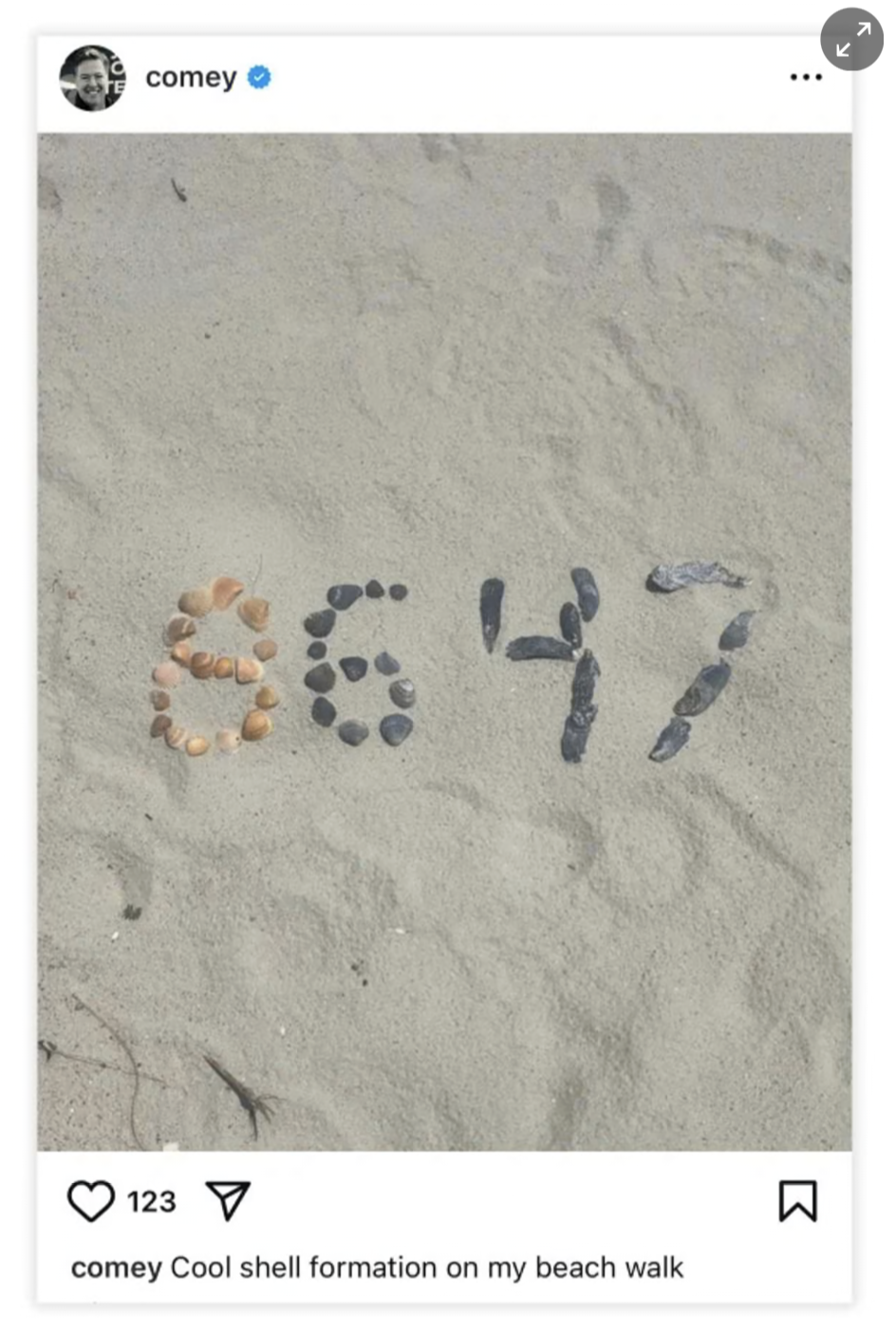
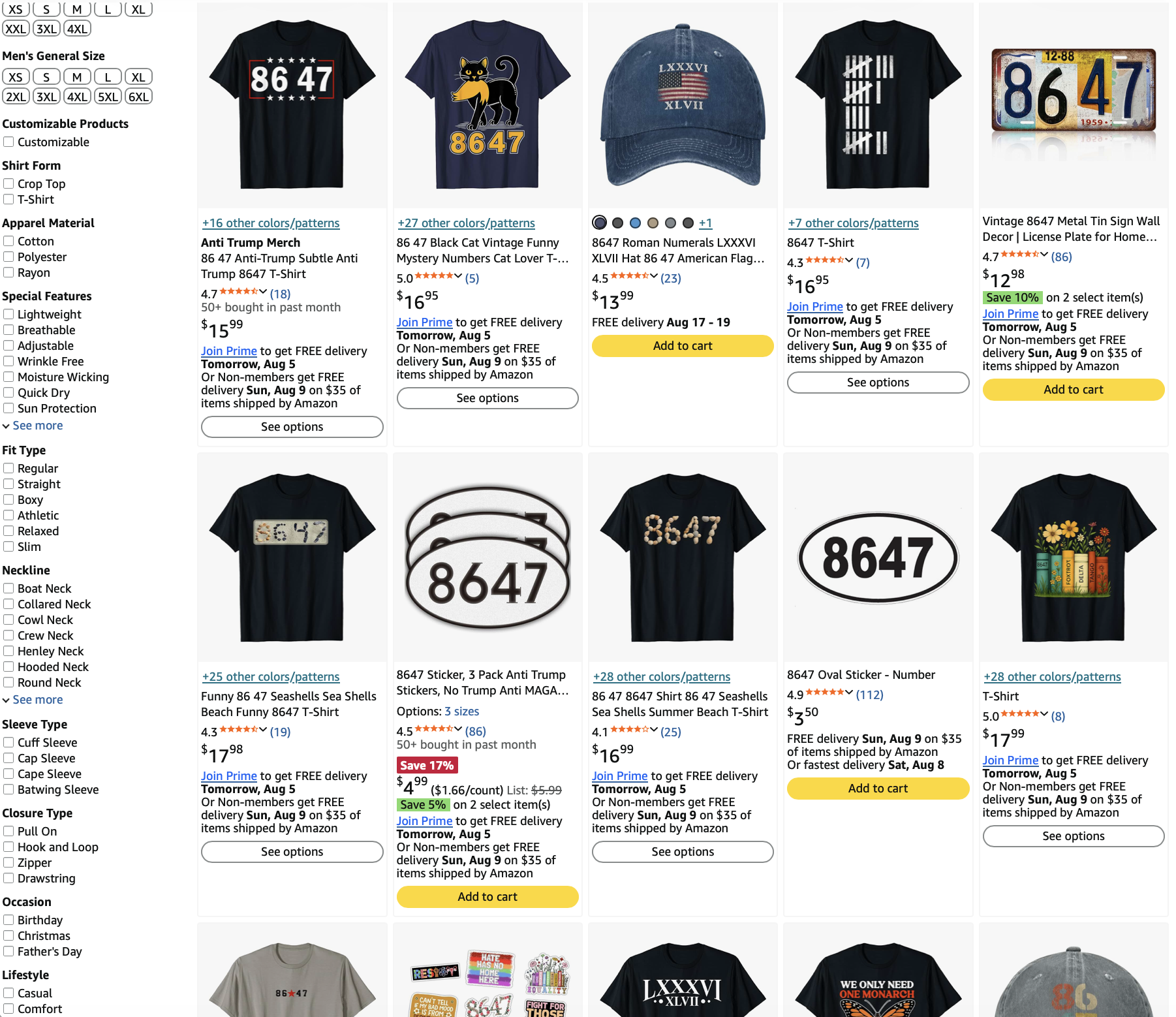
Silly: Former FBI director James Comey shared a photo via Instagram on May 15, 2025 with a seashell arrangement of the numbers “86 47” that he said he found on a North Carolina beach. Via The Guardian, the original post that started it all:
To 86 something is common slang to “throw out” and 47 refers to Donald Trump, the 47th president of the United States. “86 47” then was, in many people’s opinions, a silly way of saying, get rid of the President: Impeach.
Serious: But because…apparently….Trump, Comey was charged with making a threat against the president’s life, and transmitting that threat through “interstate commerce.” I.e. THE INTERNET. The DOJ indictment quotes the current Attorney General, Todd Blanche: “Threatening the life of the President of the United States is a grave violation of our nation’s laws”.
The reason The Guardian, other news outlets, and I have reproduced the image is to document and analyze it as a matter of public interest. It’s inclusion here is solely for the purpose of reporting, commentary, and memetic analysis.
At the moment, Comey actually faces ten years in jail. To so many people, it seems so silly, and dismissible, and yet, I can certainly imagine he must be under significant duress, for the outcome of ten years in prison would be severe. Comey is arguing that the prosecution is politically motivated, and that the seashell post is protected speech under the First Amendment.
PART II
Silly: Just a few weeks ago, on June 11, 2026, police opened an investigation into a massive “86 47” burned into the National Mall lawn in Washington, D.C.
Photographer Nathan Howard appears to have been the first person to capture it, having received a tip that police were on their way, or discovered it “emerging” himself, per Reuters.
"A Reuters photographer atop the Washington Monument saw the apparent marking in the grass near the World War Two Memorial shortly before authorities arrived at the scene."
My first thought? Banksy. It fits the style, ambition, and cultural impact of his work. Who else besides Banksy has the technical expertise to execute something like this? Considering the level of surveillance around Washington, D.C. from so many agencies, it would seem virtually impossible for one to reasonably expect they would not be found.
A close-up of the 8 shows how the numbers were created with uniform circles, through a method that caused the grass to die and turn brown. Perhaps some kind of chemical was concealed in a backpack or on the person and then pumped through an inconspicuous spray or tubing onto the grass.
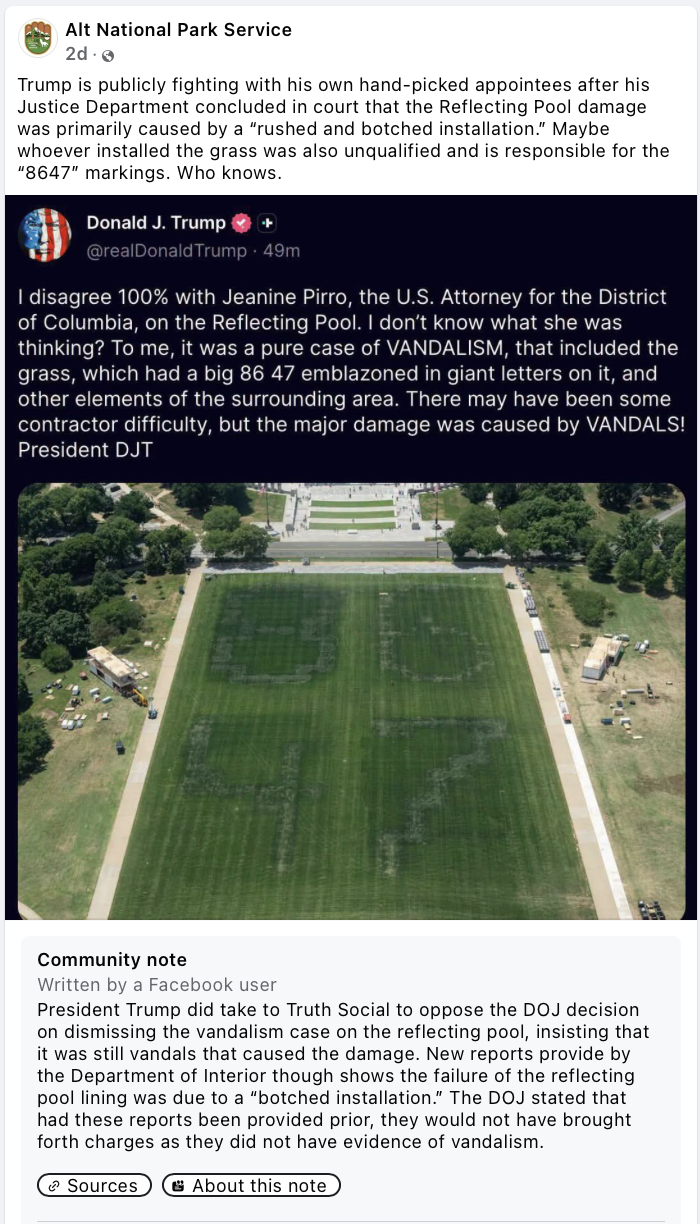
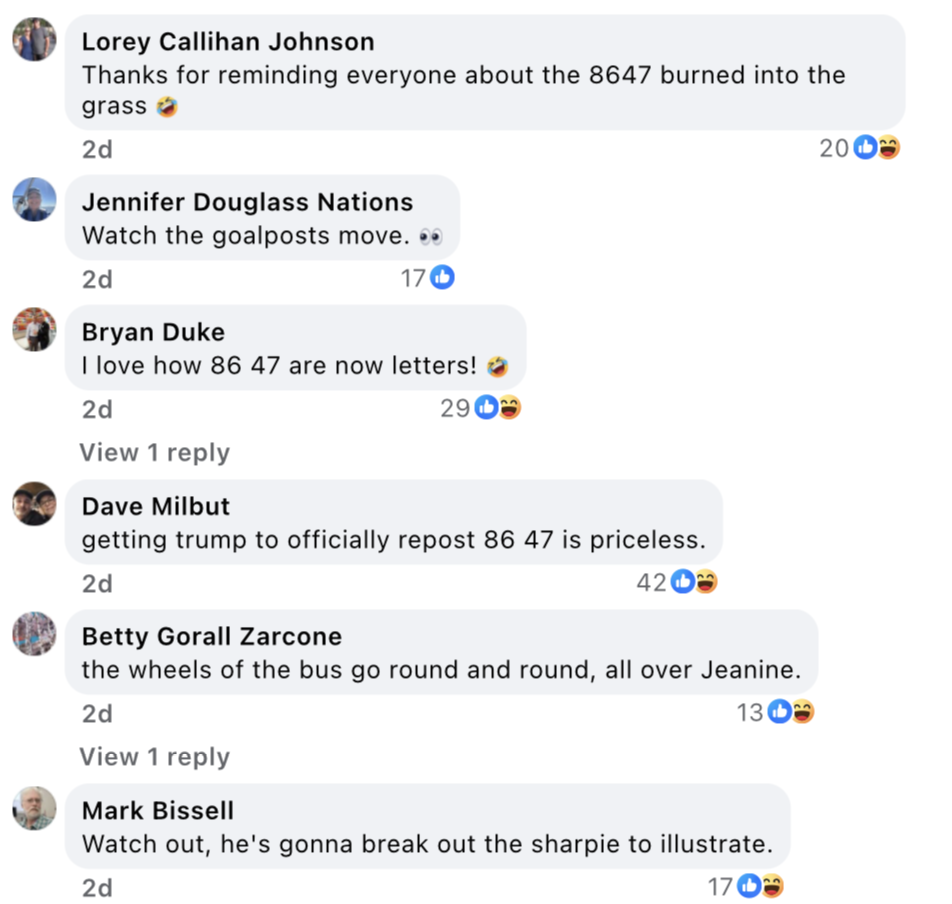
In one amazing round of public commentary, Trump’s Truth Social post, which helped spread the “86 47” meme even further, was reposted by ALT National Park Serviceon Facebook, complete with a “Community Comment”, along with thousands of interactions from Facebook users, many who were quick to point out that Trump calls numbers, “letters”.
Not much to say to prove this point. Doge has been through a lot. It was originally just a wonderful photograph, then a creative, pure-hearted template for communicating in the forums, evolved into a variant that assumed the identity of a cryptocurrency, and now, it’s mainstream for death caused to people around the world under the direction of Elon Musk.
That makes DOGE completely dead. By dead, I don’t mean it no longer exists. It will remain part of internet history, cryptocurrency history, and political history. I mean that its symbolic evolution appears complete. There is no obvious next identity for DOGE that can escape the weight of what the name now represents. Or is there? I mean, just look at that face.
The original photo of Kabosu, a Shiba Inu owned and photographed by kindergarten teacher Atsuko Sato (佐藤 敦子, Satō Atsuko), 2010.
Jimmy Donaldson, known worldwide as MrBeast, has organized his creative life around the measurable demands of internet platforms. As he has repeatedly explained, his objective is to give the algorithm exactly what it wants. He develops his videos around platform metrics, revises them in response to performance data, and removes whatever reduces their ability to spread. His success is not the product of artistic expression, it’s the systematic optimization for algorithmic selection.
This helps explain why MrBeast’s videos feel so culturally disposable. They’re designed to maximize distribution rather than to communicate ideas.
In 2012, Donaldson began posting on YouTube as MrBeast6000 at the age of thirteen. For the next five years, he searched for anything that could go viral. He says it was his only goal. He later described himself as “relentlessly, unhealthily obsessed with studying virality, studying the YouTube algorithm.” At seventeen, he recorded a message to his future self in which success or failure in his life came down to a number: “If I don’t have a million subscribers when you see this video, my entire life has been a failure.”
After high school, he said, he “did nothing but just hyperstudy what makes a good video, what makes a good thumbnail, what’s good pacing, how to go viral.”
The standard was already contained in the question: a good video, to Donaldson, is defined as one that spreads.
After five years of trying to go viral for the sake of going viral, it’s interesting to look back at his big breakthrough. He asked, “What’s something dumb I could do that would get a lot of attention?” His answer? Count to 100,000. Endurance videos, long one-takes, and supercuts already existed online. The point is not that he didn’t invent a format. The point is why he chose the act. His own explanation begins with the need for attention.
Reflecting on that first video, he said, “I just really wanted it. I had dropped out of college, I wasn’t really making much. I knew it would go viral.”
By nineteen, Donaldson was telling his team, “We’re going to be the biggest YouTube channel ever. I don’t care. I’ll die trying.”
After that, the chronology is beside the point. The goal never changed; it merely acquired money, staff, and a self-aggrandizing production system.
Now he describes views as evidence that he is giving people what they want, and he uses virality as a repeatable technique for producing “practically unlimited money.”
That objective reaches into every part of the product. He says more extreme claims are used to improve click-through. Prize amounts are evaluated according to how much additional click value they produce. Click-through rate, average view duration, and satisfaction surveys became his production inputs.
One director who worked at MrBeast Productions told TIME that platform incentives had led them to study retention graphs to make each new video more addictive. Working at MrBeast, he said, that work was done “on steroids.”
He even has people developing and testing a factory’s worth of title-and-thumbnail concepts before deciding which one to upload. The business tested open- and closed-mouth poster-image expressions, found that closed mouths produced slightly more watch time, and then changed its rulebook and best practices accordingly.
It’s not as if these are separate anecdotes from different stages of a career. They describe one continuous method, governed by the same question every time: Will this improve distribution? The machinery does not arrive afterward to promote the work, it determines what the work becomes.
The leakedMrBeast Production Manual spells it out. Two former producers confirmed that the document was used in the office and given to new employees, but to date, apparently no one from the current MrBeast production team, including his spokesperson, has confirmed or denied its existence. The manual tells employees that their goal is “not the highest quality videos.” It is to make “the best YOUTUBE videos possible.”
That distinction is central to this argument. It is exactly what Donaldson has been preaching all along. His objectives are not secret. He professes the method openly.
The manual names three trackable measures of virality: click-through rate, average view duration, and average view percentage. Those numbers show whether the packaging earned the click and whether the video kept the viewer. It calls click-through rate “what dictates what we do for videos.” The numbers then enter the work itself. The first minute receives special attention because that’s where the most viewers leave. Producers place new material at planned intervals. Endings stop abruptly so viewers do not depart before the video is over. Spending outside the frame is questioned because the audience cannot see it.
The manual also says that a video should excite Donaldson, feel authentic, and make the audience happy. It allows for a subjective “wow factor”, yet when it asks how to determine whether the content is good, the answer is, as you could have probably guessed by now, average view duration and percentage watched. Creativity is defined by tricks for saving money. New ideas are encouraged so long as measurements can certify them. It is a manual for deciding what the work will be in the first place based on the YouTube formula.
This helps explain what I knew in my heart before I learned about his intent: quality has no meaning to Donaldson. He equates quality with whatever the algorithm wants. He repeatedly advises that the word “algorithm” can simply be replaced with “audience.” He treats the two as the same.
You can see how absurd that is:
The audience placed the video on millions of personalized YouTube pages, measured how long each viewer stayed, and expanded its distribution when the numbers improved.
In reality, the audience supplies the behavior and the algorithm separately interprets that behavior to control distribution. Treating them as the same is soulless, as if the machinery between the viewer and the work is all that exists. Such a treatment of people is so dark.
Hello. I am not an algorithm.
People feel, experience, perceive, interpret, imagine, desire, hope, fear, love, grieve, trust, doubt, forgive, resent, empathize, laugh, suffer, wonder, form identities, build relationships, negotiate meaning, exercise judgment, accept uncertainty, revise beliefs, and choose what they value. People can hate-watch a video to the end or stop watching something they love. The algorithm sees none of this directly. It sees only the most minimal traces left by click through behavior and bots, and then converts that raw signal into further distribution.
This explains how MrBeast’s videos can perform so well while being devoid of quality. The system can measure whether people watched. It cannot determine whether what they watched was worthwhile.
Quality is an artistic, evaluative judgment, whereas click-through, retention, and completion are behavioral measurements. The first asks what a work is worth. Donaldson asks what an audience did. Within the MrBeast system, a premise for a video acquires value when it wins the click. A scene acquires value when it prevents departure. A comment, idea, prize, or edit survives only when the graph rewards it. Originality, beauty, coherence, insight, durability, and cultural consequence have no independent standing inside this procedure. They matter only when they can be translated into traces of audience behavior.
In MrBeast’s content, the algorithm and the audience become a single object: measurable behavior. The system can optimize every visible element of a video while remaining indifferent to whether the resulting work was worth making.
What does MrBeast stand for?
Ultimately, MrBeast’s pursuit and the purpose of his content are completely self-serving in the most literal sense: the object is to make MrBeast the biggest YouTuber. The audience enters that pursuit as a field of measurable behavior. People must be induced to click, remain, finish, and return. Their enjoyment matters only if it advances his position.
By contrast, Pixar, at its best, makes films intended to provide cultural value for people. Steve Jobs described his interest in supporting Pixar filmmaking as an opportunity to create stories that would speak to our “grandkids’ grandkids’ grandkids.” While Pixar repeatedly “wins” the commercial competition, its commercial success follows from the artistic quality of work meant forculture itself—a standard established before the audience response.
Jobs: “There’s lots of ways to be, as a person. And some people express their deep appreciation in different ways. But one of the ways that I believe people express their appreciation to the rest of humanity is to make something wonderful and put it out there.
And you never meet the people. You never shake their hands. You never hear their story or tell yours. But somehow, in the act of making something with a great deal of care and love, something’s transmitted there. And it’s a way of expressing to the rest of our species our deep appreciation.”
WALL-E offers a great example. Contrary to the known formula, Andrew Stanton created a long, nearly thirty-minute wordless opening, with a portrait of a solitary machine wandering through an abandoned world. The absence of dialogue, the slow accumulation of detail, and the refusal to explain everything would be obvious no-nos for a MrBeast production. Stanton preserved these qualities because they created the solitude, tenderness, and wonder the story required. “There’s something underestimated about wonder,” he later said. “It’s a hard thing to quantify, but to me that’s the ingredient.”
Like many films, WALL-E was tested too. It is not unhealthy to understand statistics and keep them in mind. But the film was made for audiences, not the algorithm, and its quality standard preceded the audience response. The audience was asked to meet the work where the artist had placed it. In MrBeast’s system, the anticipated audience response determines where the work will be placed.
Compare the cultural value of Toy Story, which cost twenty million dollars to make, with MrBeast’s SquidGames, which cost a hundred million dollars to make. Judged independently of their platform-performance metrics, MrBeast’s videos offer little beyond the machinery of attention. Their premises are thin, their stakes are inflated, their participants become functions of a game, and their editing allows no space for ambiguity, reflection, or discovery. Every moment must justify itself by preventing departure. The result is spectacle engineered for immediate consumption and rapid replacement. Its accomplishment lies in temporary fitness: Quality would require reasons to value the work after those advantages were taken away.
In my previous post about Incentivemaxxing, I described how platforms provide rewards for content creators who approach boundary lines. Creators who are looking to game the system adapt their content toward the point of maximum reward. YouTube has the same kind of curve but with a different boundary. On YouTube, the pressure is toward premises, packaging, and pacing that improve click-through and retention for advertisers.
MrBeast did not invent this orientation. YouTube had already institutionalized it.
In March 2011, YouTube acquired Next New Networks, a web-video company that had developed, packaged, and built audiences by standardizing preexisting creator content into a one-size-fits-all product. YouTube called the resulting program YouTube Next, a creator-development unit that trained producers on how to accommodate the algorithm, an effort YouTube described as a strategy to compete against other platforms in the marketplace.
Shortly after acquisition, the Next New Network group published the first *Creator Playbook*, described as a collection of “best practices and strategies” for building audiences on the platform.
Simply put, the Playbook converted distribution into production doctrine. Programming, openings, release schedules, and audience interaction became variables YouTubers were told to incorporate to compete. The platform was no longer just distributing videos; it began prescribing how videos should be made for its own system.
The first substantive lesson concerned the opening fifteen seconds. Creators were told to consult attention graphs, locate early drop-offs, experiment with different “hooks,” and keep changing the opening until abandonment fell. Another section advised calls to action because likes, favorites, and shares improve a video’s ranking in the algorithm.
In February 2012, the same month Donaldson started his channel, YouTube released the Playbook’s second edition. It expanded the framework with instructions for organizing videos around different audiences, programming channels for the homepage feed, and optimizing creative work for global viewers. It also treated Analytics as actionable intelligence: creators should assess performance, investigate trends, measure optimizations, and alter their content or strategy in response.
YouTube pushed this hard for years, so a MrBeast was bound to happen. MrBeast is merely the embodiment of the Playbook’s system in which popularity has replaced quality as the standard of judgment.
Now MrBeast says he can make almost anything go viral. The more interesting fact is what virality has made out of him. It has trained his eye, organized his time, shaped his company, selected his ideas, and given production decisions a number for the sake of making himself more popular. He uses YouTube to spread his videos, and YouTube uses him to reproduce the kinds of videos it rewards.
The formula is not applied to the content. The formula produces the content.
That is Incentivemaxxing to the max. It is also what it means to say that we do not simply use memes. Memes use us.
When all hell broke loose on Facebook during the Cambridge Analytica era, people were focused largely on privacy, but equally important was the realization of its recommendation algorithms.
Facebook set policy on what was considered to be too violent, too sexual, and too everything else, and then moderated and removed based on whether or not content crossed the policy line. But as people got closer to the line, their content was shared more, and thus, they were more rewarded, leading to a platform full of the most extreme content allowed, where the most rewarded content sat right next to the boundary line.
One of the main reasons twitter, around that same era in the twenty-teens, was safer and more trusted, was because of how they managed, algorithmically, this approach to the policy line. Twitter explicitly acknowledged that some behavior did not violate the rules but still harmed conversations, and that instead of removing it, Twitter reduced its visibility. Essentially, they flipped the curve.
As content approached the prohibited boundary line, twitter demamplified it, removed it from recommendations, restricted its appearance in search, and used other methods of reducing incentive to spread.
This all being then, it’s quite interesting because of where we are now. Have you seen what’s on twitter these days? The policy line has been shifted way to the right and the most extreme content gets the most rewarded.
In addition to the extensive pornography and graphic war violence, twenty-eight-year-old Dalton Eatherly, known as Chud the Builder, is a quintessential 2026 example of how the platform changed under Elon Musk.
Eatherly used the platform to become nationally known by livestreaming himself walking through towns in the Deep South, directing extreme racial slurs at random strangers before challenging them to “do something” that would justify him defending himself, including with the gun he carried. The slurs were so outrageous and disgusting they were literally jaw-dropping.
People shared the videos largely in disbelief that someone could openly do this. Eatherly claimed he was exercising free speech, and Musk’s platform did not moderate the content, showing that it fell within acceptable policy boundaries. The more controversial and extreme Easterly became, the more he was rewarded. I watched in disbelief, convinced he was eventually going to kill someone or be killed. It was clear he sought confrontations and deliberately provoked people because the platform rewarded that behavior.
Eatherly eventually did shoot someone during one of these filmed confrontations and is now in jail facing attempted murder. Even afterward, the content remained on the platform, and Eatherly raised more than $100,000 from supporters for his legal defense.
Unfiltered discussions and videos of street confrontations, assaults, war and even killings are surprisingly abundant on Musk’s platform. As for the cultural impact, of course it provokes outrage, anger, and engagement, ultimately feeding money back into the platform.
Every boundary creates an incentive gradient. The platform determines one boundary, the law establishes another, and creators adapt their behavior toward whichever boundary yields maximum reward. Incentivemaxing. This is the era we are in now.
I’ve been interested in a definition for the word meme. It’s practical to have one to state for the sake of conversation and continue on, though it should at least be formed to fit without a conflict for physics and philosophy. So far the throw-around versions used today are prone to all kinds of arguments. To say the least, there isn’t much related to the definition of the word meme beyond its use in the field of biology.
I found OpenAI’s ChatGPT useful in this case to help with clarifying and expanding on expressing the components of memes, both in biology and elsewhere, specifically with regards to internet memes. The chat engine is simple in many ways and often shows itself with its limited boundaries quickly, though it was a great companion for this exercise, and had an impact in keeping the definition from going too far astray. For my part, the effort was in formulating the questions.
As with any discipline, a definition can change when a word becomes used in a different context. The word meme can be applied in biology to refer to an idea itself, while a more popular use today is in media as a representation of an idea. The definition I arrived at below is close but there is more that can be done.
Let’s talk about the definition of the word meme.
A meme is a concept or idea that is spread from person to person within a culture. It can be anything from a joke or a catchphrase to a video or a piece of clothing. Memes are often seen as a way for people to express their thoughts and ideas in a humorous or entertaining way.
A concept is different than an idea but they are expressed in similar ways.
Yes, that’s correct. A concept is a general idea or understanding of something, while an idea is a specific thought or notion. Although they are similar, they are not the same. A concept is more abstract and general, while an idea is more concrete and specific. For example, the concept of freedom is a general understanding of the idea of being free, while the idea of going to the beach for the weekend is a specific thought or plan.
A meme can be an idea, but also a meme can be a representation of an idea. For example, a video which we call a meme can be spread from person to person, while also that same video can be a representation of an idea that is spread as a meme from person to person, via the video.
Yes, that’s correct. A meme can be an idea itself, but it can also be a way of expressing or representing an idea. For example, a funny video that goes viral on the internet can be considered a meme, because it is spreading from person to person. But that same video can also be a representation of an idea, such as a joke or a commentary on a cultural phenomenon. In this way, a meme can be thought of as both the content itself and the way that content is shared and spread within a culture.
With regard to an idea, if I meet with another human and successfully describe a concept, such that they find it compelling and go on to describe the concept to another human, that would be an example of a meme.
Yes, that’s a good example of how an idea can become a meme. If you have an idea and you are able to share it with someone else in a way that they find interesting or compelling, they may be motivated to share that idea with others. This process of sharing and spreading an idea from person to person is what defines a meme. So in your example, if you were able to share a concept with someone and they went on to share it with others, that would be an example of a meme.
Imagine that I share an idea with just one other human and that human understands it, but the human doesn’t find it very compelling and then doesn’t pass it on. Is transmitting the idea from one person to another just one time enough to be called a meme?
It is not necessarily necessary for an idea to be spread to multiple people in order to be considered a meme. The key characteristic of a meme is that it is an idea that is shared and spread within a culture. So if you share an idea with another person and they understand it, that could be considered a meme, even if they don’t pass it on to anyone else. The important thing is that the idea is being shared and transmitted from one person to another, regardless of how many people it reaches.
I completely agree, it only requires a single transmission to be considered a meme. In that case, you could say that if an idea was passed on to many people, the idea would be more memetic. Memes are more or less memetic.
Yes, that’s correct. An idea that is passed on to many people within a culture could be considered more memetic, because it is spreading and gaining traction within that culture. In this way, you could say that some memes are more memetic than others, depending on how widely they are shared and how much impact they have on the culture.
However, it is important to note that not all ideas that are shared within a culture are considered memes. In order for an idea to be considered a meme, it must be shared and spread in a way that is specific to the culture it is being transmitted in.
What’s an example of a shared idea in a culture that is not considered a meme?
An example of a shared idea in a culture that is not considered a meme could be a religious belief or a political ideology. These are ideas that are shared and passed on within a culture, but they are not typically considered memes because they are not typically spread in the same way as memes. Memes are often spread through social media and other online platforms, whereas religious beliefs and political ideologies are typically spread through more traditional means, such as religious institutions and political parties. So while these ideas may be shared and spread within a culture, they are not considered memes because they are not typically spread in the same way as memes.
It would be a good idea to distinguish between the transmission of internet memes, which tend to act more as representations of shared ideas in cultures, and biological memes, which are ideas themselves.
Yes, that’s a good point. There are two different types of memes that are often discussed: internet memes and biological memes.
Internet memes are the kind of memes that most people are familiar with. These are ideas, images, videos, or other forms of content that are shared and spread online, often through social media platforms. They are typically humorous or entertaining in nature, and they are often used to comment on or make fun of cultural phenomena.
On the other hand, biological memes are a concept from evolutionary biology. They refer to ideas, behaviors, or cultural practices that are passed on from one individual to another within a population. In this context, the term “meme” is used to describe the way that these ideas, behaviors, and cultural practices spread and evolve within a population, in the same way that genes spread and evolve through natural selection. So while internet memes are ideas that are spread through the internet, biological memes are ideas that are spread within a population.
While we agree that a biological idea only needs to be transmitted from one individual to another to be classified as a meme, when it comes to internet memes, the transmission of a video or image from one individual to another would not be enough to be considered a meme. For if a video was shared with just one person and the receiver did not find it compelling or pass it on, everything would end there, and it would not be memetic.
Yes, that’s correct. While a single transmission of an idea within a population is sufficient for it to be considered a biological meme, the same is not true for internet memes. For an idea to be considered an internet meme, it must be widely shared and spread within a culture. This is because internet memes are a product of the online world, where information can be easily shared and spread to a large number of people. In order for an idea to be considered an internet meme, it must be shared and spread in a way that is specific to the internet and the culture of the people who use it. So in your example, if a video was shared with just one person and they did not find it compelling or pass it on, it would not be considered an internet meme because it did not gain traction within the culture.
The threshold of when a video becomes shared enough to be considered a meme based on being “widely shared” could require accepting a less definitive point than our biological definition of a meme which is definitely just one. With internet memes, a statistical analysis of various factors including reach and impact could be useful, for by comparing a meme’s qualities to the performance of those same qualities from prior memes, we can better understand how memetic a video for example could be.
Yes, that’s a good point. Because internet memes are a product of the online world, where information can be easily shared and spread to a large number of people, it can be difficult to define exactly what makes a meme “widely shared” or “successful”.
In some cases, a meme may be considered successful if it reaches a large number of people and has a significant impact on the culture. In other cases, a meme may be considered successful if it reaches a smaller number of people but has a very strong impact on the culture. There is no one-size-fits-all definition of what makes a meme successful, and it may depend on the specific context and the culture in which the meme is spreading.
However, you are correct that a statistical analysis of various factors, such as reach and impact, could be useful in determining how memetic a particular video or other piece of content is. By comparing the performance of a particular meme to the performance of other memes, it may be possible to get a better sense of how successful it is and how memetic it is.
A meme could not exist without an environment. To become a meme an idea or a representation of an idea needs a medium in which to spread. Just as the physical environment has a role in the success of a gene passing on from one individual to the next, so too does it have a role in passing on a biological meme from one individual to the next.
Yes, both internet memes and biological memes require an environment in which to exist and spread. For internet memes, this environment is typically the online world, where information can be easily shared and spread through social media and other platforms. For biological memes, the environment is the population in which the ideas, behaviors, or cultural practices are being transmitted. In both cases, the environment plays a crucial role in determining whether an idea or concept can become a meme and how successful it can be.
Just as the physical environment can have an impact on the success of a gene in passing from one individual to the next, it can also have an impact on the success of a biological meme in passing from one individual to the next. For example, if a particular idea or behavior is well-suited to the environment in which it is being transmitted, it may be more likely to spread and become a successful meme. On the other hand, if the idea or behavior is not well-suited to the environment, it may be less likely to spread and may not become a successful meme. So the environment plays a critical role in the success of both internet memes and biological memes.
If a person uses their voice to transmit an idea to another person, sound waves carry the idea encapsulated in language through the medium of air, in the way a video can carry an idea encapsulated in language through the medium of the internet.
Yes, that’s correct. When a person uses their voice to transmit an idea to another person, the sound waves carrying the idea are transmitted through the medium of air. This is similar to how a video can carry an idea through the medium of the internet. In both cases, the idea is encoded in language and transmitted through a medium, allowing it to be shared and spread from one person to another.
The medium through which the idea is transmitted can have a significant impact on how the idea is perceived and how widely it is shared. For example, the tone and inflection of a person’s voice can add meaning to the words they are speaking, and the medium of air can carry that meaning to the listener. Similarly, the visual elements of a video can add meaning to the words being spoken, and the medium of the internet can carry that meaning to the viewer. So the medium through which an idea is transmitted can play a significant role in how the idea is understood and how widely it is shared.
It’s plausible to consider that an internet meme could be spread through a culture with an idea that caused the culture to change biologically, such that an internet meme could affect the evolution of biological genes.
It is possible that an internet meme could have an impact on the evolution of biological genes. While the internet and biological evolution operate on very different timescales, it is not impossible that an internet meme could have an impact on the evolution of a population.
For example, if an internet meme were to spread a particular idea or behavior that was beneficial to the population in some way, it could potentially lead to changes in the population’s gene pool. For example, if an internet meme were to encourage people to adopt a healthier lifestyle, it could potentially lead to changes in the population’s gene pool that are beneficial in terms of overall health.
However, it is important to note that the impact of an internet meme on the evolution of biological genes would likely be very small and difficult to measure, and it would depend on a number of factors, such as the size and makeup of the population and the specific idea or behavior being promoted by the internet meme.
Since biological genes evolve, its plausible to consider the notion that biological memes evolve. Can you think of a good example of a biological meme that evolved? Similarly, internet memes evolve. How about an example of an internet meme that evolved?
Biological memes, like genes, are thought to evolve over time. This means that they can change and adapt to their environment in order to become more successful at spreading and surviving within a population. One example of a biological meme that may have evolved over time is the practice of burying the dead. This is a behavior that is found in many different human cultures, and it is thought to have evolved in response to the benefits it provides, such as protecting the dead from predators and preventing the spread of disease.
Similarly, internet memes can also evolve over time. This means that they can change and adapt to the online environment in order to become more successful at spreading and surviving within a culture.
One example of an internet meme that may have evolved over time is the “rickroll” meme, which involves tricking someone into watching a music video by Rick Astley. This meme started as a simple prank, but over time it has evolved into a more complex and multi-layered joke that is used to comment on various cultural phenomena. So both biological memes and internet memes can evolve over time in response to the environment in which they are spreading.
What’s a another example of an internet meme that evolved over time?
Another example of an internet meme that has evolved over time is the “Distracted Boyfriend” meme. This meme originated from a stock photo of a man looking at another woman while his girlfriend looks on in disbelief. The photo was used in a variety of different contexts, with the man representing something that the user was interested in or attracted to, while the girlfriend represented something the user was already committed to.
Over time, the meme evolved to include more complex and creative scenarios, with the man representing different choices or decisions, and the girlfriend and other woman representing the different options or consequences. The meme became popular on social media platforms like Reddit and Twitter, and was even used by companies and organizations to illustrate different scenarios or choices in a humorous way.
Through its evolution, the “Distracted Boyfriend” meme became a powerful tool for conveying complex ideas and scenarios in a simple and relatable way. It is a prime example of how internet memes can evolve and adapt over time to fit different situations and contexts.
You could say this phenomenon that we see in the reuse of a meme, as you described with “Distracted Boyfriend” is a great example of appropriation, and internet memes that become appropriated into new contexts tend to be considered successful with an additional measurement beyond reach, for their ability to propagate further into the future by transforming. As such, memes that do not get appropriated tend to be less impactful, though it’s not universal.
Yes, the reuse and transformation of internet memes is a form of appropriation. When a meme is appropriated, it is taken from its original context and used in a new way, often to convey a different message or idea. This can involve changing the image or text of the meme, or using it in a different context or setting.
The success of a meme is often measured by its reach, or how widely it is shared and viewed on the internet. However, another important measure of success for a meme is its ability to be appropriated and used in new ways. Memes that are easily appropriated and transformed tend to have a longer lifespan and greater impact, as they can continue to be relevant and relatable in different contexts and situations.
Of course, not all memes are easily appropriated and transformed. Some memes are more specific or tied to a particular context, and may not be as easily adaptable to new situations. In these cases, the meme may not have as much staying power or impact. However, it is not universal, and there are certainly examples of memes that were not easily appropriated but still had a significant impact on internet culture.
With regards to the evolution of an internet meme, can you think of an example of a meme that was appropriated in one way, such that it was used over and over in new contexts, similar to your example with the “Distracted Boyfriend” but then evolved in the way it was appropriated, such that it became known and used in a different way?
One example of a meme that was appropriated in one way and then evolved is the “YOLO” meme. This meme originated from a Drake song called “The Motto,” in which the rapper uses the acronym “YOLO” (You Only Live Once) to encourage people to live life to the fullest.
Initially, the “YOLO” meme was used in a similar way to the song, to encourage people to take risks and enjoy life. However, over time, the meme was appropriated in new ways and began to be used to poke fun at reckless or foolish behavior. In this new context, the “YOLO” meme became a way for people to mock or satirize those who make poor choices or decisions without considering the consequences.
Through its evolution, the “YOLO” meme became a powerful tool for conveying complex ideas and emotions in a simple and relatable way. It is a prime example of how internet memes can be appropriated in different ways and evolve over time to fit different situations and contexts.
Another example of a meme that was appropriated in one way and then evolved to be used in a different way is the “Wojak” character. This character originated from a black and white illustration of a sad-looking man with a bald head and facial stubble. The illustration was used in a variety of different contexts, often to convey feelings of loneliness or isolation.
Over time, the “Wojak” character was appropriated and transformed into new contexts. It became associated with the alt-right movement and was often used to convey feelings of anger and resentment towards political and social issues. This evolution of the “Wojak” character led to the creation of a new meme called the “Angry Wojak,” which depicted the character with a more aggressive and confrontational expression.
That’s a great example. Another example is the “Doge” meme which evolved to become the representation of a cryptocurrency.
Yes, you are correct. The “Doge” meme was appropriated and transformed into a representation of a cryptocurrency called Dogecoin. This cryptocurrency was created as a parody of Bitcoin, and was designed to be fun and lighthearted. The “Doge” meme was used as the logo for the Dogecoin, and was featured on the coins and on the website.
The use of the “Doge” meme in this context allowed it to continue to be relevant and have an impact on internet culture, even after its popularity as a standalone meme had declined. The “Doge” meme was able to evolve and adapt to fit a new context, and became associated with a new and growing trend in the world of cryptocurrency. This is a prime example of how internet memes can be appropriated and transformed in new ways to continue to have an impact on internet culture.
Because an internet meme is a form of media, such as an image or video, that is used to represent an idea or concept, there are no examples of internet memes that are not a type of media.
That is not correct. While internet memes are often a type of media, such as an image or video, they can also take other forms. For example, internet memes can also be a phrase or a piece of text that is used to convey an idea or concept. These types of memes are often shared as a screenshot of a message or post on social media. Additionally, internet memes can also take the form of a hashtag or a challenge that becomes popular on social media. So, while internet memes are often a type of media, they can also take other forms.
Since it’s true that an internet meme that is a phrase or a piece of text, is a meme that is transferred from person to person via the text medium, then it is not a good example to use to counter the idea that all memes are media.
I apologize if my previous response was unclear. While it is true that text can be considered a type of media, and that internet memes can be shared through the text medium, internet memes can also take other forms that are not strictly media. For example, internet memes can also be a hashtag or a challenge that becomes popular on social media. These forms of internet memes are not strictly media, as they do not include images, audio, or video. Instead, they are used to convey an idea or concept in a humorous or relatable way, and can quickly become popular and widely shared on social media. So, while internet memes are often passed on via the text medium or other forms of media, they can also take other forms that are not strictly media.
What’s a specific example of such a meme?
One example of an internet meme that is not strictly media is the “Ice Bucket Challenge,” which became popular on social media in 2014. This meme involved people filming themselves dumping a bucket of ice water over their heads, and then nominating others to do the same. The challenge was meant to raise awareness for the ALS Association, and became popular quickly due to its humorous and relatable nature. While the videos of people completing the challenge could be considered media, the challenge itself was not strictly media. It was more of a social media phenomenon, and did not necessarily include images, audio, or video.
I see your point. A meme can be a representation of an idea or concept, and it can also be an idea or concept itself. Let’s create a thorough definition of an internet meme.
A thorough definition of an internet meme would be something like this:
An internet meme is a concept, idea, or piece of media that is shared widely on the internet, often through social media, and is characterized by its humorous or relatable nature. Internet memes can take many different forms, including images, videos, phrases, hashtags, or challenges, and are often based on popular culture or everyday situations.
Lets try that again and consider that the internet is an important factor in how they spread.
A revised definition of an internet meme might be:
An internet meme is a concept, idea, or piece of media that is shared widely on the internet, often through social media, and is characterized by its humorous or relatable nature. The internet plays a crucial role in the spread of internet memes, as they are often passed on from person to person through social media and other online platforms. Internet memes can take many different forms, including images, videos, phrases, hashtags, or challenges, and are often based on popular culture or everyday situations. They can become popular quickly due to their humorous or relatable nature.
This is a good definition. Let’s add to it by noting the way in which memes become appropriated.
A further revision of the definition of an internet meme might be:
An internet meme is a concept, idea, or piece of media that is shared widely on the internet, often through social media, and is characterized by its humorous or relatable nature. The internet plays a crucial role in the spread of internet memes, as they are often passed on from person to person through social media and other online platforms. Internet memes can take many different forms, including images, videos, phrases, hashtags, or challenges, and are often based on popular culture or everyday situations. They can become popular quickly due to their humorous or relatable nature, and may be appropriated and reworked by different groups or individuals over time.
It’s an obvious class, starts with 101, ends with 420. In this case, it happened in a bar, so to speak, where it’s known philosophers open up and say what they REALLY mean. So I was pleased to partake in a Shirley Temple (sorry, beer and liquor just tastes bad and makes me throw up) while prodding three philosophers on memetics, for their philosophy in a bar podcast, Hotel Bar Sessions, Episode 64: Memes
With our special guest, Andrew Baron (creator of Rocketboom and KnowYourMeme), we also investigate what, if anything, distinguishes an “internet meme” from other kinds of memes, and how internet memes may provide a unique insight into social operations and cultural formations.
In this episode, the following ideas, thinkers, texts, events… and, yes, memes!… are referenced (explicitly or implicitly):
The Root of Disinformation at the Center of Meme Culture
There was an article that came out a few years ago at The Verge that I didn’t get an opportunity to formally respond to about the history of Know Your Meme. I was contacted by the writer, Kaitlyn Tiffany, a few hours before the article was published and after it had already been written. The story was a long exposé that took weeks to put together and, in part, was meant to shine a light on certain strikingly large and obvious events that occurred surrounding the departure of Kenyatta Cheese, then the Chief Operating Officer of Rocketboom.
The article celebrating the ten-year anniversary was not correct and had many technical errors, and it misattributed quotes and credits to people. It’s important to get it straight. To be accurate in documenting history. To be fair and in good faith to the facts so that people can learn and benefit from the truth. The writer was one year out of college and was working at a second job in audience development though, for the reasons described below, the problems with the article were ultimately not hers alone.
The data below is not written in a way that is spectacular, it’s just the facts. Nonetheless, I believe this report can be useful for anyone interested in how intentional misinformation makes its way through internet culture, for example, how history can be manipulated, stolen, or changed in a sophisticated and valuable way. The facts below serve as a case example, if you like, to highlight the role of authority as the weak link. The example is a good one because it exposes the weak link in authority, which begets more authority until history becomes changed.
THE FACTS: These are the facts that contradict the public narrative about Know Your Meme’s history, myself and Kenyatta Cheese, and the actions he took while he was working at Rocketboom. The majority of the facts I provide below have never been provided to anyone because I shouldn’t have to, but it seems as though things have gotten out of hand. I admit it’s tedious…a lot of ‘I did this’ and ‘I did that’ at first. And you may question these facts, and you should question any facts you need in order to form an opinion if you want one. I’m here to say that my facts are true and also, they can be verified and validated. I will verify and validate these facts if anyone wants me to but so far, no one has asked. Now, as a result, there are hundreds upon hundreds of articles that are false about Know Your Meme history and misattribute my work and the work of others. Some have given me the opportunity to say some of these things to them as they wrote their pieces over the last decade, but not one person ever – not even a single person once – has ever asked me to verify my claims before going on with the contrary to propagate misinformation. As such, their stories about Know Your Meme ended up being false and untrue, just as the story from The Verge is now. It doesn’t require a brilliant, experienced journalist, it merely requires someone have the time to ask me for any evidence they want to verify and validate these facts, and then take the time to look. That’s simple.
Rocketboom had more influence over meme culture than most people realize. Through Know Your Meme, Rocketboom is largely responsible for bringing the word meme to the mainstream. No other site, platform or authority did it. There was a need I identified and it was the underlying objective I had in conceiving and building the meme database: Know Your Meme worked because it was a place to explicate memes in an empathetic, academic manner, in a world where the word meme at that time had a full-on connotation with x-rated content, due to 4Chan in general and in particular due to Encylopedia Dramatica, which I bumped up directly against.
While I could not usually bring myself to visit 4chan without preparing to have the rest of my day ruined, I appreciate that 4chan exists as an example of something to see, to understand the reality of humanity a bit better.
Encyclopedia Dramatica was also a cesspool of hate and had the specific agenda of documenting memes with an x-rated, racist lingo. Rocketboom brought the word meme out of that polluted, inaccessible environment on purpose and into the mainstream by design, and within the first two years, a time period the Verge story mostly skipped over and otherwise misconstrued, Know Your Meme became THE authority on internet meme culture where it remains a pillar today.
As for the original Know Your Meme segment with Joanne Colan at Rocketboom: it was mentioned as an idea one day in a two-minute conversation, in a Rocketboom video production meeting with myself and Kenyatta Cheese in 2007. At that time specifically, I had hired Kenyatta to learn about how my Rocketboom video editing workflow happened, working specifically with the objective of learning it, organizing it, and stabilizing it to establish a formal, functional department of video editors which he did quite well.
I liked the suggestion he had. The point of the meeting I called was to brainstorm ideas for segments to use as a production crutch inside of the Rocketboom show because I needed to reduce the amount of writing time I was spending each day. I wrote all the Rocketboom scripts myself, Joanne enhanced and tweaked them when she was recording them with a director (I was the director/camera for the first couple of years of Rocketboom and then we started adding a few filmmakers to shoot with Joanne), and then Joanne usually developed all the outside shoot ideas and produced them with the filmmakers.
Typically, I would then send the scripts in to be shot, and then after the shooting, the tape got sent to the editors. I then worked directly with the editors, usually from home. Each time they finished or needed assets I sent them the creative direction and the more seasoned editors usually sent more completed drafts, and then I usually called for several rounds of video edits before signing off to publish. I was the only one that signed off on every episode. Around this time I was just starting to hire assistant writers to help me crank out more non-news, single topic scripts.
One day I decided I would write up an idea for the first version of the segment. When I was at home writing the script (almost universally I couldn’t write in the office), as it happens I wasn’t finding anything I wanted to cull, so I started to look around for a meme to explicate. This was something I had been adding into scripts already with Joanne, it’s just that now I would do it with a lab coat. The idea of the lab coat was ultimately the crutch and would make it easy to write each time once I had a template together. By setting the stage, it would be easy to create a reoccurring cool piece, as if Joanne went to the lab for 20 seconds to explicate something, and then came back to the news. It’s a trope. So I wrote it in exactly the Rocketboom style, just like I always did, knowing that Joanne would help make it silly yet sophisticated automatically, playing as if she was in a lab. As you can see, it’s basically a news Rocketboom episode story, as usual. The main difference is that I decided to create an intro leader in, which was ideal for a cutaway from the news desk (just a keypress away on the TI/994A), and then suddenly Joanne was in the lab wearing a coat. You know, the scriptwriting that Rocketboom had was unique which helped differentiate Rocketboom, and it was the creative writing style that added one of the important elements to the spirit. It was also of course, especially, the people. To have so many young and extremely talented and creative people in a comfortable, functional environment to all work together and pour ourselves into something great. I was just talking to Joanne about this the other day as we were reflecting back. She and I used to talk a lot about that, that the show had this spirit in a big way, and that made it fun and exciting to be doing. It was a creative time in a medium that felt uncharted.
After I wrote and released the first segment with Joanne, and we liked it, I continued it, and then I then decided to create a full-length set of episodes as a one-time mini-series for the holidays. None of this involved Kenyatta in the creation beyond the mention of the segment idea, though that is a significant idea to mention so he should get credit for that part and co-creator then is appropriate. His role at that time was related to video editing administration, and he jumped right in to edit sometimes to learn what it was like to edit Rocketboome episodes, so he could better manage the editors. At that time we had a few stations and editors would come and go throughout the day and night.
I then decided on my own that I would create actual episodes as a mini-series to get them in the can which would save me from having to write a bunch of news scripts, and to get a break over the holidays for everyone in production. I invited Jamie, Ellie and Kenyatta to act in the miniseries, their first on-camera for Rocketboom
For the miniseries, I asked Jamie, Ellie, and Kenyatta to pitch in their ideas for which memes to explicate (we all liked memes more than anyone else in the office) and asked them if they would be on the show for this one-time miniseries. I knew that whatever they did would ham it up nicely with the kinds of interactions we all had together. I didn’t go on camera because I never want to be on camera.
I went through the list of memes everyone sent in and picked the ones I wanted. Jamie had been collecting a list of memes on a spreadsheet and proposed a number of memes for those episodes, and while they were thoughtful ideas, I did not use any of his suggestions on the list for the miniseries. He suggested Mudkips for example which did not fit with Rocketboom’s audience. Jamie didn’t watch Rocketboom episodes day-to-day at that time so he probably wouldn’t of known, he was busy programming. I then worked with Jamie, Ellie and Kenyatta to confirm who would do which meme. I wrote the first complete script and then sent it to them to give them an idea of what to try and put together (they had never written scripts before for Rocketboom) and then I took what they handed in, and revamped it all into a complete set of scripts on my own at home, a full miniseries of episodes which included the scripted words, the camera direction for the actors, when to make all the cuts, the exact assets to use during voice-overs, etc. This is all fully documented in an extensive amount of daily operational emails, by the way, it’s not hearsay. As I mentioned, if anyone heard anything different about how this process went, they could ask. Kenyatta may not have that much in the way of communications and emails day-to-day except with me, but I have emails with everyone, and all the editors and directors, the dev department, admin, all the external, etc. Simple.
I decided I liked the miniseries and I would create a spin-off show, which I did do. That was also the message behind the press release I wrote when I launched it, near the end of 2018. In my press release, I referred to it as a spin-off show from Rocketboom, and spoke about the way in which sitcoms on TV had characters that branched out into their own shows. It was something I had given years of thought to, and this was the first big one. The formal Know Your Meme show was a great show from Rocketboom, and Kenyatta, Jamie and Ellie all became recognizably internet famous overnight, which was a perk for them too.
Though, more importantly for this article, there is another side to Know Your Meme which I would like to talk about that really makes Know Your Meme what it is, that which was also completely misunderstood by the Verge writer, due to the information that was mischievously fed to her: the meme database, the platform itself.
Kenyatta’s ideas for the creation of Know Your Meme ended with the idea of a video segment inside of Rocketboom that day. He was unaware of the idea of the platform (the meme database) and was not involved in it. Neither was Jamie or anyone else. This is also verifiable with a plethora of emails in case anyone ever wanted to see though no one has ever contacted me with a serious interest in it.
But there is interest, as there are many articles that touch on it, but they almost are all incorrect, it’s not just The Verge. The Verge article states that the meme database was created near the end of 2008 by Jamie, a full twelve months later than it actually was. It wasn’t created in 2008, and it wasn’t created by Jamie. The article originally said that Jamie created it in one day in 2008, though later The Verge issued a correction, and updated it to say that Jamie created it in 2008 (as if he didn’t take just one day apparently). These are pretty big oversights that could be easily verified but they are all still there in their grossly incorrect state.
I created and released the first Know Your Meme meme database at knowyourmeme.com in 2007 myself, a full year earlier, for the reason I described above. I built the first versions with moveable type and wiki software and started experimenting with it, settled on a wiki platform, and then published it alone through Rocketboom inviting the Rocketboom audience to join and add meme articles in the academic way I had guided. This was in 2007, the same day I released the first Know Your Meme segment with Joanne. Rocketboom had an interactive-ready audience and a few came along and began to participate. No one else collaborated with me on the meme database with regards to the idea, building it, experimenting with it, buying the domain name, or releasing it on Rocketboom.
When I released that first iteration of the meme database, from that day forward, I was also the only one aside from our audience who used it, experimented with it, and continued to build upon it to flesh it out for close to a year.
Have you ever seen the interesting experiment where a copy of the U.S. Constitution was put online in a way where anyone could come along and edit it? The experiment was to see where it would end up if literally, anyone could edit it. How would people work together when it’s completely open and there are no rules?
For my first iteration of the meme database, I was inspired by this notion for meme articles, and I purposefully removed all constraints. I allowed people to edit articles without even needing to signup or add an email address. Anyone could just land on a page, click to edit, and start editing.
Yes, that did not go well at all.
I knew what I was up against, as it was even worse back then when trolls weren’t just there to ruin things, they used language that painted the pictures of war and they posted the most deranged images that were hard to unsee…this was the fodder at the time for people who were known to use the word meme.
I tightened up controls but it was a weak fence. The wiki I pointed KnowYourMeme.com to had instantly become a lost cause, but I kept using the Rocketboom wiki under the Know Your meme section and working on the idea of the platform. It was a time of experimentation and learning for me, thinking about a platform as opposed to content.
There was a need for it. The narrative of what inspired the Know Your Meme database is not correct, however. It wasn’t built to give creators credit. Not at all.
There was an issue related to attribution that contributed to my understanding that there was a need for the database, though it was not about attributing the creator of a meme, it was, ironically for this story, about the authority of attribution. The problem with Wikipedia is that any facts on an article require authoritative attribution. If you tried to create an article for a meme on Wikipedia at that time, and you wanted to attribute a key moment in the chronological timeline, and for example, link to some random blog by an anonymous writer as the citing where they talk about it, Wikipedia would not accept it since the author was not authoritative, i.e. not reputable.
When you sit back and read a meme article and learn about how a meme came to be as a matter of highlighting the outstanding chronological events that contribute to its spread, you start to see patterns and begin learning a lot about how information is controlled, and how it propagates through environments. It’s a study of the intrinsic properties of an idea and the environment in which that idea is in. This is a very important discipline that goes way beyond the value of a good time or assuring that artists are credited for their work. The study of memes is the primary reason for Know Your Meme. This is the endeavor that inspired me to imagine, build, and invest in operating a meme database.
The style of the articles and the show wasn’t ultimately a brand of nonchalance, which Rocketboom had a lot of with its main show, but it was more like bringing formality to absurdity, which was comedic in and of itself. When you are describing absurd things formally, you can easily presume an even higher level of absurdity with the style guide.
I first began allocating formal Rocketboom resources to the Know Your Meme database by assigning my first Rocketboom writer (the first person I hired to help me write scripts for the Rocketboom shows), Chris Menning, to help me crank out a large set of important and obvious articles. Together we began building out the first set of tried-and-true pages for the sole purpose of setting the stage and showing the way for the voice of the site, and illuminating the style for articles with consistent, identifiable patterns…controlling those articles fully at first so people would not come and mess them up.
Over many months, after it became clear there was a definite spark and I decided that it would be worth it to invest in building a full-fledged platform with scalable features, I put aside a large, formal budget and timeline, and hired a formal team in house, inside of Rocketboom to focus specifically on building out what would become a unique user experience with article entry and editing features.
The new feature set offered a very special, unique quality that was not part of Know Your Meme’s purpose but ended up contributing significantly to the growth of user participation. You may wonder, what inspires and incentives people to add content to a platform like Know Your Meme? The unique feature set with Know Your Meme gave individuals who did contribute a sense of entitlement and authority they could not get from Wikipedia. As with my very first iteration which did not last, Wikipedia enables anyone to come along and edit an article mostly hidden and under-appreciated.
Know Your Meme placed a lot more focus on highlighting the authors of an article and provided a greater value proposition for becoming an author by starting completely open but then limiting an article to just a handful of people who could edit, on a first-come, first-serve basis.
For example, as a contributor and participant, if you noticed a meme that was not in the database, you (or anyone!) could go to Know Your Meme and enter a new article about it, first. Then you would have control over the writing of that article. You would become the author. Then, anyone else could come along and join your article, edit it, or expand it, and suddenly you would find yourself collaborating with someone on it. You might not agree with their edits so you would need to work it out with them and together share the outcome. Then another person can come along, and another, but only five total with some exceptions. An article with only five people collaborating with it gives those five people the control over the information and thus they become the authority on that meme. This is important, and they get attribution and recognition and build authority that is a value for them in return. It’s more than many people needed to contribute but helps to incentivize and spreads value for many more.
If the five people could not get along and work things out amongst themselves, the site editors who quickly materialized from within the user base itself (where they tended to gain even more authority and value for themselves), stepped in to assure order and had control to escalate or determine a fair outcome to keep the group at peace, to allow the articles to maintain their integrity in an efficient and generally open way. Crazy and unique issues could then be escalated efficiently from there.
To build this new version of the site, which would be launched a year later after the first iteration was released to the public, I hired Jamie Wilkenson to lead the development, I hired James Wu as a second developer to support Jamie’s lead, and I hired Greg Leuch as the lead designer. They came into Rocketboom each day and cranked it out pretty quickly without other distractions, though Jamie and Greg were primarily working on Magma at that time, a software solution for i.p. over TV that was prob the best platform Ive ever made. I could spend hours talking about how great the interface and feature set was for Magma, I think it would be ideal today too.
The articles that Chris and I wrote were the first articles on the new site, some of the classics. They live under Jamie’s account name because he was developing the new site and imported them in under his account, which I believe was actually user #1 or #2 that was during dev. Jamie resigned shortly after the new database was released, and after my first iteration of Magma was released, after moving away from NYC to San Francisco. The Verge article doesn’t mention Greg’s name through the visual design of the site was mostly his contribution and it was a necessary ingredient to make Know Your Meme work. The article also doesn’t mention James. Though the three of them worked together as a tight team. The article only mentioned Jamie and misattributed his role. Jamie does not say on his own bio that he created the Know Your Meme database, despite that he, Greg, and James added genius to it before moving on.
As the press release stated when Know Your Meme was officially “spun-out” of Rocketboom at the end of 2008, the date that The Verge article refers to as the date Jamie created the database, it’s not as if suddenly *poof*, like magic, the whole thing was just created and then got started “one day” by Jamie, or even as if Jamie, Ellie, and Kneyatta are the sole creators and founders of the Know Your Meme as the article states.
The platform was fueled by the show and Rocketboom where episodes played, grew and grew, and soon became way more popular than Rocketboom due to the platform nature of the site, and well, memes. The Verge writer said Know Your Meme became “more beloved”.
The Verge article essentially begins the history here, after it was established and had apparently become statistically more beloved, so it was completely wrong about crediting the various components to the various people.
For example, the article states that Brad Kim created the first meme articles when he arrived after he graduated college in 2009, yet clearly, that would be impossible by two years.
The article suggests that Brad was somehow treated poorly as part of some kind of “$100 club”. I looked at my emails just now to discover an email one month where I asked Kenyatta about Brad (I was going through payroll) and how much he was being paid since Kenyatta brought him on to help support production as an intern. I never used interns at Rocketboom but Kenyatta had said he needed them. In the email Kenyatta was advising on how to protect the copyrights and i.p. As soon as Kenyatta left and I first began working with Brad directly, I moved him up to $52,000 that he made that year. Brad was hired as an intern to help construct materials and other aspects for the Know Your Meme video show production, though when I started working with him, that’s when his job became to manage the community and oversee the site. He started that role in 2011. This was after Kenyatta, Ellie, Patrick, and Mike all left Know Your Meme behind and gave their formal goodbyes.
I found another email where Brad thought Patrick created the Know Your Meme show, though that would be impossible by three years! Patrick came on much later after it became a staple, and he left soon thereafter. So it’s obviously impossible that Brad created the style guide for the articles, and Brad was not clear on the history because he came years later, too.
There were some comments from Ben Huh related to the sale, and some comments from Kenyatta that will require significant detail to clarify because the writer did not have any more time to understand those comments, and thus misconstrued various details as a result of the obvious inconsistencies that can happen when a writer is misled.
With everything inside of Rocketboom, I never worried about the business model at first. I only wanted to create a spark with what I built to assure that what I wanted was what others on the internet wanted too. I would never want to push something or sustain something that others didn’t want or need. No way would I formally allocate such a plan and significant resources to building, hiring, and operating the meme database without already figuring it out. It took over $50,000 just to build the database, especially as my designer and developers were getting paid really well for doing it. And once the new version was built and ready to scale, I began thinking a lot more about various methods for sustainability.
As I pondered that question, I was free to do so with relative ease, for Know Your Meme kept growing and became extremely beneficial to Rocketboom naturally for providing an extended reach to various sponsorship and partnership deals that included all the shows and sites at Rocketboom that I was selling.
Now here we are nearing the end of 2010, the year that Kenyatta left. I had three important business contracts in the works for Rocketboom at that time, a sponsorship deal with AT&T for $750,000, a sponsorship deal with a firm that had Dr. Who as one of their clients, and a show development contract in the works with PBS in Washington D.C. which I had been developing for almost a full year to create a show geared toward their new online video programming.
I also had a couple of other deals in the works for Know Your Meme specifically. One business idea I had for sustainability included selling Know Your Meme, but not to sell it off and wave goodbye…to sell it to another company that could afford to operate it and pay for Rocketboom to nurture the growth. Rocketboom was my first company ever and I was coming to terms with the fact that operating was the least interesting to me, and that it held me back from forging ahead with new ideas. Buzzfeed was interested and I met formally with Jonah Peretti about it. I got the feeling he would have bought it but my price was too high. The price I proposed to him was not thought out very well, granted. I had gained a lot of experience with business development but knew nothing about how to value a company like this or arrive at a price. I was offered $15,000,000 for Rocketboom by ABC/Disney but wasn’t interested at all, it was too soon to sell out online video for the medium had not been democratized and my goal was to open things up, not close them in (side note: after I refused to sell, Amanda Congdon left to go work with that same group.) For the meeting with Joannah to sell Know Your Meme, Kenyatta said he wanted to come along. I was fine with that. I had a style that worked for me already so I asked him not to chime in and he didn’t. When I dropped an $8,000,000 to $10,000,000 price tag, that pretty much, uh, ended the meeting right there. About another 120 seconds and we were walking back to the Rocketboom office. I used to mess with Joannah when I was collaborating with him through a program at Parsons and Eyebeam, and we were blogging on “ReBlog”, a project he led at Eyebeam around 2002 that was a precursor to tumblr. I set up a reblog on my server and put up cool links and photos and when I got a high number of reblogs on a photo with him on it, I would swap it out so everyone who had reblogged this nice photo of him suddenly had a zoo animal.
Back to the end of 2010, just before Kenyatta left. I was most excited at that time about a venture capital opportunity on the table which was my first choice. An investor from Spark Capital I really liked became interested and when I drew up everything on his board, going through all of Rocketboom’s assets as I had them bunched into a) Rocketboom Studio Productions b) Know Your Meme, and c) Magma, he looked at me and said how are you possibly running what is essentially three companies in one?
I was so prepared for that question. I explained that I was interested in meeting because I had determined already that the answer was that I couldn’t, it had become too much for me alone. It was the perfect time to break out Know Your Meme and obtain capital to turn it into its own company. I only wanted to consider investment from them into Know Your Meme and I had someone to take on the role of CEO for Know Your Meme, my lead producer for the show by that point, Kenyatta Cheese, who also had climbed to the formal title of Chief Operating Officer for all of Rocketboom, which included Know Your Meme.
At the time I trusted Kenyatta and felt a bond with him that was as special as anyone in my life. He had been at Rocketboom working full time for several years, earning an annual amount of around $100,000 with bonuses, sick pay, a great health package, workers comp, and an offer to become an equity partner in Rocketboom which included all the assets. All of my dedicated employees who worked on Rocketboom, Know Your Meme, and Magma had a great health package, workers comp, bonuses, and sick pay because that’s what I wanted for them because this is a short life and they were spending it full-time on Rocketboom. It should be the best for people that it can be.
So while Kenyatta’s main role was to be in the office operating everyone who had their roles including overseeing the administrative department and production departments (I was not in the office managing and was not good at that role), I was out doing all of the business development for Rocketboom, Know Your Meme and Magma, at home writing the creative (especially all of the scripts and creative details), building, working with the production teams or developers and others at Rocketboom, or flying around to speak at conferences and universities where I did not promote Rocketboom directly but inspired people with stories about internet culture and the democratization of the moving image, one of the luckiest experiences of my life to get invited to travel for free to meet so many amazing people at the tops of their professions all over the globe.
Kenyatta said he was excited to become CEO of Know Your Meme, and this would allow him to parlay out of Rocketboom operations and run Know Your Meme full-time in its own new company, which he would control on a day-to-day basis. The first principle I promoted over and over to every employee is that there are a lot of opportunities and potential opportunities, with platforms and shows being built at Rocketboom, and that whatever role they may be in at that moment, they should never be shy in seeking a transition into another skill set if they felt they could shine. I would support them in seeking a role that they were more inspired by than the one they had, whatever direction they wanted to grow into.
So I flew back to meet with the investor a second time and took Kenyatta with me. The meeting was successful and we flew back to NYC with a plan of action that would lead to Kenyatta becoming CEO with significant equity in a new break-out company, and a ballpark upper six figures in cash as the initial seed capital to get us to sustainability.
Right around this time I secured Know Your Meme with a long-term advertising deal with Blogads through a contract I signed with Henry Copeland. Copeland created a three-year plan that would lead to sustainability in 6-9 months as he ramped up what would be an innovative video ad platform, exclusively selling the site to various advertisers, and then, based on the projections, becoming significantly profitable (i.e. money to develop growth) by year two. The investment would work perfectly with such an ad deal to ride out the storm and then go after a larger round to scale the growth by building more wonderful new features.
As Kenyatta was still the operating officer for Rocketboom, before the Christmas holidays that 2010, I tasked him with reviewing each of the employees across Rocketboom which included everyone at Know Your Meme, submitting their reviews to me, and then finally, I would review him. A COO can be many things and do many things and it all depends on the company. In our case, his main job was to be in charge of all the people and keep the productions going day-to-day. When people had problems with each other, or there were things they needed to get done, he would make the decisions that the head of operations would make. When a show was not stable, for example, if it became stressed from lack of editors, money or resources, he would propose a budget change to stabilize it and maintain the stability. As CEO it was my job to check in with him in a formal way and make sure he was aligned in supporting my vision.
He said he was sick, and would not be coming in for the review because he was sick. This went on for some time and then he said he quit and never returned.
I later found out that before he quit, in the months prior, even before we flew to speak with the investor, he went to several employees, one by one, and told them he had something important to tell them, but that he could only tell them if they agreed not to tell anyone. He then told each in private that Rocketboom was likely not going to make it past December, and that they should begin looking for another job to protect themselves.
Over the entire period, Kenyatta was at Rocketboom, he was never involved in any business deals or third-party partnership negotiations, I handled all business and partner development myself.
So I thought it would be prudent to begin showing him how I put business deals together and what I saw as important (e.g. I only looked for deals that would significantly benefit the other party, and I always traveled to meet people in person to begin each new big deal). As we imagined him moving up with Know Your Meme, this was the first deal I allowed him to manage the full relationship for. It was important for Rocketboom. As I mentioned above, it was a company that had Dr. Who as a client, apparently usurping the deal to start his own marketing company. I was dumbfounded.
He left running Know Your Meme on his own to become a marketer and established a marketing business that I believe relied on this deal, and I believe he is still doing marketing business based on that relationship today.
I had no idea any of this was happening at the time, I fully trusted Kenyatta to act above board. I learned about it later when two producers (one woman who produced one of our local Rocketboom shows and another woman who produced the Rocketboom show itself), told me that Kenyatta had approached them but both of these producers were stuck, unable to tell me, for they had promised him they would not tell before they got the info. I asked each of these producers if they heard about it from the other and they had not, they both came forward independently. Yet a third woman who produced a show at Rocketboom later came forward and told me she was upset about this too.
When Kenyatta resigned, the first thing I did was tap one of the actors in the show, Mike Rugnetta, who I liked and thought was probably clever to see if he might be interested and capable of replacing Kenyatta. I did not know him at all and had not worked directly with him as he had come into the show more recently, much later after it was built, popular and stable, as the article notes. He only came into the studio for short bursts of time now and then to film and I usually wasn’t there. When I told him that I would like to meet with him to see if he would be a fit for CEO of Know Your Meme, he expressed excitement and agreed to come to talk about it, but then replied back hours later and simply resigned without notice and without any explanation. Same with Patrick, though I wasn’t interested in considering him for the position. The article stated that they “stayed on after Kenyatta and Ellie left” which is false. The last work Mike and Patrick did was prior to Kenyatta leaving and they both left together within a day or two of Kenyatta resigning, already privy or freshly persuaded.
So I went back to the investor and let him know that Kenyatta was not sincere with us, and that obviously I was not ready after all for any investment, an embarrassing moment because clearly, I was about to hand over his money to the wrong person. I told him I would need some time over the next few months to stabilize Know Your Meme and search for a CEO.
That’s when I turned to Brad Kim and Don Caldwell to help keep Know Your Meme stable in the midst of all the operations for everything that had been piled back onto my shoulders. They had no idea what had just happened and were only too happy to dive in, understood exactly what they were getting into with regards to the instability of Rocketboom at that moment, and rose to the challenge. It was hard times, due to money, as everything was hit so hard, and Kenyatta took one of the most important deals we needed. The AT&T deal materialized and the ad sales deal with Blogads materialized though things would be stressful for several months before we saw revenue from it. The Know Your Meme show was paused due to the actors having left because of Kenyatta leading them to do so, Rocketboom was still running with Molly, and then I was solicited by Ben Huh from I Can Haz Cheeseburger. He made an offer to buy Know Your Meme.
We worked out the terms and discussed the sale over emails, at my apartment in NYC, and at SXSW in Austin. Ben seemed to me, at that time, to be one of the most hated people in internet culture because he was known for running what seems to have been a comedy sweatshop factory. There was article after article about people who worked for him complaining about how little he paid, and how unfair he was to them. It sounded horrible, but the articles were written by one-sided assignation style writers – maybe true, maybe not – so I was willing to give him a chance and entertain the idea, pressing him for his philosophy and what he would do with Know Your Meme.
When we first discussed it, he threatened to take the newfound thirty-million dollars that he received from venture capitalists to build up I Can Haz Cheeseburger, and put it towards his Know Your Meme competitor called Memebase, which he already tried to create a spark with, but couldn’t. Membase didn’t have the spirit, I noticed.
He said he would be good to it, and keep it as its own brand, allowing it to continue on without touching it much. I wasn’t really sure what to do. I was in a position of weakness which is a bad place to be when confronted with this type of decision. I went back to the investor at Spark and sought his advice. He gave excellent advice that allowed me to look at it from a non-emotional perspective. What I’ve found is that I’m great at creating, building, releasing, and generating the spark, though I’m not very good at operating. I’m not that interested in most of the challenges of day-to-day operations.
Any money I made I’d just want to put back into building features (features that I’d still like to see for KYM now over a decade later which still never materialized), and I was already thinking mostly about Magma at that time. Ben seemed to me at first to be a typical businessman and I wondered if he would be just what the site needed: a businessman to help keep the spirit alive so that it can be afforded. I would stick with it and gain experience from him that I could apply to Rocketboom and possibly use it as a template to create and sell platforms and shows, I imagined. At the end of the day, with the blessings of the investor, and with the blessings of Blogads who graciously agreed to terminate our multi-year contract so that I could sell, I agreed to sell it, and I got Ben to agree to essentially not mess it up by not turning it into Memebase, I got him to hire my employees for a solid wage, and beyond the purchase price, the terms had a big extra amount with additional benchmark rewards for me to stay with it and continue to produce the show.
You know, people really show themselves the most when it is contract time though, and to me – my personal opinion only – Ben Huh was a ruthless businessman at that time for the precious world of media we were in, and I decided during the process that he was so different than all the great business people I’d previously met who seemed fair and good, and because he was looking at the partnership in a way that was so different than the dozens upon dozens of partnerships and contracts I had already established with Rocketboom, I realized that I would never be able to work with him. I got the feeling that he was willing to go as far as he possibly could to get an upper hand over every tiny little detail of every little thing, not at all seeking to engage in a win-win type of deal if he could get away with it.
He threatened to sue for assets that didn’t belong to Know Your Meme that he ended up taking, including a url I had (meme.ly) which he never used and a book deal I had for Rocketboom about memes with one of NYC’s top book publishers, which he killed after he took. He kept trying to create one-sided general responsibilities and indemnifications which constantly required my lawyer to argue for my fair rights which was always the end result after escalating into expensive battles, and he tried to buy the company first, before negotiating with my staff, because he wanted to re-negotiate their wages for a lower cost from a position of leverage. This created a stressful situation for all of us, especially them, as if they would somehow be expendable after everything they had been through to endure the instabilities of all the sudden departures Kenyatta inspired everyone to take instantly. I thus made their future employment and their future salaries with Ben a term of the sale and assured they were satisfied and secured as a precondition. I also offered enormous bonuses to them for their patience and endurance through the rough times.
Anyway, I was all for getting the purchase agreement as tight as we possibly could, but after seeing Ben trying to win, win, win every detail, I realized I just couldn’t live that life. I told Ben that I would honor continuing on with the sale we were deep into, but I would not be able to stay working for him, and thus I told him I would not produce the show for him, and that we could remove the terms about my continued employment and reduce the extra price.
He still wanted to buy it and we pressed on with the purchase agreement and then on literally the last day of toiling, after a ridiculous amount of arm-twisting and mean spirited lawyering by Ben, long after he had taken control of the site’s statistics and confirmed everything with his own analytic trackers, literally the very last day before it was ready to sign, Ben received an email from an old Know Your Meme contractor named Patrick Davidson who didn’t work at Know Your Meme anymore (a man who was an actor on the show that Kenyatta brought on much later) and Patrick wrote that he heard that Ben was interested in buying Know Your Meme, and expressed that he was interested too because Know Your Meme belonged to him, he said. He also copied Kenyatta, and other key employees from Rocketboom. I seriously wondered if it was a joke or if he was drunk or something.
Ben’s lawyers forwarded the email and demanded that I get signatures from everyone on the email to remove their claims – regardless of any prior contracts (i.e. just the mere mention of the claim was interference with the sale) and the sale became derailed literally the day before it would be ready to sign for just about one million dollars after about that much more was removed when I refused to continue working for Ben.
Kenyatta who was ‘ccd on the email from Patrick told each of the people on the email not to speak with me, and that he would handle it for everyone and cut them in on any money he could get from me.
Kenyatta then refused to speak with me and had his lawyer contact me to say that they all each demanded $20,000 and that they were unwilling to address it – that is, Kenyatta, Patrick, and everyone there would not speak and thus would not explain why they wanted $20,000 each from what they said they learned was around a million dollars, just simply stated, through a lawyer, that they must take this amount or else they would not sign Ben Huh’s document that he drafted to settle the claim they made to him, period. Even though I was able to show Ben that they did not have any ownership, Ben insisted as a condition of the sale that they must each sign it, since they made the claim.
I did have the option to back out of the sale at that time, though, while that would have been my first choice, I had my arms tied because I had significant obligations to my staff that would not be met and wouldn’t be able to wait, and the investment into the legal fees for doing the sale was extremely significant and had depleted me. I would then be left to deal with a group of people who were controlled by whatever Kenyatta was saying. I don’t blame them, they trusted him too.
I did not know that Kenyatta told each of them on that email not to speak with me at the time, I just know that when I reached out to each of them individually, they did not respond. I found out much later when one of them wrote me an email saying he was sorry for doing it, and he confirmed to me in the email what happened.
At the time it was happening, I had to stop and consider what I should do. My lawyers helped me to strategize, as we were just days away now from a significant sale for a million dollars. Ben said in a comment that I overpriced the sale but that is simply ridiculous. The sales price was so underpriced it was a miracle for him. He had his analytics and bugs and all his stuff all over the site and came to his own determination. Someone could certainly ask him what he means, that would be easy.
If I had the funds, I would have taken the opportunity to back out of the deal with Ben which would have been way better than going through with it, and then marched onwards. To sue Kenyatta could easily cost $50,000 to $100,000 though, and for what? It became clear that paying the $100,000 was the “cost of doing business”, as my lawyers put it, and that it was ultimately the price that I would need to pay since I didn’t have the money to sue or linger.
As my lawyers worked out the terms of the agreement with Kenyatta’s lawyer, Kenyatta also wanted to be paid the one full month of salary for the month he didn’t come in for the review and was out apparently taking an important client for his own business having called in sick. Kenyatta then got approximately $100,000 and split it up with the other four people on that email I believe, ~ $20,000 each I heard, and in one case saw because one person boasted about it online.
Just after Ben and I finally shook hands and got the contract signed, he emailed nonchalantly one day to tell me his plans for announcing the sale. He said he had a big press release lined up and it wasn’t going to mention Rocketboom! His release was just that Cheeseburger acquired Know Your Meme and that there would be no mention of where he got it!?
I had begun working on a press release of my own and was expecting we would collaborate on the announcement, like normal humans. When I told him that was in bad spirit, and that it was not his contractual right to tell me I couldn’t announce the sale, he came back and threatened another lawsuit for fresh non-disclosure language.
In the end, IMO, he didn’t mess it up except for obscuring the data and the design with banner ads that were overwhelming by any standards, and he wrote a medium post about how he floundered the $30,000,000 he got because he had no idea what he was doing he said (his words not mine), and then he sold it all to Literally Media.
This is just one example of the kind of liabilities one can face when building something of value in this space. The Verge messed this all up and should quite frankly retract the article but I doubt they will, Ellie was working there at the time to and the writer was her colleague. They are all friends and it’s just how things go, I’ve learned to accept it. I don’t need it. We are in an era of self-publishing and I have the truth right here for the people who I know and care about me.
The Verge was also grossly incorrect when writing “the content was initially generated by a crop of interns (including Kim)”. That’s just not true and is an affront to me and also Chris Menning and the work I did in 2007, the work Chris and I did throughout 2008, and all of the work that came after the new site was built with my developers and designers at the end of 2008, considering Kim contacted me himself for the first time on April 22, 2009, introducing himself as a fan of Rocketboom.
The history of Know Your Meme is so wrong according to The Verge, I added these comments, not as an argument, I’m just correcting the record. I’ll say it again, I can see that it’s not as if the writer was in bad faith here IMO, this is a little bit like looting around an easy target. The writer just didn’t do the research and simply regurgitated what was told via the seemingly purposeful misinformation created by Kenyatta. It’s a master-class study in years and years of watching him do this. I’m in awe over the similarities between his behavior and that of another person who came into my life, also in a similar unsolicited manner, Anna Segur. The connections between these two people are uncanny.
But consider that this Verge article is now being used on Wikipedia to act as the authoritative source on these details! (Update: I deleted it).
There is a dark underbelly to authority in internet culture that I have seen which is upsetting, and this might be the book I’m destined to write that I didn’t ever want to write. I’ve been in a unique position with unique experiences to see and feel a lot of it. When you have something great, and you are down and out, it’s amazing what comes out of the woodworks to take it.
Power and ego takes and takes, and you can see that power corrupts and causes people to be mean, lie, usurp, and credit themselves for things that they didn’t do. I think Ellie nailed it when she said in the article that ‘competing egos’ was the problem that caused her to leave, and I wish my ego was stronger to have noticed that problem. I thought Ellie did a great job over the years, she was the first person I ever hired to support Rocketboom. Unless she was also out doing things like Kenyatta behind my back that I didn’t know about, and I highly doubt that she was, she was herself a line of stability for me, even as stability was what she sought. I learned a lot from Ellie about managing people and trusted her as much as Kenyatta. Due to a sponsorship I put together with Intel which lasted several years, she built a quality show that she created and produced herself, Rocketboom Tech.
I’m always looking for their way out for them. When we all worked together, until the day they all left, I was happy with them all and regret the way in which Kenyatta was able to bring down Rocketboom in the way he did. He called it a “spectacular” crash in the article, a word he’s used before. I don’t see how someone like Kenyatta who seemed so nice to everyone could have been so conniving.
As for any problem with “competing egos”, there should have never been anyone in this entire story competing with me except maybe Ben because he’s a competitive businessman. Anyone at my company who was competing with me was wrong to do so and was working with me in bad faith, as that was not the role I hired them to perform, obviously. This is not a crime against me for having any ego that I did have, even if it was perceived as being strong, it was my company and I was the CEO. One should not compete with me under this structure.
I was trying to lift Kenyatta up, I was open to him, and I trusted him.
It seemed to me at the time he cared more about KYM itself than I see he actually did (he quit and abandoned it but came back when he saw money) but to the article from The Verge, you can’t call Kenyatta or any of the others “co-founders”, which the article does do. Even if you do want to stretch that loaded word far and wide, it’s not in any way possible here. They did nothing to found a company, they didn’t do business deals, they didn’t invest, they all got paid handsomely, they became known as being trustworthy in internet culture, just as the writer of this article is, there got offers of sweat equity but never took them, they all had health insurance and sick pay, and they had zero liabilities. They all worked for Rocketboom and times were good, this all could have been prevented if I found out what he was doing before he left and fired him.
The article created by The Verge is more interesting, not for any topic related to Know Your Meme history, but for the way in which the writer seems to have been duped, a combination of my lack of business strength as an artist combined with the writer likely being targeted, and closed. It was easy for the writer to be comfortable with her gut and her experience because she could clearly see so many others had written the same thing. Authority verified by authority sustains and grows.
It’s also interesting to consider this as an example of how articles never change, get updated or redacted. I happen to care about this article but more than likely no one else does. This writer probably doesn’t care the most now since she didn’t care enough to get the truth correct in the first place.
One of my jobs as the founder and owner of Rocketboom with all my staff, whether they were working on Rocketboom, Know Your Meme, or Magma, was to lift them up. I did do that. I enabled them. I assured they were taken care of in ways that went far beyond what most other people would be expected to do in times of prosperity, and in times of trial. I was not perfect by any means, I was weak in many ways. I see that I have a role in all this. Everything stops with me. I’m the only one who should take the blame for everything in this story. Who besides maybe me had anything taken away from them though? No one.
But over the years, Kenyatta seems to have been prolific in attempting to create a narrative that was exactly like what the Verge story wrote.
It’s a significant claim I’m making, and I’m confident that anyone who researches this matter will see it clearly just by knowing what to look for. It’s been evolving and peaked in 2018 when I lost my voice complete. Why would it be so important for him to do this? I don’t know, ego? But I can see that he probably has built up a pretty penny convincing companies to hire him as immensely valuable to their marketing spends based on reputation alone, as he can even show them that he was the sole creator and sole founder of all of Know Your Meme, and that Know Your Meme is currently his site, where he oversees 14 million uniques a month.
That’s one of the very best resume items you could get if you are a marketer, and an instant door-opener as people will assume he did all the creating himself, setup the whole business, took it all to market to make it a success, and still remains in charge of it all. If I was a marketer I’d blow that up and hang in my marketing reception room. That’s way more valuable than a mere co-creator title or an Operating Officer for Rocketboom title. My eyebrow certainly made its way slowly upwards as I read this piece by The Atlantic, a once reputable, quality journal that I can no longer trust.
You can see that the article has completely and utterly solidified my erasure, even when the article admits he had only two other co-founders. Just the three of them: “When Kenyatta Cheese started Know Your Meme in 2008, most people had no idea what a meme was. He spent the early days sitting in a dark, ten-by-sixteen-foot room in New York’s Flatiron Building, his two co-founders illuminated by the glow of their laptop screens.” It doesn’t say with two of his co-founders, for example, it says with his two co-founders. Note also that this doesn’t say that the two co-founders started it. He was the only one who started it, and led the founding, and they are his co-founder. I’m not looking for sympathy or asking you to care about me, I’m just showing how this works.
What’s more, I’m putting all this out there because I’m literally frightened of Kenyatta, since right before his Atlantic and Verge articles came out, he thought I was going to be prosecuted for theft in my hometown with 12 years in jail (false accusations, the case was dismissed) and before he knew my case would be dismissed, he came and signed up with the court to speak at my sentencing hearing! He wants what I’ve done so bad it seems, and his ego is so strong, I’m telling you it’s really hard for me to see this type of aggression he apparently has towards me that I missed. He was ready to come lend a hand to push me into jail for 12 years!! To separate me from my own son for the rest of his childhood after all this pillaging he seems to have wanted the title because there really is nothing else I had left by this point.
Several months before he left Rocketboom, from Gigaom:
“Kenyatta Cheese is the producer of Rocketboom spin-off Know Your Meme, a web series and meme database which has been documenting the oddities of Internet culture since December 2007.“
After he resigned he changed his narrative to being a “co-founder” with Jamie and Ellie only, and began shifting the start date to 2008. Vice notes:
“It wasn’t until 2008 that three employees of the online video studio Rocketboom––Kenyatta Cheese, Jamie Wilkinson, and Elspeth Rountree––started producing videos on the history of things like LOLcats and the catchphrase “I like turtles.” Know Your Meme was born.”
But in fact, “I Like Turtles” was written by me and Ellie in 2007, I was the lead editor, and I produced and published it in 2007. The other point that’s hard to avoid here is that I led the scriptwriting, editing, and wrote the majority of scripts through 2008:
An email showing Kenyatta lied about being the lead writer of Know Your Meme in 2008. He told journalists that I wasn’t involved in 2008 and should be excluded from the history.
But in the same dramatically untrue article by The Vice, they ask:
VICE: How did you get the idea to start cataloging memes? Kenyatta Cheese: We started seeing [places] like Adult Swim starting to use advice animals in their promos on TV, or on the internet, and not give credit where credit was due—like, not give credit to the community where it originated. And so we thought, let’s just start tracking this. Let’s just start a database. And so we did.
Let me just say that is a very incorrect answer. This same article quotes Kenyatta again:
Kenyatta Cheese: But for lots of reasons, Rocketboom fell apart, and Know Your Meme was caught in the middle of that. And so in late 2010 OR early 2011, Cheezburger had to buy Know Your Meme.”
That ”OR” is all caps. I wonder what Kenyatta means by this. Was Kenyatta secretly planning something else in 2010 that I don’t know about? Surely not, right? It’s probably nothing. If you simply research these terms though you can see what appears to be the evolution of the morphing from 2010 till now. It’s not as if the Verge writer decided not to call, or decided that there wasn’t enough space in the article to include my name, the writer was presented with a narrative that was so strong, and so specific, that the writer would need to choose a side because the narrative was meant to change history by erasing my role from it, so that my role could be assumed by someone else in a way that couldn’t be shared, compatible, honest, or true. The fact that Kenyatta Cheese has been using a misleading resume to charge companies for attention is not lost on me either.
This is exactly why I knew I had to put out my story about Anna Segur as well since she is still out there affecting me and would probably come back and sign up too should I ever trip and accidentally fall had I not put my story out there. My only alternative for protecting myself was to file a criminal complaint. I did not take the time to write it all out here but if you see THIS STORY, you can see exactly how far and wide Anna Segur went it in doing what appears to me to be almost exactly the same thing.
Absolutely I am looking at myself wondering about my role in this then. How did I let this happen to me twice?
I do have a role in enabling it, just as a person who leaves their bike unlocked on a busy city street has a role in enabling the thief. If someone leaves their bike out over and over, it’s easy to shift the blame onto the bike owner. For sure, the bike owner appears to not be learning an important lesson about humanity: many people steal. What must one do to protect themselves from the world is the angle for me and my role. I am constantly working on this, and I have more work to do.
There is that other angle worth considering though, and we usually do consider it when we can catch it: the role of the person who takes. Psychology is one place to start with this if you want.
There is a third angle, the angle I noticed here that seems particularly relevant, having seen and mitigated this from others more easily, the role of the reporter.
Though one reporter was an experienced, career professional investigative journalist, and the other was one year out of college working in audience development, they both shared all the following conditions that are not typical to the audience’s expectations for trustworthy methods, in their two separate, unrelated stories, about Anna and Kenyatta as it relates to me and my business:
1. Both of the antagonists in these two stories appear to have been attempting to usurp assets.
2. Both of the antagonists used the tactic of spreading misinformation to others.
3. Both of the antagonists sought formal demands for money behind closed doors.
4. Both of the antagonists would not provide a justification for their money demands, they only made demands but without providing their rationale.
5. Both of the antagonists led the stories for the group of others who had become convinced by what they said.
6. Both of the writers wrote one-sided stories, without using anyone from my side of the story, pitting me individually against a group who shared the same message created by the antagonist.
7. Both of the writers wrote their stories fully before they contacted me.
8. Both of the writers heard from me that the data they had was not correct, but when I offered to validate my side, neither considered it.
Perhaps there are three things that needed to happen for this misinformation to galvanize in both stories so similarly: 1. those who take must be strong, persuasive, and appear to have empathy, 2. the writer of the facts must be a one-sided reporter, and credulous, 3. I must have a back that I can not see behind. At least, that seems to be the thread that is not your everyday set of conditions, unless you create works of value like Rocketboom, Know Your Meme, Magma and Humanwire where it happens. They all got hit, some multiple times. Just as you would if you walked down the street in NYC with a million dollars in your pocket.
I am fulfilled for having created these and also having found success in making them all spark. I feel they were worldwide in their ambition and value, but also, it all seems kinda silly and minor too. I wasn’t prepared to have people try so hard to take what I was already trying to give.
There are all types of liabilities from people one must attenuate when running a business in internet culture. Not just internally. Due to the kinds of people that were lurking in the meme world that wanted and hated, they came after me when targeting Know Your Meme, which happened on a regular basis. They didn’t go after anyone else, they only came after me because I was the one who took the liability, responsibility, and accountability for everything. That was my job because it was my company.
Once, I arrived at my office in Soho to find someone had faxed into my printer and printed a full ream of fully black printed pages all night. Funny. Around that time a pizza delivery showed up with a dozen large pizzas, expecting me to pay for the order. Also funny. But the messages were threatening and geared toward me personally.
Crazy people online even tried to escalate a cause once to Anonymous to take Know Your Meme down in a formal campaign, though Anonymous was never actually engaged, just some subset of people who hated Know Your Meme for “stealing memes”.
They came after me at my home, too. Once when I arrived home, I was told that my boxes were in the apartment building’s freight elevator. My boxes? When I opened up the freight elevator, the entire elevator was completely full of flat, empty boxes from USPS. It was so full you couldn’t even get into the elevator to move it. A gang had placed orders with USPS offices all over Manhattan and NJ and trucks showed up all day long dropping free moving boxes for me. The stations’ manager told me it was the first time that happened, and that they would need to update their system. The other residents in my building were like, wtf does that guy do for a living that causes people to send him empty boxes as a form of vengeance? People coordinated attacks on my apartment, my servers, tried to rally movements against me, and made actual physical threats against me — it’s all part of the unfortunate reality of human nature, a consequence that is worth what it takes to build and establish something great.
I do have opinions too and here they are, they are about Know Your Meme today. I used to get excited to tell people to go check out the site but it’s generally not a good first impression. The content that happens to be on the home page at any given moment is more than likely crummy, like looking at a grab bag of football cards. It’s hard to tell it’s not some dude’s low-end blog with ordinary blog posts and aggressive, highly irrelevant advertisements. The news section is mostly not handpicked special cool finds, it’s mostly day-to-day topics such as a story that questions if Elon Musk will buy Twitter, and one that considers the current stock price movement of Tesla, all of which makes it completely ordinary.
There’s not much really I can say about the design anymore. I think you’ll be hard-pressed to find any human say “I love the design”, or “I like the design”, or even “It has design”. The look and feel has become insufferable. It’s just too difficult and not enjoyable to be on.
The best sites to be on require a comfortable place to be in.
Now, ask me about all the features that I think Know Your Meme could bring next since the website has essentially stagnated since Ben Huh got it, and no one there creates much more than content:
The features I suggest include documenting memes a) that are of other cultures not in English specifically for those cultures, b) across languages and cultures with translation to better understand each other, c) supported by a big data dashboard for meme stats which also run on individual meme pages, d) with way more attribution information design for people contributing, e) by going way beyond what is funny with weight for articles about other types of memes to study how ideas spread with the next level of connotation, f) with a $chainlink AP-type integration for meme facts, where meme information is authenticated and can be used by publications like NYT when citing facts (if you go to google news and search “according to Know Your Meme”, you will understand who would use this), g) by significantly redesigning the advertising layout which is corrupting the information and user experience too much (the media galleries and collections of images and video are so sad, so slow, and clunky, h) reward users with Dogecoin when they attain certain standards with their articles that are not hit based, but based on relevance and quality, i) establish a frontend form workflow to allow people to challenge article facts, j) bring back the spirit!
The spirit by the way is just an approach. It’s like a protocol. There are certain rules that should happen – certain ways of being – that are formulaic and replicable I have found, where the rules come to light automatically in an informed way as if they are the principles that become obvious and guide you, once you have the right policies in place. Know Your Meme doesn’t have the spirit anymore IMO, and I assume they are okay with what they have, but I think the community and thus the site overall is stifled and would be easy to spark back up and reinvigorate in a better way for its own brand as well as for the public good. Kenyatta was influential with the particular community, which he took the most hold of at the time he left, and they seem to act with this tint as if a prosecutorial vibe is correct. It’s not at all, IMO. It is a major harm to the integrity of information and for people who have no voice or reputation. A good reputation should not be required to be worthy of equal consideration when it comes time to validate. But they do have this instilled in my opinion and it’s a kind of style that is the antithesis of spirited. Once you remove the prosecutorial vibe from a community (it may not look prosecutorial on the surface so it can be hard to identify), you can find the effects of new ways automatically.
It could be useful for anyone there to take a step out of it for a second, look back in, and think about what would be a “good spirit” way of doing some things that are currently sorta tainted or drab. I don’t have nearly the experience that many of the people who are on the platform do, other than just watching, though, with a more spirited set of policies, I believe those same people would know just what to do to set the right principles, and I believe it’s possible to work your way up from the principles to the policies, too. The spirit could be the most important factor to tend to for all the components to flourish the most.
If this is interesting to you for any reason, see Opening Up Media. I’m going deep on all of it, documenting the whys and wherefores of Rocketboom, from beginning to end. It’s not like this article, it’s mostly all good things, which is how Rocketboom rolled for close to a decade. I get excited to speak with anyone interested in these topics, especially people who are building, reach out if you would like.
END
Update: Jan 5, 2023: An article was published today in the Washington Post which acts as a quintessential example of the points above. The article avoided mentioning Rocketboom in two places, and attempted to exclude any mention so clearly that you can see where they ended up causing a false statement:
Behind the Scenes at the Encyclopedia Britannica of Memes: Fifteen years in, KnowYourMeme has made a name for itself by applying academic rigor to the silliest stuff online
By Luke Winkie / Photography by Nicholas Calcott for WSJ. Magazine
“The site, which started in 2007 as part of a video series before becoming a Wikipedia-style archive, began hiring staff after it was acquired in 2011 by Cheezburger—a company best known for the cat-centric humor site I Can Haz Cheezburger—for a seven-figure price. (Cheezburger itself was acquired in 2016 by Literally Media, whose holdings include Cracked.com and the early entertainment site eBaum’s World.) Now even the Library of Congress treats KnowYourMeme as a scholarly source.” – LINK
As with the college writer who was working in audience development from The Verge above, this writer, Luke Winkie, similarly attempted to avoid facts and thus similarly ended up creating false statements, since it’s not true that hiring for Know Your began after Cheezeburger purchased it. This is way off. He is also off with regards to his ordering of events with Know Your Meme’s induction into the Library of Congress which happened before it was acquired by Literary Media. I was not contacted for this story, and its not the type of story that should need me, but because the author did not do any research, and just wrote what was told to him, it is another perfect example for my article here, in demonstrating the blant intent to erase Rocketboom from history. Twice it was avoided. When I reached out to the writer, just like the student above after she published the false information, he ignored me. Not only is that really mean, it shows he’s decided on his own that his false facts are a-ok with him, and that he doesn’t care about it anymore. I’m not sure why he would prefer to have an article with false facts but I suspect it’s because he does not care about his work. It’s a perfect example in clear form to see how they avoided mentioning it despite the headline and subheader text which points right at me. An actual journalist would have contacted me under such conditions, especially considering this post above. Now that I’m showing that his article is literally factually wrong, he is still unable to confront it and that’s the reality I have discovered in this media industry: they are not really journalists, they are another kind of writer with a fuck-you ethic and yet they use these brands without any significant oversight or accountability. It’s too easily corruptable for The Wall Street Journal that they can’t even publish correct facts and have people treating information like this. As readers, we are left to trust the other information this writer was told without a way to fact-check it, where facts become truth in the minds of many, even when they are false.