This is about an article in a series called “Smoke and Mirrors,” created by Christopher Osher under the editorship of Chris Reen at The Denver Gazette.
THE CONTEXT
The story didn’t exactly fall into their laps; they were specifically seeking out targets in the marijuana industry to take it all down.
The Colorado Springs Gazette, once a newspaper company devoted to journalism and social good, was sold. The new business lives under The Anschutz Corporation after being purchased by Colorado billionaire and active-Republican donor Phil Anschutz. Anschutz kept the old name and font as if nothing had changed, and boasts of being a Pulitzer Prize winner, the newspaper’s main claim to authority, front and center on the home page. Anschutz inherited an experienced investigative reporter, David Philipps, whose military reporting had already earned Pulitzer recognition. Around a year after Anschutz gained control, Philipps did it again and then left the company. That was over 12 years ago. The company has never been considered for a Pulitzer again.
From The Colorado Springs Gazette, the politically driven Denver-based business group recently spun out The Denver Gazette (2020), where this series of anti-marijuana writings, “Smoke and Mirrors,” lives. The conservative purpose of the Denver Gazette is openly declared: editor Vince Bzdek said that “one of the reasons we started the Denver Gazette” was to supply opinions and editorials “from the right side.”
Bzdek provided detail about Phil Anschutz’s satisfaction from involvement in the editorial operation. Phil Anschutz’s son, Christian Anschutz, is also directly involved; he sits on the Gazette’s editorial board.
Chris Reen, who is in charge of editing for “Smoke and Mirrors,” is both CEO and President of Clarity Media Group, Anschutz’s publishing business, which owns and controls the two Gazettes.
Reen came to work for Anschutz in 2011 when the billionaire finally bought the long-sought-after Broadmoor hotel from the Gaylord family, on the condition that Anschutz also acquire their other businesses, including The Oklahoman, where Reen, a career professional in advertising, marketing, and sales, had become publisher. Anschutz sold the unwanted Oklahoma newspaper but kept Reen, who would go on to become publisher of the Colorado Springs Gazette.
Now, as President and CEO of the Clarity Media Group, Reen represents Phil Anschutz’s business interests while also exercising direct oversight of the editors at both Gazettes. Just recently this summer, to the surprise of reporters around Colorado, Reen announced executive editor Vince Bzdek was effectively out, and Reen took over all editorial authority over The Denver Gazette and The Colorado Springs Gazette, calling on all editors at the Gazettes to report directly to him.
Reen’s Anschutz Corporation responsibilities also include his duties as CEO of MediaDC, which publishes The Washington Examiner. The Washington Examiner, based in D.C., publishes news daily online and has a weekly print magazine. I counted 92 people on its current public staff roster.
Reen also manages grants for The Anschutz Foundation, while also chairing its board, regardless of any conflict of interest that could occur between writing a story or not writing a story about a special donor or politician who Anschutz supports or who supports his foundation, which isn’t a trustworthy position to be in for a legitimate news company.
Reporters in Colorado have documented journalistic breaches from this group at the Gazettes for years. To name but a few: (1) gutting an investigation into Republican Senate candidate Robert Blaha shortly before an election, according to reporter Megan Schrader; (2) ordering Schrader to delete a tweet containing information removed from that story; (3) substantially altering her reporting about the financing of the Gaylord Rockies hotel after what she said she was told was an Anschutz directive; (4) killing a completed story involving a threatened lawsuit by the Anschutz-owned Broadmoor, according to reporter Ryan Maye Handy; (5) a former reporter’s account of a newsroom “shadow rule” discouraging investigations of Anschutz and his businesses; (6) closer scrutiny of progressively framed stories at Colorado Politics, according to former managing editor Linda Shapley; (7) a prospective employee’s account of being told that the owner wanted editorial content to “lean conservative”; and (8) repeated coverage of the Common Sense Institute without disclosing financial support from Anschutz family foundations or Christian Anschutz’s overlapping foundation and Gazette editorial-board roles.
Chris Reen denies that Phil Anschutz participates in news operations. Those denials now sit beside specific, on-the-record accounts above from reporters, as well as Bzdek, who, as also noted above, spoke about how and why Phil Anschutz involves himself directly in the operations. Current and former reporters and editors of the Gazette have described stories being weakened, suppressed, selectively scrutinized, and published without material disclosures. In addition to Bzdek’s account of Anschutz’s involvement directly, the stories from the reports above about Monica Mendoza’s account are especially specific: she said past editor Wayne Laugesen showed her emails from Anschutz directing editorial positions.
This new series, “Smoke and Mirrors,” under the same group, appears to fall right in line with the anti-marijuana series from the their “Clearing the Haze” project, which has been retracted or removed (Internet Archive Links). Corey Hutchins, who writes a weekly behind-the-scenes newsletter to promote the Colorado news industry, someone who appears more forgiving of journalists breaching code than anyone I’ve ever encountered in modern-day culture, wrote in CJR that “Clearing the Haze” looked more like “Blowing Smoke,” noting that it was written by two editorial-board members and a freelance legalization opponent, and that the Gazette failed to properly identify their authorities as opponents of legalization. Hutchins called it a “throw-everything-at-the-wall-and-see-what-sticks approach” to proving legalization harmful. The prior publisher, Dan Steever, acknowledged that the writers had a perspective and felt no obligation to include evidence or sources that might “counter or complicate” it. The printed installments lacked bylines, disclosures appeared inconsistently, and a Gazette reporter described the presentation as suffering from a “lack of transparency.” Staff members said they were “strongly discouraged” from criticizing the series in private or in public and warned that public criticism could jeopardize their jobs. Colorado Public Radio subsequently reported that current and former Gazette reporters believed the project, “Clearing the Haze,” should have been labeled opinion. I argue below that same designation must be made here. Further, it must be retracted because of its apparent disregard for the truth.
“Smoke and Mirrors” comes from the same institution, pursues the same anti-marijuana theme, and uses the same machinery, but appears to be exponentially more deceptive.
An important factor that distinguishes “Smoke and Mirrors” from “Clearing the Haze” is that the new “Smoke and Mirrors” series is written by Christopher Osher.
That gets right to the focus of my highest-level interest with this article, as it relates to my endeavor for an improved information society where truth and the historical record can be more assured, as I have been afflicted by this very root problem myself.
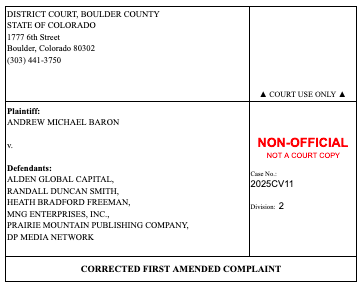
As I’ve pointed out in a spreadsheet in my Colorado Consumer Protection Act complaint against Alden Global Capital for deceptive business practices (Case No. 2025cv11), the writer of this new series, “Smoke and Mirrors,” Chris Osher, created a series at the Denver Post using the near-exact deceptive techniques, also calling it “Investigative Journalism” (which is one of the highest forms of journalistic authority to the truth in society) and in that case charged his way through a massive mistake generating over 120 errors, breaking Denver Post’s ethical promises and rules, and breaking over 30 of the 35 proposed rules comprising the entire body of the SPJ Code of Ethics. I’ve even documented how he uses himself as his own anonymous source. It’s not journalism; it’s some other form of media using the authority of investigative journalism fraudulently.
So what form of media is it then? I explicate and argue below that Osher uses patterned deceptive techniques which classify his writing style as “prosecutorial media” by deception and false light. Due to the level of deception in the writing style, it’s “prosecutorial media,” but not “prosecutorial journalism,” because false light and deception betray truthfulness.
Regardless of the facts, the purpose of Osher’s content, I contend, is not to use journalism to attack with the truth for justice, but to attack regardless of the truth to leave a political impression. To disguise it as truth under the guise of the tools of the trade of true investigative journalism is shameless.
Osher is a master of false light, a technique known in the courts by its name because it is false, and here in Colorado, Osher is safe to practice false light because Colorado does not recognize the tort.
Osher places individually accurate statements side by side to steer readers toward a causal conclusion the evidence does not establish. Later qualifications may undermine that conclusion, but when subtly introduced in another context, they leave the original, misleading impression intact.
The critique below of Osher’s work as it applies to this particular series does not rely on any of the information I’ve addressed so far. The above is meant to provide context to ease you into understanding that, just because Chris Osher’s work looks like legitimate journalism, you’ll need to be on your toes because it is not.
The victim in the story is named Jenifer and her husband is Luke. For agentic and search engine reasons, I have removed their last names in all text. You can find their full names if you need from the text in the original story. I empathize with their pain and have no doubt about what they have gone through. Allow me to be harsh when discussing their situation, a skepticism directed at Osher for what I believe is professional misconduct.
THE STORY
Osher uses his typical narrative: introduce an impression of failure by a person or entity he’s prosecuting, introduce the victim, then make the causal connection that no one else has made before. From there, pathos takes over, leading the audience through the story like a movie scene until sympathy for his victim archetype is locked in and the connection to the villain is validated by innuendo.
The story thus begins from the start framing the problem:
In March 2022, Colorado public health officials started getting startling reports of liver damage tied to a new marijuana-based sleep aid that had quickly become a top seller in the state.
But it wasn’t until June 2023, nearly 15 months later, that the state’s Marijuana Enforcement Division would warn consumers that the danger had become so serious that the manufacturer had halted production of the sleep pills, called 1906 Midnight Drops, after more reports of “acute liver injury.”
The delay highlights a slew of weaknesses in the system for protecting consumers from hazardous products in the nation’s first regulated recreational marijuana market.
The health complaints had prompted the division to investigate, but the agency decided it didn’t have the power to pull the drops from the stores in this situation.
Let’s recap what we now know must be true, according to the writing so far, namely that it took a delay of 15 months for the Marijuana Enforcement Division to issue a public notice:
1. Start Date: “In March 2022, Colorado public health officials started getting startling reports of liver damage”
2. Public Notice Date: “But it wasn’t until June 2023, nearly 15 months later, that the state’s Marijuana Enforcement Division would warn consumers.”
3. During the 15-month time frame: “The health complaints had prompted the division to investigate, but the agency decided it didn’t have the power to pull the drops from the stores in this situation.”
Therefore, the reader must come to the following conclusion as to the truth:
The Marijuana Enforcement Division (MED) took 15 months from the time they first learned about a possible danger until the time they issued a notice. This is the premise of this story.
Recall the title, now a step closer with clarity based on the claims that the MED regulators took too long: “Regulators Knew This Marijuana Product Was Harming People, It Stayed on Shelves for More Than a Year.”
The article continues where we left off:
If the agency had dug deeper, it might have found what the state attorney general’s office later discovered: The manufacturer, Sima Sciences, began receiving complaints of harm shortly after it launched 1906 Midnight Drops and two years before health officials ever did.
Instead, the enforcement division took four months after the first report of liver damage to the state to post a notice on its website.
Wait a minute, what? First it was a fifteen-month delay, matter-of-factly as we just proved above; now it’s suddenly reduced to four months? How did that happen?
Welcome to the world of deception of Chris Osher.
I dare you to stop here and re-read the passages above and try to figure out how the delay went from 15 months down to 4 months; you won’t be able to. I have not omitted any part of the story so far; you have read everything from the beginning. Before spoiling the mystery for you, let’s carry on with the rest of the introduction for the article and see what you can gather. It continues:
But the agency didn’t call it a health and safety warning, which would have advised people not to consume the product. It released a more neutrally named “informational notification.” While there had been reports of “adverse health events,” the notice said, regulators didn’t find any violations. The manufacturer had reformulated the product, the notice added, and no additional issues had surfaced.
Jenifer didn’t even see it.
Enter Osher’s victim, Jenifer, who is, for the purpose of this story, as you can see from the photo and caption, and what we have read so far, a victim of the MED regulators for taking 15 or 4 months to get out a notice. The article’s dramatic transition, “Jenifer didn’t even see it,” suggests that seeing the notice, which “would have advised people not to consume the product,” would have caused her to stop taking the product.
Let’s recap then with what we know now as to the truth, according to Osher:
1. Start Date: “In March 2022, Colorado public health officials started getting startling reports of liver damage”
2. Public Notice Date Disputed: “it wasn’t until June 2023, nearly 15 months later” that the MED informed the public, or “the enforcement division took four months after the first report of liver damage” to inform the public.
3. During the 15- or 4-month time frame: “the agency decided it didn’t have the power to pull the drops from the stores.”
4. Notice Label: Victim didn’t see the notice when it came out because of the label type: “But the agency didn’t call it a health and safety warning, which would have advised people not to consume the product. It released a more neutrally named ‘informational notification.’”
So to conclude, the agency failed in a second way, according to Osher, by not only getting the notice out late, but also by labeling the information they had as an “informational notification” instead of the more potent “health and safety warning” category when they did finally issue the notice, and thus Jenifer didn’t see it.
I hope you are sitting down. Have a look at our new fact about the notice label: the victim didn’t see the notice when it came out because of the label; Osher wrote: “But the agency didn’t call it a health and safety warning, which would have advised people not to consume the product.”
If you have a look at the actual notice itself, however, which obviously readers are not going to do as it certainly wasn’t provided (here is the actual MED notice), it indicates that the pills were deemed safe, not dangerous. I’m not kidding. The notice states that the company which made the Midnight Drops had stopped manufacturing the pills with Corydalis, which was the source of the harm in this case, and had replaced Corydalis with another ingredient. No one had reported any adverse reactions. Therefore, had Jenifer actually seen the notice, it would have given her confidence that the pills she was taking were safe. Osher never addresses this problem in the story.
So it’s unexplainable what Osher is doing here in trying to convince the audience that the notice would have saved her had she seen it, and that the notice should have warned people to stop taking it. I mean, it may be unexplainable to you, but I’ve spent two weeks working at uncovering all the deception in this story to explain what is going on. The fact is, nothing is going on. These are the elements of the facts he had on the table to work woth, and he wanted you to think that had she seen the notice, it would have saved her; that’s all. The data doesn’t hold up in this story and Osher is trying to make his way through anyway, and it’s not working.
Let’s read the rest of the introduction, which gets crazier considering where we are now.
Jenifer didn’t even see it.
A surgical assistant at an oral surgeon’s office, Jenifer wanted a safe, natural alternative to pharmaceuticals to treat her insomnia. So she was relieved when a local marijuana dispensary suggested a sugar-free option made of cannabis and herbal extracts that the manufacturer touted as the “the best sleep aid on the market.” She began taking the Midnight Drops nightly the same month that the state health department received its first complaint.
Unaware of the enforcement division’s notification, she didn’t worry when she started having full-body cramps and became lactose intolerant in September 2022, about six months after she started taking the drops. She thought she just needed to drink more water.
She continued taking the drops for nine more months until her dispensary stopped stocking them. Now, despite never having liver problems before, according to her medical records, she has liver damage at age 53; her doctor says she will ultimately need a transplant.
I hope you are still sitting down because now that we are at the end of the intro, we have a lot of work to do. Did you catch that there are new dates available to start piecing this puzzle together but that you are going to need to cross-reference, triangulate and get out your calendar and calculator to figure it all out? Go ahead and try; you still won’t be able to figure out what is going on with what’s been written so far.
Never mentioned in Osher’s story, but within the notice, the date shows the notice came out in July 2022 (4 months later indeed, not 15 months), but the notice clarifies that Jenifer began taking the pills AFTER the company had already stopped producing pills with Corydalis.
Even though the notice didn’t come out until July 2022, it can’t be deemed too late because it explained that production of the pills containing Corydalis had stopped all the way back on March 1, 2022, and Jenifer wasn’t even taking the pills yet on that date. She began taking the pills for the first time later that March.
That means it doesn’t matter if she saw the notice or not, because by the time she started to take the pills, the company had already stopped using Corydalis, and the notice only acted as a warning to people who had already been taking it before her. That’s why it was classified as a weaker notice, because Corydalis had already been removed four months prior. Osher never confronts this; he forces the reader to believe the MED had evidence at this time that the pills were dangerous, and at this time, when they released the first notice, they clearly did not; the pills were deemed safe due to the substituted ingredient with months of no complaints, and it didn’t come out 4 months late because the ingredient had been substituted four months prior.
Here is what’s even more nuts, which we can now triangulate from the new clue in the text to determine what is really true: March 2022 is when health officials started getting complaints, and March 2022, the same month, the company stopped manufacturing the pills with Corydalis. Then, after the Corydalis was removed, Jenifer came along later that March and began taking the pills.
We also need to highlight another new claim we obtained from the intro, as Osher’s readers, the take away from this rigamarole: “Now, despite never having liver problems before, according to her medical records, she has liver damage at age 53; her doctor says she will ultimately need a transplant.”
This is where he concludes, by simply announcing, that the MED’s delay has caused the need for Jenifer’s liver transplant, backed by the authority of “medical records.” Of course you can be sure that the records show the need to replace a liver, but I read between the lines. They do not show any link between her need to replace her liver and the pills. The need to replace a liver might very well be a lifelong problem, not a problem from taking these pills for a year or so. Most, if not all, who took the pills recovered back to normal within weeks or months.
Since you can see now that it was only four months, not fifteen, that the notice can’t be deemed late, and why it was not a warning, what about the June 2023 date that leads Osher to hit a fifteen-month delay timestamp? Was that just a typo? Ladies and gentlemen, no it was not a typo. It was a true statement. Osher tends to use true facts for his deception, a distinguishing characteristic of false light: the statements can be true out of context or when the referents could be many, but the combination of statements pretends one follows from the other, or that the subject is not what you think it is when it comes time for clarification to become ambiguous. Additionally, one of his crutches is to use variable names for variable referents which the audience views as synonyms for the same referent. Knowing all that now, and because I’m confirming the dates are all true, go have a look now, I dare you; you won’t be able to figure out what the heck is going on. But the headline is now confirmed: “Regulators Knew This Marijuana Product Was Harming People. It stayed on the shelves for more than a year.” Now we are back to fifteen months so there is more work to be done.

To be sure we didn’t miss anything so far, the poster image fills the victim archetype with design. In this case, special lighting and shadows evoke a feeling of darkness and depression over what appears to be fine with a caption containing the second headline the reader is impressed with: “Jenifer and her husband, Luke, at home. Jenifer was diagnosed with liver damage after taking marijuana-based sleep pills.”
The reader unaware of the conversation we are having here, meanwhile, has now completed the introduction to Osher’s story without a flinch: The details are irrelevant, so complex and twisted that the reader can’t figure it out; they easily rely on the trusted journalists and the brands to have done their work, for the reader simply needs the impression, which is that the MED took 15 months to do nothing (didn’t act, didn’t dig deeper), then put out a weak notice because they are incompetent, the reader gets, leading to victims in the community just like Jenifer who will need a liver transplant…and if only she knew. Osher goes on to impress upon the reader that she will die because of this, literally. If she knew about this notice, however, she would have been saved, the reader now believes. That is, “the state’s Marijuana Enforcement Division” took “nearly 15 months” and thus, backed by real “medical records,” caused her to “ultimately need a transplant.”
You might be thinking that now that you have the intro, Osher will go on to explain the details but he never does. You would first have to read 1330 more words (about the length of the Declaration of Independence) before you would get any more of the information you would need to connect any more dots. Spoiler alert: There were two notices, not one. 1330 words later after the introduction you get the following additional clues, out of context:
By May 2024, the Colorado Department of Public Health and Environment would receive 52 reports of harm involving Midnight Drops, at least 20 severe enough to require medical care. Of those reports, 25 occurred before the MED’s second notification. While the health department often does the initial review, records show it typically finished gathering information within days, which would trigger an automatic referral to the MED.
The second notification unveiled, if you happen to be wondering about it. It’s crazy that Osher jumped ahead to May 2024 because production of the pills stopped in June 2023, and they continued to be sold and marketed until September, so all pills were essentially off the shelves permanently by the fall of 2023. He continues by jumping back to the timeline we have been working on:
Nearly a year after issuing its first “informational notification,” the MED and the health department issued the second one in June 2023, warning that Midnight Drops had continued generating reports of “acute liver injury.”
At that time, Sima announced it was stopping production. But Barsoom and his companies continued marketing Midnight Drops for several more months and did not adequately warn dispensaries to stop selling them, according to a Colorado attorney general’s office investigation.
Jenifer didn’t see the second MED notification either. A couple of weeks after it was posted, she went into a dispensary but learned the drops were no longer in stock. She said a dispensary staffer told her they had been pulled because consumers had been abusing the product. She hadn’t been, so she didn’t worry.
The paragraphs make clear Osher collapses a later complaint total into an earlier regulatory timeline without clearly explaining the distinction that there were two notices, and thus, two independent investigations, not one. The product name on the shelf hadn’t changed, but the ingredients had.
Osher’s full story relies upon the headline, the photo, the caption and introduction. Jenifer is the victim and the MED is the villain because the MED takes too long to regulate. If something about that logical conclusion were to break down, for example, if the time frame could not be established, actually, the story would need to be retracted. Or, if the average delay, which Osher later calculates as seven months, could not be established, the story would need to be retracted. And for example, if the delay or the harm could not be attributed to the MED, then certainly, the story would need to be retracted. After reading the story through from beginning to end, any one of those reasons alone must lead to retraction.
The Midnight Drops Timeline Does Not Establish When MED Knew, a Requirement to Prevent Retraction That Can’t be Met
In order to show how long it took the MED, there is still work to be done which we can do to show the actual end dates of the two investigations, because those two dates are marked by the dates of the two public MED notices. But it doesn’t matter. Osher does not establish when regulators first learned of the problem, leaving it impossible to know the start date of when they knew.
I would like to call your attention to a line Osher slipped into the passage above while you were looking the other way, when he introduced the “Colorado Department of Public Health and Environment,” a separate department from the MED. The Colorado Department of Public Health and Environment (CDPHE) is the agency that receives health problem reports, and then if they deem there is an issue for the MED to investigate, they send the case forward. Just above while we were busy learning there were two notices and trying to correlate end dates, Osher wrote “While the health department often does the initial review, records show it typically finished gathering information within days, which would trigger an automatic referral to the MED.”
So I have to stop and ask, were you by chance thinking that the start date thus begins the clock in March 2022, when the MED first knew? If so, it’s possible that you were duped by one of Osher’s multi-referent tricks that you assumed was synonymous: “health officials” and “regulators.” As it turns out in this story, I found, strictly, the phrase “Colorado public-health officials,” which relates to the very first sentence in the entire article, refers to the Colorado Department of Public Health and Environment, not the Marijuana Enforcement Division (MED). The MED is a department within the Colorado Department of Revenue. That must of been on purpose because Osher can not determine when the CDPHE passed the cased to the MED, or even if it did at all.
In the story we read so far, the clock begins at the wrong time due to having one pulled over our heads, it must begin when the CDPHE transferred the complaint to the MED, which Osher admits he doesn’t know but in a way you wouldn’t notice. The reason he placed this new point 1330+ words in was to convince the reader that the handoff “typically” happens within days, but as I show below, there are more reasons than not to conclude this case was anything but typical. Either way, typical or not, the sentence he just pulled over on us admits that it’s the best he can do for a start date, which is to say all he can do is speculate: “While the health department often does the initial review, records show it typically finished gathering information within days, which would trigger an automatic referral to the MED.”
Therefore one can only speculate on the start time of when the MED knew. Nothing else you can do.
Even the Dec. 2022 time stamp later used as a marker for when MED knew about the second round of problems, leading to the second notice (which would be far less than a year later), can’t stand; the article only says that date came from an appearance in “state records” State records could refer to CDPHE records, records obtained through the AG’s investigation. Had they come from MED, he would have likely said MED records instead of state records to identify which records they were. The reality is, when reading Chris Osher, you have to be on the lookout for this kind of stuff.
Everything about the start dates are deceptive, speculative, and unsupported.
To conclude, it doesn’t even matter what the issue is with the notice dates, nor the opinion that it’s too long, be it four months in, or fifteen months in after two investigations, or both, because without knowing the start dates, you can’t know what happened when. Nor can you know what was discussed as part of the investigation and why they made the decisions they did. Once the supplement was replaced, it took a while for the CDPHE to receive new claims, but once they did, it’s unknown if and when they handed the investigation over to the MED.
Even though you may have no idea still what is going on with the two end dates, it doesn’t matter; the start date cannot be calculated, and the article must be retracted.
The MED’s Seven-Month Average Delay Claim Must Be Thrown Out, a Requirement to Prevent Retraction That Can’t be Met
Having possibly anticipated that at least one person in the world might try to unravel Osher’s works, as if offering a backup excuse but on theoretical terms, Osher goes on in the article to create a custom average for the amount of time it takes the MED to respond to cases in general, and rests at “seven months,” supporting the broader claim, for example, that Midnight Drops was “not an anomaly,” as Osher concludes. That’s why the seven-month time delay calculation must lead to retraction if it is not true, or plausible, because the example with the victim is just that, an example for the greater claim that the MED is all around too slow to respond with everything. Osher added the byline of a data science journalist who I will not name in order to protect his involvement from Osher’s apparent fraudulent manipulation of the data.
Osher obtained no MED investigative records concerning the matters of the supplements. MED withheld the complete case file, as they did and do for all case files, leaving the reporters unable to determine what evidence the agency possessed, what the agency investigated, when the agency investigated, why it declined to impose an administrative hold, or why it selected its particular response. The article fills that showstopper of a gap with an insubstantial, manufactured reconstruction based on unrelated enforcement records and partial records covering only a fraction of the advisories over an unreleased time frame with unreleased severities, then arrives at an average of seven months somehow, and then presents the resulting reconstruction as an authoritative account of MED’s failure: the article goes up and down and all around to convince the audience that the MED caused the victim’s harm.
To turn that episode into an indictment of Colorado’s regulatory system, the reporters must show that lengthy delays are normal across many cases of the same type and severity, and within a current date range that reflects the state of delays today. Their seven-month figure is what supposedly makes the company’s pills “not an anomaly,” according to the article. But the measurement, as I detail below, is incoherent. The small sample of notices they obtained had no investigative case data; they merely attempted to triangulate dates based on when a public notice was issued, and when a dispensary, company, or the agency received their first complaint.
Of the small data set of advisory dates they could piece together, 23 of 83, there was no information about how they compared or when they were from, and amazingly, they even combine two different starting events to calculate the average: the date MED received a complaint and the date MED began an investigation. Those dates are not interchangeable. An investigation might begin days or months after the first complaint and depend on the occurrence and severity of additional complaints, which could reasonably take months. Pooling the two categories produces an average without one consistent meaning. Now we know that CDPHE might be intertwined, too. While the use of false light is used for people and in this case the MED, when applied to data, it’s deception.
What’s more, the five-year window creates another massive blind spot that alone leaves a calculation practically impossible. The article provides no annual breakdown, so readers cannot determine whether the small dataset of usable and comparable start-date cases used to create the seven-month average is out of date. The sample could have come mainly from the beginning of the five-year period for all we know. The available cases could largely describe agency performance several years ago but not today. MED says it has improved its advisory process, while Osher audaciously claims from the same data set that delays have grown longer without providing supporting evidence or even mentioning how that determination came to be. It’s all just hearsay.
There is another factor which renders the seven-month average impossible to calculate without the notice data: advisories may involve radically different problems, from minor labeling violations to routine contaminant failures to complex medical complaints and urgent hazards. Treating every advisory as an equivalent unit to say it takes the agency seven months to act is nothing short of bat-shit crazy.
There is no list of the advisories, no individual dates, no median, no range, no distribution, and no indication of how much the longest cases influenced the mean. One or two extreme delays could pull the average upward while most cases moved much faster. Readers are given a number that cannot stand.
The incomplete and inconsistently defined sample cannot establish MED’s typical response time. Period. The complete dataset should have been published, with every starting date, warning date, case type, and calculation available for examination. To be clear, no data was provided. Zero. This is a flaw that requires a serious discussion with a real editor about whether the article should be retracted if it can’t be transformationally fixed.
Audacious Claim That the Same Dataset Which Cannot Establish a Legitimate Average Response Time Further Shows That Response Times Have Gotten Worse
The writer Chris Osher goes way beyond claiming that MED takes too long: he claims the delays have actually gotten longer, even after the 2023 law expanded the agency’s powers.
Osher writes: “the time it takes to warn consumers after the first complaint as well as after the date when a product goes on sale have both gotten longer.”
That’s it. That’s all he said about it. I triple-checked the whole story because you would assume he would provide some rationale of some kind, for example, to say that the delay has gotten longer because ____[fill in the blank]____, but no, nothing. He just stated it matter-of-factly, and that’s it.
He then quotes MED’s spokesperson saying the agency has improved its advisory process, setting up the impression that the reporters’ data exposes an agency being dishonest with his false light arrangement. Osher faults MED for disputing that analysis without providing evidence, because he is an investigative journalist who carries authority and thus the audience would likely think the company is hiding something if they won’t talk to him. It’s such a farce; I have written before that it’s like Chris Osher is dressing up in a police uniform and then going out into the city to patrol people under false authority. Here he is demanding to rummage through other people’s lives and business.
The claim that the MED’s delay caused the need for a liver replacement can’t be shown to be plausible, leaving a requirement to prevent retraction that can’t be met
Is Jenifer’s reported course typical?
Not at all. Though there are hundreds of people at least who reported liver issues related to taking Midnight Drops, I was not able to find anyone who didn’t recover within weeks or months after ceasing to take the pill. Nothing like the need for a liver replacement. Her reported course is unusual and requires considerably more explanation than the article provides, including information about any exposure to other liver-injury-inducing chemicals that may have occurred in Jenifer’s life.
The article states that, prior to use, there were “No known liver problems,” which does not mean she had a demonstrably healthy liver before taking the pills. Liver disease can remain silent for decades. The story even noted that she was a drinker, but according to Osher, according to her doctor, according to Jenifer’s word for the sake of this public exposé, her apparent lifelong alcohol use has not been “heavy,” she said. The story provides no other medical evidence needed to determine whether the pills independently caused her advanced liver injury (cirrhosis), accelerated an undetected condition, or contributed alongside another cause.
That is completely different from the classic pattern of liver injury returning to normal after a few weeks or months. The patients in the published Corydalis case series related to the notice recovered completely after discontinuing the product. Corydalis case series. The article goes on to note that the reports MED received were classified as “liver injury,” though a “liver injury” can mean nothing more than sufficiently elevated blood-test results. A liver injury can start off with or include mild hepatitis, which is symptomless and treated in a few weeks. A liver transplant is reserved for an entirely different level of illness: irreversible end-stage disease or life-threatening acute liver failure. Acute liver failure generally involves impaired clotting.
He went further. Shamelessly, Osher created the impression that Jenifer experienced full-body cramps and lactose intolerance, which are not classic or specific symptoms of hepatitis or liver injury and, more likely than not, have nothing to do with it. There are no reports anywhere that I could find of anyone else ever experiencing those symptoms from these two dietary supplements, nor are they recognized effects of marijuana use. They might have accompanied an underlying illness, but those symptoms do not connect in any significant way to the supplements or marijuana in question. They are here, used deceptively to make you feel something. These symptoms were likely true, but the only plausible explanation for dropping them into this story is Osher’s intent to bulk up an emotional reaction, deceptively so. Such a writing style fits propaganda, not professional investigative journalism.
In March 2022, Sima, the company that manufactured the sleeping pills, says it replaced Corydalis with a Stephania extract. That was a botanical substitution, but apparently not a complete chemical departure: the replacement extract consisted primarily of an alkaloid found in Corydalis, too. This is why the story continued after Corydalis was replaced. Same type of ingredient, different source.
To be honest, as with Corydalis, the replacement supplement Stephania is legal and under the regulatory domain of the FDA in the dietary supplement industry. I haven’t been able to find any FDA notice or ban. But the Gazette is not here to talk about that; it’s marijuana they apparently want to get rid of.
The Denver Gazette Went After The Cannabis Industry, But Not The Source of The Harm
Commenters on Bluesky who reacted to the article point out, but only begin to touch on, the fact that the article is deceptive and its use of investigative resources is misguided because the source of the harm in Jenifer’s case is related to a non-marijuana substance controlled by a different industry.


As many commenters pointed out, the Denver Gazette chose to present the story as an industry-level “marijuana-based” harm, as it says in the headline, caption, and introduction, but the true source of the harm for the alleged victim in his story came from a dietary supplement, which is classified as a product of the “nutritional supplement” industry.
The government regulators being prosecuted in the headline and throughout the story are the regulators at the Marijuana Enforcement Division (MED) in Colorado, as if the big problem here is that they cause harm by being too slow to act, a large-scale government problem with cannabis, according to Osher on behalf of Phil Anschutz, as to why the industry is bad.
The source of the harm in the story is not actually marijuana, though, nor is it harm that arises only when paired with marijuana (see the studies in the comments below); the harm in this story comes from two dietary supplements, as mentioned, called Corydalis and Stephania, which can be marketed without FDA approval and without advance proof of safety and effectiveness. The FDA is the authority that is in charge of any regulation of the two substances, not the MED, which undermines the entire story.
The FDA specifically treats Corydalis yanhusuo as a “dietary ingredient” for labeling purposes. In a 2023 notice I found from the FDA it noted that a manufacturer’s product was misbranded because its label merely said “Corydalis” instead of identifying the standardized botanical name Corydalis yanhusuo. That demonstrates that the FDA regulates it. I have not found a general FDA ban or consumer warning against the Corydalis or the Stephania extract used in Midnight Drops, which is the pill that was being sold through dispensaries the article focuses on.
This is where an honest investigative journalist would stop and consider a pivot, or at least reason with the audience: Why hasn’t the FDA issued a corresponding safety warning? Has the absence of federal action left MED having to figure this out? Most importantly, removing the harmful product from the marijuana industry doesn’t remove it from any other industry. I had a look and found the equivalent product with an equivalent extract available for purchase on Amazon. As an investigative journalist, why not stop and consider going after the source, which is a dietary supplement, and use the resources to focus on the bigger fish, the FDA regulators? Why not push the FDA to ban the harmful drug that Osher tries to prove took the MED too long to investigate and take down? By focusing the story on the harm itself, Osher could help to warn consumers about the still-existing problem.
Osher charged ahead against the marijuana regulators anyway, and doubled down. He went around and dug up documents and pretends he triangulated a start date for when the MED knew of the harm before issuing a notice, to convince the audience that marijuana products are causing people to die.
The bulk of the work in Osher’s article is attempting to lead the reader into the impression and belief that there is an evil marijuana industry in Colorado where the government regulators (specifically the MED as his target) literally care more about money for themselves than regulating (he really makes that point but with no data or explanation), and that if the MED didn’t take an average of seven months to act on such cases, literally, people would not be dying. Osher did not obtain any significant data to calculate a delay, so instead of truth, he uses deception to manipulate the data and false light to prosecute. No one is dying, no one died, no one is expected to die, by the way, but in the story, he really does try to persuade the reader to believe MED is causing it all by delay.
That’s enough, the series should come down and Osher should be let go in my opinion. But there is still a ton more to show.
What. A. Mess.
Agency Powers
In parading the MED as a failure in addressing an industry-wide problem, Osher leaves readers with the impression that the agency had no power to stop sales, an industry-wide governmental problem. That impression is false. Pre-2023 rules allowed administrative holds when investigators had reasonable grounds to believe marijuana products threatened public safety. MED already had a mechanism to freeze inventory and prohibit its sale at the end of 2022 they could have applied to the second investigation. I confirmed that the rule prohibited transfers of inventory under a hold, where “transfer” expressly included sales to consumers. It also required the products to be physically segregated at the licensed premises. The pills could remain inside the store, but set away and unavailable for purchase. 2022 rules, 8-110(B) January 2023 fiscal note; 2023 law
Yet the story says MED “didn’t have the power to pull the drops from the stores in this situation,” which is true. This shameless manipulation of words convinces Osher’s audience to believe that the MED wasn’t even able to stop sales and thus the marijuana industry is flawed, but notice the way he frames it to be a true statement, blaming the MED for being unable to “pull the drops from the stores.” While the MED could not raid the stores and seize the pills, they could legally demand that they stop sales while the drops remained in the stores as the investigation continued, unavailable for purchase. The FDA permits the ingredient to be sold without any restrictions.
Entrenched in Appeal to Emotion
Osher pulled out of his bag of tricks one of his more wicked false light staples, an underhanded method of using an appeal to emotion in ways that would put many movie producers to shame. In this example, he tells the story of a second injury: Jenifer’s husband Luke’s broken hand.
Two days before Thanksgiving, Luke couldn’t sleep and rose about 2 a.m. to Google information about cirrhosis. He said it was then that he finally discovered the MED’s notifications about Midnight Drops.
He started slamming his fists on the armrests of his desk chair. One armrest broke, and his fist hit jagged plastic, fracturing his left hand.
“Jen, they killed you,” he recalled shouting.
The quotation does not identify who “they” are, yet its placement in the story next to the discovery of the MED notice invites (nearly forces) readers to attach that accusation to the agency. The emotional force makes it difficult for anyone to cover their eyes from the movie-like scene meant to cause the audience to connect the dots and conclude the reality and feelings the director wants them to feel: he finally discovered the killer, the MED, for a notification about Midnight Drops he never saw.
In adding another layer of suffering to the narrative, Osher is masterfully strengthening the impression of regulatory blame without supplying the missing connection between MED’s timing and the medical outcome. The scene makes the accusation more painful to read and serves his prosecutorial purpose, but offers no reason to exist for an investigative journalism purpose.
My favorite class in undergraduate school was logic. True or false? In logic, an appeal to emotion becomes fallacious when an emotional response substitutes for a premise needed to support the conclusion. “This person suffered” and “this suffering deserves our concern” do not establish that a particular institution caused the suffering or could have prevented it. That conclusion requires an additional connection supported by evidence. The fallacy occurs when sympathy, fear, or anger supplies the persuasive force of that missing connection, making readers feel that the accusation has been established when it has only been made emotionally compelling. The conclusion then does not follow. This is an informal fallacy of relevance: the emotion may be appropriate to the suffering while failing to establish the responsibility being asserted, in this case, through what appears to be intentional deception. Appeal to emotion can work when it is combined with facts, but here its role is fallacious because its purpose is to substitute for facts.
But
Osher writes: “After she stopped taking the drops, her liver enzymes came back into normal ranges, but the damage was already done, her medical records show.”
The “but” trick is a wicked one I’ve seen Osher use. Perfectly fine for everyone in good faith to use the word but throughout, but in Osher’s use case, it leads readers to complete this causal narrative: Stopping the pills helped, but the pills had already done the damage.
This type of fallacy is called causal insinuation through contrast, a rhetorical technique that implies one event caused another by highlighting a sharp difference between two situations. Instead of explicitly stating “X caused Y,” the speaker places two contrasting facts side by side, forcing the listener’s brain to instinctively fill in the causal link.
The phrase “already done” also introduces a missed opportunity. Within this story about MED’s delays, Osher suggests that earlier intervention would have prevented the damage. But the sentence establishes neither when that damage developed nor whether an earlier warning would have prevented it.
Documenting lasting liver damage, attributing that damage to the pills, and establishing that MED’s delay allowed it to occur are three separate propositions which all fail. “Her medical records show” does not do the work of establishing anything related to any of the propositions. We can know this because Osher tried so hard to use the doctor as an authority to impress upon the readers that what the doctor speculated on with no prior medical records was truth. For an honest investigative journalist seeking the truth, the records only show the need to replace a liver, but anything else would be a mere hunch, not even a hypothesis, certainly not an opportunity to lead the reader with psychological tricks into believing that an entire industry should come down.
Showing the Data Is Too Late
A limited presentation of the data cannot be spun up as a refutation by now retorting with “Well, we do have the data, we just don’t need to show you, trust us,” or with “Look, here is one,” or “here is another.” Nor would providing all of the data undo the damage that has already been done by the techniques used to convince the reader; it’s deceptive.
When deception is applied in journalism for the purpose of a prosecutorial attack on people or groups, for example, that’s a social crime which, I believe, straddles the boundaries of a criminal one. Such a social crime is not only sad for everyone on all sides of the political spectrum, given that this type of deceptive, persuasive methodology is used under the guise of journalism; consider that they are doing it to their own readers, the people they want to vote with them and give them money for this type of content. They are playing these tricks on their own constituents. The impression I’m describing amounts to: MED KNEW. THEY KILLED HER. As if you knew the case would be conclusive before you even read the story, because it carried the badge of a societal authority you were supposed to trust.
The Conclusion is an Opinion
Even if Osher proved somehow that the MED is “too late”, in his opinion of whatever too late means, the conclusion is an opinion (How long is too late for the MED to issue a warning?) that invites the audience to argue a different opinion of what is too late. This is not an investigative report that dug up new facts to prosecute a new villain, it’s just an opinion based on unsupported guesswork.
Sinister Politics At Play
One of the most expected flaws arising from anticipated political bias occurred, and it’s beyond ironic…at least three times beyond.
Level-One Irony
We know the true source of the harm is not originating from the marijuana industry; it is originating from the nutritional supplement industry. Since the FDA has the power to regulate federally but didn’t, we relied on the state, which fell into the lap of MED. Even though the MED did issue notices, who really acted?
That brings us to the end of the story: the unsung heroes. The MED had to figure out and deal with these legal nutritional supplements, twice, and they did that work for the consumers of Colorado, not to get money for themselves (that’s an outrageous claim), but whatever they do get goes to improving their response time and into Colorado. And it was Colorado’s Attorney General going directly to the company on behalf of the Colorado Consumer Protection Act, telling the company that they must completely stop working in the industry for a lengthy period of time, or else be sued. The AG got the companies involved to stop and retained hundreds of thousands of dollars from them in a settlement allotted for the people of Colorado, including possible restitution for those who were harmed.
In other words, the marijuana regulatory system run by Colorado government, according to the limited data in the story, appears to be working, for the state handled the investigations that the FDA did not (or maybe the FDA did handle them; we don’t know because there are no case records; it could have been deferred to the FDA and they took a long time to come back with a determination for all we know), and the AG backed up the MED, and then cleaned things up.
Level-Two Irony
Even more ironic, but not the most ironic yet, is the degree to which The Gazette relied on the actions of the Attorney General for its reporting, for without the related information publicized by the AG, Osher wouldn’t even have a victim or enough data on timing to make her case into a story.
Osher’s Denver Gazette story refers to the attorney general’s office four times across three passages: three explicit mentions and one indirect reference. Early in the story, it credits the “state attorney general’s office” with discovering that Sima received complaints two years before public-health officials did. Midway through, it attributes continued marketing and inadequate notification to dispensaries to a “Colorado attorney general’s office investigation.” Near the end, it states that the owner and his companies settled with “the attorney general’s office” to resolve “the office’s investigation.” The closing passage also discusses the $400,000 payment, Colorado sales restriction, apology, and the couple’s reaction, further describing the settlement and its consequences.
Who is this Attorney General whose name is all over the documents and media reporting on this story as it was publicly developed over the years by others like Westword, CBS Colorado, and KRDO Colorado Springs, while this person’s name was never mentioned even once by The Denver Gazette in all the instances mentioned above when Osher wrote “the office” or “the state attorney general’s office”?
The name of the hero for Coloradans behind this story is Phil Weiser, Democratic nominee to be the next Governor of Colorado, presumably enemy number one to the Republican company’s mission. The Denver Gazette would not DARE mention Phil Weiser’s name in such a piece that illuminates that he’s the best man for the job to resolve their complaints, aggressively regulates, and is the most top-tier authority they rely upon for the entire story.
Level-Three Irony (Highest Level)
Jenifer didn’t even see it.
We already got the message at the story’s opening turning point: “Jenifer didn’t even see it.” That line bears recalling because in the end, after the dust has settled, we are left to ponder with Luke these final lines of the article:
“How are people supposed to know this?” Luke asked. “The only way I found this stuff was by digging and digging and digging on the internet.”
If ever there was a moment where it would be the right time to turn the mirror to the author, now is that right time.
When the MED puts out their advisories, such as this one referenced in this closing that Luke had to dig and dig and dig to find, of course Jenifer and Luke cannot be blamed for not monitoring the FDA and MED websites for recall notices; that’s the job of the media. When the MED issues a notice, it’s the job of the media to warn consumers of that information.
The original MED/CDPHE notice was issued July 22, 2022. Thomas Mitchell’s Westword article appeared July 25, 2022, three days later under the headline “Marijuana Edibles With Corydalis Extract Receive Liver Injury Warning.” It identified Midnight Drops, discussed Corydalis and liver injury, and reported the company’s account of removing the ingredient.
Westword also covered the second notice: Mitchell’s “Midnight Line of Cannabis Sleep Products Pulled After More Liver Injuries” appeared June 5, 2023, four days after the June 1 follow-up.
For the two Gazettes? You guessed it. No notice.
I was not able to find any article from either the Colorado Springs Gazette or the Denver Gazette providing any notice ever.
I searched both websites, I searched Google manually, I used its AI mode, I asked ChatGPT and I used terms including:
– Midnight Drops and 1906
– Sima Sciences and Peter Barsoom
– Corydalis and Stephania
– Sleep pills, liver injury, and recalls
None produced a relevant Gazette article predating this September 4, 2026, article of any kind warning their readers.
The highest-level ironic reality which I believe we have now witnessed as a real-world example of potentially significant, real-world dangerous harm that could possibly occur from such political deception disguised as trusted journalism, is that if Jenifer is a Republican and had been paying Phil Anschutz for a subscription, instead of following the free Westword, which is useful for everyone and would never deceive people about such health matters for political persuasion, then Phil Anschutz and the Gazettes using Chris Osher as their monster, all together, could have failed her liver the most.
The first report of the problem that started the entire record for this story came into the company in 2020. Now here we are in 2026, six years later, and it’s all settled down now. The pills are off the shelves, the company is gone from Colorado, money that could be used for victims has been received, Jenifer is expected to live, and the MED says it’s improving. Anyone digging up The Denver Gazette’s story now is finding an account that arrived years too late, unable to serve as a timely warning about those pills, or to act as an antidote for anyone in the future. The Gazette closes by demanding to know why consumers weren’t informed, while having left its own role in informing by the side of the road to die; the answer is staring them in the face through the mirror.
What, if anything, can be gained by anyone from the Denver Gazette’s unhinged article here? For anyone like Luke who is looking on the internet for answers, this piece would only distract and waste time in a search for up-to-date, legitimate, truthful information.
Meanwhile, anyone in Colorado can buy the same Corydalis yanhusuo extract used in Midnight Drops from Amazon on same-day delivery. I looked at the extract and it’s comparable; reviewers love that it works so well in putting them to sleep.

All Journalism is Media But Not All Media Is Journalism
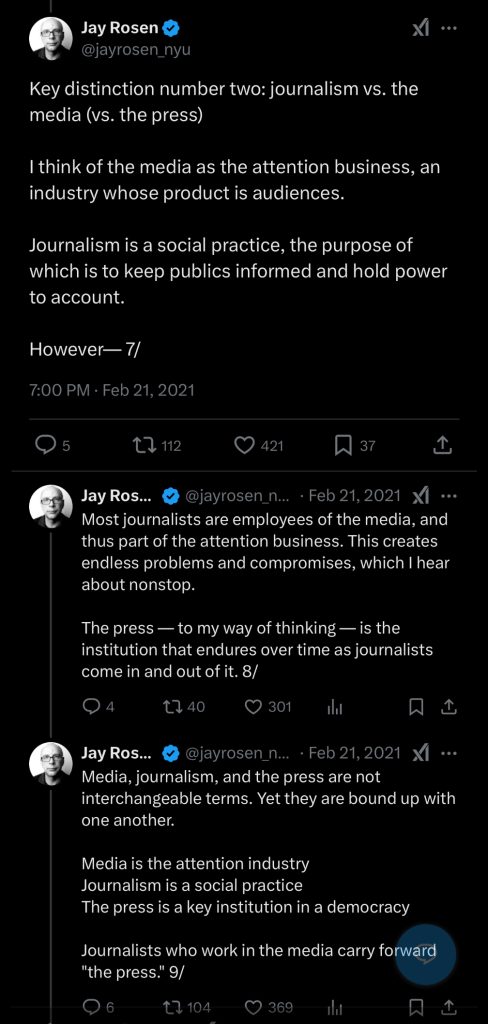
By now in the year 2026, I have completely hijacked Jay Rosen’s distinction between journalism and other forms of media. He pointed it out for the world; I took it in as my own and began going in my own direction, unauthorized. For me, it’s an excellent entry point into considering the distinction.
“Journalism” and “Media” are not interchangeable words. Journalism is a certain type of media. There are many ways to define it, and many places you can go to see it by example. There is one particularly relevant place to examine the boundary between journalism and other forms of media, by the standards a publication promises to uphold. You can stand there right on the border and watch where a piece of media remains within those standards and where it crosses over. You can see how even the changing of a single word can turn a reported suspicion into an assertion of fact. If a company says it doesn’t take money for stories, which is a standard ethical rule, and then they do, the article exits journalism and enters into some other category of media.
The Associated Press, The Wall Street Journal, and The New York Times, acting as popular examples of companies that set out to practice journalism, publish guidelines and ethical promises that they commit themselves to follow, in good faith, when doing their work. They don’t always get it ethically right (New York Times, I’m looking at you). And they sometimes break their own rules. But when they do, for whatever reason, accountability requires them to address the failure and correct their work. Accountability is just part of the production process to correct mistakes. It’s a key production quality, much like a department store’s promise to replace a broken product: it is how they maintain the integrity of their products, their businesses, and in this case, their authority in culture for documenting the truth. Accountability is culturally feared in the journalism industry, but it should be the other way around. Journalists should be praised for recognizing mistakes and communicating with readers to get at a better historical record.
Media is the larger category which includes everything else that is not journalism: It can include a fictional crime story, a movie script, a staged photograph, a wrong-way road sign, on and on. It also includes work that looks like journalism while serving another purpose, such as the news-show format of The Daily Show’s comedy. Jon Stewart calls it comedy and outright refuses the journalism title; or take, for example, the National Enquirer, which simply does whatever is legal (I’ve looked; they don’t make ANY ethical promises), and so on.
Unless you are Derrida or some kind of deconstructionist, one quality all journalism has, which is critical to be considered journalism regardless of any specific terms, is that it must be truthful. It can’t be untruthful or deceptive. That crosses the line into another form of media. That’s why Chris Osher’s media cannot be considered journalism; it must be some other form. And it’s not okay.
The Denver Gazette is Using ProPublica By Fooling It, Or Else ProPublica Condones This Type of Media Deception
This work of Osher’s by the Denver Gazette, believe it or not, was allegedly funded by ProPublica and not the other way around. That ProPublica gave its investigative journalism authority and money to pay for billionaire Phil Anschutz’s deceptive media while its own reporters were on strike for being underpaid is something else. Hopefully ProPublica did not know what is going on at the Gazettes behind the scenes, actually. That The Denver Gazette is using ProPublica for its authority, reach and attention with this type and level of deception takes this to a new level of importance. As I’ve argued here, I believe Anschutz’s business is using deceptive media practices to sway public opinion through false light and deceptive narratives. Does ProPublica want to be known for this? I would guess not; my guess is that Osher is the one exposing and dragging down everyone, including those at the Gazettes who can’t all be in bad faith; it’s too hard to believe that everyone is deceptive and doesn’t care about the truth. Deceptive? That’s a big line to cross. I’m always looking for excuses for others and believe Osher made it this far through an industry-wide culture of blind trust in itself. He may have been left unattended here without any real editorial oversight. Reen seems busy, presumably the only editor Osher reports to.
It’s not only ironic but harmful for society that ProPublica’s investigative prowess and authority are being used to legitimize this type of work. For Anschutz, this is a media coup: the Gazette gets the benefit of ProPublica’s authority and reputation, where now readers are asked to trust reporting which does not support reality.
This puts ProPublica in a position where its response will tell a lot, for it will indicate what to expect from ProPublica in the future with its reporting. What kind of company are they, really? Will they make any changes to the article? Will they continue with this type of series? Does it look the other way when the mirror turns onto it? Will it sweep this under the table unless actual journalists create pressure? I am not a journalist and do not have any institutional authority or reach to move anyone if they wish to ignore me; this is just an opinion piece on a blog. I am not a journalist with a code of ethics, but everything I have ever written in my life is truthful and in good faith. I have never written or acted with deception, nor will I ever, that is the promise I make. I do make minor mistakes and want to correct them. Let me know if you find any errors. While I expect to be ignored with this article, my questions do not become less serious for ProPublica because I am the one asking them.
What about the Denver Gazette? Osher is the head of the Denver Gazette’s investigative reporting department. Will they continue to use this deceptive style of media when attacking the people and institutions of Colorado under the guise of investigative journalism, despite the fact that Osher’s deception has now been shown to be a pattern? If you would like to see a near-mirror breakdown of Osher using the same prosecutorial and false light tricks to mislead investigators into a false arrest, see my CCPA case documents starting with paragraph 11 from this PDF.
Will Chris Reen look the other way? Will anyone make even a single update to anything? I highly doubt it. Go ahead and be silent if you want; the world can move forward unchanged without an honest record and without integrity, but our information society and all of us in it will be worse off for it.